Alaska Airlines Connects Anchorage with Dallas, Austin, and Nashville in Summer 2027 Domestic Network Expansion

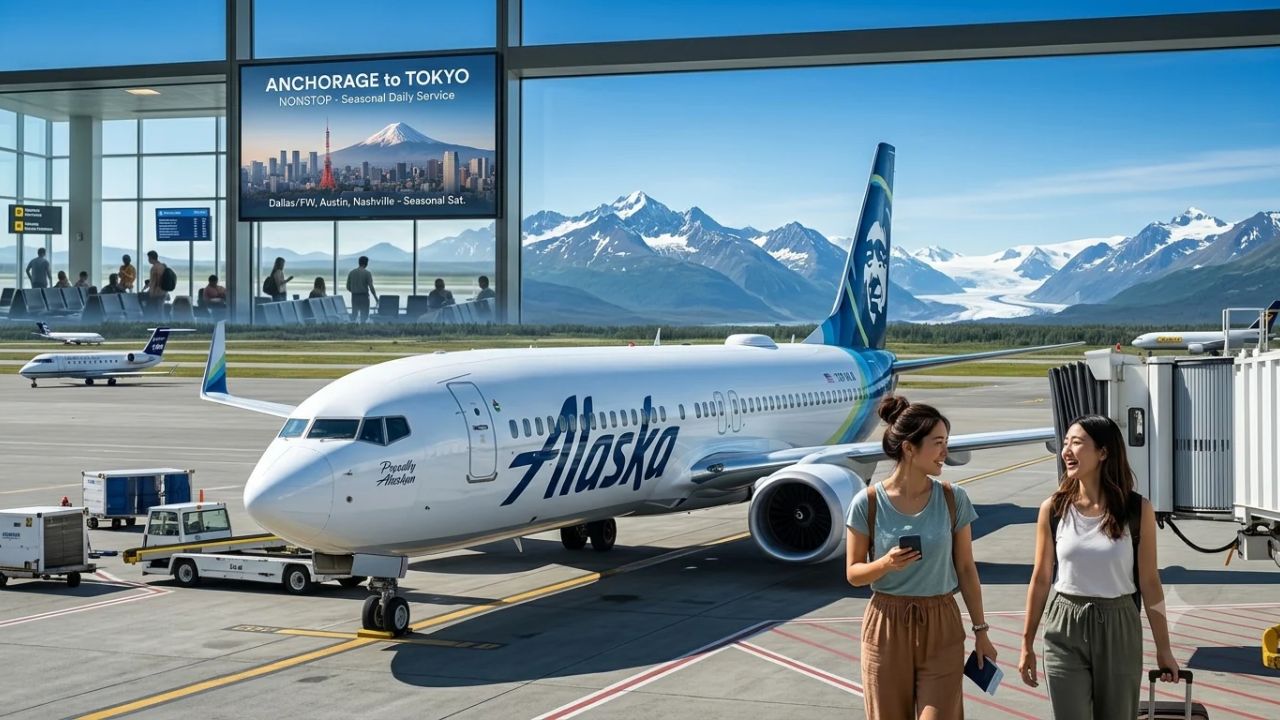
Alaska Airlines expands domestic summer operations from Anchorage in 2027 with direct weekly flights to Dallas-Fort Worth, Austin, and Nashville
[ANCHORAGE, Oct 30, 2026] — Ted Stevens Anchorage International Airport is preparing for an unprecedented domestic and intercontinental network expansion in summer 2027, as Alaska Airlines launches scheduled nonstop passenger flights linking Alaska directly to Dallas-Fort Worth, Austin, and Nashville, alongside a milestone transpacific service to Tokyo Narita.
[!NOTE] Key Operational Dates and Route Details: The domestic expansion introduces weekly Saturday nonstop departures between Anchorage (ANC) and three major Sunbelt and Mid-South hubs: Dallas-Fort Worth International Airport (DFW), Austin-Bergstrom International Airport (AUS), and Nashville International Airport (BNA). These domestic services operate from June 12 through August 7, 2027. Concurrently, Alaska Airlines will initiate international service between Anchorage and Tokyo Narita (NRT) on May 13, 2027, running daily through September 7, 2027, before returning in January 2028 with three weekly departures. Single-aisle Boeing 737 MAX 8 aircraft featuring a 159-to-161-seat three-class cabin layout will operate across the expanding Anchorage network.
ALASKA AIRLINES 2027 ANCHORAGE NETWORK EXPANSION ARCHITECTURE
| [ HUB ORIGIN: TED STEVENS ANCHORAGE INTERNATIONAL AIRPORT (ANC) ] |
|---|
| - Geographic Position: Key Great Circle crossroads connecting North America and Asia |
| - Peak Operational Window: Summer 2027 (Mid-May to Late-August) |
| +---------------------------+----------------------------+ |
| v v |
| [ DOMESTIC SUNBELT & MID-SOUTH CORRIDORS ] [ TRANSPACIFIC GATEWAY SERVICE ] |
| - Dallas-Fort Worth (DFW): Saturday Nonstops - Tokyo Narita (NRT): Daily Summer |
| - Austin-Bergstrom (AUS): Saturday Nonstops - Winter Resumption: January 2028 |
| - Nashville Metropolitan (BNA): Saturday Nonstops - Fleet Deployment: Boeing 737 MAX 8 |
| +---------------------------+----------------------------+ |
| v |
| [ STRATEGIC PASSENGER & ECONOMIC BENEFITS ] |
| - Seamless point-to-point connections bypassing traditional West Coast layovers (SEA, PDX) |
| - Eliminates multi-hour transit times for Southern travelers heading to Alaskan wilderness |
| - Direct access for Gulf Coast energy executives and Texas technology professionals |
| - Synchronized disembarkation corridors for Gulf of Alaska cruise liners (Whittier & Seward) |
The Strategic Shift: Linking the Last Frontier Directly to the American South
For decades, commercial air travelers journeying between Alaska and the central or southern regions of the United States were funneled through traditional West Coast gateway airports. Itineraries originating in Texas, Tennessee, or neighboring southern states required intermediate connections at Seattle-Tacoma International Airport (SEA) or Portland International Airport (PDX). While this legacy hub-and-spoke model provided high-frequency operations, it routinely added four to seven hours of total transit time, elevated the risk of mishandled checked baggage during peak summer travel periods, and forced travelers to endure early-morning or redeye connection banks.
Alaska Airlines' scheduled summer 2027 schedule represents a decisive break from this routing structure. By inaugurating direct Saturday nonstop flights from Anchorage to Dallas-Fort Worth, Austin, and Nashville, the carrier is capitalizing on strong demographic and leisure travel shifts. Millions of residents across the American Sunbelt actively seek escape from extreme summer heat, turning to Alaska's temperate climate, national parks, wildlife excursions, and marine glaciers.
Operating these services on Saturdays aligns precisely with the hospitality rhythms of the 49th State. Most Gulf of Alaska cruise itineraries, multi-day wilderness expeditions, guided sport-fishing trips, and Kenai Peninsula backcountry tours operate on Saturday-to-Saturday or Sunday-to-Sunday guest rotations. By timing departures for Saturday mornings and afternoons, Alaska Airlines provides travelers with direct, same-day access to embarkation ports in Whittier and Seward, while allowing returning visitors to fly home without paying for transitional hotel nights in Seattle or Anchorage.
The strategic dimension extends into corporate commerce. Texas and Alaska maintain longstanding economic ties rooted in energy exploration, oilfield services, maritime engineering, and heavy infrastructure. Establishing direct air links to Dallas-Fort Worth—the primary global mega-hub of oneworld alliance partner American Airlines—enables streamlined business travel while connecting corporate travelers to hundreds of secondary markets across the Southeast, Central America, and Latin America.
ANCHORAGE SUMMER 2027 NEW DOMESTIC & INTERNATIONAL FLIGHT SPECIFICATIONS
| Route Corridor Airport Code Distance (mi) Flight Time Aircraft Type Weekly Frequency |
|---|
| -------------------------------------------------------------------------------------------- |
| Anchorage - Dallas ANC - DFW 3,043 miles ~6h 15m Boeing 737 MAX 8 1x (Saturdays) |
| Anchorage - Austin ANC - AUS 3,178 miles ~6h 30m Boeing 737 MAX 8 1x (Saturdays) |
| Anchorage - NashvilleANC - BNA 3,109 miles ~6h 20m Boeing 737 MAX 8 1x (Saturdays) |
| Anchorage - Tokyo ANC - NRT 3,460 miles ~8h 15m Boeing 737 MAX 8 7x (Daily) |
| -------------------------------------------------------------------------------------------- |
| Operating Calendar: Domestic routes operate June 12 – August 7, 2027; Tokyo operates May-Sept |
Detailed Analysis of the Three New Domestic Corridors
Each of the three new domestic routes introduced by Alaska Airlines addresses distinct travel demographics, catchment areas, and economic drivers.
1. Anchorage (ANC) to Dallas-Fort Worth (DFW): The Alliance Mega-Hub Link
The addition of nonstop service between Ted Stevens Anchorage International Airport and Dallas-Fort Worth International Airport establishes a direct bridge to one of the largest metropolitan regions and aviation hubs in North America. Spanning approximately 3,043 statute miles, the flight requires an estimated block time of six hours and fifteen minutes.
Dallas-Fort Worth serves as the central fortress hub for American Airlines, Alaska Airlines' premier domestic partner within the global oneworld alliance. This geographic and operational positioning offers immense value for connecting itineraries:
- Alliance Reciprocity: Passengers traveling on Alaska Airlines flights between Anchorage and Dallas-Fort Worth can earn and redeem miles through either Alaska's Mileage Plan or American's AAdvantage program. Elite status holders across both carriers receive reciprocal benefits, including priority check-in, expedited TSA security screening access, priority boarding, and complimentary space-available upgrades to First Class or Premium Class.
- Sunbelt Catchment Area: DFW functions as a primary air transport funnel for travelers across North Texas, Oklahoma, Arkansas, and northern Louisiana. Travelers in these regions previously faced multi-leg itineraries to reach Alaska; direct service to DFW removes this friction.
- Corporate Energy Connectivity: Houston and Dallas represent the corporate financial centers of the American petroleum and natural gas industries. With Alaska's North Slope oil fields generating sustained demand for executive transit, engineering personnel, and specialized technical contractors, a direct Dallas link provides a valuable alternative to legacy transits through Seattle.
2. Anchorage (ANC) to Austin-Bergstrom (AUS): Silicon Hills to the Wilderness
Spanning 3,178 statute miles, the Anchorage-to-Austin nonstop route represents one of the longest domestic narrowbody routes in the entire United States. Blocked at approximately six hours and thirty minutes, this seasonal Saturday service connects Alaska directly with the fast-growing economic capital of Central Texas.
The Austin metropolitan area has undergone rapid economic and demographic expansion over the past decade, transforming into a prominent technology hub home to major operations for companies including Apple, Tesla, Dell, Google, and Oracle. This development has created a distinct passenger market:
- High-Income Leisure Travelers: Austin boasts a young, affluent demographic with high disposable income and strong preferences for outdoor adventure, eco-tourism, hiking, and experiential holidays. Alaska's national parks—including Denali, Kenai Fjords, and Katmai—represent bucket-list destinations for this population.
- Direct Point-to-Point Convenience: Prior to this announcement, Austin travelers bound for Anchorage had to route through hubs like Seattle, Denver, or Salt Lake City. Eliminating connection stops saves between three and five hours of travel time per direction, making one-week Alaskan vacations considerably more practical for working professionals.
- Inbound Alaskan Tourism to Central Texas: The route also provides Alaskans with direct access to Austin's renowned music festivals, culinary scene, and burgeoning technology conferences without requiring connections in California or the Pacific Northwest.
3. Anchorage (ANC) to Nashville International (BNA): Connecting Music City to the Last Frontier
The third domestic link in Alaska Airlines' expansion connects Anchorage directly with Nashville International Airport in Tennessee, covering 3,109 statute miles with an anticipated flight duration of six hours and twenty minutes.
Nashville represents one of the fastest-growing leisure and business destinations in the United States, serving as the commercial and cultural anchor for Middle Tennessee, southern Kentucky, and northern Alabama.
- Broad Regional Appeal: BNA's expansive catchment area encompasses millions of travelers across the Mid-South who previously lacked direct access to Alaska. Bypassing crowded Midwest or West Coast connecting hubs makes summer wilderness travel significantly more appealing for families, retirees, and recreational anglers throughout Tennessee and neighboring states.
- Cultural Tourism Symmetry: While Tennessee travelers head north to experience glacier treks, whale watching, and the summer midnight sun, Alaskan residents gain effortless nonstop access to Nashville's world-famous country music heritage, entertainment districts, and healthcare corporate centers.
PASSENGER TRANSIT TIME COMPARISON: 2026 VS. 2027
| Column 1 |
|---|
| Origin City -> Anchorage (ANC) 2026 Routing (via SEA Layover) 2027 Nonstop Routing Saved |
| -------------------------------------------------------------------------------------------- |
| Dallas-Fort Worth (DFW) 9h 45m - 11h 15m (1 stop) 6h 15m (Direct) 3h 30m |
| Austin-Bergstrom (AUS) 10h 10m - 12h 00m (1 stop) 6h 30m (Direct) 3h 40m |
| Nashville (BNA) 10h 25m - 12h 30m (1 stop) 6h 20m (Direct) 4h 05m |
| -------------------------------------------------------------------------------------------- |
| Result: Significant reduction in travel fatigue, baggage transfer risks, and airport layovers |
Fleet Economics: The Boeing 737 MAX 8 as an Operational Workhorse
Executing non-daily, long-distance routes spanning over 3,000 statute miles requires aircraft that combine extended range, high fuel efficiency, and right-sized passenger capacity. Alaska Airlines has selected the Boeing 737 MAX 8 to spearhead this expansion.
Historically, flights of this distance were the exclusive domain of widebody twin-aisle aircraft like the Boeing 767 or Douglas DC-10. However, deploying widebody aircraft carrying 250 to 300 passengers on seasonal, weekly domestic routes poses immense commercial risk, as filling that volume of seats on a single weekly frequency often depresses ticket yields. The Boeing 737 MAX 8 solves this challenge by providing single-aisle operational economics tailored to long, thin routes.
Aerodynamic and Propulsion Efficiency
Equipped with advanced CFM International LEAP-1B engines and distinctive Advanced Technology winglets, the 737 MAX 8 delivers a 14% to 20% reduction in fuel consumption and carbon emissions compared to previous-generation Boeing 737 Next Generation airframes.
With a maximum certified design range of approximately 3,500 nautical miles (over 4,000 statute miles), the MAX 8 handles the 3,000-to-3,200-mile distances between Anchorage, Texas, and Tennessee with substantial operational reserves. Even when facing persistent summer jet stream headwinds on westbound return flights to Anchorage, the aircraft maintains adequate fuel margins to comply with strict domestic alternate airport reserves without imposing weight penalties on passenger baggage or cargo.
Interior Configuration and Passenger Experience
Alaska Airlines' Boeing 737 MAX 8 aircraft are configured with 159 to 161 seats arranged in a passenger-friendly three-class layout:
- First Class: 16 recliner seats in a 2x2 configuration, featuring 41 inches of seat pitch, generous recline, dedicated footrests, and premium complimentary meal and beverage service.
- Premium Class: 24 seats located in the forward cabin offering 35 inches of pitch—providing an extra four inches of legroom compared to standard economy—along with early boarding privileges and complimentary craft beer, wine, and cocktails.
- Main Cabin: 119 to 121 standard economy seats featuring 31 to 32 inches of pitch, equipped with ergonomic cushioning and adjustable headrests.
Every seat throughout the aircraft includes dedicated AC power outlets and USB charging ports. Passengers have access to Alaska's high-speed satellite-based Wi-Fi system, which allows streaming and web browsing over the remote expanses of northern Canada and Alaska. In addition, travelers can access hundreds of complimentary movies and television shows streamed directly to their personal smartphones, tablets, or laptops via the airline's inflight entertainment portal.
Cold-Weather Operational Resilience and Polar Avionics
Operating extended long-haul flights from Ted Stevens Anchorage International Airport demands specialized operational readiness. While the summer schedule avoids severe sub-zero temperatures, the aircraft assigned to Anchorage must maintain year-round capability for Alaskan conditions.
The Boeing 737 MAX 8 features advanced dual Honeywell GPS and multi-sensor navigation avionics capable of operating across high-latitude northern flight tracks. Magnetic variation increases rapidly near the Arctic Circle, requiring flight management computers to toggle between magnetic heading and true heading references during polar or high-latitude overflights. In addition, Anchorage's centralized aircraft de-icing facilities allow Alaska Airlines to maintain rigorous on-time departure performance even during unseasonal late-spring freezes or early-autumn snowfalls. The reliability of modern high-bypass turbofans and redundant electrical systems ensures that passenger comfort and cabin environmental controls remain steady throughout transcontinental and transoceanic sectors.
BOEING 737 MAX 8 FLEET SPECIFICATION PROFILE
| Technical Parameter Engineering Metric Passenger Comfort Detail |
|---|
| -------------------------------------------------------------------------------------------- |
| Overall Passenger Capacity 159 to 161 Seats 3 Distinct Cabin Classes |
| First Class Seating 16 Recliner Seats (2x2) 41-inch Pitch, Full Meal Service |
| Premium Class Seating 24 Extra-Legroom Seats (3x3) 35-inch Pitch, Free Beverages |
| Main Cabin Seating 119 to 121 Standard Seats (3x3)31-inch Pitch, Ergonomic Design |
| Power & Inflight Device 110V AC + USB at every seat Device-holder seatbacks |
| Propulsion Systems CFM International LEAP-1B 14-20% Fuel Burn Reduction |
| Maximum Operating Range 3,500 Nautical Miles Enables 6+ Hour Transcontinental Legs |
The Trans-Pacific Milestone: Tokyo Narita Service Details
While the domestic expansion opens vital pathways to the American South, Alaska Airlines' concurrent launch of nonstop service between Anchorage and Tokyo Narita International Airport (NRT) represents the most historically significant element of the 2027 network plan.
Subject to final regulatory approvals from both the United States Department of Transportation (DOT) and the Japan Civil Aviation Bureau (JCAB), scheduled service between Anchorage and Tokyo will commence on May 13, 2027. Operating on a daily schedule throughout the peak summer season until September 7, 2027, the route marks the return of scheduled nonstop passenger air links between Alaska and Japan after an absence of several years.
The Transpacific Narrowbody Journey
Covering approximately 3,460 statute miles across the North Pacific Ocean, the flight will be operated using the same Boeing 737 MAX 8 aircraft deployed on domestic routes. The journey is scheduled to take approximately eight hours and fifteen minutes heading westbound toward Japan, with eastbound return journeys benefiting from tailwinds that reduce flight time to under seven hours.
Deploying a single-aisle aircraft on a transoceanic flight of this length highlights the evolution of modern airline network planning. While traditional transpacific travel has long relied on massive twin-aisle widebody aircraft like the Boeing 777 or Airbus A350, utilizing a fuel-efficient narrowbody jet allows Alaska Airlines to offer daily frequency while managing capacity risk during the initial route launch.
Because the flight traverses the International Date Line heading west, passengers departing Anchorage in the afternoon arrive at Tokyo Narita the following calendar day, allowing straightforward evening connections onto domestic Japanese flights or regional services across East Asia.
Winter Resumption: Aurora Tourism in January 2028
Recognizing that Japanese tourism demand for Alaska is not limited to summer wildlife viewing, Alaska Airlines has structured a seasonal operational pause followed by a winter resumption. After concluding daily summer operations on September 7, 2027, the carrier will temporarily suspend the Anchorage–Tokyo route during the autumn low season before resuming service in January 2028 with three weekly departures.
Winter travel between Japan and Alaska is heavily propelled by aurora borealis tourism. Fairbanks and the interior of Alaska represent globally renowned locations for viewing the Northern Lights, drawing thousands of Japanese visitors each winter. Japanese travelers traditionally fly into Anchorage before taking scenic rail journeys aboard the Alaska Railroad or catching regional flights north to Fairbanks and Chena Hot Springs. Direct nonstop flights in midwinter eliminate the exhausting multi-connection itineraries through Seattle or Vancouver that travelers currently endure.
ANCHORAGE TO TOKYO NARITA (NRT) OPERATING SCHEDULE
| Phase / Season Operating Window Flight Frequency Primary Market |
|---|
| -------------------------------------------------------------------------------------------- |
| Inaugural Summer Season May 13 - September 7, 2027 Daily (7x Weekly) Cruises & Parks |
| Autumn Operational Break September 8 - December 2027 Seasonal SuspensionFleet Reposition |
| Winter Northern Lights Run January 2028 - Late Winter 3x Weekly Aurora Borealis |
| -------------------------------------------------------------------------------------------- |
| Flight Characteristics: ~8h 15m Westbound, crosses International Date Line, Boeing 737 MAX 8 |
Anchorage's Aviation Heritage: From Cold War Crossroads to Modern Gateway
The introduction of direct flights connecting Anchorage to Tokyo, Texas, and Tennessee represents the latest chapter in one of the most storied aviation histories in the world.
During the Cold War era spanning the 1950s through the late 1980s, commercial airliners operated by European, American, and Asian carriers were prohibited from entering the sovereign airspace of the Soviet Union. Flights operating between Western Europe and East Asia had to navigate extreme polar routes. Because the range of early passenger jetliners—such as the Boeing 707, Douglas DC-8, and early Boeing 747 variants—was insufficient to complete the journey nonstop, aircraft required an intermediate technical refueling stop.
Due to its strategic location at the top of the globe along the Great Circle route, Ted Stevens Anchorage International Airport became known as the "Air Crossroads of the World." Flag carriers including British Airways, Air France, Lufthansa, KLM, Japan Airlines, Korean Air, and Scandinavian Airlines landed daily at Anchorage to refuel, change flight crews, and allow passengers to stretch their legs inside the international terminal.
This operational role transformed abruptly in the 1990s following the dissolution of the Soviet Union. Russia opened Siberian airspace corridors to Western commercial aviation, and new twin-engine widebody aircraft—principally the Boeing 777 and Airbus A330—possessed the range to fly nonstop between Europe and Asia without stopping. International passenger traffic at Anchorage declined sharply, although the airport rapidly reinvented itself into one of the world's premier air cargo hubs, today ranking as the third busiest cargo airport globally behind Hong Kong and Memphis.
Alaska Airlines' 2027 passenger expansion signals a resurgence of passenger traffic at Ted Stevens. Rather than serving merely as a technical refueling stop, Anchorage is asserting itself as a destination and an originating passenger gateway, connecting international Asian visitors directly to Alaska's interior while linking Alaskans to key metropolitan centers across the Lower 48.
THE EVOLUTION OF ANCHORAGE AVIATION CHRONOLOGY
| Column 1 |
|---|
| 1950s - 1980s: The Cold War Crossroads |
| - Soviet airspace closed to Western carriers; polar routing between Europe & Asia required stops |
| - Ted Stevens ANC served as the world's central refueling and crew-change hub for global airlines |
| v |
| 1990s - 2010s: The Siberian Corridor & Cargo Transition |
| - Siberian airspace opens; modern long-haul jets fly Europe-Asia nonstop, bypassing Anchorage |
| - ANC transitions into a global air freight powerhouse (FedEx, UPS, Atlas Air international hub) |
| v |
| 2020s - 2027: The Direct Point-to-Point Resurgence |
| - Efficient narrowbody aircraft (Boeing 737 MAX 8) enable direct point-to-point seasonal links |
| - Alaska Airlines restores direct Tokyo link; introduces nonstops to Dallas, Austin & Nashville |
Broader Network Synergies: Seattle, Osaka, and the Pacific Northwest
Alaska Airlines' expansion from Anchorage is not occurring in isolation. It forms a coordinated component of the carrier's broader transpacific and international growth strategy, reinforced by its expanding operational fleet and recent commercial developments.
The Seattle Gateway and Boeing 787 Operations
Alaska Airlines already connects Seattle-Tacoma International Airport (SEA) with Tokyo Narita through nonstop services operated by Boeing 787-9 Dreamliner aircraft. The Seattle-Tokyo route serves as the carrier's primary intercontinental pipeline, feeding corporate traffic from the Pacific Northwest technology corridor into Japan and connecting inbound Asian travelers to Alaska's extensive domestic network.
The Seattle to Osaka Kansai Expansion (May 14, 2027)
Just one day after the planned launch of the Anchorage–Tokyo flight, Alaska Airlines will expand its Japanese network further by inaugurating direct service between Seattle-Tacoma and Osaka Kansai International Airport (KIX) on May 14, 2027.
This new route to Japan's Kansai region will be operated using Airbus A330-200 aircraft from Hawaiian Airlines, reflecting the integration of fleet assets following the commercial combination of Alaska Air Group and Hawaiian Airlines. The Seattle–Osaka service provides travelers with direct access to Kyoto, Osaka, and the historic Kansai region, creating reciprocal options for American travelers visiting western Japan and Japanese tourists heading to North America.
Strategic Coordination Across Three Hubs
By synchronizing operations across Anchorage, Seattle, and Honolulu, Alaska Airlines is assembling a versatile transpacific network:
- Anchorage: Specializes in high-demand seasonal leisure traffic, direct transpacific links for Alaskan residents, and Japanese inbound nature tourism.
- Seattle: Operates year-round, high-capacity widebody routes catering to corporate tech travelers, commercial cargo, and connecting passenger flows across the continental United States.
- Honolulu: Provides leisure holiday travel between Japan and the Hawaiian Islands, while offering connecting pathways across the South Pacific.
ALASKA AIRLINES TRANS-PACIFIC JAPAN EXPANSION (MAY 2027)
| Column 1 |
|---|
| Route Corridor Launch Date Operating Fleet Target Market Demographics |
| -------------------------------------------------------------------------------------------- |
| Anchorage - Tokyo May 13, 2027 Boeing 737 MAX 8 Alaskan summer leisure & tourism |
| Seattle - Osaka May 14, 2027 Airbus A330 (Hawaiian) Kansai cultural & corporate travel |
| Seattle - Tokyo Active Daily Boeing 787-9 Dreamliner Year-round corporate & cargo hub |
| -------------------------------------------------------------------------------------------- |
| Strategy: Coordinated scheduling providing multi-gateway flexibility between North America & Asia |
Economic and Tourism Implications for the 49th State
The introduction of direct flights from Dallas-Fort Worth, Austin, Nashville, and Tokyo arrives at a pivotal moment for Alaska's visitor economy. Tourism stands as one of the largest private-sector employers in Alaska, generating over $4 billion in annual economic impact and supporting tens of thousands of jobs across hospitality, transportation, and wilderness recreation.
Catalyst for Independent Wilderness Tourism
While large cruise vessels carry more than 1.6 million passengers to Southeast Alaska each summer, travelers arriving by air represent an economically vital segment known as independent travelers. Unlike cruise passengers whose spending is largely confined to port communities like Ketchikan and Juneau, independent air visitors rent vehicles, stay in locally owned lodges, dine in neighborhood restaurants, and spend extended time in Southcentral and Interior Alaska.
Visitors arriving via direct flights from Texas and Tennessee are expected to generate substantial economic benefits for regional businesses:
- Vehicle Rentals and Campervans: Travelers arriving on Saturday nonstops routinely book week-long car or RV rentals to drive the scenic Seward Highway, explore the Kenai Peninsula, or travel north toward Denali National Park and Fairbanks.
- Guided Adventures and Excursions: Sunbelt travelers demonstrate high demand for premium guided experiences, including helicopter glacier landings, Kenai River salmon fishing charters, bear-viewing excursions in Lake Clark, and marine wildlife cruises in Prince William Sound.
- Backcountry Lodging: Wilderness eco-lodges along the Talkeetna Mountains and Kachemak Bay benefit from guests booking multi-night stays supported by straightforward flight itineraries.
Cruise Line Passenger Synchronization
Whittier and Seward serve as the primary northern turnaround ports for cross-gulf cruises operated by major cruise lines, including Princess Cruises, Holland America Line, and Royal Caribbean. Every weekend during the summer season, thousands of passengers disembark at these ports after completing seven-day northbound voyages from Vancouver or Seattle.
Historically, coordinating return flights for these disembarking cruise guests required complex bus or rail transfers to Anchorage, followed by long layovers at Seattle or Portland. The introduction of Saturday nonstops from Anchorage to Dallas-Fort Worth, Austin, and Nashville provides cruise operators and travel advisors with seamless same-day departure options, allowing guests to complete their Alaskan vacations with a single direct flight home.
Indigenous Cultural Heritage and Regional Community Impact
The economic benefits of expanded air connectivity reach beyond traditional outdoor recreation. Alaska is home to 229 federally recognized sovereign tribes, representing diverse Alaska Native cultural heritages including Iñupiat, Yup'ik, Athabascan, Tlingit, Haida, and Tsimshian nations.
Direct air links from major cultural centers in Texas and Tennessee facilitate authentic cultural tourism, connecting visitors directly to Indigenous-owned cultural centers, art collectives, and heritage museums in Anchorage and surrounding regions. Establishments such as the Alaska Native Heritage Center in Anchorage experience increased attendance from independent travelers who seek meaningful historical engagement. By enabling visitors to connect directly with Native-owned artisan markets, guided cultural heritage tours, and community storytelling gatherings, the expanded air routes support sustainable economic self-determination for Indigenous communities across Southcentral and Interior Alaska.
ALASKA VISITOR INDUSTRY IMPACT PROJECTIONS
| Column 1 |
|---|
| Visitor Sector Economic Catalyst Mechanism Projected Commercial Benefit |
| -------------------------------------------------------------------------------------------- |
| Independent Air Visitors Direct Saturday flights Extended stays in Southcentral |
| Car & RV Rental Companies Saturday-to-Saturday turnover Maximized weekly fleet utilization |
| Wilderness & Eco-Lodges Elimination of transit layovers Higher booking rates from Sunbelt |
| Cruise Disembarkation Coordinated weekend schedules Smooth same-day transfers from port |
| Local Food & Hospitality Direct spending in Anchorage Increased downtown restaurant spend |
Practical Guide for Travelers Planning Summer 2027 Journeys
For travelers eager to take advantage of Alaska Airlines' new routes in summer 2027, forward planning is essential to secure preferred fares, lodging, and vehicle reservations.
1. Booking Around the Saturday Operating Window
Because the domestic flights to Dallas-Fort Worth, Austin, and Nashville operate exclusively on Saturdays, itineraries must be constructed in week-long blocks:
- Weekly Rotations: Plan vacations in seven-day or fourteen-day increments (departing Saturday and returning the following Saturday).
- Rental Car Coordination: Reserve rental cars or campervans as soon as airline tickets are secured. Alaska's rental vehicle fleet experiences severe seasonal supply constraints during June and July, with rates escalating significantly as summer approaches.
- Accommodation Alignments: Ensure hotel, lodge, and campground reservations match Saturday arrival and departure times, particularly in popular gateway communities like Seward, Homer, and Denali.
2. Maximizing oneworld Frequent Flyer Benefits
Members of Alaska Airlines Mileage Plan, American Airlines AAdvantage, and partner oneworld loyalty programs can leverage their elite status on these new routes:
- Status Match and Reciprocal Perks: AAdvantage Executive Platinum, Platinum Pro, and Platinum members traveling on Alaska Airlines flights receive priority check-in, two complimentary checked bags, and priority boarding.
- Mileage Redemption: Look for award space early. Long-distance transcontinental routes often have limited saver award seats during the peak July summer travel window.
3. Understanding Time Zone Transitions
Travelers journeying between Alaska and the Sunbelt cross multiple time zones:
- Alaska Standard Time (AKST) is three hours behind Central Time (CT) observed in Dallas and Austin, and four hours behind Eastern Time (ET).
- When departing Anchorage on an afternoon flight heading to Texas or Tennessee, the flight lands late in the evening or early the following morning due to the eastward time change.
- Westbound flights departing Dallas, Austin, or Nashville in the morning gain hours traveling west, arriving in Anchorage early in the afternoon with plenty of daylight remaining to explore.
PASSENGER ITINERARY PLANNING RECOMMENDATIONS
| Column 1 |
|---|
| Planning Stage Recommended Timeline Actionable Traveler Strategy |
| -------------------------------------------------------------------------------------------- |
| Flight Booking 9 to 11 Months Prior Lock in Saturday seats for June-August |
| Vehicle Rental Immediately After Flight Secure rental car before inventory depletes |
| National Park Passes 6 Months Prior Book Denali transit & tour bus reservations |
| Backcountry Lodging 6 to 9 Months Prior Reserve wilderness lodges in Kenai/Denali |
| Packing Preparation 2 Weeks Prior Pack layered clothing for 45°F - 75°F range |
Strategic Outlook: Ted Stevens Anchorage International as an Expanding Hub
Alaska Airlines' investment in new nonstop passenger services to Dallas-Fort Worth, Austin, Nashville, and Tokyo Narita underscores the evolving landscape of North American commercial aviation.
By leveraging the extended range and operating efficiency of the Boeing 737 MAX 8, airlines can bypass congested intermediate hubs to connect specialized, high-yield leisure and business markets directly. For Anchorage, this development marks a return to its historical prominence as a pivotal transpacific passenger gateway, combined with direct connectivity to the fastest-growing economic metropolitan areas in the United States.
As the summer 2027 travel season approaches, these direct air corridors will shorten travel times, expand business collaboration between the energy and technology sectors of Alaska and the South, and provide thousands of travelers with comfortable access to the extraordinary natural wilderness of the Last Frontier.
Frequently Asked Questions (PAA)
When do Alaska Airlines' new nonstop flights from Anchorage begin operating?
Alaska Airlines' new international service between Anchorage (ANC) and Tokyo Narita (NRT) is scheduled to launch on May 13, 2027, operating daily through September 7, 2027, before returning in January 2028 with three weekly departures. The new domestic nonstop flights from Anchorage to Dallas-Fort Worth (DFW), Austin (AUS), and Nashville (BNA) will begin on June 12, 2027, operating weekly on Saturdays through August 7, 2027.
Which aircraft will Alaska Airlines fly on the new Anchorage routes?
Alaska Airlines will deploy the fuel-efficient single-aisle Boeing 737 MAX 8 across all four new routes from Anchorage, including the transpacific service to Tokyo Narita. The aircraft features 159 to 161 seats across three cabin classes: First Class (16 seats), Premium Class (24 seats), and Main Cabin economy (119 to 121 seats), equipped with power outlets, satellite Wi-Fi, and streaming inflight entertainment.
How long are the direct flights between Anchorage, Texas, and Tennessee?
The nonstop flight between Anchorage and Dallas-Fort Worth takes approximately six hours and fifteen minutes (3,043 miles). The Anchorage to Austin route spans 3,178 miles with a flight time of approximately six hours and thirty minutes, while the Anchorage to Nashville flight covers 3,109 miles in approximately six hours and twenty minutes.
Can American Airlines AAdvantage members earn miles on Alaska Airlines' Anchorage flights?
Yes. Because Alaska Airlines and American Airlines are both members of the global oneworld alliance, passengers can earn and redeem American Airlines AAdvantage miles when booking eligible Alaska Airlines flights. Elite status members also enjoy reciprocal perks such as priority boarding, complimentary checked baggage allowances, and space-available seat upgrades.
Why is Alaska Airlines pausing and then resuming the Anchorage to Tokyo flight in January 2028?
Alaska Airlines has designed the Anchorage–Tokyo route to target two distinct peak tourism seasons: summer wildlife and cruise travel from May to September, and winter aurora borealis tourism in January. After a seasonal autumn pause, the airline will resume service in January 2028 with three weekly flights to accommodate Japanese travelers visiting Fairbanks and Interior Alaska to view the Northern Lights.
Related Travel Guides
This article is for informational purposes. Flight routes, passenger regulations, visa rules, and transit advisories are subject to change by airlines and aviation authorities. Readers are advised to verify schedules and travel documentation with relevant carriers and border agencies before departure.
Related Stories

Alaska Airlines Expands Anchorage Hub with Nonstop Flights to Tokyo Narita, Dallas, Austin, and Nashville for Summer 2027
Brazil Nears 100 Million Air Passengers in 2026 Amid Divergent Global Aviation Growth