
SkyWest, Southwest, and American Airlines Trigger Massive Travel Chaos as 3,770 Flights Suffer Severe Delays and Cancellations Across San Francisco, Los Angeles, and Phoenix: Latest Airline News
A highly destructive wave of severe flight delays and sudden cancellations violently fractures the US aviation network, paralyzing San Francisco and completely severing vital transcontinental corridors.

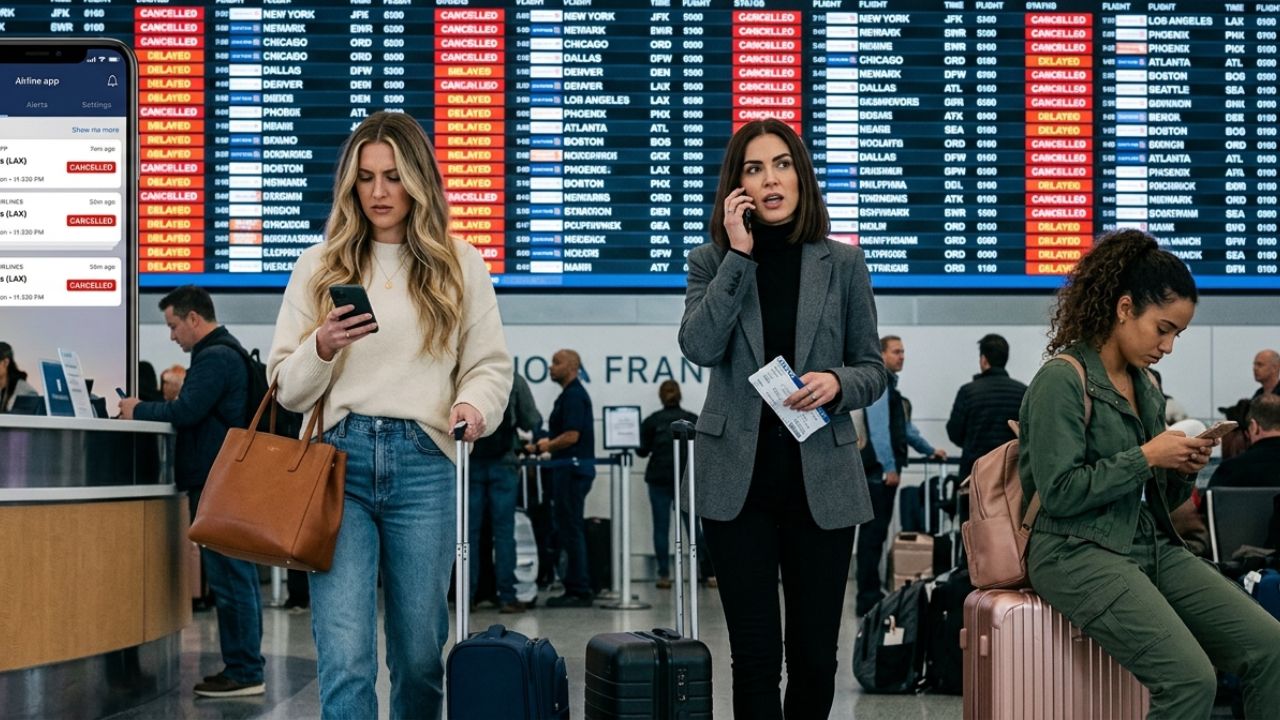
Image generated by AI
A Devastating Collapse in American Aviation
A terrifying, highly destructive wave of sudden flight cancellations and severe schedule delays is currently tearing through the absolute heart of the American aviation system, instantly plunging thousands of unsuspecting domestic and international passengers into a severe state of travel chaos. Over the past 24 hours, an aggressive cascade of 3,611 agonizing flight delays and 159 abrupt flight groundings has completely paralyzed operations across the United States. Heavyweight carriers, led by American Airlines, Southwest, United, Delta, and regional titan SkyWest Airlines, have all heavily contributed to this massive operational collapse. With severe airport disruptions completely dominating today's primary airline news, these highly volatile aviation updates confirm that critical corridors connecting San Francisco, Los Angeles, Phoenix, Nashville, and Newark have been violently severed, leaving desperate commuters and holidaymakers fighting for non-existent re-accommodation in heavily congested terminal lobbies.
Expanded Overview: Measuring the Scale of the Disruption
The sheer geographic scale and rapid acceleration of this systemic breakdown mark a highly concerning period of scheduling instability for the North American aviation sector. These 3,770 confirmed disruptions are not isolated to a single, localized mechanical failure; rather, they signify a massive, interconnected failure triggered by severe meteorological events rapidly cascading into nationwide air traffic control congestion.
Because the US network operates on a highly delicate hub-and-spoke model, the absolute paralysis of a massive West Coast gateway like San Francisco immediately triggers a devastating domino effect. The sudden accumulation of delayed departures and abruptly cancelled flights completely destroyed terminal flow across California, Arizona, Tennessee, Missouri, Pennsylvania, and New York. This massive logistical pressure overwhelmed station managers and ground handling crews who frantically attempted to process the massive backlog of stranded travelers across both domestic short-haul and transcontinental networks.
Section-Wise Breakdown of Network Failures
San Francisco International Airport (SFO): The Epicenter of Chaos
San Francisco International officially emerged as the absolute worst-hit airport in this latest disruption wave. A staggering total of 466 severe delays and 69 complete flight cancellations were violently registered by ground operations. The collapse was directly triggered by severe, highly disruptive easterly winds that violently reduced runway efficiency. The Federal Aviation Administration (FAA) was forced to aggressively intervene, reducing arrival capacity and implementing a massive ground delay program. Average inbound delays reportedly reached an agonizing three hours, completely paralyzing United Airlines (210 delays at SFO alone) and severely crippling SkyWest operations.
West Coast and Desert Hubs Severed
The operational rot rapidly infected the broader western United States. Los Angeles International Airport (LAX) suffered massive scheduling degradation, reporting 188 delays and 11 cancellations, heavily stalling transpacific and domestic pipelines. In Arizona, Phoenix Sky Harbor International Airport recorded a highly disruptive 151 delays and 3 cancellations, severing vital Southwest travel corridors. Furthermore, regional Californian hubs were heavily damaged; John Wayne Airport in Orange County faced 41 delays and an alarming 9 cancellations, while Sacramento International Airport registered 26 delays.
East Coast and Midwest Hubs Paralyzed
The crisis rapidly bled across the continent, shattering connectivity in the Midwest and East Coast. Nashville International Airport experienced a massive 121 delays and 2 cancellations, severely impeding domestic traffic. The incredibly congested New York metropolitan airspace was also heavily fractured; Newark Liberty International Airport reported 63 delays and 4 cancellations, while the private-jet-heavy Teterboro Airport recorded 6 complete cancellations. St. Louis Lambert International Airport (57 delays) and Pittsburgh International Airport (36 delays) also suffered severe operational setbacks.
Flight Details and Mandatory Disruption Tables
To fully comprehend the sheer scale and precise distribution of this massive operational strain, the following tables explicitly document the exact delay and cancellation metrics recorded across all major affected airlines and primary airports:
Airlines Most Affected by USA Disruptions
| Airline | Delays | Cancellations |
|---|---|---|
| American Airlines | 643 | 1 |
| Southwest Airlines | 620 | 9 |
| United Airlines | 420 | 13 |
| Delta Air Lines | 253 | 10 |
| SkyWest Airlines | 221 | 52 |
| PSA Airlines | 143 | 8 |
| Endeavor Air | 107 | 8 |
| Republic Airways | 78 | 1 |
| Alaska Airlines | 75 | 3 |
| Frontier Airlines | 55 | 8 |
| Piedmont Airlines | 35 | 1 |
| Mesa Airlines | 21 | 4 |
Airports Most Affected by USA Disruptions
| Airport | Delays | Cancellations |
|---|---|---|
| San Francisco (SFO) | 466 | 69 |
| Los Angeles (LAX) | 188 | 11 |
| Phoenix Sky Harbor | 151 | 3 |
| Nashville | 121 | 2 |
| Newark Liberty | 63 | 4 |
| St. Louis Lambert | 57 | 2 |
| John Wayne (SNA) | 41 | 9 |
| Pittsburgh | 36 | 4 |
| Sacramento | 26 | 3 |
| Teterboro | 0 | 6 |
Passenger Impact: Systemic Logistical Nightmare
The massive scale of this 3,770-flight disruption has directly inflicted catastrophic financial and logistical damage on tens of thousands of passengers stranded across the United States. Travelers abruptly facing last-minute schedule changes at San Francisco were violently subjected to missed international connections, heavily reduced flight availability, and the terrifying prospect of losing prepaid hotel bookings.
Because San Francisco operates as a massive trans-Pacific gateway, missing a massive wide-body connection out of SFO typically requires a mandatory 24-hour layover, forcing passengers to absorb the massive, unbudgeted costs of emergency hotel bookings in the incredibly expensive Bay Area. Domestically, the total collapse of the LAX-SFO and Phoenix-Nashville corridors meant regional business commuters had absolutely zero alternative routing options, destroying corporate productivity across the continent.
Industry Analysis: Exposing Systemic Vulnerability
Aviation analysts evaluating this massive data set point to severe, synchronized operational challenges stemming from extreme weather vulnerability. The fact that high easterly winds at a single mega-hub (San Francisco) could force the FAA to implement a ground delay program that mathematically triggered a 3,770-flight nationwide collapse proves that the US system operates with dangerously thin buffer zones. The massive disruptions heavily impacted both legacy giants (American, United) and critical regional feed carriers (SkyWest, PSA, Endeavor), completely exposing the fragility of the hub-and-spoke model when primary runways are meteorologically restricted.
Conclusion: A Precarious Recovery Outlook
The unprecedented disruption involving 159 cancelled flights and 3,611 delays across the United States brutally highlights how terrifyingly interconnected and fragile the American aviation system truly is. With vital domestic and international routes heavily affected from San Francisco to Newark, this situation reflects a massive strain on the operational capacity of the nation's most critical air corridors. As airlines desperately attempt to reposition crews and clear the massive backlog of delayed passengers, travelers navigating the US airspace must mentally and financially prepare for a highly volatile environment where schedule reliability remains under extreme pressure.
Key Takeaways
- Massive Nationwide Grounding: A staggering 3,611 flights were severely delayed and 159 were abruptly cancelled across the United States.
- San Francisco Paralyzed: SFO suffered the absolute heaviest operational damage (466 delays, 69 cancellations) after high winds triggered massive FAA arrival restrictions.
- Airlines Affected: American Airlines recorded the highest delay total (643), while regional operator SkyWest Airlines suffered the highest cancellation total (52).
- West Coast Gridlock: Los Angeles (188 delays) and Phoenix Sky Harbor (151 delays) experienced devastating schedule degradation.
- Systemic Instability: The massive collapse across both major legacy carriers and regional feed networks mathematically proves the extreme vulnerability of the US hub-and-spoke model to localized weather events.
Disclaimer: The massive flight cancellation and delay data presented is based on reported operational schedules sourced directly from flight tracking databases. Passengers booked on American, Southwest, United, SkyWest, or any other carrier operating across the affected US hubs are strongly advised to consult their airline directly for the absolute latest flight status and re-accommodation protocols.
Disclaimer
This article is for informational and educational purposes only. It does not constitute legal, financial, or professional advice. While we strive to provide accurate and up-to-date information, travel policies, regulations, and conditions change rapidly. Always verify information with official sources before making travel decisions. Nomad Lawyer makes no representations about the accuracy, reliability, completeness, or suitability of the information provided. Readers should consult qualified professionals for advice specific to their circumstances. The views expressed in this article are those of the author and do not necessarily reflect the views of Nomad Lawyer.
Kunal K Choudhary
Co-Founder & Contributor
A passionate traveller and tech enthusiast. Kunal contributes to the vision and growth of Nomad Lawyer, bringing fresh perspectives and driving the community forward.
Learn more about our team →