
US Coast Guard Heightens Travel Arctic Surveillance as Chinese Research Vessels Operate Off Alaska
US Coast Guard Heightens Travel Arctic Surveillance as Chinese Research Vessels Operate Off Alaska

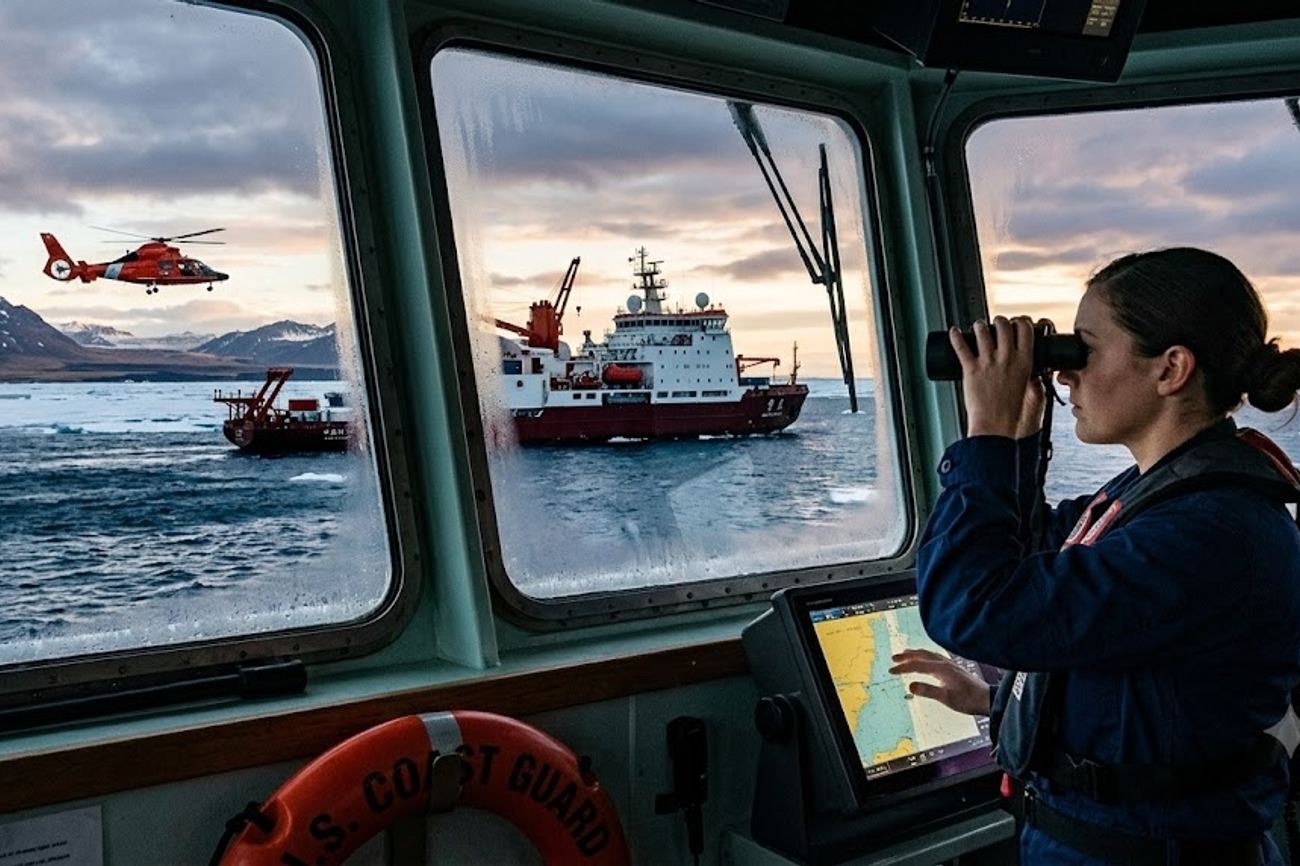
Image generated by AI
[Anchorage, September 2026] — The United States is escalating maritime security operations in Alaskan waters following the unannounced transit of four Chinese research vessels through the U.S. Exclusive Economic Zone (EEZ) and the Bering Strait.
Federal authorities confirm these vessels operated across the Aleutian Islands and extended their reach toward the North Pole throughout 2026. The U.S. government reports that Beijing failed to provide any diplomatic notification prior to these operations, violating customary international protocols for foreign marine scientific research within a sovereign state's EEZ.
Unannounced Incursions in the High North
The current friction stems from a sustained pattern of foreign maritime activity that bypassed standard diplomatic channels. According to Rear Admiral Bob Little, Commander of the U.S. Coast Guard Arctic District (District 17), surveillance assets tracked four Chinese research ships operating within the 200-nautical-mile EEZ off the Alaskan coast and over the U.S. Extended Continental Shelf.
The vessels followed a strategic trajectory starting at the Aleutian Islands, moving through the Bering Sea, and navigating the Bering Strait—a critical 82-kilometer chokepoint between Cape Prince of Wales, Alaska, and Cape Dezhnev, Russia. When queried via radio by U.S. Coast Guard cutters, the shipmasters claimed they were conducting routine science or operating in international waters, despite their presence in U.S.-monitored economic zones.
Entities and Zones Impacted
The geopolitical tension is concentrated in the Pacific Arctic sector, where the following areas and actors are currently engaged:
- U.S. Exclusive Economic Zone (EEZ): The primary zone of contention, extending 200 nautical miles from the Alaskan shoreline.
- The Bering Strait: The sole maritime gateway between the Pacific and Arctic Oceans, now seeing increased naval and commercial traffic.
- The Aleutian Islands: The initial point of entry for the 2026 research transits.
- The "Polar Silk Road": China's strategic initiative to develop trans-Arctic shipping corridors, including the Northern Sea Route and the Northwest Passage.
- U.S. Federal Agencies: A "whole-of-government" coalition including the U.S. Coast Guard and various federal defense departments.
What This Means for Travelers
While these developments are primarily military and diplomatic, they have direct implications for the growing sector of Arctic eco-tourism and commercial shipping.
Increased Security Screenings Travelers booking expeditions to the Bering Strait or the Aleutian Islands should expect a heightened presence of U.S. Coast Guard vessels. This may result in more frequent identification checks for private charters and expedition cruise ships.
Route Volatility Commercial shipping is increasingly eyeing the Northern Sea Route and Northwest Passage to reduce transit times between East Asia and Western Europe by up to 40%. However, as these routes become "theaters of national defense," shipping companies may face sudden rerouting or delays due to security lockdowns or diplomatic disputes.
Permit Rigidity Private researchers or specialized tour operators seeking to conduct any form of sampling or mapping in Alaskan waters will likely face stricter permit enforcement. The U.S. is currently recalibrating its domain awareness, meaning any unauthorized activity—even for leisure—could be flagged as a security risk.
The Shift Toward Dual-Use Surveillance
The U.S. government is treating these "scientific" missions as potential intelligence-gathering operations. Defense analysts argue that the data collected by vessels like the Xue Long and Xue Long 2—specifically seabed bathymetry, water column salinity, and thermal layers—serves a dual purpose. While presented as civilian oceanography, this data is essential for submarine navigation and acoustic mapping.
The acceleration of summer sea ice retreat in the Bering Sea and Arctic Ocean has widened the navigational window, allowing non-Arctic states to assert themselves as "near-Arctic states." This shift has transformed the High North from a remote buffer zone into a critical corridor for resource exploration and maritime sovereignty.
The U.S. is now moving away from seasonal patrols toward a permanent, robust security posture. This involves integrating maritime surveillance with federal defense planning to protect domestic economic interests and ensure unfettered access to Alaskan waters.
FAQ: Arctic Maritime Security 2026
Are cruise ships currently banned from the Bering Strait? No, commercial and eco-tourism traffic continues. However, passengers should expect increased sightings of military and Coast Guard assets and potential delays for security inspections.
Why is China operating in Alaskan waters? Beijing is pursuing its "Polar Silk Road" initiative, seeking to establish shipping corridors and map mineral resources to reduce reliance on the Suez Canal and Malacca Strait.
What is an Exclusive Economic Zone (EEZ)? An EEZ is an area of the ocean, usually extending 200 nautical miles from a country's coast, where the coastal state has special rights regarding the exploration and use of marine resources.
Will this affect flight paths over the Arctic? Current tensions are focused on maritime security. There is no immediate indication that civilian aviation corridors over the North Pole will be restricted.
The race for the High North is no longer about science; it is about sovereignty.
#USCG #BeringStrait #AlaskaEEZ #PolarSilkRoad #ArcticSecurity2026 #MaritimeSovereignty
Related Travel Guides
Disclaimer
This article is for informational and educational purposes only. It does not constitute legal, financial, or professional advice. While we strive to provide accurate and up-to-date information, travel policies, regulations, and conditions change rapidly. Always verify information with official sources before making travel decisions. Nomad Lawyer makes no representations about the accuracy, reliability, completeness, or suitability of the information provided. Readers should consult qualified professionals for advice specific to their circumstances. The views expressed in this article are those of the author and do not necessarily reflect the views of Nomad Lawyer.
Kunal K Choudhary
Co-Founder & Contributor
A passionate traveller and tech enthusiast. Kunal contributes to the vision and growth of Nomad Lawyer, bringing fresh perspectives and driving the community forward.
Learn more about our team →