
Copa Airlines Connection Guide: Navigating Tocumen International Airport Transfers in 2026
Master the Hub of the Americas with this detailed guide on Copa Airlines transfers, T1 and T2 terminal navigation, and immigration rules at Tocumen International Airport.

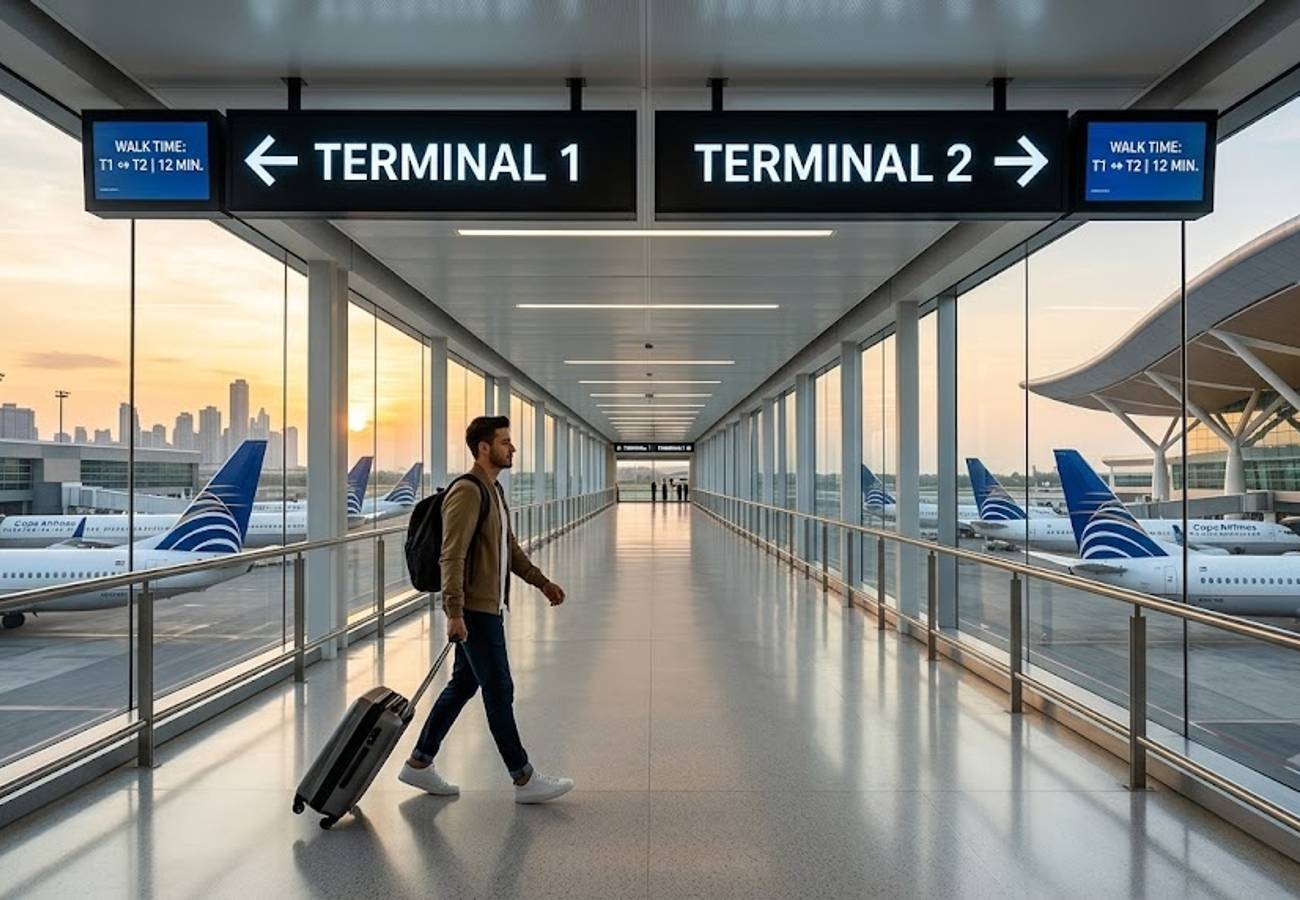
Image generated by AI
Copa Airlines has optimized Panama City’s Tocumen International Airport into a high-velocity transit machine, yet the dual-terminal layout and specific customs protocols can still disorient first-time visitors. With thousands of passengers moving through "flight banks" every few hours, understanding the distinction between Terminal 1 (T1) and Terminal 2 (T2) is the difference between a stress-free transit and a missed departure.
The Strategic Design of the Hub of the Americas
Tocumen International Airport does not operate like a standard city airport; it is a specialized engine for the "Hub of the Americas" model. The facility is engineered specifically to facilitate rapid international-to-international transfers between North, Central, and South America, as well as the Caribbean. Unlike point-to-point hubs in the U.S., such as Los Angeles or Miami, Tocumen is designed to keep the vast majority of its passengers airside, meaning they never formally enter Panamanian territory.
Copa Airlines manages this volume through a "bank" system. This operational strategy involves scheduling clusters of arriving flights and departing flights in tight windows. For example, a flight arriving from Los Angeles at 5:30 p.m. is timed to feed into a wave of departures to cities like Bogotá, Quito, and Lima between 6:30 p.m. and 7:15 p.m.
Because the infrastructure is built for this specific flow, the transit experience is streamlined. Passengers moving between international destinations—such as a trip from Santiago to Toronto—typically avoid the long passport queues associated with arrival halls. Instead, the process involves exiting the aircraft, following "Connections" signage, passing through a single security screen, and proceeding to the next gate. In optimal conditions, this entire sequence is completed in 15 to 30 minutes.
Navigating Terminal 1 and Terminal 2 Transitions
Tocumen is split into two primary international zones. Terminal 1 represents the original infrastructure, while Terminal 2 is the modern expansion that now handles a significant portion of Copa’s fleet. These terminals are arranged parallel to one another and are linked by airside corridors, ensuring passengers can move between them without exiting the secure zone.
Many modern Copa itineraries are contained entirely within Terminal 2. A traveler arriving from New York may land at a 200-series gate and find their connecting flight to Guayaquil departing from a neighboring gate in the same series. In these instances, the "transfer" is merely a short walk across the concourse.
However, when a transfer between T1 and T2 is required, passengers should utilize the upper-level walking route. This corridor is clearly marked in both English and Spanish. A standard walking pace allows a traveler to traverse the distance between terminals in approximately 10 to 15 minutes. For example, a passenger arriving from Bogotá in T1 and connecting to an Orlando-bound flight in T2 can typically reach their gate within 20 to 25 minutes, even with a brief stop.
For those with limited mobility or those facing extremely tight connection windows, an internal airside shuttle is available. This service connects the 100-series gates in T1 with the 200-series gates in T2. While the shuttle is free, its frequency is lower than the walking option. Industry observers recommend that passengers with mobility requirements notify Copa Airlines in advance to arrange for wheelchair or golf-cart assistance.
Step-by-Step International Transfer Process
For the majority of passengers flying an international-to-international itinerary (e.g., Toronto to Panama to Cartagena), the process is highly standardized:
- Deplaning: Upon arrival, ignore the "Arrivals" or "Exit" signs and immediately look for overhead "Connections" signage.
- Security Screening: Transfer passengers are funneled toward a central security checkpoint within the international zone. No immigration or passport control is required for pure transit.
- Documentation: Passengers should have their onward boarding pass ready. If a second boarding pass was not issued at the origin airport, Copa transfer desks are located along the connection paths for reprints.
- Security Protocol: Carry-on luggage is screened via X-ray. Travelers are cautioned that standard liquid restrictions apply; water bottles purchased before the first leg must be discarded unless they are in sealed, duty-free packaging.
- Gate Arrival: After security, passengers enter the departure concourse where flight boards indicate the final gate assignments.
To illustrate the timing, a traveler from Chicago to Lima with a 70-minute layover typically spends 5 minutes deplaning, 10 minutes walking to security, 10 minutes clearing the checkpoint, and 5 minutes reaching the gate. This leaves a 30-minute buffer before boarding commences.
Baggage Handling and Immigration Requirements
A critical aspect of the Copa hub model is the "through-check" baggage system. For standard international connections on a single ticket, checked luggage is tagged at the origin and routed automatically to the final destination. Passengers flying from Montreal to Bogotá or Cancun to São Paulo do not collect their bags or pass through customs in Panama.
Similarly, immigration is bypassed for same-day international transits. As long as the passenger remains in the secure area and the layover falls within the permitted window—generally up to 12 hours for most nationalities—no Panamanian entry stamp is required.
However, there are three specific scenarios where immigration and customs must be cleared:
- Final Destination: If Panama City is the end of the journey.
- Domestic Connections: If the traveler is connecting to a domestic flight to locations such as Bocas del Toro or David. This often requires exiting the international zone and re-checking bags at the domestic terminal.
- Self-Transfer/Separate Tickets: If flights are booked on separate reservations with different airlines that do not have a baggage agreement.
| Connection Type | Immigration Required? | Baggage Collection? | Terminal Change? |
|---|---|---|---|
| International $\rightarrow$ International (Copa) | No | No | Possible (T1 $\leftrightarrow$ T2) |
| International $\rightarrow$ Domestic (Panama) | Yes | Yes | Yes |
| International $\rightarrow$ Final Destination | Yes | Yes | N/A |
| Separate Tickets (Unlinked) | Yes | Yes | Yes |
Why This Matters: The Passenger Perspective
For the modern traveler, the Tocumen experience highlights a shift toward "frictionless" transit. From a logistical standpoint, the removal of immigration and baggage re-checks for transit passengers drastically reduces the risk of lost luggage and missed flights. However, the reliance on "flight banks" means that if a primary flight is delayed, the ripple effect can be significant, as hundreds of passengers are competing for the same onward slots.
From a user-experience perspective, the primary challenge is the physical scale of the T2 expansion. While the walking paths are efficient, the distance can be deceptive. Travelers should prioritize staying airside; attempting to exit the airport for a short layover is almost always a mistake due to the time required to re-clear security and immigration.
Efficient transit through Panama requires following the "Connections" signs and trusting the through-check baggage system.
Related Travel Guides
Disclaimer
This article is for informational and educational purposes only. It does not constitute legal, financial, or professional advice. While we strive to provide accurate and up-to-date information, travel policies, regulations, and conditions change rapidly. Always verify information with official sources before making travel decisions. Nomad Lawyer makes no representations about the accuracy, reliability, completeness, or suitability of the information provided. Readers should consult qualified professionals for advice specific to their circumstances. The views expressed in this article are those of the author and do not necessarily reflect the views of Nomad Lawyer.
Raushan Kumar
Founder & Lead Developer
Full-stack developer with 11+ years of experience and a passionate traveller. Raushan built Nomad Lawyer from the ground up with a vision to create the best travel and law experience on the web.
Learn more about our team →