FAA Flags Major US Airports for Weather Delays: East Coast, Texas, and California Travel Guide

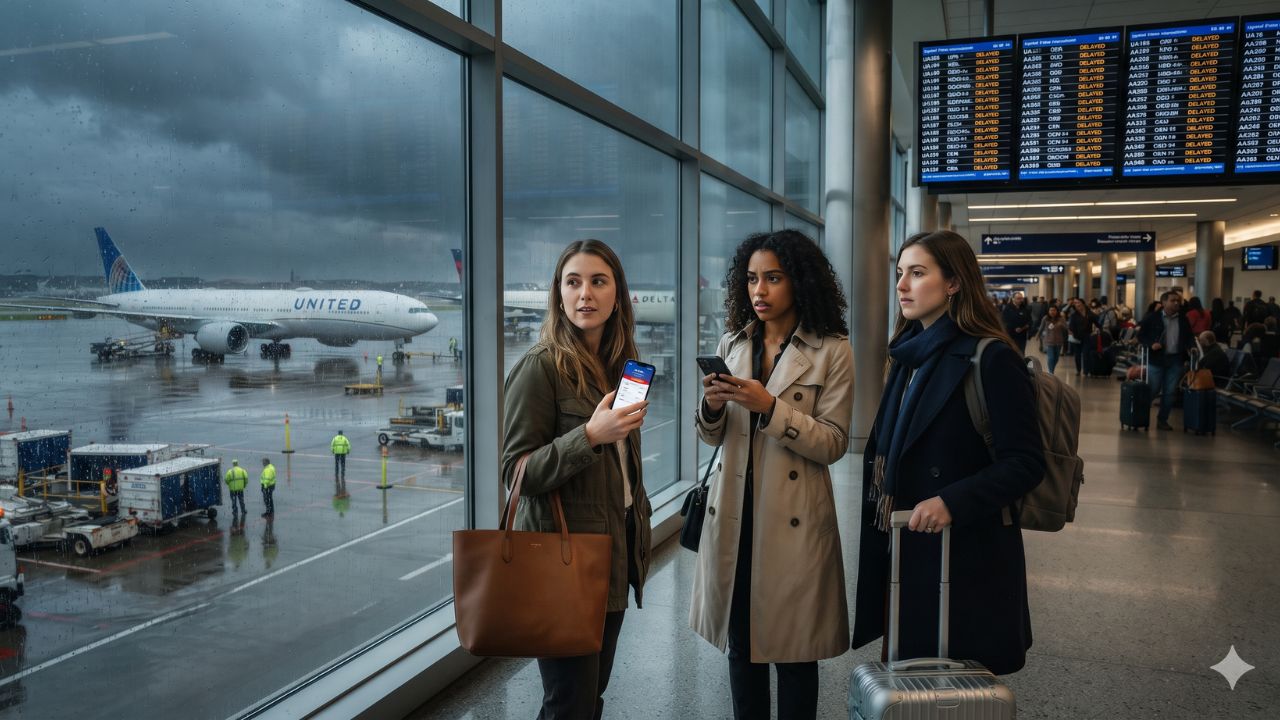
A dry, cloudless autumn sky in Manhattan does not guarantee on-time departures: surface crosswinds exceeding operational safety thresholds can slash runway acceptance rates by 40% across New York airspace without a single drop of rain. On Monday, 9 November 2026, the Federal Aviation Administration (FAA) issued a widespread aviation outlook identifying weather systems capable of slowing flight operations across several major transit hubs. Rather than announcing nationwide cancellations, the federal advisory warned that severe gusts across the Northeast, convective thunderstorm clusters in Central Texas, and marine cloud layers along the Pacific coast could trigger ground delay programs and arrival spacing protocols.
Gust Fronts and Low Ceilings: Tracking the November 9 Aviation Advisory
The core focus of the FAA Daily Air Traffic Report centers on the crowded air traffic corridors of the eastern seaboard. Gusty winds sweeping across Massachusetts, New York, New Jersey, Pennsylvania, Maryland, and the Washington metropolitan area threaten to compress arrival spacing and force single-runway operations at multi-runway facilities. Three primary New York metropolitan airfields—John F. Kennedy International Airport (JFK), LaGuardia Airport (LGA), and Newark Liberty International Airport (EWR)—are under close observation for surface-level shear and crosswind alignment.
Further north, Boston Logan International Airport faces coastal headwinds that complicate standard approach paths over Massachusetts Bay, while Philadelphia International Airport contends with shifting wind directions along the Delaware Valley. Surrounding the capital, Ronald Reagan Washington National Airport, Washington Dulles International Airport, and Baltimore/Washington International Thurgood Marshall Airport are adjusting ground operations to prevent ramp bottlenecks. Concurrently, southern weather patterns present isolated convective disruptions: thunderstorms and low cloud decks around Austin and San Antonio in Texas threaten localized holding patterns, while morning marine layer cloud ceilings in San Diego and San Francisco reduce visual approach clearances.
Regional Airport Weather Conditions and Operational Risks (9 November 2026)
The table below outlines the specific meteorological challenges identified by federal monitors across active US commercial aviation sectors:
| Airport Facility & IATA Code | Geographic Region | Primary Meteorological Trigger | Expected Operational Impact |
|---|---|---|---|
| JFK, LGA, Newark (EWR) | New York Metro | High sustained winds & gusts | Reduced departure rates, gate hold programs |
| Boston Logan (BOS) | New England | Coastal crosswinds | Modified approach vectors, ground spacing |
| Philadelphia (PHL) | Mid-Atlantic | Surface gusts & wind shifts | Arrival throttling, connection compression |
| Reagan (DCA), Dulles (IAD), Baltimore (BWI) | Washington Metro | Strong regional wind currents | Variable departure sequencing, taxiway queues |
| Austin (AUS), San Antonio (SAT) | Central Texas | Thunderstorms & low cloud ceilings | En-route tactical deviations, apron lightning holds |
| San Francisco (SFO), San Diego (SAN) | California Coast | Low marine cloud cover | Instrument flight rule (IFR) approach spacing |
What Makes This Weather Pattern Different Across US Gateways
What sets autumn aviation delays apart from winter blizzards is how invisible atmospheric friction ripples across separate regions. In the Northeast, airports like LaGuardia and Washington Reagan operate on compact footprints with intersecting runways. When winds exceed crosswind limits on secondary strips, air traffic controllers must funnel both arrivals and departures onto a single strip. This immediately halves an airport's hourly movements, creating multi-hour ground delays even when weather at your destination remains fair.
In Texas, convective storms around Austin and San Antonio require aircraft to route around towering storm cells, eating up fuel reserves and straining regional sector control centers. Meanwhile, on the Pacific coast, San Francisco's notorious closely spaced parallel runways cannot handle simultaneous visual landings when marine cloud layers drop below visual minimums. Real-time air navigation data from FAA Airspace Status and meteorological telemetry published by the National Weather Service demonstrate that these distinct localized phenomena can trigger downstream aircraft rotation delays thousands of miles away.
Visitor Insider Tips: Navigating Terminal Delays and Rail Alternatives
Experienced travelers heading through affected corridors on 9 November 2026 can deploy local workarounds to bypass terminal gridlock:
- Pivot to the Northeast Corridor Rail Line: If you are booked on short regional flights between Boston, New York, Philadelphia, Baltimore, or Washington, DC, consider shifting to Amtrak's Acela or Northeast Regional trains. Rail links operate unaffected by high-altitude crosswinds, delivering you directly into city centers like Moynihan Train Hall or Washington Union Station while avoiding hours of tarmac confinement.
- Monitor Inbound Aircraft Registration: Instead of checking only your scheduled flight number, track the physical aircraft's tail number on tracking applications. If the Boeing 737 assigned to fly you from Austin to Chicago is originating in San Antonio where active convective cells exist, your departure will slide regardless of local gate conditions.
- Neighborhood Escapes Outside Terminals: If caught in an extended ground hold at JFK, skip the crowded concourse gates and take the AirTrain to the historic TWA Hotel to rest in a mid-century quiet room. At San Diego International Airport, a quick ten-minute cab ride puts you in the pedestrian-friendly streets of Little Italy for espresso and fresh pasta until gate boarding commences.
- Strategic Airline App Rebooking: When the FAA activates ground delay programs, major carriers issue automated travel waivers. Do not wait in customer service queues with hundreds of passengers; use the carrier's mobile application to switch to morning flights the following day or reroute through untroubled southern hubs without paying fare differentials.
Cultural and Environmental Context: Seasonal Meteorology and Passenger Protections
Autumn marks a transition window across North America, where Canadian cold fronts collide with warm moisture from the Gulf of Mexico, generating steep pressure gradients across the eastern seaboard. While extreme weather tests modern transportation grids, US Department of Transportation regulations require commercial airlines to adhere to strict tarmac-delay rules, mandating that domestic passengers receive water, snacks, and the opportunity to deplane if tarmac holds exceed three hours.
Environmental adaptation remains a growing focus for American airports cataloged on the Official US Tourism Guide. Modern terminal redesigns, such as the newly redeveloped terminals at LaGuardia and Newark, incorporate sustainable indoor climate management, advanced runway drainage, and satellite ground tracking to reduce aircraft taxi emissions during delay sequencing. Supporting sensible travel planning during transition months ensures that regional economies sustain tourism flows while respecting aviation safety limits.
FAQ: Navigating US Autumn Flight Disruptions 2026
Has the FAA closed any major airports on 9 November 2026? No, the FAA advisory is a planning outlook identifying potential arrival delays and spacing adjustments, not an announcement of airport closures or national flight suspensions.
What should I do if my flight out of New York or Boston is delayed? Check your airline's app for flight-specific status and explore whether travel waivers permit rebooking onto Amtrak rail services or alternate morning departures free of charge.
Why do low clouds cause delays in San Francisco and San Diego? Low cloud ceilings prevent pilots from conducting simultaneous visual approaches on parallel runways, forcing air traffic control to increase longitudinal separation between landing aircraft.
Are airlines required to provide hotel vouchers for wind-related delays? Because high winds and low visibility are classified as weather-related events outside carrier control, airlines are generally exempt from mandatory hotel compensation under standard consumer rules.
Understanding how seasonal wind currents and coastal clouds govern air traffic ensures you spend your travel days discovering great destinations rather than waiting helplessly at departure gates.
This article is for informational purposes. Flight routes, passenger regulations, visa rules, and transit advisories are subject to change by airlines and aviation authorities. Readers are advised to verify schedules and travel documentation with relevant carriers and border agencies before departure.
Related Stories

US Halloween 2026 Weather Alert: Texas, California, and Northwest Face Major Travel Disruptions
Asia Air Travel Disrupted: 304 Cancellations and 3,643 Delays Hit Jakarta, KL, and Mumbai