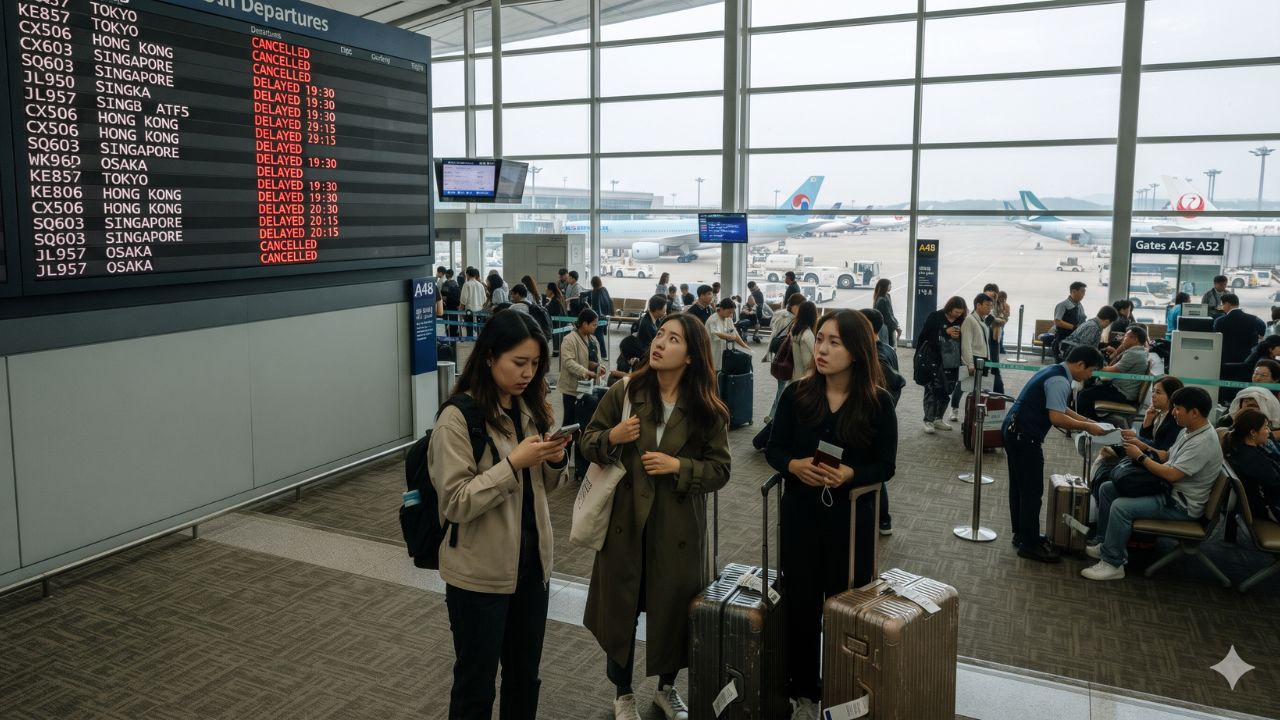
Asia Air Travel Disrupted: 304 Cancellations and 3,643 Delays Hit Jakarta, KL, and Mumbai


Even when a severe tropical cyclone sits more than 1,400 kilometers away over open water, its barometric wake can pull seasonal monsoon currents into regional flight corridors, turning clear transit schedules into multi-hour holding patterns across Southeast Asia. On 9 and 10 November 2026, aviation networks across China, India, Indonesia, Malaysia, the Philippines, and the Middle East recorded a combined 304 flight cancellations and 3,643 delays. What began as localized weather challenges—including gale-force northeast monsoon squalls across the Philippines, persistent afternoon thunderstorms over the Malacca Strait, and five-kilometer hazy visibility in Java—rapidly multiplied through tight international aircraft turnarounds into system-wide transit congestion.
Monsoon Fronts and Low Visibility: Tracking the Asian Aviation Squeeze
Aviation monitoring records captured on 9 November at 3:05 pm ET (10 November at 3:05:30 pm Jakarta time) revealed that flight disruptions were distributed widely across primary transit hubs rather than isolated to a single country. Kuala Lumpur International Airport experienced the heaviest schedule slippage in the region, registering 316 delayed flights alongside three cancellations. Jakarta’s Soekarno-Hatta Airport followed with 227 delays and 11 cancellations, influenced by atmospheric haze and surface visibility hovering near five kilometers as confirmed by Indonesia’s meteorology agency BMKG.
In the Philippines, the Atmospheric, Geophysical and Astronomical Services Administration (PAGASA) confirmed that Typhoon Samuel (internationally designated Cempaka) had moved outside the Philippine Area of Responsibility, positioned approximately 1,410 kilometers east-northeast of extreme northern Luzon. However, the accompanying northeast monsoon unleashed strong to gale-force gusts across Luzon and the Visayas on 10–11 November, adding operational friction to Manila’s Ninoy Aquino International Airport, which posted 195 delays and seven cancellations.
Across South Asia and the Gulf, similar patterns emerged. Mumbai’s Chhatrapati Shivaji Maharaj International Airport reported 19 cancellations—the highest cancellation total among all tracked airports—along with 160 delayed services. Delhi’s Indira Gandhi International Airport recorded 196 delays and 16 cancellations, while Dubai International logged 209 delays and five cancellations, and Saudi Arabia’s King Abdulaziz International Airport in Jeddah posted 191 delays and 17 cancellations.
Regional Flight Disruptions and Airport Performance (10 November 2026)
The schedule below details operational delays and cancellations recorded across major commercial hubs during the peak disruption window:
| Airport Facility & Location | Scheduled Delays | Cancellations Recorded | Primary Operational Challenge |
|---|---|---|---|
| Kuala Lumpur International (KUL) | 316 flights | 3 flights | Convective thunderstorms & apron queues |
| Jakarta Soekarno-Hatta (CGK) | 227 flights | 11 flights | 5 km haze visibility & gusty surface winds |
| Dubai International (DXB) | 209 flights | 5 flights | Flow control spacing & late inbound aircraft |
| Delhi Indira Gandhi (DEL) | 196 flights | 16 flights | Airspace congestion & seasonal weather |
| Manila Ninoy Aquino (MNL) | 195 flights | 7 flights | Northeast monsoon squalls & runway slots |
| Jeddah King Abdulaziz (JED) | 191 flights | 17 flights | Regional arrival sequencing & schedule compression |
| Shanghai Pudong (PVG) | 187 flights | 5 flights | Coastal wind conditions & slot holds |
| Guangzhou Baiyun (CAN) | 164 flights | 3 flights | Southern regional flow control |
| Mumbai Shivaji Maharaj (BOM) | 160 flights | 19 flights | High ground turnaround delays & cancellations |
| Shenzhen Baoan (SZX) | 148 flights | 4 flights | Pearl River Delta airway congestion |
| Beijing Daxing (PKX) | 103 flights | 17 flights | Crosswind alignments & aircraft rotations |
| Shanghai Hongqiao (SHA) | 94 flights | 6 flights | Domestic trunk route cascading delays |
| Kunming Changshui (KMG) | 76 flights | 8 flights | High-altitude approach spacing |
| Beijing Capital (PEK) | 59 flights | 7 flights | Northern airway pacing & sequencing |
| Chengdu Tianfu (TFU) | 57 flights | 5 flights | Western transit routing delays |
| Xi'an Xianyang (XIY) | 57 flights | 5 flights | Domestic flight bank adjustments |
| Bengaluru Kempegowda (BLR) | 56 flights | 14 flights | Domestic network knock-on cancellations |
| Cochin International (COK) | 25 flights | 8 flights | Regional feeder service delays |
| Pune Airport (PNQ) | 20 flights | 8 flights | Military-civilian runway slot limitations |
| Bagdogra Airport (IXB) | 10 flights | 6 flights | Foothill weather & visual limitations |
| Gorakhpur Airport (GOP) | 4 flights | 5 flights | Northern feeder route cancellations |
Airlines felt the strain unevenly across their fleets. China Eastern logged 235 delays (10% of operations) and 30 cancellations (1%), representing the highest raw delay count among carriers. In India, regional low-cost operators absorbed heavy operational hits: Akasa Air canceled 35 flights (14%) with 30 delays (12%), while SpiceJet posted 32 cancellations (27%) and 28 delays (23%). US-Bangla Airlines faced an acute operational delay rate of 62%, impacting 57 flights with four cancellations. Meanwhile, Japan Airlines recorded 175 delays representing 22% of its daily departures, while holding cancellations to just a single flight.
What Makes Asian Air Corridor Cascades Geographically Distinct
The geography of Asian aviation differs fundamentally from North American or European networks. Long distances between island archipelagos and peninsula nations mean air corridors are concentrated over narrow oceanic flight paths. When seasonal pressure systems sweep across the South China Sea or the Bay of Bengal, aircraft must navigate around active convective cells within narrow international corridors governed by separate sovereign flight information regions.
Furthermore, domestic carriers in India and China operate aircraft on intensive multi-leg rotations, sending a single narrowbody jet through four or five provincial destinations in a single day. A 45-minute delay caused by morning haze in Jakarta or wind shear in Manila accumulates through the afternoon, turning into late evening cancellations at spoke airports like Bagdogra, Cochin, or Gorakhpur where regional airfields lack 24-hour instrument landing support.
Visitor Insider Tips: Navigating Asian Transit Hubs and Layover Logistics
Travelers moving through affected Asian capitals during mid-November weather transitions can use these field-tested tactics to protect their travel plans:
- Pad International Connections in Kuala Lumpur and Jakarta: If your journey involves transferring between Terminal 1 and Terminal 2 at KLIA, allow at least four hours between flights. Terminal transit trains and baggage handling experience significant delays when afternoon rainstorms force temporary ground groundings. At Soekarno-Hatta in Jakarta, utilize the free automated Skytrain between Terminals 1, 2, and 3, but maintain verified offline tickets to pass terminal security checks quickly.
- Avoid Same-Day Separate-Ticket Bookings: In India, where airlines like SpiceJet and Akasa Air experienced cancellation rates between 14% and 27%, avoid booking onward regional hops on separate tickets immediately following international flights. If your long-haul flight arrives into Delhi or Mumbai behind schedule, an unlinked domestic ticket will not be refunded or rebooked automatically.
- Explore Rail Alternatives for Chinese Trunk Routes: If your flight between Shanghai Hongqiao and Beijing Capital or Beijing Daxing is delayed by several hours, switch to China's high-speed railway from Shanghai Hongqiao Railway Station. The Fuxing bullet train covers the 1,318-kilometer corridor to Beijing South in just four hours and 18 minutes, remaining immune to coastal wind advisories.
- Retain Printed Gate Boarding Verification: In airports across the Philippines and Indonesia, gate agents issue physical delay stamps or written delay certificates upon request. Having this documentation stamped at the service counter is essential when submitting travel insurance claims for meals or emergency accommodation.
Cultural and Environmental Context: Seasonal Winds, Smog Layers, and Passenger Rights
November marks the onset of the Northeast Monsoon (Amihan) across Southeast Asia and the arrival of winter temperature inversions across the Indo-Gangetic Plain. While travelers experience these shifts as flight board revisions, they represent vital seasonal markers for rural communities whose agricultural cycles depend on seasonal wind shifts and monsoon precipitation. Conserving heritage landscapes—from the terraced paddy cultures documented under UNESCO World Heritage across the Philippines and Indonesia to fragile coastal mangrove zones—requires airlines to manage flight paths responsibly without creating unnecessary low-altitude emissions over populated deltas.
Consumer rights during irregular operations vary widely across Asian jurisdictions. Under Directorate General of Civil Aviation (DGCA) guidelines in India, passengers facing cancellations announced less than 24 hours before departure are entitled to alternate flights or full refunds, along with meals for extended delays. In Southeast Asia, carrier liabilities depend heavily on fare conditions and whether delays stem from meteorological forces beyond airline control. Keeping independent travel insurance active ensures travelers stay protected when regional weather systems test the limits of airport infrastructure.
FAQ: Navigating Asian Flight Delays 2026
Which airport recorded the highest number of flight delays during this period? Kuala Lumpur International Airport recorded 316 delays, making it the most delayed airport in the regional dataset, followed by Jakarta Soekarno-Hatta with 227 delayed departures.
Did Typhoon Samuel directly strike the Philippines on 9–10 November? No, Typhoon Samuel (Cempaka) remained approximately 1,410 kilometers east-northeast of northern Luzon and exited the Philippine monitoring zone, though the active northeast monsoon generated gale-force winds across Luzon and the Visayas.
What airline had the highest percentage of flight delays? US-Bangla Airlines reported the highest delay rate at 62% across 57 flights, while Japan Airlines delayed 22% of its operations (175 flights) despite suffering only one cancellation.
Can passengers claim cash compensation for monsoon-related flight delays? Most Asian aviation regulators classify extreme monsoon gusts, lightning, and atmospheric haze as uncontrollable meteorological events, meaning airlines must offer rebooking or ticket refunds rather than statutory cash compensation.
Adapting to the seasonal rhythms of Asian weather turns unexpected travel delays into opportunities to discover the patience, resilience, and hospitality that define this vast region.
This article is for informational purposes. Flight routes, passenger regulations, visa rules, and transit advisories are subject to change by airlines and aviation authorities. Readers are advised to verify schedules and travel documentation with relevant carriers and border agencies before departure.
Related Stories

FAA Flags Major US Airports for Weather Delays: East Coast, Texas, and California Travel Guide
Spain Faces 72-Hour Transport Crisis: Rail and Flight Disruptions as November Strikes Impact Madrid and Barcelona