
Tallinn Tops Europe's Calmcation Travel Rankings for 2026, Leading Zurich, Tartu, Trondheim, and Vilnius as Stress-Free Destinations Beat Overcrowded Hotspots — While Naples, Antwerp, and Bucharest Rank Lowest: New Update
A comprehensive analysis of nearly 70 European cities has ranked Tallinn, Estonia, as Europe's top calmcation destination for 2026 — leading Zurich, Switzerland; Tartu, Estonia; Trondheim, Norway; and Vilnius, Lithuania — based on factors including noise pollution levels, air quality, safety standards, walkability, and green space access, as the growing calmcation travel trend reshapes how millions of travelers choose their European holiday destinations.

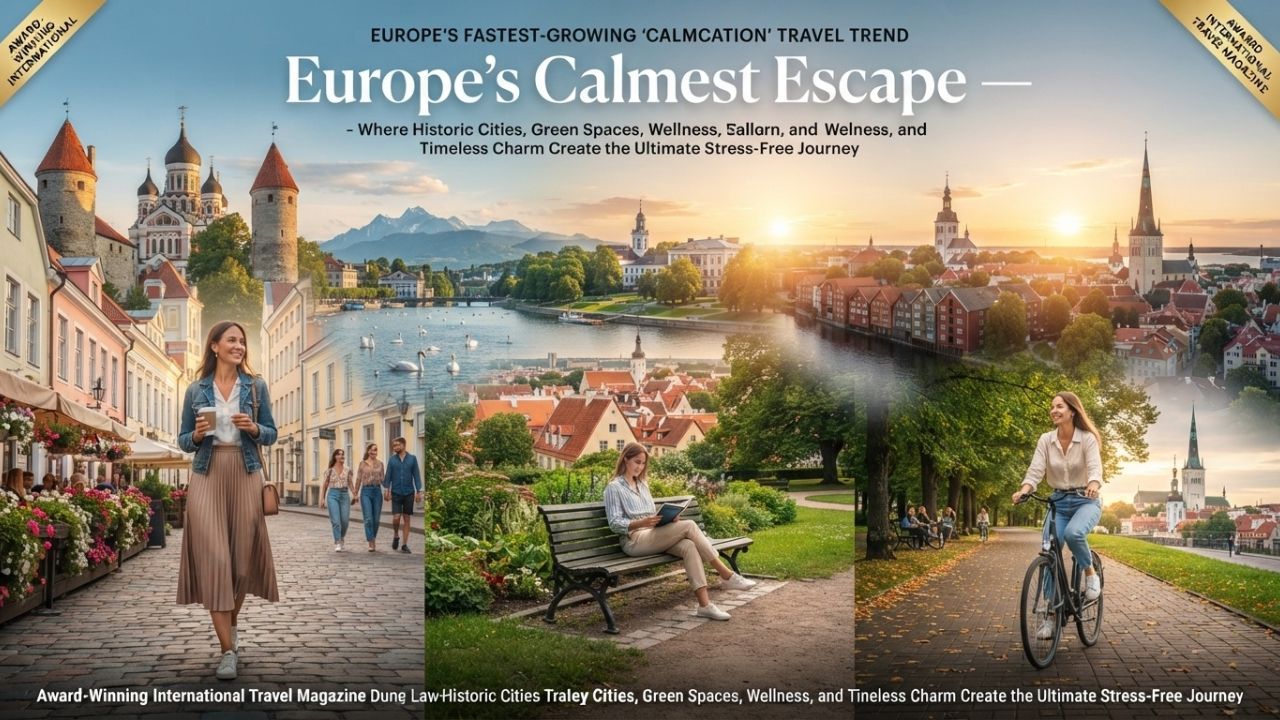
Image generated by AI
Published on July 28, 2026
A detailed ranking of nearly 70 European cities has placed Tallinn, Estonia, at the top of Europe's most peaceful urban destinations for 2026 — making it the continent's leading calmcation destination ahead of Zurich (Switzerland), Tartu (Estonia), Trondheim (Norway), and Vilnius (Lithuania) — while Naples, Antwerp, and Bucharest ranked among the more stressful destinations in the analysis. The study evaluated cities across key wellness and urban comfort metrics including noise pollution, air quality, safety standards, walkability, and access to green spaces, reflecting the rapid growth of the calmcation travel trend — a movement that is fundamentally shifting how travelers prioritize their European holiday choices away from overcrowded headline capitals and toward quieter cities that support genuine rest, cultural discovery, and personal wellbeing. For travelers planning European trips in 2026, the calmcation rankings provide a practical evidence-based framework for identifying destinations that can deliver the genuinely restorative travel experience that growing numbers of global visitors are actively seeking.
Quick Summary
- Top Calmcation Destination: Tallinn, Estonia ranks first among nearly 70 European cities analyzed for peaceful, stress-free travel in 2026.
- Top 5 Peaceful Cities: Tallinn (Estonia), Zurich (Switzerland), Tartu (Estonia), Trondheim (Norway), Vilnius (Lithuania)
- Ranking Criteria: Cities evaluated on noise pollution, air quality, safety, walkability, and green space access
- Lower-Ranked Cities: Naples, Antwerp, and Bucharest ranked lower in the analysis; Athens, Marseille, and Milan also scored lower on calmcation metrics
- Why It Matters: The calmcation trend is driving travelers toward fewer, more deeply experienced destinations that prioritize wellbeing and authentic cultural connection over high-volume landmark tourism
The way travelers make destination decisions is undergoing one of its most significant structural shifts in modern tourism history. For decades, the dominant logic of European travel prioritized maximum coverage — as many cities, as many landmarks, and as many photographs as possible within a fixed number of days. In 2026, that logic is being actively rejected by a growing and influential traveler segment that has concluded that rushed, crowded, exhausting holidays are defeating the purpose of travel itself. The calmcation trend is the name the travel industry has given to the alternative: a deliberate choice to select destinations based on their capacity to restore rather than merely entertain, to allow slower exploration rather than enforcing relentless transit, and to support wellbeing as actively as they support sightseeing.
Calmcation Europe 2026: The Full Ranking and What It Reveals
The analysis evaluated nearly 70 European cities across a set of criteria specifically chosen to measure the factors that determine whether a destination feels genuinely calm and restorative rather than merely visually impressive or historically significant.
Evaluation Criteria:
- Noise pollution levels — lower urban noise correlates directly with visitor relaxation and recovery
- Air quality — cleaner environments support both physical health and the psychological sense of refreshment that travelers seek
- Safety standards — personal security allows visitors to explore freely without anxiety
- Walkability — compact, pedestrian-accessible cities reduce transport stress and encourage slow discovery
- Access to green spaces — parks, nature areas, and outdoor environments support mental wellbeing
The Top 5 Calmcation Destinations in Europe for 2026:
- Tallinn, Estonia — ranked first overall
- Zurich, Switzerland
- Tartu, Estonia
- Trondheim, Norway
- Vilnius, Lithuania
Cities Ranking Lower in Calmcation Metrics:
- Naples, Italy — ranked as one of Europe's most stressful urban destinations
- Antwerp, Belgium — ranked lower among the analyzed cities
- Bucharest, Romania — also ranked lower in the analysis
- Athens, Marseille, and Milan — noted as cities that continue to attract travelers for culture, history, and attractions but score lower on calmcation-specific metrics
Why Tallinn, Estonia, Leads Europe's Calmcation Rankings
Tallinn has achieved something genuinely unusual for a European capital: it has become one of the continent's most internationally recognized tourist destinations while simultaneously maintaining the low noise levels, clean air, strong safety standards, and walkable historic character that increasingly rare combination of factors delivers in a calmcation context.
The city's famous medieval Old Town — one of the best-preserved in all of Europe — provides the cultural and architectural depth that international travelers expect from a European capital, but delivers it through a compact, pedestrian-scale environment that visitors can navigate on foot without the transport stress that defines the experience in larger capitals. The historic district's cobblestone streets, Gothic spires, and layered centuries of architectural history can be explored entirely without the need for extensive public transport use.
Tallinn's relatively low noise pollution and cleaner air distinguish it meaningfully from western European capitals of comparable cultural significance. The absence of the constant traffic noise and urban ambient pressure that characterizes Paris, Rome, or Barcelona creates an environment where the experience of simply being in the city — sitting in a café, walking along the city wall, or exploring a quiet neighborhood — feels genuinely peaceful rather than performatively relaxing.
Safety is another key contributor to Tallinn's calmcation ranking. Visitors consistently report a high degree of personal security comfort throughout the city, including in the historic center and surrounding neighborhoods, which directly affects whether travelers feel able to move freely and spontaneously — a prerequisite for the unhurried exploration that calmcation travel requires.
The city's compact layout is perhaps its most practically important calmcation attribute. The walkable distance between Tallinn's major attractions, neighborhoods, café clusters, and green spaces means that travelers can genuinely slow down without experiencing the logistical frustration of needing to connect between distant sites — an experience that frequently undermines calm travel intentions in larger European cities.
The Full Calmcation Destination Profiles: Zurich, Tartu, Trondheim, and Vilnius
Zurich, Switzerland — Second Place
Zurich secured the second position in the calmcation ranking through a combination of excellent walkability, attractive and well-maintained public spaces, and strong access to natural environments that give the city one of Europe's most consistently comfortable urban visitor experiences. The Swiss city provides easy pedestrian access to green areas alongside a thoughtfully organized urban infrastructure that keeps noise levels meaningfully lower than many larger European capitals.
The analysis acknowledges that Zurich experiences some challenges typical of major international cities, but notes that its organized infrastructure and lower noise levels sustain a peaceful atmosphere that wellness-focused travelers find distinctly more restorative than comparable cities in the top tier of European tourism.
Tartu, Estonia — Third Place
Tartu ranked third — reflecting not just Estonia's broader advantage in urban calm, but this specific city's distinctively relaxed character as a university town. The academic community gives Tartu a rhythmic unhurried quality that allows visitors to experience the city's cultural attractions without the intensity of a major tourist hub. Its quiet surroundings and manageable visitor volumes make it one of the most genuinely peaceful urban environments in the analysis.
Trondheim, Norway — Fourth Place
Trondheim performed strongly on the strength of its parks and natural landscapes and its consistent reputation as a safe destination. The Norwegian city offers travelers the specific combination that calmcation visitors find most valuable: urban cultural discovery supported by outdoor relaxation — the ability to move between historic architecture and riverfront parks, or between cathedral visits and forest-edge walking routes, within the same afternoon.
Vilnius, Lithuania — Fifth Place
Vilnius completes the top five through a combination of green urban spaces, peaceful residential streets, and a comfortable visitor environment that allows travelers to experience one of Europe's most historically layered small capitals at a genuinely slower pace. The Lithuanian capital's baroque architecture, bohemian neighborhoods, and café culture are all accessible within a walkable compact city that rewards extended wandering over rapid attraction coverage.
Lower-Ranked Cities: What the Data Says About More Stressful European Destinations
The analysis identified several cities where the combination of urban congestion, noise levels, crowded attractions, and high visitor density creates conditions less suited to calmcation-style travel:
- Naples, Italy: Ranked as one of Europe's most stressful urban destinations. The analysis acknowledges Naples' extraordinary cultural significance — its world-famous cuisine, archaeological heritage, and historic neighborhoods remain among Europe's most compelling tourism draws — but notes that busy streets and urban pressure affect the overall visitor experience in ways that directly conflict with calmcation priorities.
- Antwerp, Belgium: Ranked lower in the calmcation analysis relative to the leading destinations.
- Bucharest, Romania: Also positioned lower in the calmcation rankings.
- Athens, Marseille, and Milan: All three cities continue to attract travelers in large numbers for their cultural richness, history, and food scenes — but score lower on the specific metrics of noise, calm, and stress-free exploration that define the calmcation framework.
Critically, the analysis is not a recommendation to avoid these destinations. All of them offer genuine and valuable travel experiences. The ranking instead highlights the growing distinction between traditional sightseeing-focused travel and the emerging calmcation category — and enables travelers to make more informed choices based on their specific holiday priorities.
Practical Traveler Advice: Planning a Calmcation Trip to Europe's Peaceful Cities
Travelers interested in incorporating calmcation principles into their 2026 European travel should follow these practical steps:
- Prioritize fewer destinations, more time. The calmcation approach only delivers its full benefit when travelers allow sufficient time in each destination to truly slow down — a minimum of three nights per city allows for unhurried exploration that a two-night city-hopping itinerary cannot replicate.
- Choose centrally located or Old Town accommodation in Tallinn. Staying within or immediately adjacent to Tallinn's medieval Old Town eliminates transport needs entirely for most day-to-day exploration — the walkability advantage of the destination is maximized by accommodation placement.
- Visit Tartu alongside Tallinn for an Estonian dual-city calmcation itinerary. Both cities rank in the top three, and the road or bus journey between Tallinn and Tartu is approximately two to two and a half hours — making a combined Estonian itinerary genuinely practical for travelers with a week or more.
- Use green spaces deliberately, not incidentally. Calmcation destinations like Trondheim and Zurich are ranked specifically for their green space access — build park time, riverside walks, and nature outings explicitly into your itinerary rather than treating them as optional extras.
- Avoid peak tourist season crowd times even in calm cities. While Tallinn and Vilnius are significantly less crowded than major European capitals, their historic centers do see meaningful visitor volumes during peak summer weekends — mid-week days and early morning exploration preserve the calm atmosphere that makes these destinations rank so highly.
- Walk rather than use ride-hailing or taxis within the city center. The calmcation cities in this ranking are selected partly for walkability — using transport unnecessarily removes one of the key factors that makes these destinations peaceful.
- Plan meals at locally run restaurants off the main tourist streets. Even in calm cities, the streets immediately adjacent to major attractions can feel pressured. Moving one or two streets deeper into residential neighborhoods consistently reveals quieter, more authentic dining at better value.
What to Expect Next: The Calmcation Trend's Influence on European Tourism
The calmcation movement is expected to continue strengthening as a market force through the remainder of 2026 and into subsequent years. Tourism authorities in Estonia, Norway, and Lithuania — whose cities perform strongly in the calmcation framework — are increasingly aware of their competitive advantage in the wellness travel segment and are likely to begin active marketing around these credentials.
Future tourism growth may disproportionately benefit destinations that provide a balance between cultural discovery and genuine relaxation. Cities with cleaner environments, accessible natural areas, safer streets, and slower-paced lifestyles are positioned to attract a growing share of international travel spending as the global traveler base continues to shift toward wellbeing-first holiday planning.
For larger European cities that rank lower on calmcation metrics — including Naples, Athens, and Milan — the data serves as useful intelligence about traveler expectations in this emerging segment. The response for these cities need not be to change their fundamental character but rather to identify and promote their quieter neighborhoods, less-crowded time periods, and off-peak visitor experiences that can serve calmcation-inclined visitors without requiring the cities to abandon what makes them globally significant destinations.
The calmcation trend is not a rejection of European travel — it is an evolution of it, pointing toward a style of exploration that is slower, more intentional, and ultimately more genuinely restorative than the high-speed, high-volume itineraries that have dominated international tourism for decades. Travelers who plan their 2026 European journeys around the destinations that ranked highest in this nearly 70-city analysis — leading with Tallinn, Zurich, Tartu, Trondheim, and Vilnius — will arrive home with more than photographs: they will return with the rare and increasingly valuable feeling of having actually rested.
FAQ: Calmcation Travel Trend and Europe's Most Peaceful Cities 2026
What is the calmcation travel trend?
The calmcation trend is a growing travel movement that prioritizes choosing holiday destinations based on their capacity to provide genuine rest, relaxation, and wellbeing — evaluating cities on factors such as noise levels, air quality, safety, walkability, and green space access rather than selecting destinations purely based on famous landmarks or popularity.
Which city ranked first in Europe's calmcation destinations for 2026?
Tallinn, Estonia ranked first in the analysis of nearly 70 European cities, recognized for its low noise pollution, cleaner air, strong safety standards, compact walkable layout, and medieval historic character — a combination that makes it Europe's leading destination for stress-free urban travel in 2026.
What are the top 5 calmcation cities in Europe for 2026?
Based on the comprehensive European city analysis, the top five calmcation destinations are: 1. Tallinn (Estonia), 2. Zurich (Switzerland), 3. Tartu (Estonia), 4. Trondheim (Norway), 5. Vilnius (Lithuania).
Which European cities ranked lower in calmcation metrics?
Naples ranked as one of Europe's most stressful destinations in the analysis. Antwerp and Bucharest also ranked lower, while Athens, Marseille, and Milan — though highly popular for culture and history — scored lower on the specific calmcation factors of noise, walkability, and green space access.
Can a calmcation destination still be culturally rich?
Yes — the top calmcation cities are not culturally sparse. Tallinn's medieval Old Town, Vilnius's baroque architecture, Zurich's museums and lakeside culture, and Trondheim's cathedral and historic harbor all provide substantial cultural depth. The distinction is that calmcation cities deliver cultural richness in an environment where the overall urban experience — pace, noise, crowd density, safety — is conducive to genuine rest rather than additional stress.
Suggested SEO Metadata & Assets
- Meta Title: Tallinn Europe's Top Calmcation City 2026 Rankings
- Meta Description: Tallinn tops Europe's calmcation rankings for 2026, leading Zurich, Tartu, Trondheim & Vilnius in a study of 70 cities. Naples, Antwerp & Bucharest rank lowest. Full update.
- URL Slug: tallinn-calmcation-europe-peaceful-cities-2026
- Tags:
Tallinn calmcation,Europe peaceful cities 2026,stress-free travel Europe,Zurich travel 2026,calmcation trend - Featured Image Alt Text: The medieval Old Town of Tallinn, Estonia, with colorful historic buildings, quiet cobblestone streets, and green parks representing Europe's top calmcation destination in 2026.
Related Travel Guides
Disclaimer
This article is for informational and educational purposes only. It does not constitute legal, financial, or professional advice. While we strive to provide accurate and up-to-date information, travel policies, regulations, and conditions change rapidly. Always verify information with official sources before making travel decisions. Nomad Lawyer makes no representations about the accuracy, reliability, completeness, or suitability of the information provided. Readers should consult qualified professionals for advice specific to their circumstances. The views expressed in this article are those of the author and do not necessarily reflect the views of Nomad Lawyer.
Kunal K Choudhary
Co-Founder & Contributor
A passionate traveller and tech enthusiast. Kunal contributes to the vision and growth of Nomad Lawyer, bringing fresh perspectives and driving the community forward.
Learn more about our team →