Spain Faces 72-Hour Transport Crisis: Rail and Flight Disruptions as November Strikes Impact Madrid and Barcelona

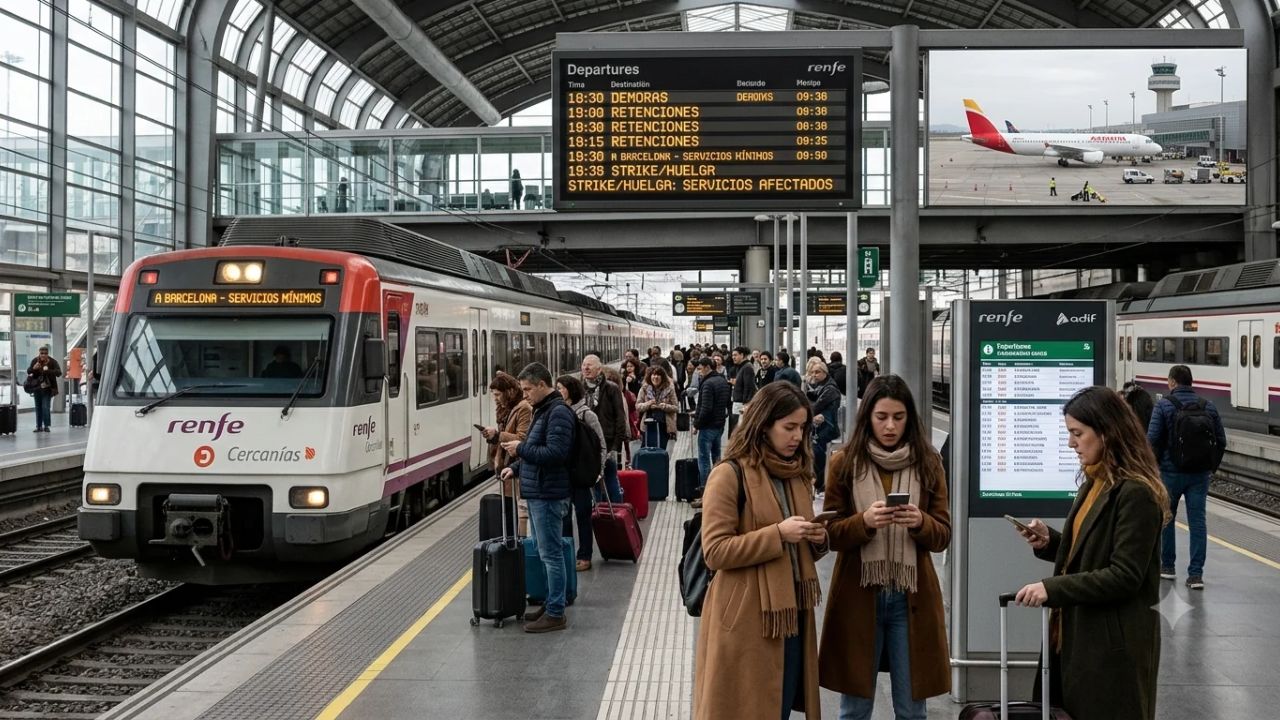
MADRID, Spain — Travelers across Spain face a challenging 72-hour rolling transport crisis from Tuesday, 10 November, through Thursday, 12 November 2026, as overlapping railway walkouts and a 24-hour nationwide general strike disrupt aviation, high-speed rail, commuter networks, and metropolitan transit. The multi-layered labor dispute began on Tuesday with industrial action called by the Spanish train drivers' union SEMAF (Sindicato Español de Maquinistas Ferroviarios), sharply curbing commuter and regional services across Catalonia. The disruption escalates on Wednesday, 11 November, when a nationwide general strike called by major labor unions brings sweeping reductions to public and private sector operations, before concluding on Thursday with a second wave of railway walkouts.
With state transport authorities and regional governments enforcing emergency minimum-service mandates (servicios mínimos), domestic and international passengers face significant timetable reductions, cancelled services, diverted airport bus corridors, and altered cultural events. Major carriers including Iberia and high-speed rail operator iryo have activated emergency rebooking frameworks, while airport managers and passenger rights advocates urge travelers to prepare for multi-modal travel delays across Madrid, Barcelona, Valencia, and regional transit hubs.
SPAIN 72-HOUR TRANSPORT CRISIS TIMELINE & SCOPE
| Column 1 |
|---|
| TUESDAY, 10 NOVEMBER 2026: SEMAF Train Drivers' Strike (Catalonia Focus) |
| * Rodalies Commuter & Regional Rail: 66% Service Peak (06:00-09:30, 17:00-20:30); 33% Off-Peak |
| * Primary Driver: Union dispute over stalled rail safety protocols and staffing pacts |
| WEDNESDAY, 11 NOVEMBER 2026: 24-Hour Nationwide General Strike (All Sectors) |
| * Renfe Cercanías (Nationwide): 75% Peak (06:00-09:00, 13:30-15:30, 18:30-20:30); 50% Off-Peak |
| * Renfe High-Speed (AVE / Avlo / Long-Distance): 73% Guaranteed; Medium-Distance: 65% Guaranteed |
| * iryo High-Speed Rail: 32 of 44 Scheduled Services Guaranteed; 12 Unguaranteed |
| * Barcelona Urban Transit: 25% Peak (06:30-09:30, 16:30-21:00); ZERO Service Off-Peak for Rodalies |
| * Barcelona Airport Bus (Aerobús): 50% Minimum Service Protected |
| * Madrid EMT Buses: 36 Urban Routes Diverted, Including Airport Express Line 203 |
| * Aviation Protections: Stratified Minimum Services (Balearic/Canary Protected; Domestic Mainland Cut |
| THURSDAY, 12 NOVEMBER 2026: Second SEMAF Train Drivers' Strike |
| * Catalonia Rail Protections: 66% Peak (06:20-09:20); 33% Afternoon (14:20-17:20) & Night (21:20) |
Understanding the Three-Day Industrial Action Architecture
The transport disruption gripping Spain is particularly complex because it does not stem from a single unified dispute. Instead, it represents the collision of two separate industrial actions operating on overlapping schedules:
The first action is a targeted sectoral dispute organized by SEMAF, Spain's dominant railway drivers' union. SEMAF called 24-hour stoppages for Tuesday, 10 November, and Thursday, 12 November, pressing state railway administrator Adif and operator Renfe to implement railway safety measures and emergency operational agreements first negotiated in February 2026. The union asserts that multi-party working groups tasked with upgrading track safety, driver security, and technical inspection protocols have remained inactive since April.
The second action is a comprehensive 24-hour nationwide general strike (huelga general) scheduled for Wednesday, 11 November. Called by confederations of Spanish labor unions, this national walkout spans both public administration and private commerce. The strike centers on broader socio-economic grievances, including demands for substantial wage adjustments to offset inflation, improved workplace safety protections, and decisive government intervention in Spain's escalating housing affordability crisis.
When combined, these two disputes create three consecutive days of operational friction. A traveler arriving in Barcelona on Tuesday faces commuter rail delays; attempting to travel onward to Madrid or Seville on Wednesday encounters high-speed rail cuts, city center street demonstrations, and public bus diversions; and returning via regional rail on Thursday meets renewed driver walkouts.
REGULATORY SERVICE MANDATES BY OPERATOR & REGION
| Entity / Facility | Delays | Cancellations | Details |
|---|---|---|---|
| Transport Entity | Wednesday 11 Nov Peak Level | Designated Peak Hours | Off-Peak Service Level |
| Renfe Cercanías | 75% Protected | 06:00-09:00 / 13:30- | 50% Protected |
| (National Average) | 15:30 / 18:30-20:30 | ||
| Renfe Media Distancia | 65% Protected Throughout | All Operating Hours | 65% Protected |
| Renfe AVE / Larga D. | 73% Protected Throughout | All Operating Hours | 73% Protected |
| Rodalies de Catalunya | 25% Protected | 06:30-09:30 / 16:30- | 0% (NO SERVICE |
| (General Strike) | 21:00 | GUARANTEED OFF-PEAK) | |
| Barcelona Metro/TMB | 25% Protected | 06:30-09:30 / 16:30- | Discretionary Operator |
| Bus / Trams / FGC | 21:00 | Timetables Only | |
| Barcelona Aerobús | 50% Protected | 24-Hour Cycle | Min. 1 Full Return Run |
| Rail Freight (Adif) | 26% (11 Nov) / 20% (10/12) | Industrial Corridors | Essential Cargo Only |
Catalonia: Severe Rail Reductions and the Rodalies Blackout
Catalonia represents the focal point of ground transport disruption during this 72-hour period. Commuters and tourists relying on Rodalies de Catalunya—the commuter and regional network operated jointly under the supervision of the Generalitat de Catalunya and Renfe—face unprecedented timetable reductions.
On Tuesday, 10 November, the Department of Business and Labour of the Catalan Government established minimum operational levels of 66% during peak hours (06:00–09:30 and 17:00–20:30) and 33% during off-peak periods for the SEMAF drivers' strike. While these requirements ensured that two out of three rush-hour trains operated, regional branch lines connecting Barcelona with Girona, Tarragona, and the Costa Brava experienced extensive cancellations and platform overcrowding.
The situation tightens dramatically on Wednesday, 11 November. Under the regional government's official general strike resolution, urban and interurban passenger transport services across Catalonia are capped at a strict 25% minimum service level during designated peak windows: 06:30 to 09:30 in the morning and 16:30 to 21:00 in the evening.
Most importantly for travelers, Rodalies announced that it will operate strictly at the 25% threshold during peak hours and run zero scheduled services during off-peak periods. Between 09:30 and 16:30, and again after 21:00 on Wednesday, commuter train lines across Barcelona will effectively shut down. Tourists planning midday day-trips to coastal enclaves such as Sitges, mountain retreats like Montserrat, or regional destinations like Figueres will find suburban railway stations locked or deserted during off-peak hours.
The 25% peak mandate extends equally to the Transports Metropolitans de Barcelona (TMB) network, encompassing the Barcelona Metro, city buses, the Ferrocarrils de la Generalitat de Catalunya (FGC) suburban rail lines, and the city's surface tramways. With Metro trains running at roughly one-fourth their usual frequency during morning and evening rush hours, stations like Plaça de Catalunya, Passeig de Gràcia, and Sagrada Família face severe crowd control measures.
Airport connectivity between central Barcelona and Josep Tarradellas Barcelona-El Prat Airport (BCN) requires careful planning. While the regional government established a 50% minimum-service guarantee for the Aerobús express shuttle service between Plaça de Catalunya and Terminals 1 and 2, lines for boarding are expected to stretch significantly. Because the Rodalies R2 Nord train connecting central Barcelona with Terminal 2 will be completely suspended during off-peak hours, passengers must rely on the Metro Line 9 Sud (operating at 25% peak capacity) or licensed taxis, which are subject to union solidarity actions and traffic congestion.
High-Speed Rail: Renfe and iryo Corridor Guarantees
Spain's extensive high-speed railway network, linking Madrid with Barcelona, Valencia, Seville, and Malaga, faces substantial service contractions throughout Wednesday's general strike. Under legal determinations issued by the Ministry of Transport and Sustainable Mobility (Ministerio de Transportes y Movilidad Sostenible), high-speed passenger rail is recognized as an essential service, requiring operators to preserve a baseline schedule.
For Wednesday, Renfe confirmed that 73% of scheduled high-speed (AVE and low-cost Avlo) and long-distance (Larga Distancia) services are protected under mandatory minimum levels. For the drivers' actions on Tuesday and Thursday, the national high-speed guarantee stands at 72%. Renfe's conventional medium-distance network (Media Distancia) operates at 65% capacity nationwide.
However, a 73% guarantee means that more than one out of every four high-speed trains will not run. Renfe has contacted ticket holders whose trains are cancelled, offering automatic rebooking on adjacent departures or full refunds without administrative penalties.
Private high-speed open-access operator iryo published a detailed operational manifest for Wednesday, 11 November, illustrating the practical impact on popular trunk routes:
- Across its primary Madrid-Chamartín/Atocha to Barcelona-Sants and Madrid to Valencia-Joaquín Sorolla corridors, iryo scheduled 44 commercial passenger services.
- Of these, 32 trains are designated as legally guaranteed minimum services and will operate as scheduled.
- The remaining 12 services are classified as unguaranteed. While iryo continues efforts to staff these departures, passengers holding reservations on unguaranteed trains are being offered immediate rebooking options or full refunds through the carrier's digital channels.
Competitor Ouigo Spain is similarly adjusting operations within ministry guidelines. Travelers with high-speed bookings between Madrid and Barcelona should verify their train status using the official booking reference (localizador) before arriving at rail terminals, as standby seats on operating trains will be extremely scarce due to business traveler consolidation.
MADRID METROPOLITAN BUS ROUTE DIVERSION PROFILE
| Column 1 |
|---|
| AFFECTED OPERATOR: EMT Madrid (Empresa Municipal de Transportes) |
| IMPACTED ROUTES: 36 Urban Surface Bus Lines Intersecting Central Demonstration Corridors |
| PRIMARY TRAFFIC CLOSURES: |
| * Paseo del Prado (Between Atocha Railway Station and Plaza de Cibeles) |
| * Plaza de Cibeles & Calle de Alcalá (Government Ministry Axis) |
| * Gran Vía & Plaza de España (Commercial Retail & Tourism Hub) |
| SPECIAL TOURISM IMPACT: Line 203 (Exprés Aeropuerto) Connecting Atocha & Barajas Airport |
| * Service maintains operations but detours away from central demonstration plazas |
| * Passengers advised to board Line 203 directly at O'Donnell or utilize Metro Line 8 |
Madrid: Urban Demonstrations and the Airport Express Diversion
In the Spanish capital, the primary travel challenge on Wednesday stems from massive public demonstrations intersecting major arterial transit corridors. While Madrid's commuter train network (Cercanías Madrid) operates under national minimum-service protections of 75% peak and 50% off-peak, surface street mobility will be heavily constrained.
Madrid's municipal bus operator, EMT Madrid (Empresa Municipal de Transportes), confirmed that 36 urban bus routes will experience significant route modifications, temporary truncations, and diversions throughout Wednesday. The disruptions center on major demonstration routes designated by trade unions, including Paseo del Prado, Plaza de Cibeles, Calle de Alcalá, Gran Vía, and Plaza de España.
A key concern for arriving and departing travelers is EMT Route 203, the 24-hour Exprés Aeropuerto bus linking Atocha Railway Station and Plaza de Cibeles directly with Adolfo Suárez Madrid-Barajas Airport (Terminals 1, 2, and 4). Because street closures will prevent buses from reaching Atocha and Cibeles during demonstration peaks, Route 203 will operate along temporary detour routes, terminating short of central plazas.
Airport-bound travelers in Madrid are strongly urged to avoid surface bus transfers during Wednesday afternoon and evening. Instead, travelers should utilize the Madrid Metro Line 8 (Nuevos Ministerios to Aeropuerto T1-T2-T3 and T4), which provides an underground, traffic-free connection. Commuters utilizing Cercanías Line C-1 or Line C-10 from Chamartín Station to Airport Terminal 4 should check revised strike timetables before heading to the platform.
Aviation Safeguards: Minimum Services and Airline Flexibility
Air travel across Spain is subject to strict statutory protections designed to prevent the total isolation of Spanish territory during general strikes. The Ministry of Transport established a tiered minimum-service formula for aviation workers, ground handlers, and air traffic control support staff:
SPANISH AVIATION MINIMUM-SERVICE STATUTORY FRAMEWORK
| Flight Category | Statutory Minimum Protection Level & Policy Objective |
|---|---|
| Non-Peninsular | 100% of Essential Connections Protected |
| (Island Corridors) | Mandates full air links connecting the Balearic and Canary Islands with the |
| Spanish mainland and inter-island hops, safeguarding territorial continuity. | |
| International | High Baseline Guarantee (50% to 70% Depending on Hub Capacity) |
| Flights | Prioritizes long-haul intercontinental routes and major European trunk lines |
| operated by national and flag carriers to avoid stranding foreign nationals. | |
| Domestic Mainland | Lower Protection Baseline (Reported ~32% to 45% for Short-Haul Routes) |
| (Rail Alternatives) | Mainland domestic flights between cities linked by high-speed rail taking |
| under five hours (e.g., Madrid-Barcelona, Madrid-Valencia) face deepest cuts. |
Under this regulatory framework, flights connecting peninsular Spain with the Canary Islands, Balearic Islands, Ceuta, and Melilla receive the highest level of legal protection, ensuring residents and visitors retain air links. Similarly, long-haul international flights across the Atlantic and to European capitals operate with substantial protection.
The sharpest reductions target domestic mainland routes where alternative public transport options exist. Domestic flights between Madrid and Barcelona, Valencia, Seville, or Malaga—corridors well served by high-speed rail networks—operate under lower minimum-service guarantees, with reports indicating protection rates as low as 32% for select short-haul domestic sectors at Madrid-Barajas.
In response to the operational uncertainty, Spain's flag carrier Iberia issued a comprehensive customer waiver on 6 November:
- The policy applies to passengers holding confirmed tickets issued on or before 6 November 2026 for travel on Iberia, Iberia Express, or Air Nostrum scheduled for Wednesday, 11 November.
- Eligible ticket holders may make one complimentary change to their departure date, rebooking for travel between 7 and 26 November 2026 in the same cabin class.
- The waiver permits rerouting to or from alternative Spanish airports located within a 300-kilometer radius of the original destination (for example, rebooking between Madrid and Valencia or Seville and Malaga), provided ground transfer expenses are borne by the passenger.
- Passengers whose flights are officially cancelled or delayed by more than five hours are entitled to a full refund to the original form of payment or a flexible electronic travel voucher.
International partner airlines, including British Airways, American Airlines, Lufthansa, and Air France, are aligning booking waivers for codeshare itineraries touching Spanish gateways on 11 November.
Cultural and Hospitality Disruptions Across Urban Centers
The ripple effects of Wednesday's general strike extend well beyond train stations and airport terminals, impacting Spain's cultural institutions and tourism hospitality infrastructure.
In Barcelona, the prestigious Gran Teatre del Liceu announced that it has officially rescheduled its Wednesday evening performance of Vincenzo Bellini's opera I Capuleti e i Montecchi. The performance, originally scheduled for 11 November, was moved to Thursday, 12 November, at 19:30. Theatre management explained that the postponement was enacted out of preventive concern for audience safety and the severe logistical barriers patrons would face attempting to reach the venue on La Rambla amidst public transit shutdowns. Tickets purchased for Wednesday remain fully valid for Thursday's rescheduled performance, with refund options provided for patrons unable to attend.
Similar adjustments are emerging across Spain's museum sector. While landmark cultural institutions including the Museo del Prado, Reina Sofía, and Thyssen-Bornemisza in Madrid, along with the Picasso Museum and Sagrada Família in Barcelona, plan to open their doors, individual gallery rooms, guided group tours, and ticket desks may experience reduced staffing. Visitors with pre-booked timed-entry tickets are advised to confirm opening hours and arrive well in advance on foot.
In the hospitality sector, major hotel chains across Madrid and Barcelona report normal operations, as hotel workers are not subject to mandatory transport shutdowns. However, hotel concierges are actively managing guest itineraries, assisting travelers with airport transfers, and extending checkout windows for guests whose outbound flights or rail connections have been rescheduled. Restaurants, cafes, and retail shops located in central demonstration corridors may close shutter gates during the afternoon as union marches pass through urban centers.
PASSENGER RIGHTS & REGULATORY PROTECTIONS GUIDE
| Category / Entity | Details / Impact |
|---|---|
| Regulatory Body | Applicable Scope & Passenger Entitlements |
| European Union | Regulation (EC) No 261/2004 for Air Travel: |
| Aviation Rules | * Right to Care: Airlines must provide complimentary meals, refreshments, |
| and hotel lodging with ground transport if delays require overnight stays. | |
| * Rebooking or Refund: Full ticket refund within seven days or rerouting. | |
| * Compensation Caveat: General strikes and air traffic management walkouts | |
| are typically categorized as 'extraordinary circumstances,' exempting | |
| airlines from statutory cash compensation (€250–€600). | |
| Spanish Railway | Ley del Sector Ferroviario & Renfe Quality Commitment: |
| Passenger Rights | * Full Ticket Reimbursement: Available for any train cancelled due to strike. |
| * Free Change of Date/Train: Passengers can rebook onto adjacent services. | |
| * Combined Ticket Protection: Missed connections on single-contract tickets | |
| guarantee alternative transport to final destination without extra cost. |
Passenger Rights: Understanding Legal Protections During Strikes
When transport strikes disrupt travel plans, understanding the legal framework governing passenger rights is essential for securing appropriate care, rebooking, or financial restitution.
1. Aviation Rights Under Regulation (EC) No 261/2004
Under European air passenger rights regulations, travelers departing from any Spanish airport (or flying into Spain aboard an EU-licensed carrier) are legally protected when flights are cancelled or severely delayed:
- The Right to Care: Regardless of the underlying cause of the disruption, if a flight cancellation or delay extends past two hours (depending on flight distance), operating carriers are legally obligated to provide passengers with complimentary meals and refreshments, two free telephone calls or emails, and overnight hotel accommodations including ground transfers whenever an overnight stay becomes necessary.
- Reimbursement or Re-routing: Passengers whose flights are cancelled must be offered a choice between a full refund of the ticket price within seven days or alternative transportation to their final destination at the earliest opportunity under comparable transport conditions.
- The Compensation Question: Under EU case law, a nationwide general strike called by external trade unions across multiple industries is generally recognized as an "extraordinary circumstance" beyond the airline's direct control. Consequently, airlines are typically exempt from paying statutory cash compensation (which ranges from €250 to €600 under EC 261), provided the airline took all reasonable measures to notify passengers and minimize disruption.
Spain's State Aviation Safety Agency (Agencia Estatal de Seguridad Aérea, AESA) monitors airline compliance and provides an official dispute-resolution channel for passengers whose claims for care or refunds are improperly denied by carriers.
2. Rail Passenger Entitlements
Passengers holding tickets on Renfe, iryo, or Ouigo services that are cancelled or delayed due to industrial action are covered by European Rail Passenger Rights (Regulation EU 2021/782) and Spanish railway sector laws:
- If a scheduled train is cancelled or delayed by more than 60 minutes, passengers have the immediate legal right to cancel their trip and receive a 100% refund of the ticket cost, or accept alternative transport on the next available service at no additional expense.
- For passengers traveling on combined or through-tickets (billetes combinados) who miss a connecting train due to an initial strike delay, the operator must provide onward transportation or overnight accommodation without extra charges.
- Rail passengers should retain all printed receipts for alternative transportation, meals, or accommodations incurred as a direct result of service cancellations to submit formal reimbursement claims through the rail operator's customer service portal.
PRACTICAL TRAVELER ACTION CHECKLIST FOR SPAIN
| 1. AUDIT RESERVATION CODES: Check the live operational status of your specific flight and train |
|---|
| numbers directly through carrier mobile apps using your booking locator (localizador). |
| 2. BYPASS OFF-PEAK RODALIES IN CATALONIA: If traveling in Barcelona on Wednesday, schedule ground |
| movements strictly during peak hours (06:30-09:30 or 16:30-21:00) or walk for central journeys. |
| 3. SECURE MADRID AIRPORT UNDERGROUND TRANSIT: Avoid surface bus line 203 on Wednesday; take |
| Madrid Metro Line 8 to bypass street demonstrations along Paseo del Prado and Gran Vía. |
| 4. RECONFIRM CULTURAL VISITS: Check official websites for museums, palaces, and performance venues |
| in Barcelona and Madrid to verify adjusted hours or rescheduled show dates. |
| 5. DOCUMENT EXPENSES & RETAIN TICKETS: Save digital copies of cancellation emails, boarding passes, |
| meal receipts, and alternative transit tickets to support EC 261 and rail refund claims. |
Strategic Traveler Recommendations for the 72-Hour Period
For international visitors, business executives, and domestic commuters navigating Spain through Thursday, 12 November, adhering to the following strategic guidelines will help minimize travel disruption:
Plan Ground Transit Around Strict Peak Windows
In Barcelona and throughout Catalonia, plan essential travel strictly within the legally mandated peak windows (06:30 to 09:30 and 16:30 to 21:00). Recognize that off-peak commuter rail services will not operate on Wednesday, and urban metro lines will run at heavily reduced frequencies. If your accommodation is located within central Barcelona districts like the Gothic Quarter, Eixample, or El Born, plan to explore on foot rather than relying on municipal buses or taxis.
Utilize Underground Rail Corridors for Airport Access
In both Madrid and Barcelona, avoid surface roadway transport for airport transfers on Wednesday. In Madrid, take Metro Line 8 directly from Nuevos Ministerios to Barajas Terminals 1, 2, 3, and 4 to bypass major union rallies blocking central avenues. In Barcelona, while the Aerobús operates at 50% capacity, Metro Line 9 Sud provides a reliable underground alternative connecting directly to both airport terminals.
Leverage Airline and Rail Flexibility Immediately
If your itinerary involves travel on Wednesday, 11 November, take proactive advantage of the free change policies offered by Iberia, Renfe, and iryo. Rebooking your journey for Friday, 13 November, or over the following weekend will allow you to bypass the peak of the industrial action entirely, ensuring a smoother travel experience.
Maintain Clear Communication with Accommodations
If your arrival in Madrid, Barcelona, or regional destinations is delayed by transport disruptions, contact your hotel or rental host immediately to confirm your revised arrival time. Ensuring that hotels note late check-ins prevents reservations from being marked as no-shows or released to other travelers during high-demand strike periods.
Related Travel Guides
- Spain November 11 General Strike: Iberia Refunds and American Airlines Waivers
- France Rail Strike: Paris Terminals and SNCF Regional Disruption Travel Alert
- Belgium Nationwide Transport Strike: Brussels, Antwerp, and Bruges Rail Disruption
- iryo Spain High-Speed Rail Expansion: Network Growth and Passenger Fleet Development
This article is for informational purposes. Flight routes, passenger regulations, visa rules, and transit advisories are subject to change by airlines and aviation authorities. Readers are advised to verify schedules and travel documentation with relevant carriers and border agencies before departure.
Related Stories
Malaysia Enters Northeast Monsoon Season as AirAsia Issues Urgent KLIA Terminal 2 Travel Advisory
Middle East Flight Disruptions: Over 820 Delays and 90 Cancellations Hit Dubai, Riyadh, and Istanbul