
South Korea Accelerates 30M Tourist Goal to 2028
South Korea advances its 30 million inbound visitor target from 2030 to 2028, driven by K-culture boom and regional tourism push. President Lee Jae Myung and KTO lead overhaul with high-speed rail, AI integration, and infrastructure upgrades for sustainable growth.

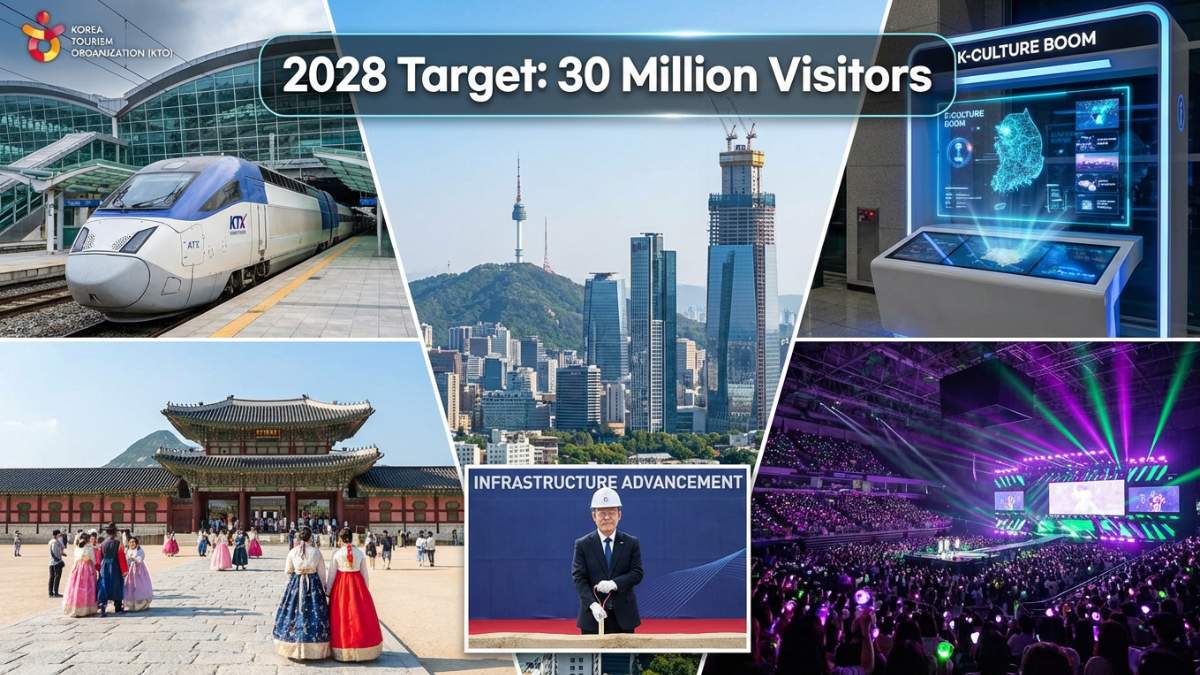
Image for illustrative purposes
Quick Summary
- South Korea Tourism Target: Accelerates 30 million inbound visitors from 2030 to 2028, building on 18.7-18.93 million in 2025.
- Key Strategies: Regional tourism push beyond Seoul (80% current concentration), high-speed rail, K-culture integration, AI platforms.
- Traveler Impact: Expect expanded regional attractions, visa reforms, better infrastructure for Jeju, K-pop tours.
- What's Next: Provisional 22 million visitors in 2026; infrastructure upgrades and Visit Korea platform by 2027.
South Korea has boldly advanced its target of 30 million inbound tourists from 2030 to as early as 2028. President Lee Jae Myung chaired the Expanded National Tourism Strategy Meeting on February 25, 2026, at Cheong Wa Dae in Seoul, calling for a tourism overhaul to spread visitors beyond Seoul and leverage K-culture.
The Korea Tourism Organization (KTO) President Park Sung-hyeuck declared, “2030 is too late. We will achieve the 30 million visitor milestone by 2028.” This shift demands 16% annual growth from 2025's record 18.7-18.93 million visitors, with a provisional 22 million targeted for 2026.
Why This Matters for Global Travelers
South Korea faces a tourism deficit but sees a path to powerhouse status through qualitative growth. With 80% of foreign travelers currently concentrated in Seoul, President Lee warned that satisfaction with this reality limits expansion. The strategy decentralizes tourism, sharing gains with regional businesses.
K-culture—fueled by K-pop, dramas, and content—drives this boom. Officials link cultural industry growth directly to tourism, aiming for higher value-added experiences. This positions South Korea to rival Japan's 42.7 million visitors, using visa-free entry and infrastructure upgrades.
The plan echoes Japan's success under former Prime Minister Shinzo Abe, who doubled visitors in three years via presidential leadership. South Korea elevates its National Tourism Strategy Council to direct presidential oversight, the first in 10 years.
Presidential Push: Lee Jae Myung's Two-Pillar Strategy
President Lee Jae Myung presided over the February 25 meeting, the first by a sitting president since 2019. He stressed upgrading regional infrastructure, services, and content to hit 30 million by 2030—or sooner.
The two pillars are expanding inbound demand and revitalizing regional tourism. Reforms target immigration procedures, regional airports, lodging, and high-speed rail networks. Culture Minister Chae announced revising the 2030 target forward by one year.
Lee emphasized transitioning from quantitative expansion to qualitative growth, capitalizing on the 20 million era within reach. "The development of the cultural industry triggered by K-culture must ultimately lead to tourism," he said.
KTO's Aggressive Roadmap: 2028 Milestone
KTO recasts its strategy for the AI age, naming 2026 the "action year." Three pillars guide efforts: attracting visitors, extending stays, and AI integration. Marketing localizes for markets like China, Japan (repeat visitors), Southeast Asia, and Middle East (K-pop links).
To boost stays, KTO aligns domestic and foreign preferences for sightseeing, local cuisine, and attractions. It will consolidate 13 websites into the "Visit Korea" platform by 2027, enhancing AI data analysis.
Projections factor in weak won, K-content surge, and Japan-China tensions drawing Japanese tourists. Minister Choi Hwi-young pledged achievement ahead of 2030 in a December 16, 2025, report.
Regional Tourism Revival: Beyond Seoul to Jeju and High-Speed Rail
Decentralization is core, reducing Seoul's 80% dominance. Plans upgrade regional airports, lodging, and high-speed rail for areas like Jeju and K-pop tour sites. The 10th National Tourism Strategy Meeting, led by the Prime Minister, announced "Three Strategies for Tourism Innovation."
By 2033, goals extend to 40 million visitors and 120 trillion won in consumption. Infrastructure expansions ensure capacity for 3 million annual additions. Multilingual support and digital platforms reduce friction.
Key Facts at a Glance
| Detail | Data |
|---|---|
| Original Target | 30 million inbound tourists by 2030 |
| Accelerated Goal | 30 million by 2028 or 2029 |
| 2025 Visitors | 18.7-18.93 million (record high) |
| 2026 Projection | 22 million (17.6% growth) |
| Long-Term | 40 million visitors, 120 trillion won by 2033 |
| Seoul Concentration | 80% of foreign travelers |
| Key Drivers | K-culture, weak won, regional infrastructure |
| Leadership | President Lee Jae Myung, KTO's Park Sung-hyeuck |
What This Means for Travelers
Visitors gain access to untapped regional gems via high-speed rail and upgraded airports. K-pop tours, Jeju escapes, and cultural immersion extend trips beyond Seoul. Visa reforms and streamlined immigration ease entry.
AI-powered "Visit Korea" offers personalized itineraries, boosting satisfaction. Repeat visitors from China and Japan benefit from tailored marketing. Global travelers enjoy qualitative upgrades like better services and local cuisine.
Expect 16% yearly growth through 2028, with sustainable infrastructure matching hype. This creates a resilient, experiential destination aligned with post-pandemic trends.
Challenges and Risks Ahead
Rapid scaling requires concrete infrastructure to handle 30 million. Regional development must match Seoul's polish to avoid limits. Annual 3 million additions demand flawless execution amid global uncertainties.
AI integration and platform consolidation face timelines; 13 sites unify by 2027. Legal amendments to the Basic Tourism Act are pending. Success hinges on presidential momentum and public-private coordination via Visit Korea Committee.
Frequently Asked Questions
When will South Korea reach 30 million tourists?
KTO aims for 30 million inbound visitors by 2028, advancing from 2030, with 22 million projected for 2026 after 18.7 million in 2025. This requires 16% annual growth fueled by K-culture and regional pushes.
What drives South Korea's tourism acceleration?
K-culture boom, weak won, regional infrastructure upgrades, high-speed rail, AI platforms, and visa reforms target decentralization from Seoul's 80% share. Presidential leadership under Lee Jae Myung backs the shift.
How will regional tourism beyond Seoul expand?
Strategies include high-speed rail networks, regional airports, lodging reforms, and K-pop/Jeju tours to share gains nationwide and hit qualitative growth.
What infrastructure changes support 30 million visitors?
Upgrades to immigration, regional airports, high-speed rail, and the unified Visit Korea AI platform by 2027 ensure capacity for 3 million annual additions through 2028.
Related Travel Guides
Ultimate K-Pop Tour Itineraries in South Korea
Jeju Island Travel Guide: Beyond Seoul
High-Speed Rail Routes for Regional Korea
Disclaimer
This article is for informational and educational purposes only. It does not constitute legal, financial, or professional advice. While we strive to provide accurate and up-to-date information, travel policies, regulations, and conditions change rapidly. Always verify information with official sources before making travel decisions. Nomad Lawyer makes no representations about the accuracy, reliability, completeness, or suitability of the information provided. Readers should consult qualified professionals for advice specific to their circumstances. The views expressed in this article are those of the author and do not necessarily reflect the views of Nomad Lawyer.
Raushan Kumar
Founder & Lead Developer
Full-stack developer with 11+ years of experience and a passionate traveller. Raushan built Nomad Lawyer from the ground up with a vision to create the best travel and law experience on the web.
Learn more about our team →