
Singapore Red Cross Deploys S$50,000 Emergency Aid Following Nepal-China Border Glacial Flood
Singapore Red Cross has pledged S$50,000 in emergency aid and activated family tracing services after a glacial collapse flooded the Nepal-China border.

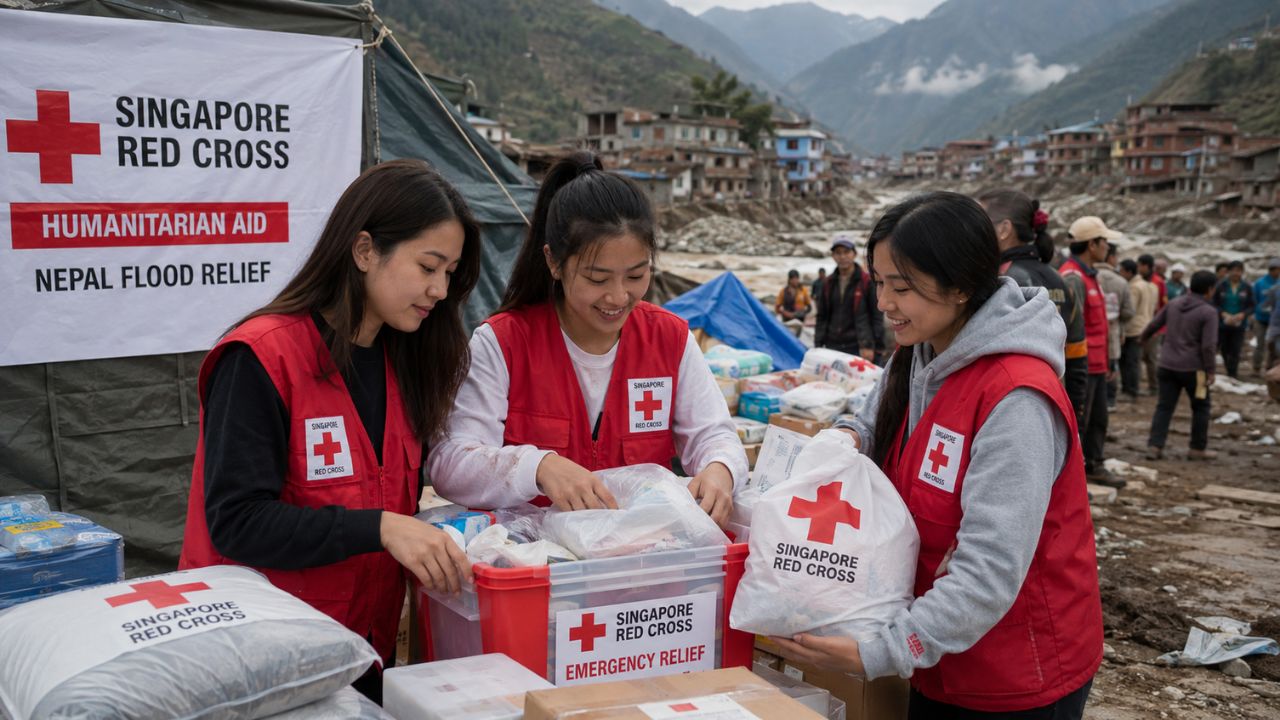
Image generated by AI
The Singapore Red Cross has committed S$50,000 in emergency funding and activated international family tracing services following a catastrophic glacial collapse and flash flood along the Nepal-China border.
[SINGAPORE] — The Singapore Red Cross (SRC) has deployed S$50,000 in immediate emergency relief aid to support rescue operations in northern Nepal and China's Xizang/Tibet autonomous region following a major flash flood. Triggered by a glacial collapse in the high Himalayas, the torrent destroyed remote villages, bridges, and mountain transport corridors, leaving hundreds reported dead and over 1,000 people missing. Official disaster response dispatches confirm that the missing include local residents alongside international tourists, mountain trekkers, and pilgrims traveling along trans-border Himalayan routes near Mount Kailash.
Glacial Collapse Triggers Trans-Border Himalayan Destruction
The disaster originated near the Nepal-China border when a high-altitude glacial rupture unleashed a wall of water, mud, and mountain debris down narrow river valleys.
Surging floodwaters severed vital transport links, sweeping away sections of highway, pedestrian suspension bridges, and communication towers. The rapid destruction isolated remote high-altitude communities across northern Nepal and Tibet, preventing ground rescue teams from reaching affected areas during the initial 24 hours.
Search and rescue operations face extreme operational challenges due to steep mountain terrain, secondary landslide threats, and destroyed road networks.
Himalayan Glacial Flood Impact Overview:
├── Primary Cause: High-altitude glacial collapse & sudden debris flow
├── Affected Regions: Northern Nepal & Xizang/Tibet Autonomous Region (China)
├── Casualty Estimate: Hundreds confirmed dead | 1,000+ missing (residents & tourists)
└── Transport Impact: Severe damage to trans-border highways, bridges & trek routes
Relief Package Composition and Family Tracing Services
The Singapore Red Cross emergency grant of S$50,000 is being funneled through the International Red Cross and Red Crescent Movement network to procure life-saving supplies on the ground.
The targeted relief package focuses on immediate survival necessities for displaced families:
- Temporary Shelter: Tarpaulins and heavy-duty ground sheets
- Warmth & Bedding: Thermal blankets and insulated sleeping mats
- Medical Support: First aid kits and emergency trauma supplies
- Sanitation & Safety: Clean drinking water purification systems
- Emergency Response: Specialized body bags for search teams
Concurrently, the Singapore Red Cross has launched a public fundraising appeal and activated its specialized "Restoring Family Links" tracing service. The global service assists individuals of any nationality who have lost contact with family members, trekkers, or relatives in the flooded regions of Nepal and Tibet.
Singapore Red Cross Emergency Response Allocation:
├── Financial Commitment: S$50,000 initial emergency grant
├── Relief Supplies: Drinking water, tarpaulins, thermal blankets, medical kits
├── Tracing Operations: Restoring Family Links service activated globally
└── Public Appeal: Channeling Singaporean donations to ground relief teams
International Disaster Response and Regional Travel Impact
The Himalayan flash flood has triggered a coordinated international relief mobilization across Asia and Europe.
Government agencies and humanitarian organizations from India, China, South Korea, the United Kingdom, and the United States have announced emergency financial aid, search-and-rescue teams, and satellite communication support. The International Federation of Red Cross and Red Crescent Societies (IFRC) is coordinating regional logistics hubs to transport supplies into remote mountain drop-zones.
The disaster has disrupted high-altitude trekking itineraries, overland transit corridors, and pilgrimage circuits connecting Nepal to sacred sites in Tibet, including Mount Kailash and Lake Manasarovar.
| Emergency Response Parameter | Operational Metric / Detail | Strategic Humanitarian Objective |
|---|---|---|
| Initial SRC Grant | S$50,000 Emergency Funding | Immediate ground procurement of survival goods |
| Primary Aid Delivery | Red Cross / Red Crescent Network | Direct distribution to remote mountain communities |
| Family Tracing | Restoring Family Links Service | Reconnecting missing travelers and residents |
| International Donors | India, China, UK, US, South Korea, IFRC | Multi-national rescue and supply coordination |
| Key Affected Travel Routes | Kathmandu-Tibet Highway, Mount Kailash Circuit | Emergency evacuation and route closures |
| Primary Hazard Risk | Glacial outburst, secondary landslides, silt deposits | Continued structural instability in valleys |
Risk Analysis of Glacial Outburst Floods in High-Altitude Corridors
Geological and environmental experts warn that glacial lake outburst floods (GLOFs) represent an escalating risk for Himalayan travel infrastructure.
Rising seasonal temperatures in high-altitude zones accelerate glacial melting, creating unstable ice-dammed lakes susceptible to sudden collapse. When these natural dams rupture, high-velocity debris flows destroy down-river bridges and roads within minutes, trapping travelers in isolated valleys.
Disaster management agencies emphasize the necessity of installing early-warning sensor networks along major Himalayan trekking corridors to alert downstream villages and tour groups before floodwaters arrive.
Why This Matters for Trekkers, Travelers, and International Families
Evaluating the Himalayan flood emergency outlines critical safety and logistical steps for international travelers:
- For Trekkers and Tour Operators: All non-essential travel along the Nepal-China border corridors, including overland routes to Tibet and Mount Kailash, should be suspended until local authorities clear secondary landslide risks.
- For Families Seeking Missing Relatives: Relatives who have lost contact with family members traveling in northern Nepal or Tibet can access the Singapore Red Cross "Restoring Family Links" service for international tracing assistance regardless of nationality.
- For International Donors: Public appeals managed through established Red Cross channels guarantee that financial contributions directly fund drinking water, shelter tarpaulins, and medical kits delivered by local rescue workers.
Related Travel Guides
Disclaimer
This article is for informational and educational purposes only. It does not constitute legal, financial, or professional advice. While we strive to provide accurate and up-to-date information, travel policies, regulations, and conditions change rapidly. Always verify information with official sources before making travel decisions. Nomad Lawyer makes no representations about the accuracy, reliability, completeness, or suitability of the information provided. Readers should consult qualified professionals for advice specific to their circumstances. The views expressed in this article are those of the author and do not necessarily reflect the views of Nomad Lawyer.
Raushan Kumar
Founder & Lead Developer
Full-stack developer with 11+ years of experience and a passionate traveller. Raushan built Nomad Lawyer from the ground up with a vision to create the best travel and law experience on the web.
Learn more about our team →