
Queensland EV Charging Gaps Are at the Heart of the Need to Unlock Better Road Trips and New Tourism Growth
Queensland EV Charging Gaps Are at the Heart of the Need to Unlock Better Road Trips and New Tourism Growth

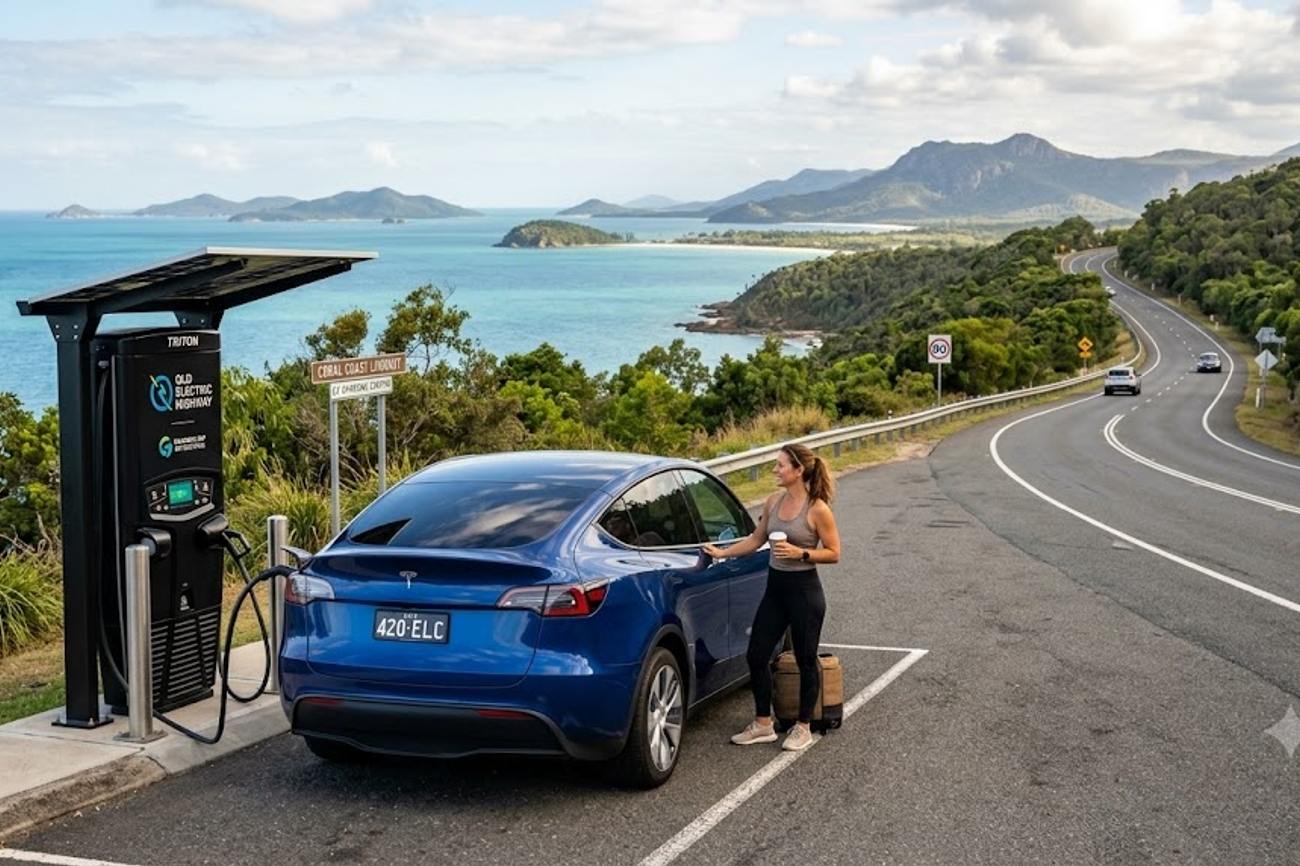
Image generated by AI
[Brisbane, July 2026] — Queensland has officially completed the final phase of its Electric Super Highway, establishing a network of 54 fast-charging locations designed to facilitate long-distance electric vehicle (EV) travel across the state.
The infrastructure now spans from Coolangatta in the south to Port Douglas in the north, including a critical link between Brisbane and Toowoomba. While the Queensland Government has successfully expanded the network into remote inland regions to support both residents and tourists, reports of inconsistent charger reliability continue to surface, creating "charging gaps" that persist despite the physical completion of the highway.
The Infrastructure Gap
The completion of the Electric Super Highway marks the end of a multi-phase rollout aimed at eliminating range anxiety for motorists traversing the vast distances of the Sunshine State. However, a discrepancy has emerged between the existence of hardware and the dependability of service. While the state has achieved its goal of installing 54 fast-charging sites, there is a notable absence of official, real-time statewide uptime data or standardized repair-time ratios.
This lack of transparency means that while a map may show a charger in a remote town, there is no government-guaranteed confirmation that the unit is operational at the moment of arrival. This creates a psychological and practical gap for drivers who cannot rely on the same "fill-and-go" certainty provided by traditional petrol stations.
Regional Coverage and Impacted Zones
The network's expansion has moved beyond the high-traffic coastal corridors to penetrate the deep interior of the state. The following regions now host official fast-charging infrastructure, though travelers are cautioned to verify individual site status:
- South Burnett & Darling Downs: Including Kingaroy, Stanthorpe, and Toowoomba.
- Southern Interior: Including Goondiwindi, Miles, Roma, St George, Cunnamulla, and Charleville.
- Central & Western Outback: Including Longreach, Barcaldine, Blackall, Winton, Hughenden, Richmond, Julia Creek, Cloncurry, and Mount Isa.
- Other Key Nodes: Esk and various coastal hubs between the Gold Coast and the Far North.
The town of Kingaroy, located approximately 218 kilometers northwest of Brisbane, serves as a primary junction for the D’Aguilar and Bunya highways. Because this area provides the main gateway to South Burnett's rural attractions, any failure in charging reliability here has a disproportionate effect on regional tourism and local business revenue.
Practical Traveler Advisory and Strategic Insights
For the average motorist, the "completion" of the Electric Super Highway does not mean a seamless experience. The transition from internal combustion engines to EVs requires a fundamental shift in trip planning.
Passenger Impact Assessment:
- Verification is Mandatory: You can no longer rely solely on a static map. Travelers must use third-party apps or official Department of Transport and Main Roads updates to confirm a charger is active before committing to a route.
- Buffer Planning: In inland Queensland, where towns are widely separated, drivers should maintain a higher-than-usual battery buffer. A single malfunctioning charger in a town like Kingaroy or Longreach can leave a vehicle stranded with few immediate alternatives.
- Tourism Integration: Charging stops are now becoming "destination events." Travelers should expect to spend 30 to 60 minutes at these locations, providing opportunities to support local cafes and museums, but this requires the charger to actually function.
- Towing Constraints: There is currently no official data confirming the network's capacity to handle heavy-load scenarios, such as EVs towing caravans, which significantly reduces battery range and increases the frequency of required stops.
The 2036 Zero-Emission Roadmap
The current infrastructure is a precursor to an aggressive state mandate. Under the Zero Emission Vehicle Strategy (2022–2032), the Queensland Government has set a target for zero-emission vehicles to account for 50% of all new passenger vehicle sales by 2030. This goal escalates to 100% by 2036.
To support this transition, the state aimed for 200,000 light zero-emission vehicles to be on the road by 2027. As the volume of EVs increases, the pressure on the 54 existing fast-charging locations will intensify. If reliability issues are not addressed through a formal uptime monitoring system, the state risks a "bottleneck" effect where the number of vehicles outpaces the functional capacity of the charging grid.
The economic stakes are high for regional tourism. The Tourism and Events Queensland promotional strategy for "Outback Queensland" relies heavily on road-trip accessibility. If the charging gaps are perceived as too risky, high-spending EV tourists may avoid the interior in favor of the more densely charged coastal strips.
FAQ: Queensland EV Charging 2026
Is the Electric Super Highway fully operational? Physically, yes. As of July 24, 2026, the network of 54 fast-charging locations is complete, stretching from Coolangatta to Port Douglas. However, individual station reliability varies, and some users report unaddressed outages.
How do I check if a regional charger is working? Because the government does not provide a real-time statewide uptime ratio, drivers should use dedicated EV charging apps or contact local visitor information centers in towns like Kingaroy or Mount Isa before arriving.
What are the state's long-term EV goals? Queensland aims for 50% of new passenger car sales to be zero-emission by 2030, reaching 100% by 2036, with an interim goal of 200,000 light ZEVs by 2027.
Are there specific risks for outback travel? Yes. The wide distance between towns in the interior means a broken charger can result in significant delays. Motorists are advised to plan routes with alternative charging options and maintain a conservative battery reserve.
The road to 2036 is paved, but the current is inconsistent.
Tags: #QueenslandElectricSuperHighway #EVCharging2026 #QLDTransport #OutbackQueenslandEV #ZeroEmissionVehicleStrategy #BrisbaneToPortDouglas
Related Travel Guides
- Australia Moves to Give Users Control Over Social Media Algorithms Putting Tourism Marketing in New Territory
- TUI Extends Sybille Reiss Leadership Role to 2030 Amid New Workforce and AI Transformation
- Visa Study Shows Adoption of Digital Remittances Accelerates in Asia Pacific, with Trust Emerging as a Critical Enabler
Disclaimer
This article is for informational and educational purposes only. It does not constitute legal, financial, or professional advice. While we strive to provide accurate and up-to-date information, travel policies, regulations, and conditions change rapidly. Always verify information with official sources before making travel decisions. Nomad Lawyer makes no representations about the accuracy, reliability, completeness, or suitability of the information provided. Readers should consult qualified professionals for advice specific to their circumstances. The views expressed in this article are those of the author and do not necessarily reflect the views of Nomad Lawyer.
Kunal K Choudhary
Co-Founder & Contributor
A passionate traveller and tech enthusiast. Kunal contributes to the vision and growth of Nomad Lawyer, bringing fresh perspectives and driving the community forward.
Learn more about our team →