
Visa Study Shows Adoption of Digital Remittances Accelerates in Asia Pacific, with Trust Emerging as a Critical Enabler
Visa's Money Travels 2026 report reveals accelerating digital remittance adoption across Asia Pacific, highlighting mobile wallet surge, AI fraud concerns, and trust.

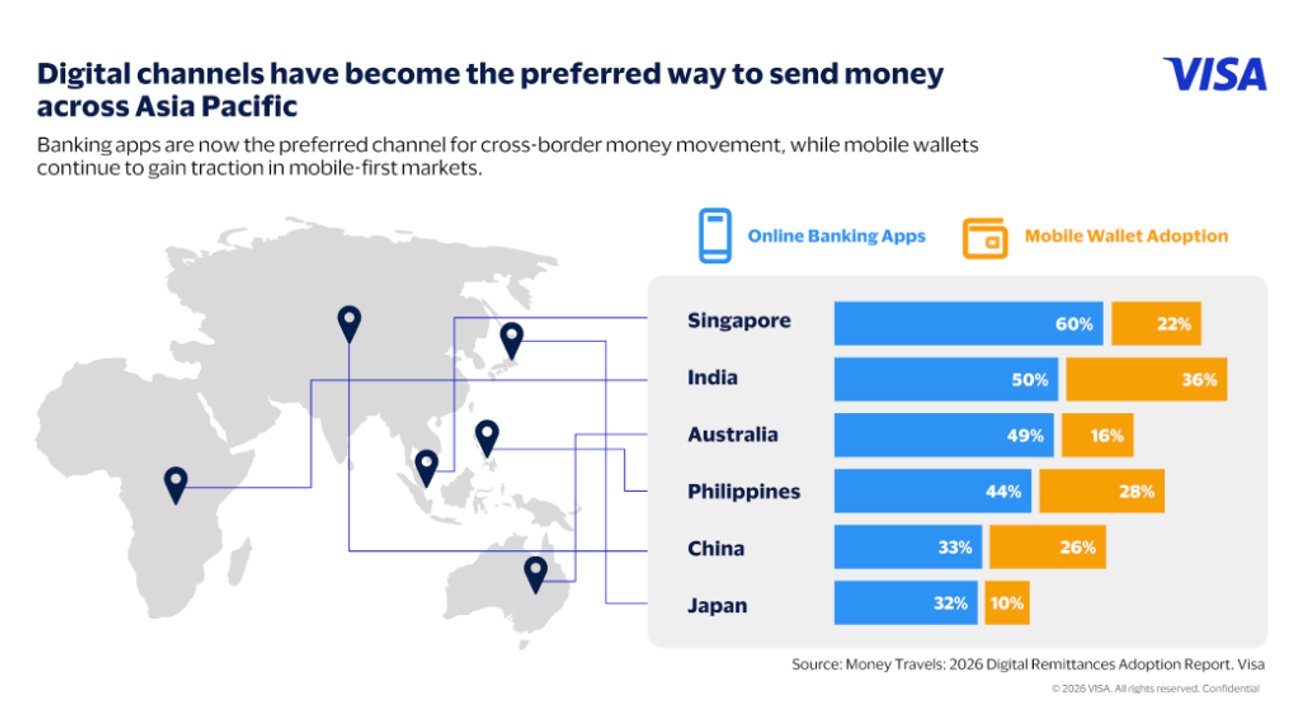
Infographic: Digital channels have become the preferred way to send money across Asia Pacific (Source: Visa Money Travels Report)
[SINGAPORE, September 16, 2026] — Cross-border digital money movement is expanding across the Asia Pacific region as consumers increasingly embrace mobile apps and digital wallets to support overseas families, while trust, security, and AI-enabled fraud concerns have become paramount factors shaping the transaction experience, according to the newly released Money Travels: 2026 Digital Remittances Adoption Report by Visa (NYSE: V).
The extensive regional study, conducted by global research firm Morning Consult between February 24 and March 2, 2026, surveyed more than 45,000 remittance senders and receivers across 20 worldwide markets. The Asia Pacific findings specifically examine consumer behavior, preferences, and payment shifts across six key economies: Australia, Mainland China, India, Japan, the Philippines, and Singapore.
For the first time, this year's edition of the study incorporated an in-depth module assessing consumer awareness, sentiment, and adoption intent toward stablecoins. The results demonstrate that while users are receptive to next-generation payment instruments, closing substantial educational gaps and providing robust safeguards against deepfakes and automated fraud will be vital to expanding adoption.
“Cross-border money movement is fundamental to how people, businesses and economies connect across Asia Pacific,” said Chavi Jafa, Senior Vice President, Head of Commercial and Money Movement Solutions, Asia Pacific at Visa. “Financial institutions have an opportunity to make cross-border payments a more integrated and valuable part of the overall customer experience as consumer expectations continue to evolve, with customers increasingly looking for solutions that combine speed, security, convenience and flexibility. Building trust through education, transparency and security will be critical to the next phase of adoption.”
Mobile Banking Apps and Wallets Cement Digital Dominance
The transition away from legacy money transfer booths toward digital-first platforms has accelerated throughout Asia Pacific. Mobile banking apps have established themselves as the undisputed channel of choice for cross-border money movement, with regional usage rates spanning between 33% and 60%.
- Singapore leads the region in mobile banking dominance, with 60% of senders relying on online banking apps and 22% leveraging mobile wallets.
- India demonstrates the strongest dual digital appetite, with 50% utilizing mobile banking apps and 36% deploying mobile wallets—the highest mobile wallet adoption rate in Asia Pacific.
- Australia records 49% utilization for mobile banking apps and 16% for digital wallets.
- In the Philippines, 44% of consumers send money via banking applications, supported by a 28% mobile wallet footprint.
- Mainland China exhibits balanced digital adoption, registering 33% app-based transfers alongside 26% mobile wallet transactions.
- Japan remains the primary regional outlier: while 32% of respondents use banking apps and 10% use mobile wallets, nearly one-third (32%) still prefer sending international remittances through physical bank branch counters.
Financial Lifelines: Household Bills, Emergencies, and Personal Sacrifices
Remittances serve as an indispensable economic stabilizer for millions of families across developing and developed Asian markets. The report highlights that funds sent from overseas directly underwrite non-negotiable living costs, utilities, and unexpected medical crises.
The frequency of international money transfers differs markedly depending on national economic structures. Senders are most active in the Philippines (45%) and Australia (35%), contrasted against Japan (8%). On the receiving side, the Philippines again logs the highest proportion at 45%, while Japan sits at the opposite end of the spectrum with 5%.
When receivers in recipient markets collect cross-border funds, the capital is directed toward vital immediate needs:
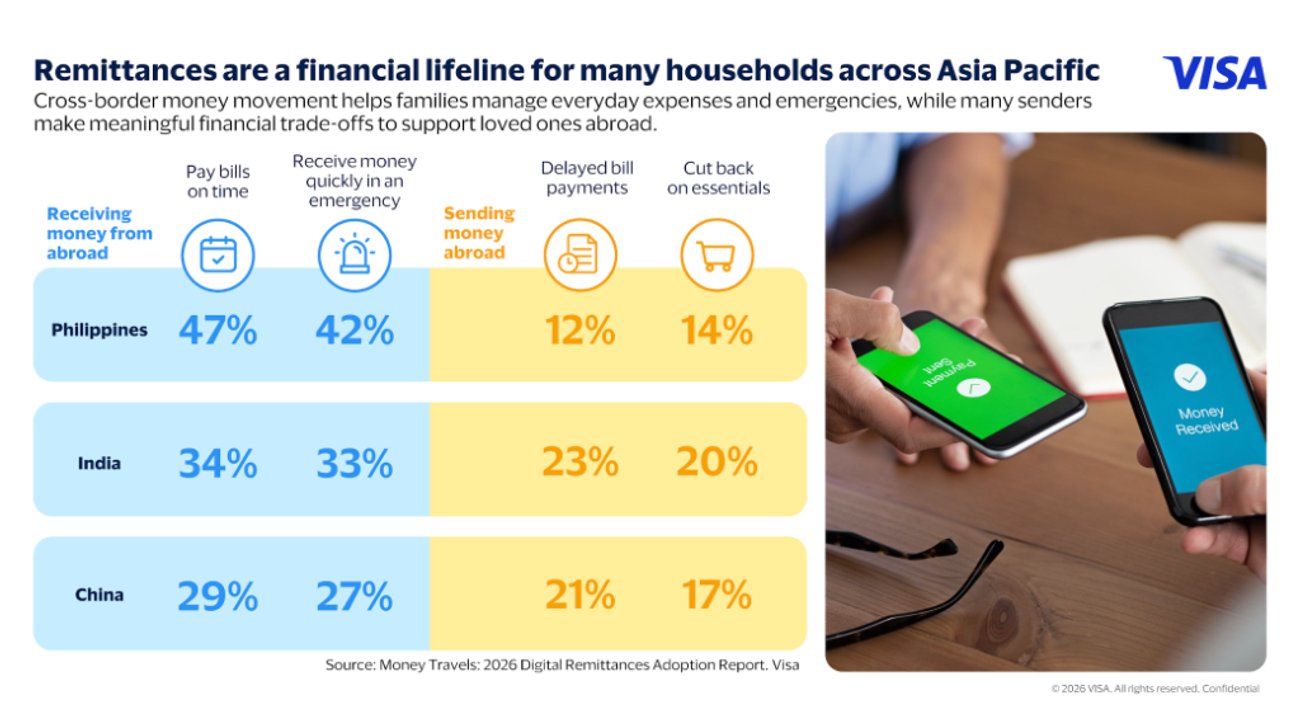
- Paying household bills on time: Identified as a primary catalyst by 47% of recipients in the Philippines, 34% in India, and 29% in China.
- Urgent emergency funding: Receiving money quickly during crises accounts for 42% of usage in the Philippines, 33% in India, and 27% in China.
Critically, sending money to family members abroad frequently imposes severe personal economic trade-offs on remitters themselves. In India, 23% of senders report having to delay their own domestic bill payments, and 20% have cut back on daily living essentials to ensure money reached overseas relatives. A similar strain is visible in Mainland China, where 21% of senders delay bill payments and 17% sacrifice essential expenditures, while 12% of Filipino remitters delay bills and 14% cut back on personal necessities.
Cross-Market Data: Digital Remittance Patterns Across Asia Pacific
The following comparative table synthesizes the core findings from the Visa Money Travels 2026 survey across the six monitored Asia Pacific economies:
| Market | Banking App Usage | Mobile Wallet Adoption | Scam Exposure Encountered | High Concern Over AI Fraud / Deepfakes | Willing to Accept 24h Delay for AI Protection |
|---|---|---|---|---|---|
| Singapore | 60% | 22% | 24% | 49% | 57% |
| India | 50% | 36% | 40% | 53% | 55% |
| Australia | 49% | 16% | 25% | 42% | 57% |
| Philippines | 44% | 28% | 29% | 62% | 39% |
| Mainland China | 33% | 26% | 19% | 18% | 53% |
| Japan | 32% | 10% | 11% | 44% | 68% |
Trust and Fraud Defenses: Consumers Choose Protection Over Speed
As generative artificial intelligence and sophisticated impersonation tactics advance globally, security has overtaken pure transfer speed as the primary benchmark of customer satisfaction.
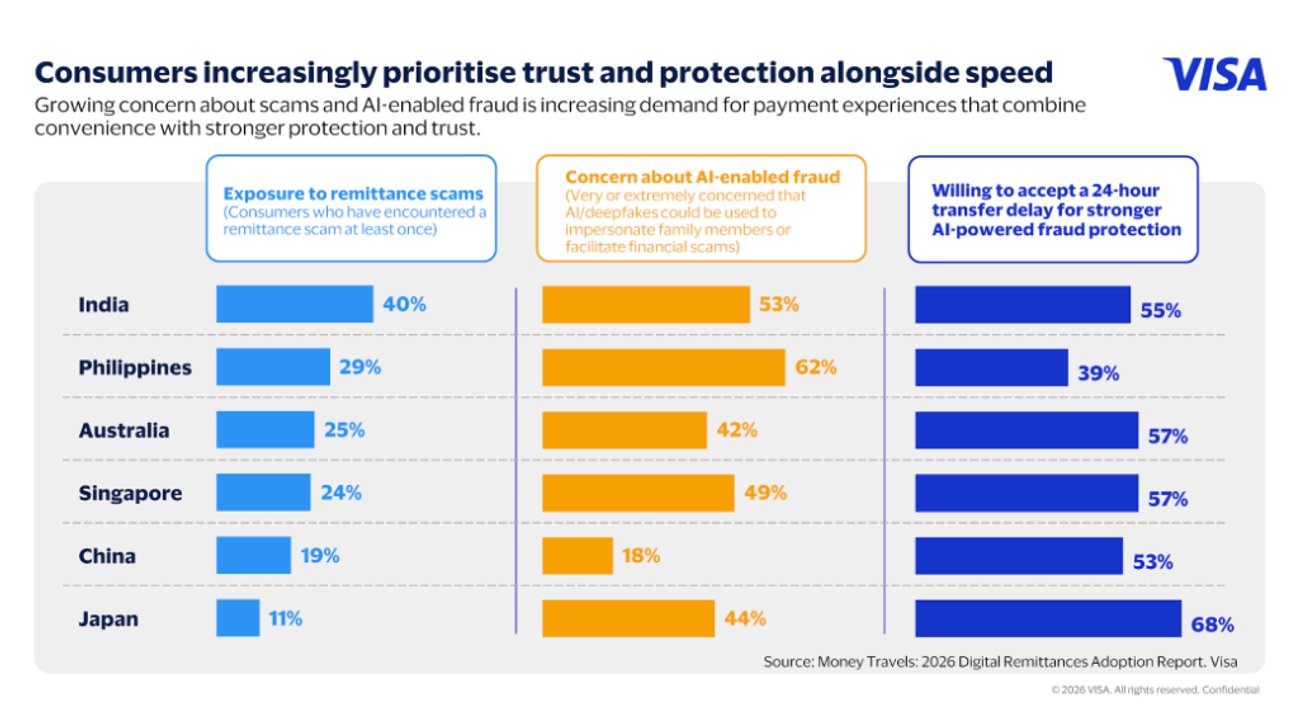
Exposure to fraudulent remittance schemes is widespread across the region. Encounter rates are highest in India (40%) and the Philippines (29%), compared to Australia (25%), Singapore (24%), Mainland China (19%), and Japan (11%).
Anxiety surrounding AI-facilitated cybercrime is exceptionally pronounced in Southeast and South Asia. In the Philippines, 62% of respondents express extreme concern that deepfake technology and synthetic voice audio could be weaponized to impersonate relatives in manufactured distress calls. In India, 53% share this fear, followed by Singapore (49%), Japan (44%), Australia (42%), and China (18%).
This acute security awareness has prompted an unprecedented shift in consumer trade-offs: large majorities of remitters now express a willingness to sacrifice instant delivery in exchange for verified safety. When asked whether they would accept a 24-hour transfer delay to permit comprehensive AI-powered anti-fraud screening, 68% of consumers in Japan agreed, alongside 57% in Singapore, 57% in Australia, 55% in India, and 53% in China. The Philippines recorded 39% willingness, reflecting a higher dependency on immediate cash for emergency survival.
The Stablecoin Knowledge Gap: Perception Versus Reality
The study’s dedicated stablecoin module highlights a stark disconnect between market interest and consumer comprehension. While central banks and fintech conglomerates examine fiat-backed tokens for programmatic cross-border liquidity, retail adoption remains constrained by widespread misconceptions.
Approximately half of surveyed consumers in Asia Pacific mistakenly believe that stablecoins carry equal or greater risk than unbacked, speculative cryptocurrencies like Bitcoin, despite stablecoins being engineered explicitly to maintain asset peg stability. However, the survey revealed that once respondents were presented with factual definitions explaining value-pegging mechanisms and operational efficiencies, consumer adoption intent and interest climbed substantially.
The report notes that survey scenarios testing consumer confidence with hypothetical "bank-equivalent protections" were illustrative; stablecoins are not covered by conventional statutory deposit insurance mechanisms such as the FDIC or CDIC. Bridging this regulatory and conceptual knowledge divide through transparent education will determine whether digital assets integrate into mainstream remittance pipelines.
“The findings underscore how diverse payment behaviours, preferences and levels of digital adoption continue to accelerate across Asia Pacific,” stated Rhidoi Krishnakumar, Vice President, Head of Visa Direct Asia Pacific. “For banks, remitters and fintechs, the opportunity lies in delivering seamless cross-border experiences while managing growing complexity on behalf of clients. Through Visa Direct, we work with partners across the region to help simplify this complexity and enable money movement experiences that are more seamless, scalable and locally relevant to how consumers and businesses move money today.”
FAQ: Visa Asia Pacific Digital Remittances Report 2026
What is the Visa Money Travels 2026 report?
It is a comprehensive cross-border payment study conducted by Morning Consult on behalf of Visa, surveying over 45,000 remittance senders and receivers across 20 worldwide markets between February 24 and March 2, 2026.
Which country leads digital banking app adoption for remittances in Asia Pacific?
Singapore leads the Asia Pacific region in online banking application usage for cross-border transfers at 60%, followed by India at 50% and Australia at 49%.
How big of a concern is AI-enabled fraud in international money transfers?
AI-enabled fraud is a major concern across the region, peaking at 62% in the Philippines and 53% in India, where consumers fear deepfakes and voice cloning being used to deceive senders.
Are consumers willing to slow down remittance speeds for better security?
Yes. Majorities in Japan (68%), Australia (57%), Singapore (57%), India (55%), and China (53%) stated they would accept a 24-hour transfer delay to allow for robust AI fraud screening.
For media inquiries regarding the study findings, contact Ary Kim at [email protected].
Related Travel Guides
Disclaimer
This article is for informational and educational purposes only. It does not constitute legal, financial, or professional advice. While we strive to provide accurate and up-to-date information, travel policies, regulations, and conditions change rapidly. Always verify information with official sources before making travel decisions. Nomad Lawyer makes no representations about the accuracy, reliability, completeness, or suitability of the information provided. Readers should consult qualified professionals for advice specific to their circumstances. The views expressed in this article are those of the author and do not necessarily reflect the views of Nomad Lawyer.
Raushan Kumar
Founder & Lead Developer
Full-stack developer with 11+ years of experience and a passionate traveller. Raushan built Nomad Lawyer from the ground up with a vision to create the best travel and law experience on the web.
Learn more about our team →