
Qatar Airways Ignites Business Travel With Daily Doha-Philadelphia Flights
Qatar Airways restores daily flights between Doha and Philadelphia, utilizing the Airbus A350-900 with Qsuite and Starlink connectivity.

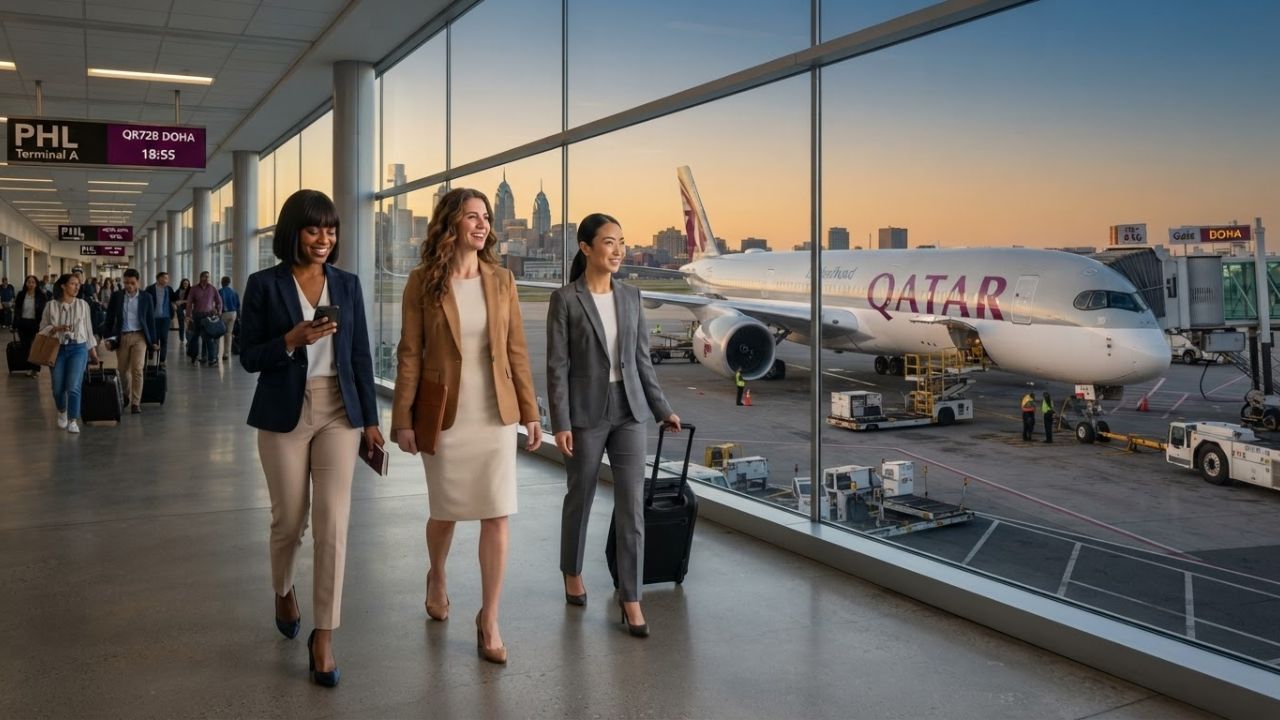
Image generated by AI
Qatar Airways has restored its daily direct flight service between Doha and Philadelphia, linking Pennsylvania's major commercial corridor directly with over 160 destinations across Asia and the Gulf. Operated by the state-of-the-art Airbus A350-900, the route offers travelers premium Qsuite accommodations and high-speed Starlink-powered internet connectivity.
A significant shift is taking place in transcontinental commercial aviation as global hubs restore daily schedules to secondary gateways. By offering daily flights rather than limited weekly services, carriers provide corporate travel departments with greater flexibility to coordinate meetings and trade delegations. For organizations in Pennsylvania, New Jersey, and Delaware, the restored link removes the need to route international transit through congested terminals in New York or Washington, DC.
Restoring the Doha-Philadelphia Air Corridor
The returned route operates out of Philadelphia International Airport (PHL), with Qatar Airways offering daily flights in both directions. The westbound service is scheduled to arrive in Philadelphia in the afternoon, while the eastbound return flight departs in the evening. This timetable allows business passengers to complete a partial working day in the Delaware Valley before boarding their international flight.
Operated by an Airbus A350-900, the flight is equipped with the carrier's proprietary Qsuite Business Class. The configuration features enclosed private cabins and lie-flat beds, alongside adjoining cabin layouts designed for colleagues traveling together. Passengers also benefit from high-speed, Starlink-powered Wi-Fi, which is currently installed on more than 140 aircraft in Qatar Airways' global fleet.
Facilitating High-Value Industry Growth and Regional Trade
According to guidelines from the City of Philadelphia Department of Commerce, international flight access is an essential driver of the regional economy. The city focuses on key sectors like biotechnology, life sciences, advanced manufacturing, logistics, and creative industries. Having direct air access to Asian commercial centers supports trade missions, research partnerships, and venture capital delegations in these specialized fields.
Furthermore, Philadelphia's role as a major hub for American Airlines and the oneworld alliance extends the usefulness of the flight. Through-ticketing allows travelers from smaller regional airports across the United States to connect via Philadelphia to Doha's Hamad International Airport, linking them with major markets in India, Singapore, Malaysia, and South Korea under a single protected reservation.
Transit and Connection Tips for International Travelers at Philadelphia
For passengers utilizing this restored air link, travel specialists recommend the following practices:
- Allow Connection Buffer Time: All international passengers arriving in the United States must clear customs and immigration procedures at their first port of entry. Ensure your itinerary has at least a two-hour buffer before connecting domestic flights.
- Coordinate Protected Bookings: Book domestic and international legs under a single ticket confirmation. In the event of flight delays, the partner airlines carry the responsibility for rebooking and luggage transfer.
- Utilize Lounge Workspaces: Qualifying loyalty members and business class passengers can utilize dedicated airport lounges at both PHL and Doha to maintain productivity during transits.
- Verify Border Entry Guidelines: Before departure, ensure passports, visas, and documentation for commercial samples or company equipment match current regulations.
Evaluating the Broader North American Aviation Network
The Philadelphia route represents one of 12 primary gateways served by the airline in the United States, alongside cities like Boston, Chicago, Dallas-Fort Worth, Houston, Los Angeles, and Seattle. Each gateway connects the Middle Eastern hub with specific regional industries, from Texas energy markets to Boston's higher education and medical centers. By maintaining daily flight frequencies, carriers support global business travel resilience while reducing transit friction for international commerce.
Related Travel Guides
Disclaimer
This article is for informational and educational purposes only. It does not constitute legal, financial, or professional advice. While we strive to provide accurate and up-to-date information, travel policies, regulations, and conditions change rapidly. Always verify information with official sources before making travel decisions. Nomad Lawyer makes no representations about the accuracy, reliability, completeness, or suitability of the information provided. Readers should consult qualified professionals for advice specific to their circumstances. The views expressed in this article are those of the author and do not necessarily reflect the views of Nomad Lawyer.
Kunal K Choudhary
Co-Founder & Contributor
A passionate traveller and tech enthusiast. Kunal contributes to the vision and growth of Nomad Lawyer, bringing fresh perspectives and driving the community forward.
Learn more about our team →