
Saudi Arabia Airport Chaos: 102 Delays and 6 Cancellations at King Fahd and King Khalid
King Fahd International (Dammam) and King Khalid International (Riyadh) record a combined 102 delays and 6 cancellations, disrupting routes to Dubai, Cairo, Jeddah, and beyond.

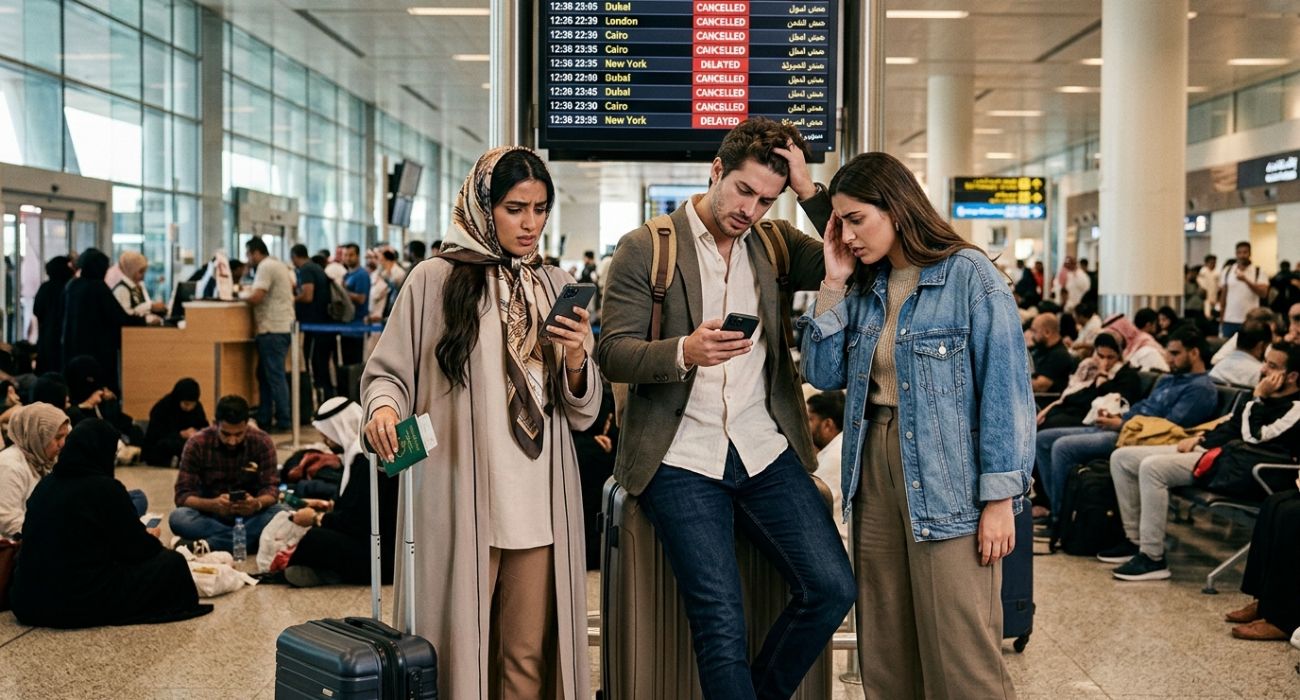
Image generated by AI
Saudi Arabia Aviation Crisis Deepens as King Fahd and King Khalid International Airports Record 102 Flight Delays and 6 Cancellations, Disrupting Thousands of Passengers on Routes to Riyadh, Dammam, Dubai, Cairo, and Jeddah
In one of the most widespread single-day aviation disruptions recorded across the Kingdom this year, Saudi Arabia's two busiest international airports are struggling under the combined weight of 102 delays and 6 cancellations — a stark signal that broader Gulf airspace pressures are hitting the heart of the region's aviation network.
Two of Saudi Arabia's most strategically critical international airports — King Fahd International Airport in Dammam and King Khalid International Airport in Riyadh — have been thrust into the spotlight of a widening aviation crisis as disruptions intensify across April and May 2026. Official flight tracking data confirms a staggering combined total of 102 flight delays and 6 cancellations across the two hubs, leaving thousands of passengers contending with rescheduled departures, sudden service withdrawals, and mounting uncertainty across domestic and international route networks. King Fahd International has recorded approximately 25 delays and 3 cancellations, while the scale at King Khalid International is dramatically more severe — with 77 delays and 3 cancellations logged, far exceeding standard seasonal benchmarks for the airport.
EXPANDED OVERVIEW: An Unprecedented Surge in Operational Pressure
The sheer scale of today's disruptions across Saudi Arabia's dual aviation hubs is extraordinary. King Khalid International Airport — the primary air gateway for the Saudi capital, Riyadh — has now accumulated a single-period total of 77 delayed flights, a figure that dwarfs routine operational variability and signals deep systemic stress within the airport's scheduling infrastructure. Even King Fahd International Airport in Dammam — historically one of the Kingdom's most operationally stable major hubs — is now logging 25 delays and 3 cancellations, compounding the national picture significantly.
Together, these two airports are processing a combined disruption volume that is placing enormous pressure on airline ground operations teams, airport customer service staff, and the GACA-governed civil aviation framework that underpins the entire Kingdom's air transport system. Passengers transiting through Riyadh and Dammam on routes to Dubai, Cairo, Jeddah, and dozens of other domestic and international destinations are absorbing the full force of a disruption pattern driven by broader regional airspace pressures, geopolitical developments, and dynamic airline scheduling adjustments.
GEOPOLITICAL CONTEXT: Gulf Airspace Under Sustained Pressure
The operational turbulence gripping Saudi Arabia's airports cannot be fully understood without reference to the intense geopolitical environment currently reshaping the Gulf region's aviation landscape. Regional airspace restrictions linked to the 2026 Iran War — which triggered emergency airspace closures across multiple Gulf corridors from late February 2026 — have generated a cascading chain of scheduling adjustments, route modifications, and capacity constraints that are still reverberating through airline operations at Riyadh and Dammam months later.
Airlines serving these airports have had to dynamically restructure approved flight corridors, re-evaluate fleet deployment strategies, and in some cases suspend or consolidate services to maintain safety compliance with evolving airspace directives. The General Authority of Civil Aviation (GACA) of Saudi Arabia has been actively coordinating with airlines, air traffic control centers, and regional aviation bodies to manage the fallout — but the sheer volume of impacted flights reflects just how structurally challenging the current environment has become.
GLOBAL ENERGY IMPACT: Saudi Arabia's Aviation at the Crossroads
Saudi Arabia's position at the intersection of global energy and global aviation makes disruptions at Riyadh and Dammam particularly consequential. King Fahd International in Dammam serves as the primary gateway for Saudi Aramco's global energy workforce — thousands of corporate travelers, engineers, and executives whose movements underpin the management of the world's largest oil production infrastructure. When disruptions hit Dammam's airport, the ripple effects extend far beyond passenger inconvenience into the operational heart of global energy supply chains.
Riyadh's King Khalid International, meanwhile, connects the Kingdom's political and economic capital with virtually every major destination across Europe, Asia, and Africa. Sustained disruption at RUH has direct implications for business travel, foreign investment flows, and Saudi Arabia's ambitious Vision 2030 tourism and economic diversification programs — all of which depend on reliable international air connectivity.
SECTION-WISE BREAKDOWN
King Fahd International Airport, Dammam (DMM)
King Fahd International Airport — one of the world's largest airports by land area and the principal gateway for eastern Saudi Arabia — has recorded approximately 25 delays and 3 cancellations during the current disruption period. Despite generally benign weather conditions around Dammam, with low winds and clear visibility reported across recent days, the delays continue to persist as airlines struggle to stabilize schedules against the backdrop of broader regional operational pressures. Airport authorities have repeatedly directed passengers to the official King Fahd International Airport flight status platform for real-time departure and arrival updates, emphasizing that gate assignments and departure times are subject to frequent revision.
King Khalid International Airport, Riyadh (RUH)
In the Saudi capital, the disruption picture is dramatically more intense. King Khalid International Airport has logged a cumulative 77 delays and 3 cancellations — a figure that far exceeds standard seasonal variability and is placing intense pressure on the airport's terminal operations. Crowded check-in halls, extended wait times at airline counters, and confusion surrounding gate assignments are being reported by passengers navigating the airport during the current disruption window. Airport operations have directed all travelers to digital flight status boards and mobile airline applications as the primary tools for obtaining reliable, real-time schedule information.
FLIGHT DISRUPTION SNAPSHOT
| Airport | IATA Code | City | Delays | Cancellations |
|---|---|---|---|---|
| King Fahd International Airport | DMM | Dammam | 25 | 3 |
| King Khalid International Airport | RUH | Riyadh | 77 | 3 |
| Combined Total | 102 | 6 |
Key International Routes Impacted: Dubai (DXB), Cairo (CAI), Jeddah (JED), and multiple domestic Saudi corridors.
Governing Authority: General Authority of Civil Aviation (GACA), Saudi Arabia
Source: FlightAware (subject to real-time change)
SHIPPING & TRADE IMPACT: The Business Travel Disruption
Beyond leisure travel, the sustained disruption at both Saudi airports is generating meaningful economic friction. Business travelers connecting through Riyadh and Dammam to destinations across Europe, Asia, and Africa are facing missed meetings, delayed negotiations, and compressed timelines. Airlines including Saudia, Flynas, flyadeal, and international carriers operating Saudi routes have all issued travel advisories urging passengers to reconfirm itineraries and build substantial buffer time into their departure plans.
REGIONAL IMPACT: The Broader Gulf Aviation Picture
Saudi Arabia's current airport disruption crisis is not occurring in a vacuum — it is the latest manifestation of a regionwide aviation stress pattern that has simultaneously impacted Kuwait International Airport, Dubai International Airport, Abu Dhabi International, and Doha's Hamad International in recent weeks. Across the Gulf Cooperation Council (GCC), airlines and airports are collectively managing one of the most challenging sustained operational environments in years, driven by the compounding effects of peak seasonal travel demand, Gulf airspace restriction residuals, and structurally elevated network congestion.
INDUSTRY ANALYSIS: Why 102 Delays Signal a Deeper Problem
Aviation analysts emphasize that a combined single-period delay count of 102 across just two airports is a significant warning indicator for the health of Saudi Arabia's wider aviation network. The well-documented "propagation effect" in aviation scheduling means that delayed morning arrivals create delayed afternoon departures on the same aircraft — compressing the entire day's schedule and pushing disruption volumes progressively higher as the clock advances.
At airports like King Khalid, which serves as a major transfer hub for passengers connecting across the Middle East and onward to Asia and Europe, this propagation dynamic is particularly destructive. A 77-delay figure at a single hub does not simply mean 77 inconvenienced passengers — it means hundreds of missed onward connections, cascading rebooking demands across partner airlines, and ripple effects that can reach airports in London, Singapore, and beyond.
WHAT HAPPENS NEXT
GACA authorities have confirmed that both King Fahd and King Khalid International airports remain fully operational with no closure orders in effect. The immediate priority for authorities is stabilizing schedules, accelerating aircraft rotation recovery, and ensuring that passenger communication channels remain clear and current. Airlines are expected to progressively restore normal scheduling as regional airspace conditions stabilize further, though the timeline for full operational normalization remains fluid given the dynamic regional environment.
CONCLUSION: Saudi Arabia's Airports Face a Defining Test
The scale of disruption currently gripping King Fahd and King Khalid International Airports — 102 total delays and 6 cancellations — represents one of the most challenging sustained aviation management periods Saudi Arabia has faced in recent years. As the Kingdom's civil aviation framework works to restore full operational stability, passengers must remain proactive, informed, and flexible. The broader implication is clear: in an era of compounding geopolitical and operational pressures, even the world's most ambitious aviation ecosystems are not immune to systemic disruption.
KEY TAKEAWAYS
- King Khalid International Airport (Riyadh) has recorded 77 delays and 3 cancellations — a figure significantly exceeding standard operational norms.
- King Fahd International Airport (Dammam) has logged approximately 25 delays and 3 cancellations.
- The combined total of 102 delays and 6 cancellations represents one of Saudi Arabia's most widespread single-period aviation disruptions in 2026.
- Routes to Dubai, Cairo, Jeddah, and multiple domestic Saudi corridors are all actively impacted.
- Disruptions are driven by regional airspace pressures, geopolitical developments, and cascading aircraft rotation delays.
- GACA confirms both airports remain fully operational — no closures are in effect.
- Passengers are urged to monitor official GACA, airport, and airline platforms for real-time flight status before departing for terminals.
Disclaimer
This article is for informational and educational purposes only. It does not constitute legal, financial, or professional advice. While we strive to provide accurate and up-to-date information, travel policies, regulations, and conditions change rapidly. Always verify information with official sources before making travel decisions. Nomad Lawyer makes no representations about the accuracy, reliability, completeness, or suitability of the information provided. Readers should consult qualified professionals for advice specific to their circumstances. The views expressed in this article are those of the author and do not necessarily reflect the views of Nomad Lawyer.
Kunal K Choudhary
Co-Founder & Contributor
A passionate traveller and tech enthusiast. Kunal contributes to the vision and growth of Nomad Lawyer, bringing fresh perspectives and driving the community forward.
Learn more about our team →