
Nepal Tibet Border Flood Disaster 2026: Glacier Collapse Triggers Humanitarian Crisis for Mount Kailash Pilgrims
A catastrophic glacier collapse in Nepal's Rasuwa district has caused deadly flash floods, trapping international tourists and pilgrims on the Mount Kailash route.

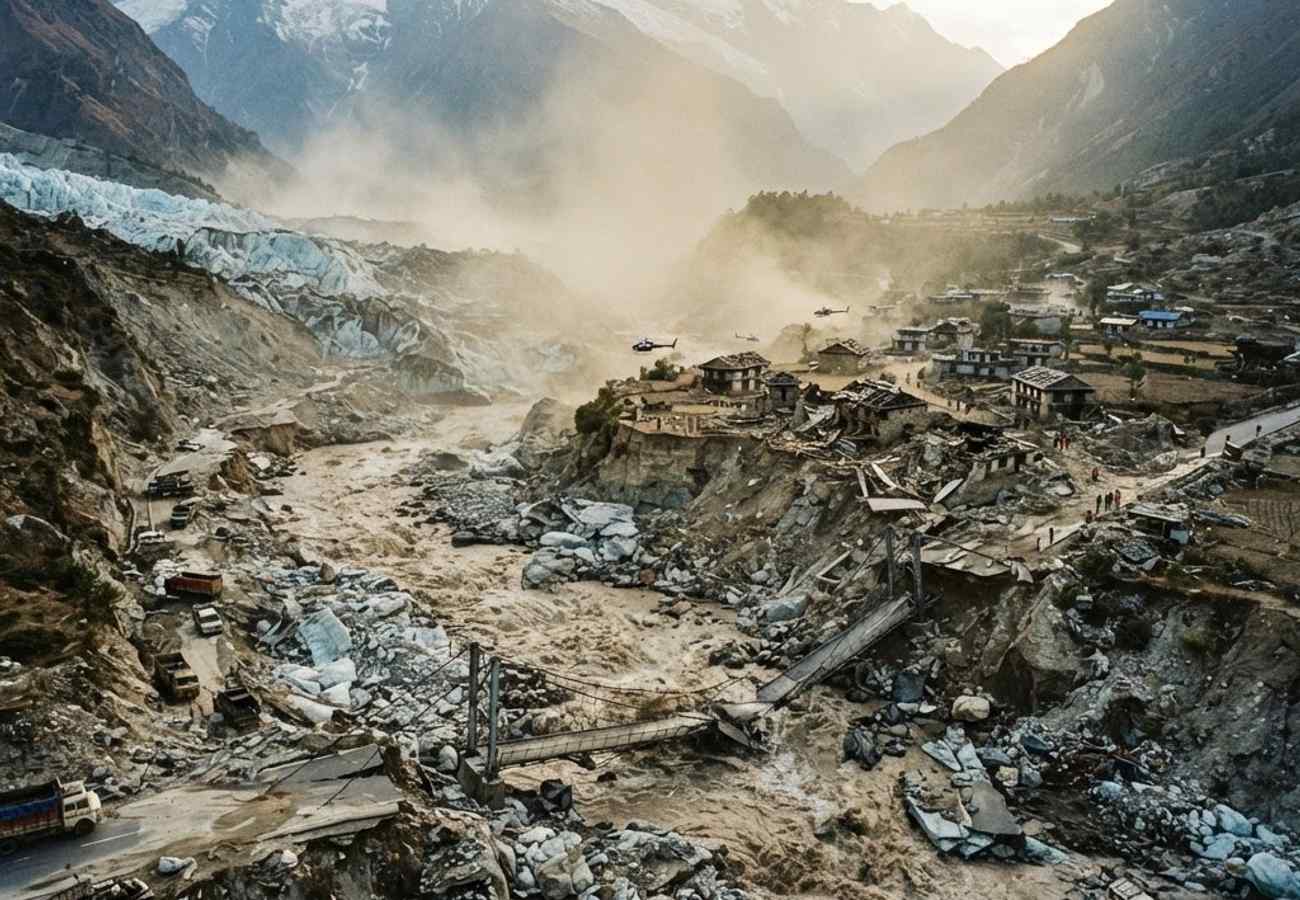
Image generated by AI
A massive glacier collapse in the Himalayas has triggered catastrophic flash floods across the Nepal-China border, leaving hundreds dead and thousands missing while trapping international pilgrims on the route to Mount Kailash.
The disaster struck the Rasuwa district of Nepal, where a sudden surge of water, mud, and boulders obliterated entire communities and severed critical transport links between Nepal and Tibet. Rescue operations are currently underway, though extreme terrain and destroyed infrastructure have severely limited access to the hardest-hit zones.
Glacier Collapse Triggers Mass Destruction in Rasuwa District
The catastrophe originated from a sudden glacier failure, which released an immense volume of ice, water, and rock into the steep mountain valleys. This debris flow transformed into a high-velocity flood that tore through the Rasuwa district, specifically targeting areas adjacent to the Nepal-China border.
The force of the surge was sufficient to wipe out bridges and roads, which serve as the primary arteries for both local commerce and international tourism. Reports indicate that the floodwaters moved with such speed that residents and travelers had mere minutes to react. This event has reignited urgent debates regarding climate resilience in the Himalayas, as increasing glacier instability makes high-altitude corridors increasingly volatile.
Narrow Escape for San Francisco Couple on Kailash Pilgrimage
Among the survivors of the disaster was a couple from the San Francisco Bay Area who were traveling toward the sacred Mount Kailash. While traversing the Rasuwa district, the pilgrims witnessed a towering wall of water and debris descending through the valley.
Realizing the imminent danger, the couple abandoned their vehicle and scrambled up steep, unstable slopes to reach higher ground. They spent the remainder of the day navigating a landscape of mud and boulders before finding temporary shelter with other survivors. Their rescue was eventually facilitated by helicopter extraction, highlighting the total failure of ground transportation in the region.
Humanitarian Impact and Casualty Figures
The scale of the emergency has created a profound humanitarian crisis. Initial data suggests that hundreds of individuals have lost their lives, with thousands more still listed as missing. The victim list is diverse, comprising local villagers, trekking guides, and international tourists from various nations.
Diplomatic channels, including those of the United States, are actively monitoring the situation to account for their citizens. The search and rescue effort is complicated by the remote nature of the affected villages, where communication networks have been completely severed and road access is non-existent.
Vulnerability of the Mount Kailash Pilgrimage Route
The timing and location of the flood were particularly devastating due to the region's role as a spiritual hub. The route to Mount Kailash is one of the most significant religious journeys in Asia, drawing followers of Hinduism, Buddhism, and Jainism.
Many of these pilgrims enter Tibet via the Gyirong Port after traveling through Nepal. Because the flood struck these specific transit corridors, a high concentration of foreign nationals were caught in the disaster zone. This incident underscores the inherent risks of "extreme" pilgrimage, where travelers are often dependent on a single road or bridge for both entry and emergency exit.
Critical Infrastructure Failures and Route Closures
The disaster has effectively paralyzed the logistics of Nepal-Tibet travel. Several key locations have been identified as high-impact zones:
- Rasuwa District: The primary epicenter of the flooding, where trekking paths and roads have been erased.
- Timure Village: A vital crossing point near the China border that suffered extensive damage.
- Gyirong Port: The main border gateway into Tibet, which is currently experiencing severe operational disruptions.
- Mount Kailash Corridor: Entire sections of the pilgrimage route are currently deemed unsafe.
The destruction of bridges and power grids has left remote settlements isolated. In the absence of roads, helicopters have become the only viable means of transporting medical supplies and evacuating the wounded.
Current Status for International Travelers
For those currently in Nepal or planning a trip to the Tibet border, officials are urging extreme caution. While major urban centers like Pokhara and Kathmandu remain unaffected and fully operational, the northern border regions are high-risk zones.
Travelers are advised to:
- Consult official government travel advisories before attempting any northern route.
- Verify the current status of border crossings with certified tour operators.
- Ensure travel insurance specifically includes high-altitude emergency helicopter evacuation.
- Maintain flexible itineraries to allow for sudden route diversions.
Long-term Implications for Himalayan Tourism
Nepal's economy relies heavily on its status as a premier adventure destination, famous for Everest and Annapurna. While this disaster may cause a short-term dip in bookings and a surge in cancellations, the global demand for Himalayan exploration remains high.
The path to recovery will require more than just rebuilding roads; it necessitates a complete overhaul of early warning systems. To regain international confidence, tourism authorities must implement better disaster preparedness and real-time communication tools to warn travelers of geological instability.
Why This Matters: The Legal and Logistical Reality for Travelers
From a logistical standpoint, this disaster proves that "standard" travel insurance is often insufficient for the Himalayas. Most basic policies do not cover the astronomical costs of private helicopter rescues in remote districts like Rasuwa. For the traveler, this means a medical emergency or a natural disaster can lead to financial ruin if specific riders are not added to their coverage.
Furthermore, this event highlights a growing legal gap in traveler protections. When a glacier collapse wipes out a road, the responsibility for evacuation often falls on the tour operator. However, many small-scale operators lack the capital or insurance to manage a mass evacuation. Travelers must now vet their operators not just for their guides' expertise, but for their emergency financial solvency and evacuation protocols.
The fragile beauty of the Himalayas now carries a documented warning: the landscape is changing faster than the infrastructure can adapt.
Related Travel Guides
Disclaimer
This article is for informational and educational purposes only. It does not constitute legal, financial, or professional advice. While we strive to provide accurate and up-to-date information, travel policies, regulations, and conditions change rapidly. Always verify information with official sources before making travel decisions. Nomad Lawyer makes no representations about the accuracy, reliability, completeness, or suitability of the information provided. Readers should consult qualified professionals for advice specific to their circumstances. The views expressed in this article are those of the author and do not necessarily reflect the views of Nomad Lawyer.
Preeti Gunjan
Contributor & Community Manager
A passionate traveller and community builder. Preeti helps grow the Nomad Lawyer community, fostering engagement and bringing the reader experience to life.
Learn more about our team →