Mystic Cruises Launches 2026–2027 Antarctic Expedition Season from Ushuaia with Three Luxury Ice-Class Ships and Enhanced Biosecurity

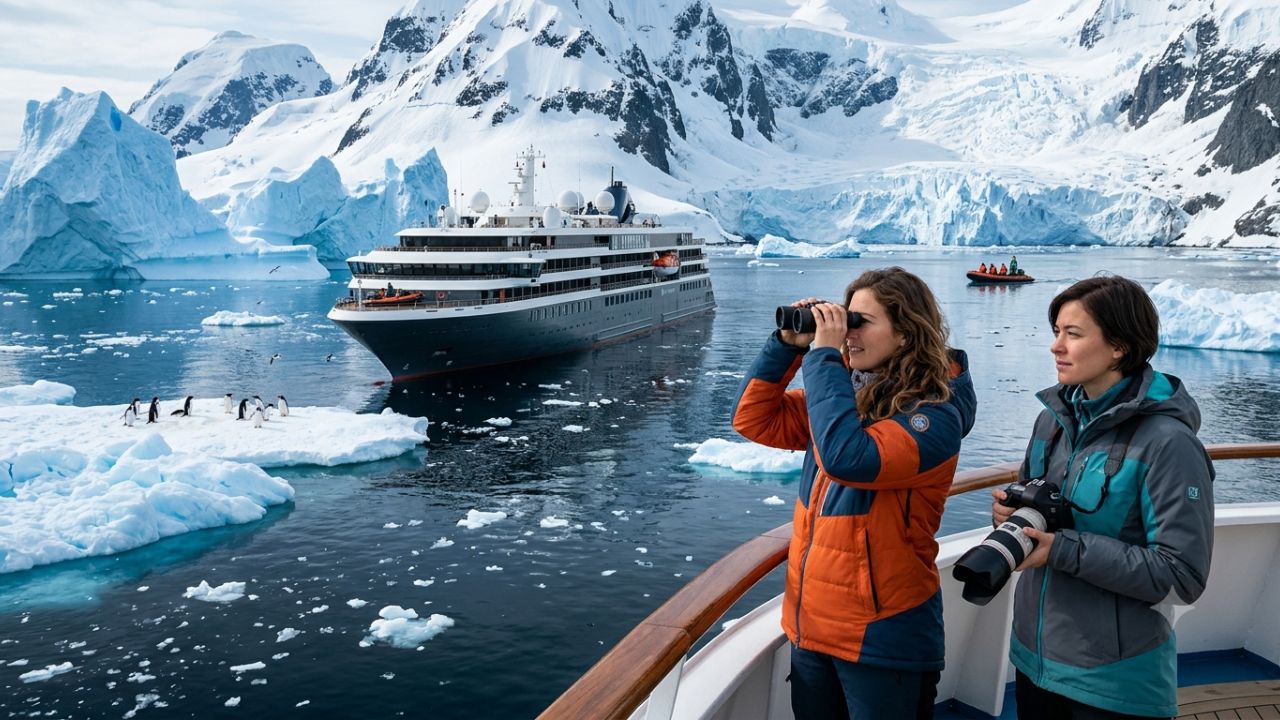
USHUAIA, Argentina — In the sub-polar port of Ushuaia along the windswept shores of the Beagle Channel, the 2026–2027 Antarctic expedition season has formally commenced as luxury ice-class vessels mobilize for deployments into the White Continent.
Following an official operational announcement published on 5 November 2026, Portuguese expedition operator Mystic Cruises has initiated a phased polar program deploying three state-of-the-art expedition vessels: World Navigator, World Voyager, and World Traveller.
Scheduled to operate across the southern polar summer through March 2027, the fleet will navigate the Drake Passage, the South Shetland Islands, and the frozen fjords of the Antarctic Peninsula.
The seasonal deployment began with World Navigator, which initiated its operational program on 8 November after arriving at the Port of Ushuaia on 7 November. Sister vessel World Voyager followed with an operational launch on 10 November, having docked at the Argentine gateway on 6 November.
Meanwhile, World Traveller is completing its trans-Atlantic repositioning voyage to commence Antarctic expedition operations on 21 November.
The 2026–2027 season highlights the dual demands of modern polar expedition travel: delivering high-end luxury in one of the planet's most remote marine environments while adhering to rigorous ecological governance.
Operating under the guidelines of the International Association of Antarctica Tour Operators (IAATO) and the Antarctic Treaty System, this season enforces heightened wildlife protection measures, specifically designed to prevent the introduction and transmission of Highly Pathogenic Avian Influenza (HPAI) across fragile polar penguin and seal colonies.
MYSTIC CRUISES ANTARCTIC EXPEDITION SEASON SCORECARD (2026–2027)
| Category / Entity | Details / Impact |
|---|---|
| Operating Maritime Fleet | 3 Ice-Class Luxury Vessels (World Navigator, Voyager, Traveller) |
| Primary Staging Gateway | Port of Ushuaia, Tierra del Fuego, Argentina (Beagle Channel) |
| Operating Season Duration | November 2026 through March 2027 (Austral Summer Season) |
| World Navigator Launch Date | 8 November 2026 (Vessel Arrived in Ushuaia on 7 November) |
| World Voyager Launch Date | 10 November 2026 (Arrived 6 Nov; Dedicated Full Charter Deployment) |
| World Traveller Launch Date | 21 November 2026 (Trans-Atlantic Repositioning to South America) |
| Commercial Retail Partner | Atlas Ocean Voyages (23 Scheduled Departures Across 6 Formats) |
| Fleet Polar Heritage | Continuous Antarctic Expedition Operations Since 2019 Deployment |
| Primary Landing Craft | Heavy-Duty Motorized Inflatable Zodiac Boats (Off-Grid Landings) |
| International Governance | Antarctic Treaty System & IAATO (Full Operator Membership) |
| Environmental Protocol | Updated 2026–2027 Avian Influenza Biosecurity & Disinfection Rules |
| Treaty Visitor Framework | Resolution 4 (Adopted July 2025 ATCM; General Visitor Guidelines) |
| Max Ashore Passenger Cap | Strictly Capped at 100 Passengers Ashore Simultaneously |
The Three-Ship Fleet Architecture: Ice-Class Engineering & Staggered Deployments
Mystic Cruises has developed an established operational pedigree in polar waters since first launching Antarctic operations in 2019 aboard World Explorer. The deployment of three sister ships for the 2026–2027 season reflects a mature fleet architecture designed specifically for the extreme nautical demands of the Southern Ocean.
Built to Polar Class 6 and 1B ice-class standards, the vessels feature reinforced hulls capable of navigating first-year polar ice, brash ice fields, and narrow glacial channels.
The ships are equipped with advanced hybrid diesel-electric propulsion systems, low-emission Rolls-Royce engines, and forward-looking sonar systems that scan underwater terrain hundreds of meters ahead of the bow.
To eliminate seabed disturbance in pristine Antarctic anchorages, the vessels utilize dynamic positioning systems—computer-controlled thrusters that maintain the ship’s precise geographical coordinates via GPS without dropping physical anchors that could damage delicate benthic ecosystems.
The operational launch dates confirmed by Mystic Cruises on 5 November were deliberately staggered across two weeks:
- World Navigator (8 November 2026): Served as the vanguard vessel, entering active deployment following comprehensive cold-weather systems testing and crew polar safety certifications.
- World Voyager (10 November 2026): Commenced seasonal operations two days later, operating under a specialized full-ship charter agreement arranged with international travel partners.
- World Traveller (21 November 2026): Enters the polar theater following an extended oceanic crossing from European waters, completing the three-vessel deployment.
MYSTIC CRUISES FLEET DEPLOYMENT TIMELINE: 2026–2027 SEASON
| Entity / Route | Metrics | Operational Status |
|---|---|---|
| Vessel Name | Announced Start Date | Commercial Operating Role |
| World Navigator | 8 November 2026 | Atlas Ocean Voyages Core |
| World Voyager | 10 November 2026 | Dedicated Full Charter |
| World Traveller | 21 November 2026 | Atlas Ocean Voyages Core |
| Fleet Operating Horizon | November 2026 – March 2027 | Continuous Polar Season |
Maritime logistics planners emphasize that staggered deployment schedules are an operational necessity in polar cruising. Preparing an expedition ship for Antarctica involves far more than embarking guests and stocking hotel provisions.
Technical teams must test cold-weather ballast water treatment systems, inspect inflatable Zodiac landing craft, certify emergency medical facilities for unassisted operations in sub-zero isolation, and conduct intensive polar survival drills with the bridge team and expedition staff.
By staggering vessel arrivals into Ushuaia between 6 November and late November, shore-side logistics teams prevent dockside congestion while ensuring every vessel receives rigorous pre-departure inspection.
Ushuaia as the Polar Nexus: Logistics at the End of the World
Perched between the Martial Mountain range and the icy waters of the Beagle Channel at 54°48′ South latitude, the Argentine city of Ushuaia functions as the undisputed capital of global Antarctic expedition tourism.
Known colloquially as El Fin del Mundo ("The End of the World"), Ushuaia’s geographical location provides an incomparable strategic advantage: it sits approximately 1,000 kilometers north of the Antarctic Peninsula, representing the shortest navigable ocean crossing to the polar continent.
For Mystic Cruises, Ushuaia serves as the primary operational staging ground. During early November, the port processed the physical arrival of the fleet, with World Voyager tying up at the commercial pier on 6 November, followed by World Navigator on 7 November.
During these dockside turnarounds, the port facilitates vital support operations:
- Bunkering and Technical Provisioning: Loading specialized low-sulfur marine gas oil (MGO) compliant with the Polar Code's strict prohibition on heavy fuel oils in Antarctic waters.
- Cold-Chain Catering Supply: Provisioning high-grade food, fresh produce, and beverage inventories required to sustain passengers and crew for weeks at sea without shore replenishment.
- Expedition Gear Staging: Inspecting and loading drysuits, specialized Muck boots, snowshoes, trekking poles, and deep-sea survival gear into onboard mudrooms.
- Environmental Waste Management: Offloading compacted municipal waste and treated black/gray water in strict compliance with MARPOL Annex IV and V standards, which ban waste discharge in Antarctic Special Areas.
USHUAIA PORT LOGISTICS SEQUENCE: EXPEDITION VESSEL TURNAROUND
| Column 1 |
|---|
| [ Inbound Vessel Docking ] |
| Vessel berths at Ushuaia Commercial Pier; disembarks returning polar passengers. |
| v |
| [ Technical & Bio-Inspections ] |
| Engine maintenance; hull check; deep cleaning and Virkon S biosecurity disinfection. |
| v |
| [ Polar Provisioning & Bunkering ] |
| Loads low-sulfur marine gas oil; stocks cold-storage food; stages Zodiac fuel supplies. |
| v |
| [ Passenger Embarkation ] |
| Guests transfer from Ushuaia hotels; mandatory IAATO briefings & boot fittings. |
| v |
| [ Beagle Channel Departure ] |
| Vessel casts off; navigates Beagle Channel east toward the open Drake Passage. |
For international travelers, Ushuaia offers an essential buffer zone. Polar veterans strongly advise arriving in Tierra del Fuego at least one or two days prior to ship embarkation.
This window insulates travelers against flight delays originating in Buenos Aires, allows lost luggage to catch up with guests, and offers opportunities to explore Tierra del Fuego National Park, hike to the Martial Glacier, or take a catamaran excursion to the sea lion colonies of the Les Eclaireurs Lighthouse.
While Ushuaia serves as the mainline embarkation hub, expedition operators also utilize alternative routing models. Certain specialized itineraries incorporate charter flights connecting Punta Arenas, Chile, directly with King George Island in the South Shetland Islands, allowing travelers to bypass the open waters of the Drake Passage.
Passengers must verify the precise embarkation and disembarkation points recorded on their voyage confirmations.
Zodiac Operations & Dynamic Navigation: The Realities of Polar Expeditioning
The defining element that separates an expedition voyage from a conventional ocean cruise is the operational reliance on small-boat landings and dynamic, weather-dependent navigation.
Antarctica possesses virtually no developed port infrastructure, deepwater piers, or passenger terminals. To transport guests from the ship to the icy shoreline of the Antarctic continent, Mystic Cruises relies on fleets of heavy-duty, motorized inflatable Zodiac boats.
These rugged, multi-chambered craft are capable of navigating shallow rocky waters, pushing through fields of brash ice, and executing "wet landings"—where passengers swing their legs over the pontoon and step directly into ankle-deep polar sea water onto rocky shores, ice shelves, or black volcanic sand.
THE POLAR OPERATIONAL DECISION-MAKING MATRIX (SHORE LANDINGS)
| Column 1 |
|---|
| [ Bridge & Meteorological Assessment ] |
| Master and Expedition Leader evaluate satellite weather models, radar, and ice maps. |
| v |
| [ On-Site Physical Scouting ] |
| Expedition Leader scouts landing bay via Zodiac; checks wind, swell, and brash ice. |
| v |
| [ Wildlife & Biosecurity Check ] |
| Assesses penguin colony behavior; inspects site for wildlife distress or HPAI symptoms. |
| v |
| [ Go / No-Go Determination ] |
| - If Conditions Safe: Execute Zodiac landing (Capped at 100 passengers ashore). |
| - If Conditions Marginal: Pivot to sheltered Zodiac coastal cruising along glacier face. |
| - If Conditions Severe: Cancel landing; reposition ship to alternate lee bay or strait. |
Executing a safe Zodiac operation requires continuous coordination between the ship's Master, the bridge watch officers, the Expedition Leader, and the boat drivers.
Before every landing, an operational assessment is performed:
- Meteorological Scouting: Wind speed and direction are measured. Katabatic winds—dense, cold air rushing down from continental ice caps—can transform a placid bay into a gale-swept hazard within twenty minutes.
- Sea Ice and Swell Evaluation: Shifting ice floes can trap small boats against the shore or block access back to the ship’s sea-level boarding platform. Ocean swells exceeding one meter can make stepping between a Zodiac and the ship's gangway hazardous.
- Wildlife Sensitivity Screening: If nesting seabirds or molting seals exhibit signs of behavioral agitation, or if potential wildlife disease is detected at a site, the landing is immediately aborted to protect fauna.
Mystic Cruises explicitly emphasizes that Antarctic routes, landing sites, and wildlife encounters can never be guaranteed. A planned landing at Neko Harbour may pivot into a Zodiac cruise through the iceberg fields of Pléneau Island, or the vessel may reposition through the Neumayer Channel to seek shelter behind Anvers Island.
Understanding that flexibility is an inherent feature of expedition travel allows passengers to embrace itinerary alterations as authentic exploration rather than disruption.
The 2026–2027 Wildlife Biosecurity Regime: IAATO Avian Flu Precautions
While Antarctica remains one of the world's least disturbed wildernesses, its isolation renders native wildlife acutely vulnerable to introduced biological pathogens.
During the 2026–2027 season, international polar operations are operating under the strictest biosecurity measures in history, coordinated through the International Association of Antarctica Tour Operators (IAATO) in response to the spread of Highly Pathogenic Avian Influenza (HPAI).
Avian influenza represents a severe ecological threat to sub-Antarctic and Antarctic seabird and marine mammal populations, including gentoo, adélie, and chinstrap penguins, wandering albatrosses, giant petrels, and southern elephant seals.
Because these species nest and breed in dense, concentrated colonies, an introduced pathogen could cause devastating mortality.
IAATO 2026–2027 BIOSECURITY & WILDLIFE PROTECTION PROTOCOLS
| Category / Entity | Details / Impact |
|---|---|
| Biosecurity Phase | Mandatory Operational Requirement |
| Home Pre-Departure Inspection | "Don't Pack a Pest": Vacuum luggage, scrub velcro cuffs, |
| clean boot treads, remove seeds, dirt, and plant fibers | |
| Shipboard Boot Wash Stations | Mandatory chemical disinfection with Virkon S biocide |
| before boarding Zodiacs and upon return to the ship | |
| Wildlife Distance Buffers | Maintain minimum 5 meters (15 feet) from all wildlife; |
| increase distance if animals alter behavior or display stress | |
| Ground Contact Restrictions | Strictly prohibited from sitting, kneeling, or placing |
| backpacks, tripods, or camera gear directly on the ground | |
| Behavioral Health Monitoring | Expedition staff survey landing sites for lethargic, sick, |
| or dead wildlife; immediate evacuation if HPAI suspected |
To prevent human visitors from acting as vectors for disease transmission between isolated colonies, IAATO’s updated 2026–2027 operational protocols impose strict behavioral mandates:
- The Virkon S Boot Disinfection Cycle: Every passenger embarking on a Zodiac must scrub their muck boots in high-pressure wash stations using Virkon S, an industrial-grade, biodegradable virucidal disinfectant approved for polar environments. This process is repeated immediately upon stepping off the Zodiac back onto the ship, preventing biological material from one landing site from contaminating the next.
- Prohibition on Ground Contact: Passengers are strictly prohibited from sitting, kneeling, or lying on the snow, rock, or guano. Backpacks, camera bags, and tripods must not be set down on the ground; camera gear must remain securely slung across the body or mounted on monopods. Resting gear on the ground creates a direct surface vector for transferring avian pathogens.
- Wildlife Distance Buffers: Visitors must maintain a minimum distance of five meters (approximately 15 feet) from all penguins, seals, and nesting seabirds. If an animal voluntarily approaches a seated or stationary human, the traveler is instructed to back away slowly to maintain the buffer.
- Site Quarantine Protocols: If expedition guides discover sick, disoriented, or dead birds displaying symptoms of avian influenza at a landing site, the area is placed under immediate biological quarantine, all visitors are evacuated to the ship, and the sighting is logged with the Scientific Committee on Antarctic Research (SCAR) and IAATO.
Antarctic Treaty Governance: Resolution 4 and International Legal Frameworks
The legal framework governing tourism in Antarctica is established by the Antarctic Treaty System (ATS), signed in Washington in 1959.
The 1991 Protocol on Environmental Protection to the Antarctic Treaty (the Madrid Protocol) designates the entire continent as a "natural reserve, devoted to peace and science," establishing that human activities must be planned and conducted to limit adverse impacts on the polar environment.
At the 47th Antarctic Treaty Consultative Meeting (ATCM) held in July 2025, member nations formally adopted Resolution 4, which introduced updated General Guidelines for Visitors to the Antarctic.
These updated treaty guidelines establish enforceable standards regarding waste management, protected area access, historic site conservation, and interactions with scientific research stations.
ANTARCTIC TREATY & IAATO OPERATIONAL FRAMEWORK
| Entity / Route | Metrics | Operational Status |
|---|---|---|
| Governance Entity | Scope of Authority | Core Policy Output |
| Antarctic Treaty System (ATS) | International State Parties; | 1991 Madrid Protocol; |
| Sovereign Environmental Law | ATCM Resolution 4 (2025) | |
| Antarctic Treaty Secretariat | Administrative Coordination; | Site-Specific Visitor |
| Conservation Management Data | Guidelines Database | |
| IAATO (Tour Operators Ass'n) | Industry Self-Regulation; | Ship coordination; |
| Commercial Safety & Operations | Biosecurity protocols | |
| Mystic Cruises Compliance | Vessel Operator & Ship Master | Strict adherence to caps, |
| permits, and biosecurity |
One of the most significant operational constraints mandated by both the Antarctic Treaty System and IAATO is the 100-passenger shore cap.
Regardless of a vessel's total capacity, no more than 100 passengers are legally permitted to be ashore at any single landing site simultaneously.
Because Mystic Cruises' vessels carry small guest complements, the operator can seamlessly manage guest rotations: while one group of 100 guests explores a penguin rookery ashore under the supervision of naturalists, a second group participates in a guided Zodiac cruise exploring marine icebergs or observing feeding humpback whales, rotating positions midway through the excursion.
Atlas Ocean Voyages 2026–2027 Itinerary Portfolio
Mystic Cruises operates as the maritime vessel management company within the broader travel holding group, with commercial retail marketing for individual travelers conducted primarily through luxury brand Atlas Ocean Voyages.
Atlas Ocean Voyages announced its 2026–2027 Antarctic schedule in March 2025, detailing a comprehensive portfolio of 23 departures aboard World Navigator and World Traveller.
Meanwhile, sister vessel World Voyager was placed under dedicated full-ship charter for specialized international tour programs.
The published 2026–2027 deployment comprises six distinct expedition categories:
ATLAS OCEAN VOYAGES 2026–2027 ANTARCTIC EXPEDITION PORTFOLIO
| Entity / Route | Metrics | Operational Status |
|---|---|---|
| Itinerary Category | Duration | Geographical Scope |
| Antarctic Discovery | 9 Nights | Classic Antarctic |
| Peninsula Exploration | ||
| Exploring the Last Continent | 11 Nights | In-Depth Peninsula & |
| South Shetland Islands | ||
| Crossing the Antarctic Circle | 11 Nights | Southern Navigation Past |
| 66°33′ South Latitude | ||
| Drake Express Fly-Cruise | 9 Nights | Air-Cruise via King |
| George Island (No Drake) | ||
| Antarctic & Falklands Advent. | 16 Nights | Falkland Islands (Mal- |
| vinas) & Peninsula | ||
| Grand Antarctica and Beyond | 18 Nights | Falklands, South Georgia |
| & Antarctic Peninsula |
Each itinerary format caters to distinct traveler profiles:
- Antarctic Discovery (9 Nights): The quintessential polar introduction, focusing on the sheltered waters of the Gerlache Strait, Paradise Bay, and the dramatic vertical basalt cliffs of the Lemaire Channel.
- Exploring the Last Continent (11 Nights): Extends the core Peninsula route, providing additional days to navigate iceberg-strewn bays, visit historic scientific outposts, and encounter massive gentoo and chinstrap penguin rookeries.
- Crossing the Antarctic Circle (11 Nights): A specialized southern voyage pushing beyond the landmark 66°33′S parallel into Marguerite Bay, where continuous daylight and dense sea ice define the landscape.
- Drake Express (9 Nights): Designed for travelers seeking to avoid the open ocean swell of the Drake Passage, utilizing private charter flights between Punta Arenas and Frei Station on King George Island to embark the ship directly in Antarctic waters.
- Antarctic and Falklands Adventure (16 Nights): Combines the rugged biodiversity of the Falkland Islands—home to black-browed albatross colonies and five penguin species—with the glacial ice of the Antarctic Peninsula.
- Grand Antarctica and Beyond (18 Nights): The ultimate Southern Ocean expedition, encompassing the Falklands, the wildlife paradise of South Georgia—where hundreds of thousands of king penguins blanket the beaches of Salisbury Plain and St. Andrews Bay alongside massive bull elephant seals—and the Antarctic Peninsula.
EXPEDITION HIGHLIGHT: THE 18-NIGHT GRAND ANTARCTICA & SOUTH GEORGIA ROUTE
| Column 1 |
|---|
| [ Ushuaia Departure ] |
| Embarkation at Ushuaia; sail east across the South Atlantic Ocean. |
| v |
| [ Falkland Islands (Islas Malvinas) ] |
| Port Stanley settlement; rockhopper penguin cliffs; Saunders Island albatross colonies. |
| v |
| [ South Georgia Island (The Serengeti of the South) ] |
| Salisbury Plain (250,000 King Penguins); Grytviken whaling station & Shackleton's grave. |
| v |
| [ South Orkney Islands & Elephant Island ] |
| Glacial sea passages; historical Shackleton Endurance survival camps at Point Wild. |
| v |
| [ The Antarctic Peninsula & South Shetlands ] |
| Deception Island caldera; Neko Harbour continental landing; Lemaire Channel. |
| v |
| [ Drake Passage Return to Ushuaia ] |
| Northbound navigation across Drake Passage; disembarkation at Ushuaia pier. |
Essential Guidance for Polar Travelers
Embarking on an expedition to Antarctica represents a significant undertaking requiring meticulous logistical and physical preparation:
- Verify the Operating Entity: Ensure you confirm whether your booking is managed directly through Atlas Ocean Voyages or through an authorized third-party charter operator, as package inclusions, flight arrangements, and onboard amenities vary across commercial partnerships.
- Mandatory Medical Evacuation Insurance: Operating in Antarctica means traveling thousands of nautical miles from modern hospital facilities. Operators enforce mandatory emergency medical evacuation and repatriation insurance coverage, typically requiring a minimum of $250,000 to $500,000 in coverage limits. Review insurance policy terms carefully to confirm polar maritime activities are explicitly covered.
- Navigating the Drake Passage: The 48-hour crossing of the Drake Passage can alternate between glassy calm ("the Drake Lake") and intense oceanic swells ("the Drake Shake"). Consult a physician prior to departure to secure appropriate preventative motion sickness medication, such as scopolamine transdermal patches or dimenhydrinate tablets, administering them prior to leaving the sheltered waters of the Beagle Channel.
- Polar Layering Principles: Do not rely on a single heavy winter coat. Pack using a three-layer system: moisture-wicking synthetic or merino wool base layers, insulating fleece or down mid-layers, and a fully waterproof, windproof outer shell jacket. Quality waterproof trousers (ski or sailing pants) are compulsory for all Zodiac excursions.
- Equipment Biosecurity Preparation: Before packing outdoor gear at home, inspect all velcro closures, backpack seams, camera bags, and hiking footwear. Thoroughly vacuum pockets and remove any residual seeds, plant fragments, or dirt to comply with IAATO’s "Don't Pack a Pest" biosecurity mandate.
As Mystic Cruises deploys World Navigator, World Voyager, and World Traveller into the Southern Ocean, the 2026–2027 season demonstrates how luxury expedition cruising can coexist with responsible environmental stewardship.
Through ice-class naval engineering, strict adherence to avian biosecurity protocols, and deep respect for the Antarctic Treaty, modern explorers can witness Earth’s greatest frozen frontier while ensuring its ecosystems remain untouched for generations to come.
Related Travel Guides
- Antarctica Cruise Masterclass: Expedition Ships, Crossing the Drake, and Wildlife Guides
- Ushuaia and Tierra del Fuego Travel Guide: Exploring the Southernmost City on Earth
- South Georgia and Falkland Islands Wildlife Expedition: The Ultimate Polar Safari
- IAATO Polar Travel Standards: Biosecurity Protocols, Wildlife Distances, and Permits
This article is for informational purposes. Flight routes, passenger regulations, visa rules, and transit advisories are subject to change by airlines and aviation authorities. Readers are advised to verify schedules and travel documentation with relevant carriers and border agencies before departure.
Related Stories
Australia and Pacific Island Nations Tighten Maritime Borders as New Biosecurity and Digital Entry Rules Reshape Oceania Cruise Tourism
Atlas Ocean Voyages Unveils Grand Voyage Collection Featuring 16 Extended Expeditions Across Europe and the Arctic for 2027–2028