Brazil Opens 2026–2027 Cruise Season as Corazul Buenavista Debuts in Santos Amid 24% Fleet Capacity Expansion

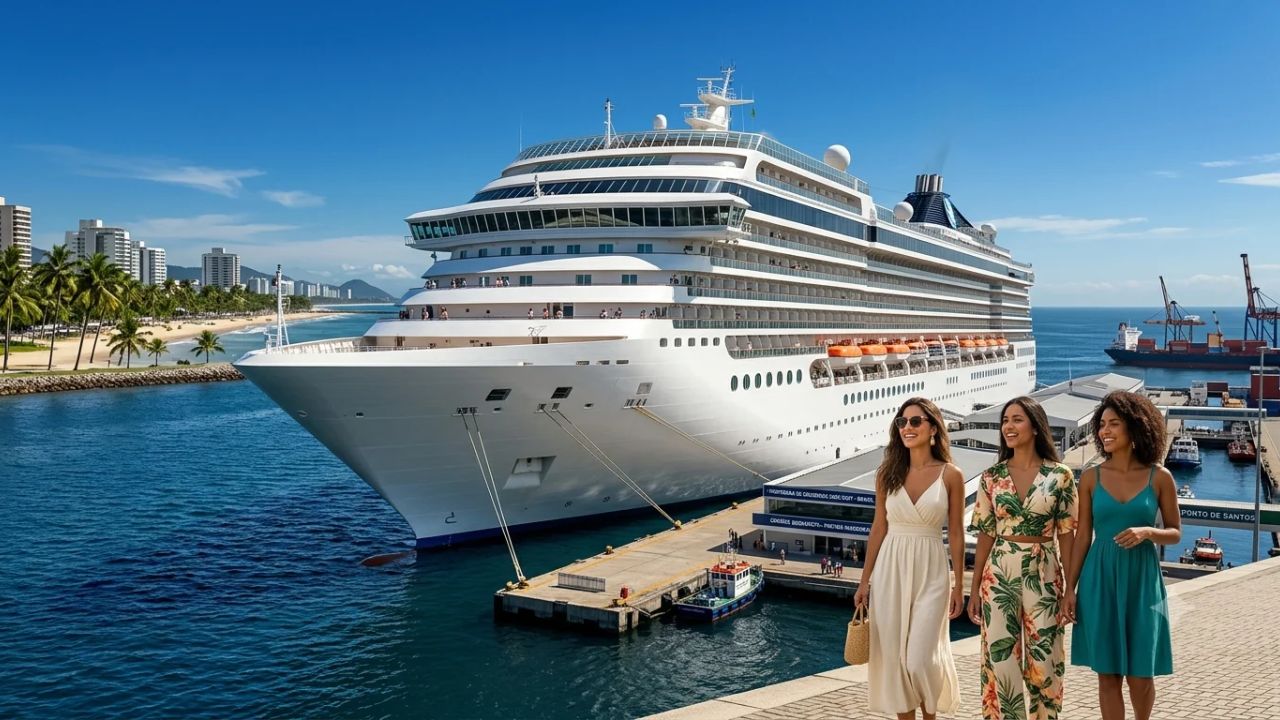
SANTOS, Brazil — Against the backdrop of the active Atlantic quays of the Giusfredo Santini Passenger Terminal, Brazil has officially launched its 2026–2027 cruise season with the historic maiden departure of Corazul Cruceros’ Buenavista.
Departing the Port of Santos on 30 October 2026, the newly revitalized vessel embarked on an inaugural three-night coastal voyage calling at Rio de Janeiro and the resort peninsula of Búzios before returning to Santos on 2 November.
The sailing marked the official entry of the Spanish cruise operator into Brazil’s maritime tourism sector, introducing a fresh brand to a market historically dominated by long-established global lines.
The debut of Buenavista heralds a major expansion across the Brazilian cruise economy. Official forecasts released by the Brazilian Ministry of Tourism confirm that eight vessels will operate regular coastal itineraries during the 2026–2027 summer cycle, representing an increase of approximately 24 percent in available passenger berth capacity compared to the previous season.
With more than 800,000 berths scheduled across approximately 700 port calls through 9 April 2027, the season signals a robust rebound following a contracted 2025–2026 campaign.
Industry leaders MSC Cruises and Costa Cruises are deploying extensive tonnage to support this growth, positioning vessels across major embarkation gateways including Santos, Rio de Janeiro, Salvador, and Itajaí.
From short three-night domestic coastal breaks to nine-night international voyages connecting Brazil with Argentina and Uruguay, the season is projected to generate over R$4.76 billion in national economic activity, supporting more than 72,000 regional jobs across the South American coastline.
BRAZIL 2026–2027 CRUISE SEASON & CORAZUL DEBUT SCORECARD
| Category / Entity | Details / Impact |
|---|---|
| Season Opening Event | Maiden Departure of Corazul Cruceros' "Buenavista" from Santos |
| Inaugural Cruise Date | 30 October 2026 (3 Nights: Santos -> Rio de Janeiro -> Búzios) |
| Inaugural Passenger Terminal | Giusfredo Santini Passenger Terminal (Concais), Santos, São Paulo |
| Operating Cruise Company | Corazul Cruceros (Spanish Maritime Brand; Operations Head: Appeldoorn) |
| Buenavista Specifications | Built 1995 (P&O Cruises); 2026 Refurbishment; 260m; 13 Decks; 939 Cabins |
| Passenger & Crew Capacity | Max 2,140 Guests (1,800 Double-Occupancy Base); ~889 Crew Members |
| Regular Seasonal Fleet Size | 8 Vessels (Corazul: 1; MSC Cruises: 5; Costa Cruises: 2) |
| National Berth Expansion | +24% Year-on-Year Growth (Exceeding 800,000 Available Berths) |
| Total Scheduled Port Calls | Approximately 700 Calls Scheduled Across Brazilian Gateways |
| Official Season Duration | Late October 2026 Through 9 April 2027 (Summer Austral Season) |
| Long-Haul International Calls | 28 International Ships (22 Companies) Making >200 Calls at 32 Ports |
| Santos Port Forecast (Oct 30) | 164 Calls (10 Ships; 7 Companies); ~930,000 Passenger/Crew Moves |
| Regional Economic Forecast | R$1.5 Billion Projected Economic Impact for Baixada Santista (SP) |
| National Economic Projection | R$4.76 Billion Total Economic Activity; >72,000 Jobs Supported |
| Previous Season Baseline | 602,864 Passengers (-28% Contraction in 2025–2026; R$4.28B Impact) |
The Maiden Voyage of Buenavista: Reimagining a Classic Cruise Liner
The arrival of Corazul Cruceros in Brazil represents a calculated commercial investment in the country's domestic vacation market.
On 30 October 2026, the formal commencement of operations at the Concais passenger terminal in Santos was commemorated through the maritime tradition of plaque exchanges between municipal authorities, terminal executives, and ship leadership.
Buenavista enters the South American market not as a newly constructed mega-ship, but as an established, thoroughly revitalized ocean liner. Originally constructed in 1995 for British operator P&O Cruises, the vessel underwent a comprehensive stem-to-stern refurbishment in 2026 before joining Corazul’s fleet.
Measuring approximately 260 meters in length with 13 passenger decks and 939 staterooms, the ship offers a diverse range of accommodations, spanning interior staterooms, ocean-view cabins, private balcony suites, and expansive luxury mini-suites.
Discrepancies in published capacity figures reflect differing maritime reporting standards: while commercial industry bulletins frequently cite an 1,800-passenger baseline based on double-occupancy standards, the Municipality of Santos officially certifies the vessel’s maximum capacity at 2,140 guests when upper pullman berths and sofa beds are occupied.
Supported by a dedicated crew of approximately 889 maritime professionals, the vessel maintains an attentive guest-to-crew ratio exceeding 2.4:1.
Corazul’s market positioning focuses on relaxed Mediterranean hospitality rather than the amusement-park amenities of modern mega-liners.
As Camille Appeldoorn, Corazul’s operations executive, emphasized during inaugural briefings, Buenavista is designed around open, social communal spaces, regional gastronomy, and comfortable lounges that encourage guests to unwind.
The ship’s seasonal deployment comprises itineraries ranging from three to seven nights, allowing the operator to capture both budget-conscious weekenders seeking a brief coastal escape and leisure holidaymakers booking week-long vacations.
CORAZUL BUENAVISTA TECHNICAL & OPERATIONAL PROFILE
| Entity / Route | Metrics | Operational Status |
|---|---|---|
| Maritime Attribute | Certified Specification | Strategic Relevance |
| Operating Line | Corazul Cruceros (Spain) | New market entrant |
| Original Construction Year | 1995 (P&O Cruises Heritage) | Classic nautical profile |
| Comprehensive Revitalization | Completed 2026 Modernization | Updated public venues |
| Length & Vertical Scale | 260 Meters; 13 Passenger Decks | Mid-sized maneuverability |
| Stateroom Inventory | 939 Cabins Across 5 Categories | Interior to Grand Suites |
| Certified Maximum Capacity | 2,140 Guests (1,800 Base Dbl) | High-density flexibility |
| Shipboard Crew Complement | Approximately 889 Crew Members | High service attention |
| Primary Homeports | Santos and Rio de Janeiro | Dual embarkation gateways |
Port of Santos as the South American Cruise Engine: Forecasts and Regional Yield
The Port of Santos, situated on the Atlantic coastline of São Paulo state, functions as the central logistical nexus of the South American cruise industry.
Serving a primary catchment area encompassing the Greater São Paulo metropolitan region—home to more than 21 million residents and the economic center of Brazil—Santos enables millions of domestic travelers to access ocean voyages without purchasing expensive interstate or international airfares.
Municipal data published by the Municipality of Santos on 30 October 2026 highlights the substantial volume anticipated at the Giusfredo Santini Passenger Terminal:
- Ship Movements: The port projects 164 ship calls between late October 2026 and 4 April 2027, hosting ten different cruise vessels operated by seven distinct international cruise lines.
- Passenger and Crew Throughput: Total throughput is forecast to reach approximately 930,000 movements, encompassing embarkations, disembarkations, and in-transit day visitors.
- Evolution of Estimates: These figures represent an upward revision from planning estimates released in September 2026, which initially anticipated 146 calls and roughly 785,000 passenger movements. The upward adjustment reflects expanded charter commitments and additional vessel rotations scheduled by operators as consumer booking momentum solidified.
PORT OF SANTOS (CONCAIS) CRUISE TRAFFIC PROJECTIONS (2026–2027)
| Entity / Route | Metrics | Operational Status |
|---|---|---|
| Planning Baseline | Projected Port Calls | Projected Passenger Moves |
| September Preliminary Model | 146 Scheduled Calls | ~785,000 Total Movements |
| October 30 Updated Forecast | 164 Scheduled Calls (+12.3%) | ~930,000 Total Movements |
| Participating Cruise Lines | 7 Distinct Cruise Companies | Corazul, MSC, Costa, etc. |
| Participating Fleet Size | 10 Individual Ocean Liners | Regular & Transatlantic |
| Regional Economic Impact | R$1.5 Billion Output Projected | Baixada Santista Region |
The economic influence of this maritime activity extends far beyond the port perimeter. The São Paulo State Tourism Authority projects that the 2026–2027 cruise season will inject approximately R$1.5 billion into the regional economy of the Baixada Santista.
Travelers embarking in Santos frequently reserve overnight stays at local beachfront hotels in Santos and neighboring Guarujá, patronize traditional seafood restaurants along the waterfront, and utilize local taxi networks, executive shuttles, and municipal parking facilities.
Additionally, port authority concessionaires and maritime supply companies generate substantial commercial revenues through provisioning fresh provisions, technical maintenance, bunkering, and dockside baggage handling.
Macroeconomic Rebound: Reversing the 2025–2026 Slump
The aggressive 24 percent capacity expansion slated for the 2026–2027 season is an essential recovery measure following a difficult 2025–2026 operating cycle.
Official retrospective data released by Brazil’s Ministry of Ports and Airports reveals that the 2025–2026 domestic cruise season experienced a sharp 28 percent contraction compared to the preceding year.
Only 602,864 passengers embarked on domestic coastal cruises across the entire season, with operators limiting deployment to seven regular vessels. While 21 foreign long-haul ships visited 35 Brazilian destinations on international repositioning itineraries, domestic volume suffered under the weight of elevated operational fuel costs, port concession fees, and domestic economic caution.
Despite the reduced passenger volume, the economic contribution of the 2025–2026 season was substantial:
- Direct Economic Impact: Generating R$4.28 billion in total economic turnover.
- Expenditure Breakdown: R$2.28 billion was generated directly by cruise line operational expenses, port charges, logistics, and crew wages, while R$2.0 billion was spent by embarking guests and in-transit passengers.
- Employment & Tax Generation: The sector supported 64,500 direct, indirect, and induced jobs, generating R$166.3 million in federal and municipal tax receipts.
BRAZILIAN CRUISE INDUSTRY PERFORMANCE: 2025–2026 ACTUALS VS. 2026–2027 TARGETS
| Entity / Route | Metrics | Operational Status |
|---|---|---|
| Industry Indicator | 2025–2026 Completed Actuals | 2026–2027 Official Targets |
| Regular Domestic Vessels | 7 Coastal Ships Deployed | 8 Coastal Ships Deployed |
| Total Embarked Passengers | 602,864 Guests (-28% YoY Drop) | Targeting Rebound Growth |
| Total Available Berth Capacity | ~650,000 Berths Offered | >800,000 Berths (+24%) |
| Total Scheduled Port Calls | ~550 Coastal Ship Calls | ~700 Scheduled Calls |
| Total Economic Output | R$4.28 Billion Turnover | R$4.76 Billion Projected |
| National Employment Supported | 64,500 Jobs Across Supply Chain | >72,000 Jobs Projected |
| International Cruise Inbound | 21 Vessels Visiting 35 Ports | 28 Vessels (22 Companies) |
For the 2026–2027 season, the Ministry of Tourism anticipates that expanding available capacity to over 800,000 berths across approximately 700 calls will drive total economic output above R$4.76 billion and expand employment to more than 72,000 positions nationwide.
Additionally, international maritime tourism will expand in parallel: 28 foreign cruise ships operated by 22 international companies are scheduled to make more than 200 port calls across 32 Brazilian coastal cities and remote Amazonian river ports, bringing high-spending foreign travelers into regional ports such as Manaus, Parintins, Fortaleza, and Recife.
The Eight-Ship Seasonal Fleet: MSC, Costa, and Corazul
The core domestic cruise season running through 9 April 2027 is powered by eight dedicated ocean liners operated by three distinct cruise organizations:
THE REGULAR 2026–2027 BRAZILIAN COASTAL FLEET DEPLOYMENT
| Entity / Route | Metrics | Operational Status |
|---|---|---|
| Cruise Line | Ship Name | Strategic Deployment |
| Corazul Cruceros | Buenavista | New market entrant; 3- to |
| 7-night coastal sailings | ||
| MSC Cruises | MSC Divina | Mega-ship deployment; |
| diverse family cabins | ||
| MSC Cruises | MSC Musica | Classic premium coastal |
| itineraries & mini-trips | ||
| MSC Cruises | MSC Seaview | Seaside-class architecture |
| expansive outdoor decks | ||
| MSC Cruises | MSC Splendida | Fantasia-class luxury |
| MSC Yacht Club suites | ||
| MSC Cruises | MSC Virtuosa | Flagship modern tonnage; |
| immersive entertainment | ||
| Costa Cruises | Costa Diadema | Short coastal getaways & |
| 7-night Mercosur cruises | ||
| Costa Cruises | Costa Serena | Refurbished 8–9 night |
| Rio departures to Plata |
A detailed examination of the fleet reveals clear product segmentation:
- MSC Cruises’ Five-Ship Armada: Swiss-based MSC Cruises dominates the market in total passenger capacity, deploying five distinct vessels. The fleet features the MSC Seaview—a ship designed with an expansive 360-degree oceanfront promenade specifically engineered for warm-weather cruising—alongside modern flagships MSC Virtuosa, MSC Splendida, MSC Divina, and MSC Musica. These vessels provide comprehensive resort amenities, Broadway-scale theatrical productions, extensive children's clubs, and the exclusive "ship-within-a-ship" MSC Yacht Club enclave for premium guests.
- Costa Cruises’ Dual Deployment: Italian operator Costa Cruises is deploying two prominent liners. Costa Diadema operates from Santos and Itajaí, balancing short three- and four-night mini-cruises to Ilhabela with seven-night international voyages crossing the Rio de la Plata to Buenos Aires and Montevideo. Meanwhile, Costa Serena returns to Brazil following an extensive refurbishment, operating eight- and nine-night extended itineraries departing from Rio de Janeiro. While the vessel is included in Costa’s broader December 2026–April 2027 South American season, its dedicated Brazilian turnaround departures commence in early January 2027 following an extended positioning voyage.
- Corazul Cruceros’ Buenavista: Serving as an alternative for travelers seeking a more relaxed, classic maritime environment, offering dual embarkation ports in Santos and Rio de Janeiro.
CORAZUL BUENAVISTA ITINERARY BLUEPRINT: DESTINATIONS & PORTS
| Column 1 |
|---|
| [ SHORT COASTAL ESCAPES (3–4 Nights) ] |
| - Embarkation: Santos or Rio de Janeiro. |
| - Calls: Búzios (Armação beach & Rua das Pedras), Ilhabela (waterfalls & sailing), |
| Cabo Frio (Prai do Forte white sands), Balneário Camboriú (Unipraias cable cars). |
| v |
| [ EXTENDED CULTURAL VOYAGES (6–7 Nights) ] |
| - Embarkation: Santos and Rio de Janeiro. |
| - Extended Coastal Run: Navigating north along the Bahia coastline. |
| - Signature Anchor: Overnight port stay in Salvador, Bahia. Guests explore historic |
| Pelourinho, Afro-Brazilian culinary traditions, and coastal lighthouses over two days. |
Regional Port Topology: Spreading Economic Impact Beyond Santos
While Santos captures the highest individual share of cruise calls, Brazil’s 2026–2027 cruise itinerary topology distributes maritime tourism across hundreds of kilometers of Atlantic coastline.
Official Ministry of Tourism planning figures illustrate the geographic spread of scheduled port calls:
SELECTED BRAZILIAN CRUISE PORT CALL FORECASTS (2026–2027)
| Entity / Route | Metrics | Operational Status |
|---|---|---|
| Coastal Destination | State / Region | Forecast Cruise Calls |
| Santos | São Paulo (Southeast) | 161 Calls (164 Municipal) |
| Rio de Janeiro | Rio de Janeiro (Southeast) | 125 Calls |
| Búzios | Rio de Janeiro (Southeast) | 108 Calls (Tender Port) |
| Ilhabela | São Paulo (Southeast) | 60 Calls (Island Tender) |
| Balneário Camboriú | Santa Catarina (South) | 52 Calls (Atracadouro) |
| Salvador | Bahia (Northeast) | 47 Calls (Heritage Hub) |
| Itajaí | Santa Catarina (South) | 40 Calls (Regional Hub) |
| Maceió | Alagoas (Northeast) | 26 Calls (Tropical Hub) |
Each destination serves a distinct strategic function within the national itinerary framework:
- Rio de Janeiro (Pier Mauá): With 125 scheduled calls, Rio serves as Brazil's premier international tourist gateway and secondary domestic turnaround hub. Its terminal at Pier Mauá allows guests to step directly into the Porto Maravilha cultural district, within minutes of the Museum of Tomorrow and historic downtown sites.
- Búzios & Ilhabela: Functioning as premier tender ports, Búzios (108 calls) and Ilhabela (60 calls) deliver scenic beach relaxation without commercial container port infrastructure. Ships anchor offshore in sheltered bays, ferrying guests ashore via tender boats to explore cobblestone villages, coastal nature reserves, and sailing bays.
- Balneário Camboriú & Itajaí: In the southern state of Santa Catarina, Itajaí (40 calls) acts as an established commercial turnaround hub, while neighboring Balneário Camboriú (52 calls) continues its rapid expansion as a lifestyle homeport. The private cruise terminal at Atracadouro Barra Sul, equipped with integrated customs and immigration screening facilities, allows passengers from southern Brazil to board voyages directly.
- Salvador & Maceió: In the tropical Northeast, Salvador (47 calls) provides rich historical immersion, while Maceió (26 calls) serves as a northern turnaround and transit stop, celebrated for its coral reefs and emerald lagoons.
- Paranaguá’s Strategic Return: In Paraná state, the historic port city of Paranaguá returns to the regular cruise schedule, offering travelers access to colonial architecture, the protected Atlantic Rainforest reserves of the Serra do Mar, and the historic Curitiba-Paranaguá mountain railway.
RECOMMENDED 4-DAY BRAZILIAN COASTAL MINI-CRUISE ITINERARY
| Column 1 |
|---|
| DAY 1: SANTOS EMBARKATION & ATLANTIC SUNSET |
| - 11:00: Transfer from São Paulo to Concais Passenger Terminal in Santos. |
| - 13:00: Check-in and embark Buenavista; welcome poolside lunch on Lido Deck. |
| - 17:00: Ship casts off; scenic departure along the Santos beachfront garden promenade. |
| - 20:00: Multi-course Mediterranean dinner followed by evening live acoustic lounge. |
| DAY 2: TROPICAL ISLAND RELAXATION IN ILHABELA |
| - 08:00: Anchor in the sheltered channel of Ilhabela; tender ashore to Vila historic. |
| - 09:30: 4WD excursion to secluded Praia dos Castelhanos through Atlantic Rainforest. |
| - 13:00: Fresh grilled seafood lunch at a beachside kiosk overlooking turquoise waters. |
| - 16:00: Browse local artisan shops; return to ship via tender boat. |
| - 19:30: Sunset cocktails on the aft deck while sailing toward Rio de Janeiro state. |
| DAY 3: PENINSULA GLAMOUR IN ARMAÇÃO DOS BÚZIOS |
| - 08:30: Arrive in Búzios; tender transfer to the Armação waterfront pier. |
| - 10:00: Schooner cruise exploring the pristine calas of Azeda, Azedinha, and João |
| Fernandes beaches. |
| - 13:30: Stroll the iconic cobblestones of Rua das Pedras; enjoy upscale seaside dining. |
| - 16:30: Afternoon visit to the Brigitte Bardot statue and seaside lookout points. |
| - 18:30: Evening departure navigating south along the Atlantic coastline. |
| DAY 4: SANTOS RETURN & SÃO PAULO CONNECTION |
| - 07:00: Early morning docking at Concais Terminal in Santos. |
| - 08:30: Disembarkation and baggage retrieval; private shuttle transfer to São Paulo. |
| - 11:30: Arrive at Guarulhos (GRU) or Congonhas (CGH) airports for onward flights. |
Essential Guidance for South American Cruise Travelers
Travelers considering an ocean cruise along the Brazilian coastline during the 2026–2027 season should keep several practical operational considerations in mind:
- Domestic vs. International Documentation: For domestic coastal itineraries operating exclusively between Brazilian ports (e.g., Santos to Búzios, Ilhabela, or Salvador), Brazilian citizens require only official government photo identification (RG, CNH, or passport), while foreign tourists must present the original passport used to enter Brazil. However, for voyages calling at international ports in Argentina (Buenos Aires) or Uruguay (Montevideo, Punta del Este), all passengers must hold valid passports, and non-exempt international nationalities must secure applicable Mercosur entry visas or reciprocity permits.
- Santos Port Ground Transportation Logistics: The Port of Santos is located approximately 80 kilometers from central São Paulo. Travelers transferring from São Paulo/Guarulhos International Airport (GRU) or Congonhas Airport (CGH) must navigate the Anchieta-Imigrantes highway system, which experiences heavy freight truck traffic and holiday weekend congestion. Allow a minimum buffer of three to four hours between domestic flight arrivals and cruise check-in windows.
- Dual Embarkation Verification: Because vessels like Buenavista and Costa Serena offer dual embarkation options across Santos and Rio de Janeiro, passengers must carefully verify the departure city recorded on their booking confirmation before finalizing flights and hotel arrangements.
- Onboard Spending and Currency: While major international cruise lines transact onboard accounts in US Dollars (USD) or Euros (€), domestic itineraries frequently offer Brazilian Real (BRL) price parity for beverage packages, specialty dining, and shore excursions. Verify foreign transaction fees with your credit card provider prior to embarkation.
As Brazil’s 2026–2027 cruise season gains momentum, the arrival of Corazul Cruceros’ Buenavista and the deployment of eight high-capacity coastal vessels demonstrate that South America’s premier maritime market has entered a dynamic phase of competitive expansion.
By pairing historic port infrastructure with diverse coastal itineraries, Brazil is positioning its tropical shoreline as one of the world's most attractive, accessible, and economically vital cruise playgrounds.
Related Travel Guides
- Brazil Travel Masterclass: Exploring Rio de Janeiro, São Paulo, and Coastal Paradises
- South American Cruise Masterclass: Itineraries, Transatlantic Routes, and Mercosur Ports
- Port of Santos and Baixada Santista Guide: Terminals, Transfers, and Historic Sights
- Salvador da Bahia Cultural Immersion: Pelourinho, Afro-Brazilian Cuisine, and Coastal Heritage
This article is for informational purposes. Flight routes, passenger regulations, visa rules, and transit advisories are subject to change by airlines and aviation authorities. Readers are advised to verify schedules and travel documentation with relevant carriers and border agencies before departure.
Related Stories
Australia and Pacific Island Nations Tighten Maritime Borders as New Biosecurity and Digital Entry Rules Reshape Oceania Cruise Tourism
Atlas Ocean Voyages Unveils Grand Voyage Collection Featuring 16 Extended Expeditions Across Europe and the Arctic for 2027–2028