
Melbourne Ignites a New Billion Transport Revolution as Giant Surprise Redraw Australia’s Future of Travel
Melbourne Ignites a New Billion Transport Revolution as Giant Surprise Redraw Australia’s Future of Travel

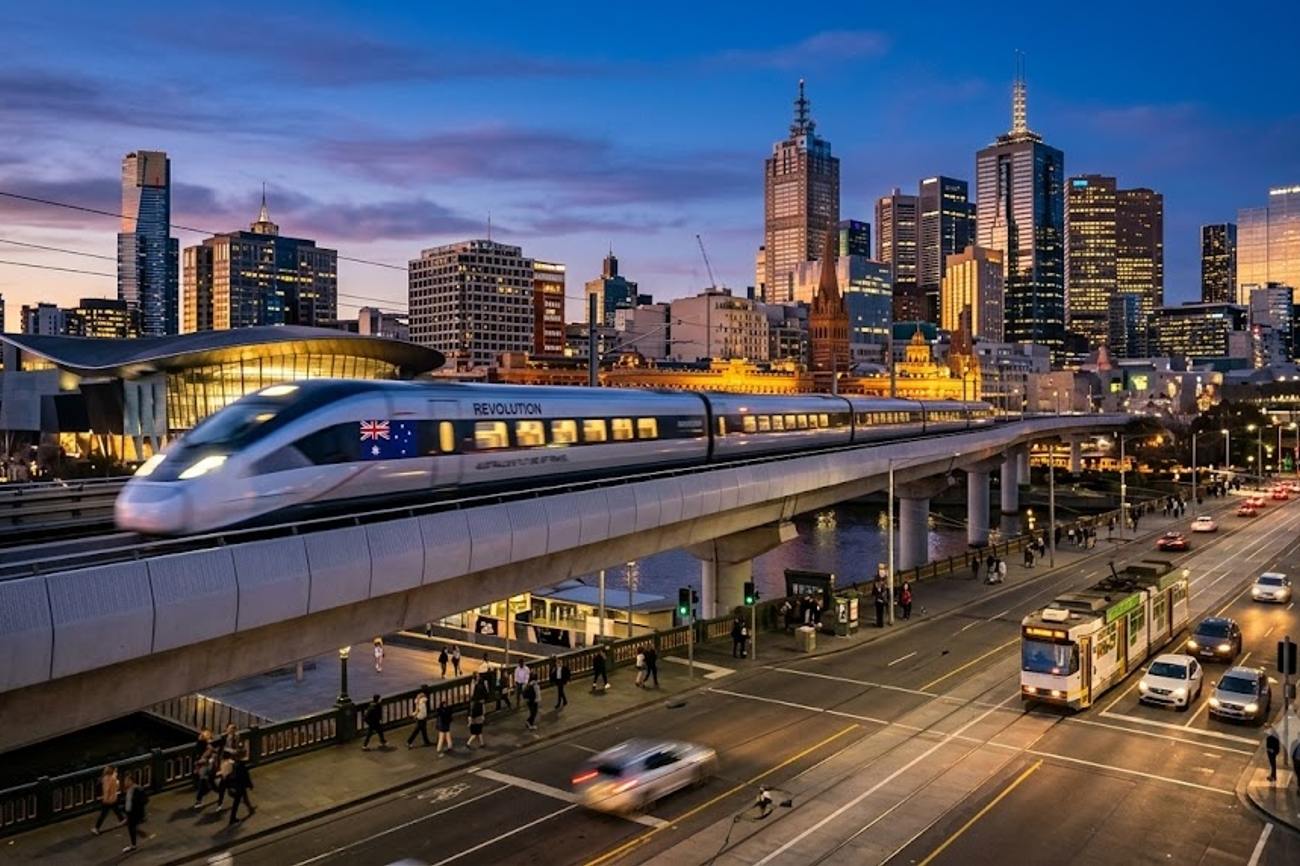
Image generated by AI
Melbourne is currently deploying an "umbilical launch" tunnelling method for the first time in the state's history, allowing massive boring machines to begin excavating while their rear components are still being connected. This high-stakes engineering gamble is part of a desperate attempt to weave a multi-billion-dollar rail network beneath one of the most densely populated urban environments in the Southern Hemisphere without paralyzing the city above.
The Great Rail Pivot of 2026
Melbourne is currently in the midst of a financial and structural reckoning. While the city is physically digging deeper than ever before, the Victorian Government is simultaneously slashing the project's ambitions to keep the budget from spiraling. As of September 14, 2026, the city has officially entered the tunnelling phase of the Suburban Rail Loop (SRL) East, but this milestone arrives alongside a ruthless $2 billion pruning of the original plans.
Under the leadership of Premier Ben Carroll, the state has moved to strip away what it deems "unnecessary additions." The impact is tangible: the dream of seamless underground interchanges at Box Hill and Glen Waverley has vanished, replaced by surface-level pedestrian transfers. Other casualties include a second entrance at Clayton, pedestrian bridges at Burwood and Cheltenham, and a planned multi-level parking facility at Glen Waverley.
The financial pressure is so acute that the government has launched an independent technical review to find another $1 billion in savings, freezing all new station construction contracts until the audit is complete. To further trim the fat, the independent Suburban Rail Loop Authority is being dissolved and absorbed into the Victorian Infrastructure Delivery Authority to eliminate administrative overlap. Despite these cuts, the federal government remains a steadfast partner, with Prime Minister Anthony Albanese increasing Commonwealth commitments to over $6 billion.
Reimagining the Middle Suburbs
What makes the SRL East fundamentally different from previous Melbourne expansions is its geometry. Rather than the traditional "hub-and-spoke" model where every line leads to the CBD, this 26-kilometre twin-tunnel network is designed to connect the middle suburbs—specifically the stretch between Cheltenham and Box Hill—directly to one another.
The scale of the operation is staggering. Two massive Tunnel Boring Machines (TBMs), named Alice and Hacia, are currently chewing through the earth. Alice has already begun her journey from the Burwood launch site toward Glen Waverley. This isn't just about moving people; it is an attempt to decentralize the city, turning suburban hubs into self-sustaining economic centers so that residents no longer have to travel through the city center just to reach a neighboring suburb.
Parallel to this is the $12 billion Melbourne Airport Rail Link. This 27-kilometre dedicated line is finally moving forward, backed by a $7 billion federal investment. In a strategic move, the airport link will utilize the Metro Tunnel—which entered full service earlier in 2026 following the "Big Switch" timetable overhaul—to funnel passengers directly into the heart of the city. For a city that has relied on buses and rideshares for airport access for decades, this represents a total shift in the urban experience.
Visitor Insider Tips
Navigating Melbourne during this era of "mega-construction" requires a local's strategy. The city is currently a grid of diversions, but the rewards for those who know where to look are significant.
Timing Your Transit: If you are staying in the eastern suburbs, avoid the Burwood and Glen Waverley corridors during peak morning hours. The surface-level construction for the SRL East creates unpredictable bottlenecks. Instead, utilize the Public Transport Victoria (PTV) app in real-time; the "Big Switch" timetable changes from early 2026 have fundamentally altered how trains move, and static maps are often obsolete.
The "Middle Suburb" Exploration: While the tunnels are being dug, the areas of Box Hill and Glen Waverley are evolving. Box Hill is effectively Melbourne's second CBD; visit the local markets for some of the city's best authentic Asian cuisine, but do so on weekday afternoons to avoid the crushing commuter crowds.
Airport Logistics: Until the Airport Rail Link is operational, do not rely on standard taxis during peak hours. The SkyBus remains the most reliable transit, but for a more local experience, consider the airport-to-city shuttle services that operate on the perimeter roads to avoid the Tullamarine Freeway congestion.
Neighborhood Base: For those wanting to experience the "new" Melbourne, base yourself in the inner north or the CBD. This allows you to utilize the newly opened Metro Tunnel infrastructure, which provides far faster access to the city's cultural precincts than the old radial lines.
Cultural and Environmental Context
The Suburban Rail Loop is more than a transport project; it is a flashpoint for Melbourne's identity crisis. The tension between the $95 billion estimated total cost—according to outside analysts—and the government's need to cut spending reflects a broader global struggle: how to build "future-proof" infrastructure without bankrupting the present.
Environmentally, the move toward a decentralized rail loop is a bid to reduce the city's reliance on cars in the sprawling eastern suburbs. By connecting Cheltenham to Box Hill, the city hopes to slash carbon emissions from thousands of daily commutes. However, the physical act of tunnelling through a developed metropolitan area brings significant challenges in soil displacement and urban vibration.
There is also a social dimension to the "scope reductions." The removal of underground interchanges and pedestrian bridges has sparked debate about accessibility. Locals argue that by reverting to surface-level transfers to save money, the government is compromising the "world-class" nature of the project and potentially marginalizing those with mobility issues. The absorption of the SRL Authority into a larger government body also signals a shift from a "visionary" project phase to a "delivery" phase, where efficiency is prioritized over architectural ambition.
FAQ: Visiting Melbourne 2026
What is the best way to get from the airport to the city right now? Until the $12 billion Airport Rail Link is completed, the SkyBus or ride-share services are the primary options. Check current traffic on the Tullamarine Freeway before departing, as construction diversions are common.
How has the "Big Switch" affected travel within the city? The Big Switch overhauled the entire Metro timetable to accommodate the new Metro Tunnel. You must use the PTV app or digital signage, as old printed timetables are no longer accurate for most city lines.
Will the construction affect my visit to the eastern suburbs? Yes, particularly around Burwood, Glen Waverley, and Box Hill. Expect surface-level diversions and noise. However, the core commercial hubs remain open and accessible.
Is the Metro Tunnel open to the public? Yes, the Metro Tunnel entered full service in early 2026 and is now the primary artery for moving through the CBD, providing faster connections than the previous rail configuration.
Melbourne is currently a city in transition, trading the polish of a blueprint for the grit of a construction site.
Tags: MelbourneRail2026, SuburbanRailLoop, MetroTunnelMelbourne, VictoriaTransport, MelbourneAirportRail
Related Travel Guides
- Bosnia and Herzegovina Sees a Foreign Tourism Drop in 2026 But the Numbers Hide an Unexpected Twist
- Kentucky Rock Climbing And Water Sports Travel Boom Delivers Unmatched Adrenaline Across Scenic Lands, Find Out Now
- Michigan Aligns Wisconsin and Illinois Could Be Hit by Thanksgiving Snow as US Holiday Travel Warning Grows
Disclaimer
This article is for informational and educational purposes only. It does not constitute legal, financial, or professional advice. While we strive to provide accurate and up-to-date information, travel policies, regulations, and conditions change rapidly. Always verify information with official sources before making travel decisions. Nomad Lawyer makes no representations about the accuracy, reliability, completeness, or suitability of the information provided. Readers should consult qualified professionals for advice specific to their circumstances. The views expressed in this article are those of the author and do not necessarily reflect the views of Nomad Lawyer.
Raushan Kumar
Founder & Lead Developer
Full-stack developer with 11+ years of experience and a passionate traveller. Raushan built Nomad Lawyer from the ground up with a vision to create the best travel and law experience on the web.
Learn more about our team →