Alaska Air Group Warns of $700 Million Loss as Fuel Costs and 200 Job Cuts Challenge Seattle Hub Expansion


Even as Alaska Air Group generated record quarterly revenue of US$4.3 billion and expanded premium ticket earnings by 25%, an unprecedented US$1.8 billion surge in jet fuel expenditures has forced the carrier into emergency fiscal discipline. In a candid internal communication delivered to staff on 30 October 2026, Chief Executive Officer Ben Minicucci revealed that persistent cost pressures could trigger an adjusted pre-tax loss of up to US$700 million for the 2026 fiscal year. This sobering projection marks the company's first non-pandemic operating deficit since 2003. To stem rising overhead without curtailing aircraft operations, the group announced the immediate elimination of approximately 200 non-contract management and administrative roles across Alaska Airlines and newly integrated Hawaiian Airlines, even as leadership insists its long-haul international expansion from Seattle-Tacoma International Airport will proceed on schedule.
Alaska Air Group's $700 Million Loss Warning and Strategic Restructuring
The financial shockwave rippling through the Pacific Northwest airline stems directly from volatile energy markets triggered by Middle East conflicts. Economic fuel assumptions for the fourth quarter of 2026 indicate jet kerosene prices will hover between US$4.65 and US$4.85 per gallon. That single quarterly metric represents an expenditure overrun of roughly US$650 million beyond original budget models, driving full-year fuel obligations US$1.8 billion above initial annual projections.
To control administrative overhead, Alaska Air Group is eliminating roughly 200 non-contract staff positions, representing less than 1% of its 32,500-strong overall workforce. Official state filings and corporate notices confirm that 125 of these positions are based in Washington state, while 48 positions originate in Hawaii. Within the Hawaiian subsidiary, approximately 40 positions will be abolished permanently, while eight personnel have been extended internal redeployment opportunities. Impacted employees received notification that official employment separation takes effect on 13 November 2026, with salary continuation guaranteed through 31 December 2026 alongside severance packages and career transition support.
Notably for passenger operations, frontline operational positions remain shielded from these workforce measures. Flight crews, commercial pilots, cabin attendants, station ramp agents, and line aircraft maintenance mechanics will experience no reductions. In Honolulu, executive operational leadership is transitioning as head of operations Jim Landers and guest operations chief Shelly Parker retire toward the close of 2026, after which their roles will be dissolved into the consolidated parent management hierarchy. The corporate restructuring follows the 18 September 2024 closure of the US$1.9 billion Hawaiian Airlines acquisition, an ambitious merger designed to establish a dominant Pacific aviation network connecting the US West Coast with Asia, Oceania, and Europe.
What Sets the Seattle Gateway Strategy Apart
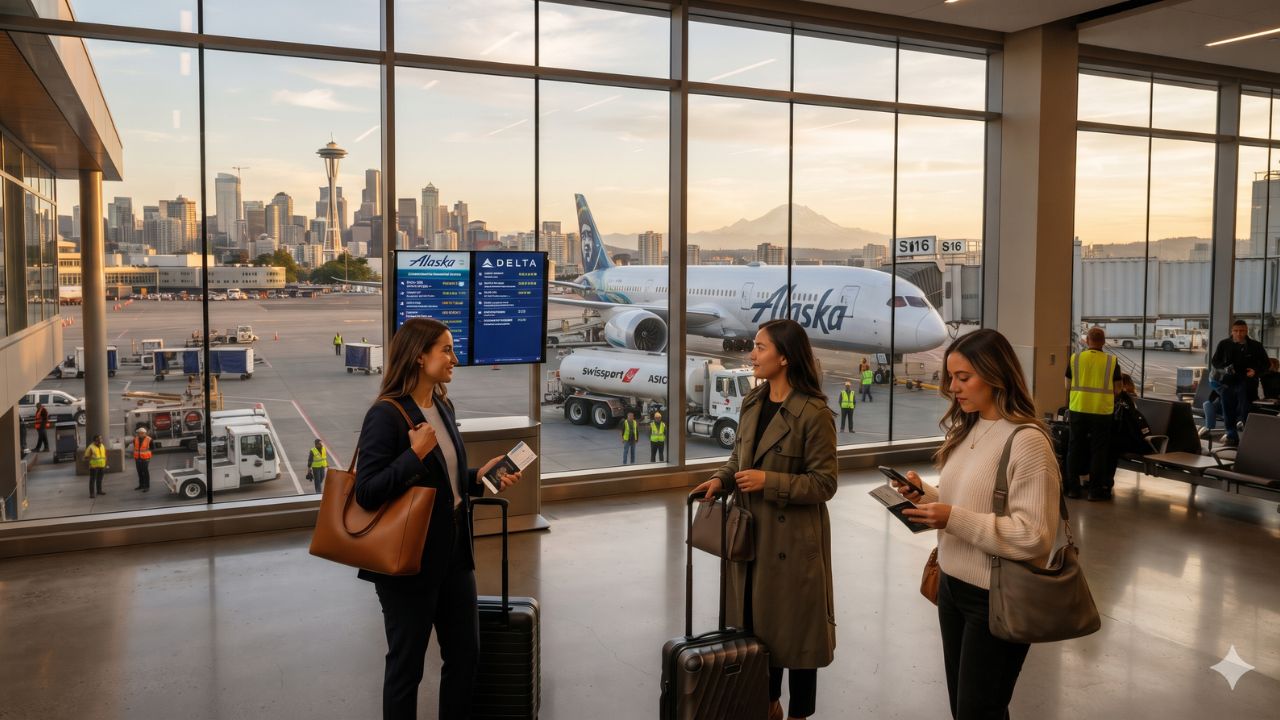
Rather than retreating into defensive domestic retrenchment, Alaska Air Group is defending the strategic investments that anchor its long-term future. At the core of this enterprise lies Seattle-Tacoma International Airport, where Alaska management aims to assemble at least 15 flagship long-haul international routes by 2030. As of October 2026, the carrier has announced nine intercontinental destinations, anchored by spring 2027 inaugurations to Paris, Athens, Osaka, and Papeete.
Unlike legacy hub competitors in Chicago or Atlanta, Alaska is pursuing a dual-brand strategy that pairs domestic feeder density with widebody international reach. Premium travel demand continues to outpace standard economy travel across its network. During the third quarter of 2026, premium seat sales expanded by 25%, generating more than 36% of Alaska Air Group's overall passenger revenue. Diversified commercial streams—encompassing cargo, regional operations, and partner ventures—now account for 54% of total group turnover. Remuneration from the co-branded Mileage Plan loyalty portfolio grew 21% year-on-year to US$721 million.
To capture international premium travelers, the carrier is investing heavily in cabin interiors. Long-haul services aboard incoming Boeing 787 widebody jets and Hawaiian’s Airbus A330 fleet will showcase Aurora and Leihōkū business class suites, featuring lie-flat seating, regional culinary offerings, and curated beverage programs. In addition, management has confirmed the introduction of Premium Reserve, a dedicated international premium economy product scheduled to enter service in 2028.
Financial Metrics and Industry Cost Pressures
Alaska Air Group's third-quarter financial statement for the period ending 30 September 2026 illustrates the stark divergence between passenger demand and operating margins. Overall group revenue advanced 14% year-on-year to US$4.3 billion, supported by a 2.4% capacity expansion and an 11.7% surge in revenue per available seat mile (RASM). However, higher fuel bills pushed reported GAAP net performance to a loss of US$147 million. On an adjusted operating basis, the net loss totaled US$35 million, though adjusted net income stood at US$49 million when excluding specific tax impacts.
Despite the projected annual loss, Alaska holds substantial financial reserves. As of 30 September 2026, the company maintained US$3.3 billion in available liquidity through cash holdings, marketable securities, and undrawn revolving credit lines. The enterprise generated US$755 million in operating cash flow through the opening nine months of 2026 and possesses approximately US$20 billion in unencumbered assets, including 134 wholly owned aircraft and loyalty program equity.
| Financial Metric | Q3 2026 Reported Figure | Operational Context |
|---|---|---|
| Group Operating Revenue | US$4.3 billion | 14% expansion over Q3 2025 |
| Capacity Growth (ASMs) | +2.4% | Disciplined capacity deployment |
| Revenue per Available Seat Mile (RASM) | +11.7% | Resilient passenger yield |
| Premium Revenue Share | >36% of total revenue | 25% year-on-year growth |
| GAAP Net Result | US$147 million loss | Reflects fuel spikes and integration |
| Adjusted Net Result (Pre-Tax) | US$35 million loss | Excludes specified accounting charges |
| Adjusted Net Income (Ex-Tax Charges) | US$49 million profit | Underlying operational performance |
| Available Liquidity (30 Sept 2026) | US$3.3 billion | Unrestricted cash and credit facilities |
| Operating Cash Flow (9 Months 2026) | US$755 million | Sustained operating cash generation |
| Unencumbered Corporate Assets | ~US$20 billion | Backed by 134 unmortgaged aircraft |
The strain confronting Alaska Air Group reflects systemic turmoil across North American commercial aviation. According to the International Air Transport Association, aviation fuel typically constitutes one-third of total airline operating expenses. During October 2026, American Airlines reduced its full-year earnings forecast, United Airlines initiated route capacity reassessments, Southwest Airlines began reviewing secondary schedules, and Delta Air Lines observed tightening operating margins. While domestic airfares across the United States increased nearly 23% during the seven months leading into September 2026, passenger ticket pricing has proven insufficient to absorb persistent multi-billion-dollar jet fuel increases.
| Carrier or Agency | 2026 Industry Action | Cost Pressures Observed |
|---|---|---|
| Alaska Air Group | Cutting 200 non-contract roles | US$1.8 billion annual fuel budget overrun |
| American Airlines | Lowered annual earnings outlook | Operating margin contraction on fuel costs |
| United Airlines | Reassessing domestic schedules | Trimming off-peak secondary frequencies |
| Southwest Airlines | Reviewing route economics | Adjusting fleet utilization and hiring |
| IATA Global Outlook | Industry-wide cost monitoring | Jet fuel averages 33% of airline operating costs |
Visitor Insider Tips: Booking and Flying Alaska Air Group in 2026
For everyday flyers, seasonal vacationers, and business travelers utilizing Seattle-Tacoma or Honolulu Daniel K. Inouye International Airport, corporate restructuring does not signal cancelled flights. The carrier expects fourth-quarter system capacity to expand by 1% to 1.5%, directed primarily toward international routes. However, navigating this shifting aviation environment requires strategic booking discipline:
- Lock In Transpacific and Transatlantic Fares Early: With jet fuel projected between US$4.65 and US$4.85 per gallon through the fourth quarter, long-haul fares to Europe and Asia will face upward tariff pressure. Securing spring 2027 departures to Paris, Athens, or Osaka at least four to six months in advance protects against fuel surcharges.
- Leverage Seattle-Tacoma's Centralized Gate Transfers: When transferring between domestic Alaska services and international departures at Sea-Tac, utilize the automated satellite transit train between the Central Terminal and S Concourse. Transfers generally require under 25 minutes, avoiding the need to reclear Transportation Security Administration security when bags are checked through.
- Consolidate HawaiianMiles into Mileage Plan Points: Because Alaska Airlines and Hawaiian Airlines operate on integrated loyalty backends, travelers can transfer miles between HawaiianMiles and Alaska Mileage Plan accounts at a 1:1 ratio with zero conversion fees. Use Hawaiian points for inter-island shuttle hops while saving Alaska miles for partner redemptions on oneworld alliance carriers.
- Monitor Schedule Adjustments on Secondary Routes: While flagship trunk routes between Seattle, San Francisco, Los Angeles, and Anchorage remain fully staffed and frequent, off-peak midday departures on thinner regional pairings may experience aircraft consolidation. Verify flight notifications 48 hours prior to departure via mobile apps.
- Target Off-Peak Premium Class Upgrades: With premium cabins providing over 36% of corporate revenues, Alaska frequently releases unsold First Class and Premium Class seats for mileage upgrades 24 hours prior to departure. Check seating charts at check-in rather than paying walk-up cash differentials.
Cultural and Environmental Context: Community Roots and Carbon Realities
Commercial aviation in the Pacific Northwest and the Hawaiian archipelago represents far more than corporate transport—it is essential civic infrastructure. In remote Alaskan communities and across the Hawaiian Islands, passenger airliners deliver medical supplies, fresh produce, and local families. The acquisition of Hawaiian Airlines for US$1.9 billion in September 2024 sparked community discussions regarding the preservation of Hawaii's unique cultural identity, prompting Alaska management to maintain the distinct Hawaiian Airlines brand, Polynesian cabin aesthetics, and dedicated island employment centers.
Simultaneously, the US$1.8 billion fuel expenditure surge highlights the aviation industry's profound ecological challenge. Traditional fossil-based jet kerosene remains the single largest operational cost and environmental liability for commercial airlines. While Alaska Air Group has committed to long-term carbon reduction targets and sustainable aviation fuel (SAF) testing in partnership with the Port of Seattle, commercial SAF supplies currently account for less than 1% of global jet fuel usage. Escalating fuel expenses can strain corporate environmental investments in the short term, yet they also accelerate the economic incentive to retire older Boeing 737 airframes in favor of fuel-efficient Boeing 737 MAX 9s and modern Boeing 787 Dreamliners. Balancing ecological responsibility with commercial survival remains the core test for Pacific Northwest aviation as energy volatility persists.
FAQ: Alaska Air Group Financial Outlook and Travel 2026
Will Alaska Airlines cancel flights because of the US$700 million loss warning?
No. Alaska Air Group confirmed no reductions to scheduled flights or frontline operations. Pilots, flight attendants, maintenance crews, and airport customer service agents are unaffected by the 200 non-contract administrative reductions, and fourth-quarter flight capacity will increase by 1% to 1.5%.
Are the 2027 non-stop routes from Seattle to Paris, Athens, and Osaka still launching?
Yes. The carrier remains committed to its long-haul strategy from Seattle-Tacoma, targeting 15 intercontinental routes by 2030. Announced services to Paris, Athens, Osaka, and Papeete remain scheduled to inaugurate in spring 2027, supported by widebody aircraft deliveries and premium cabin demand.
Which positions are affected by the workforce reduction?
The restructuring eliminates approximately 200 non-contract administrative and management roles across Alaska and Hawaiian Airlines. Impacted personnel include 125 staff in Washington state and 48 in Hawaii. Frontline operational personnel remain protected, and affected employees receive compensation through 31 December 2026.
How does the fuel crisis affect ticket prices for upcoming trips?
With fourth-quarter jet fuel costs averaging US$4.65 to US$4.85 per gallon, airlines may adjust base fares or add carrier-imposed surcharges on fuel-intensive long-haul routes. Booking international flights four to six months early remains the most effective hedge against fare adjustments.
[As Pacific Northwest aviation confronts unprecedented energy volatility, Alaska Air Group's dual focus on administrative austerity and long-haul international connectivity will define its transformation into a global carrier.]
Related Travel Guides
This article is for informational purposes. Flight routes, passenger regulations, visa rules, and transit advisories are subject to change by airlines and aviation authorities. Readers are advised to verify schedules and travel documentation with relevant carriers and border agencies before departure.
Related Stories

Seattle Tourism Eyes Extended Stays as Alaska Airlines Opens Long-Haul Gateways to Paris, Athens, Osaka, and Tahiti
Alaska Air Confronts $1.8 Billion Fuel Surge: Job Cuts, Hawaiian Merger Expansion, and Passenger Travel Guide