
Kentucky Rock Climbing And Water Sports Travel Boom Delivers Unmatched Adrenaline Across Scenic Lands, Find Out Now
Kentucky Rock Climbing And Water Sports Travel Boom Delivers Unmatched Adrenaline Across Scenic Lands, Find Out Now

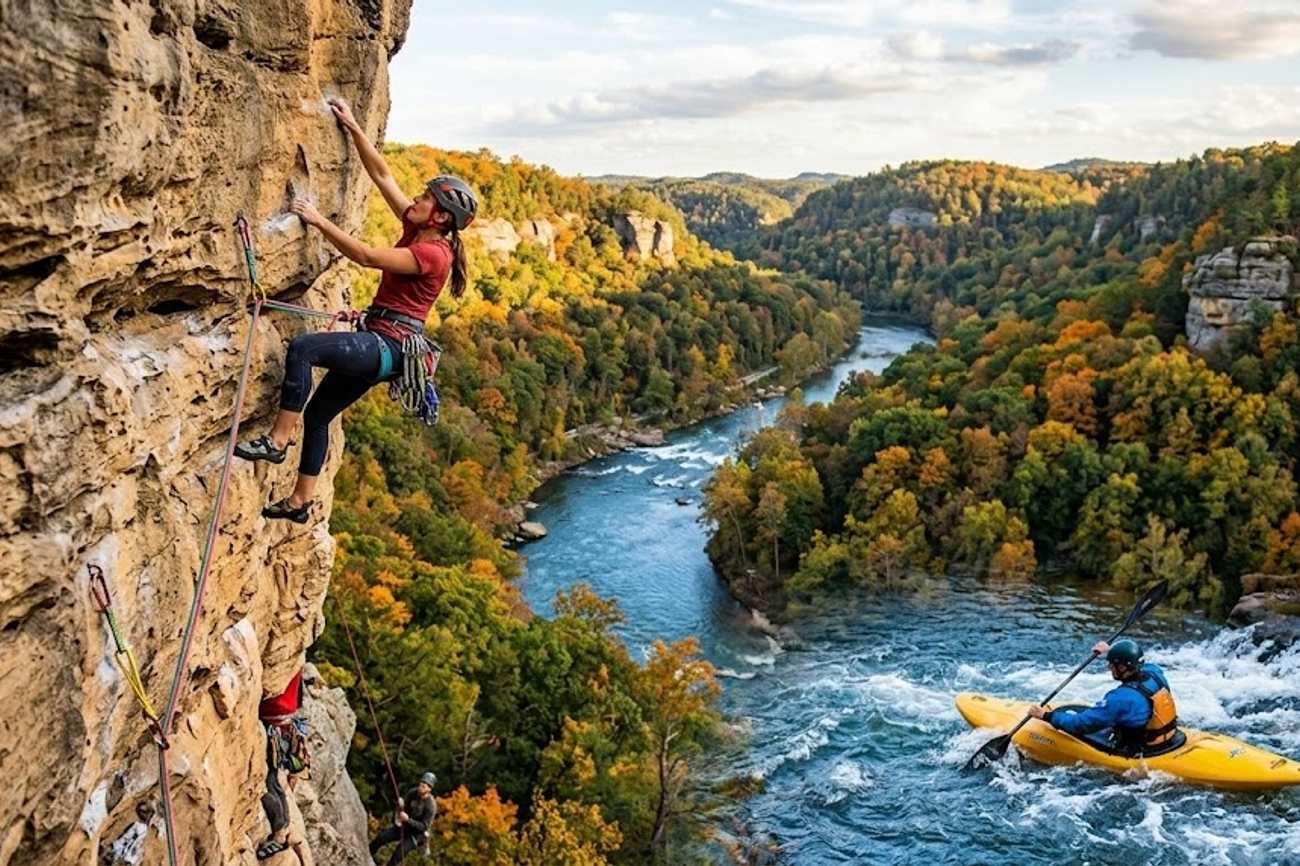
Image generated by AI
$14.6 billion in total economic impact marks the fourth consecutive record-breaking financial cycle for Kentucky’s travel and tourism sector. This massive influx of capital is not merely a result of traditional sightseeing but is driven by a strategic pivot toward high-intensity adventure travel and athletic event tourism that began in 2025. By transforming rugged natural topography into world-class athletic venues, the state has successfully attracted 81.1 million visitors, who contributed a combined $10.4 billion in direct expenditure.
The Financial Architecture of Adventure Tourism
The shift toward "extreme" tourism has created a diversified revenue stream that penetrates both urban centers and remote wilderness areas. The $10.4 billion in direct visitor spending is distributed across several critical infrastructure sectors: $2.4 billion was allocated to lodging, $2.0 billion to transportation, and $1.4 billion to direct recreation and entertainment. This data suggests that the modern adventure traveler is not a budget backpacker but a high-spend consumer who requires professional-grade lodging and logistics to support their athletic pursuits.
To sustain this growth, the state has implemented targeted financial injections. The Regional Marketing and Matching Funds Program distributed $2 million among 94 tourism organizations across 82 counties. This granular approach ensures that the economic benefits of sports tournaments and cycling invitationals reach rural communities, not just the primary metropolitan hubs. Furthermore, the state has committed $63 million to modernize state parks and an additional $40 million specifically for campground infrastructure, recognizing that the "base camp" experience is a prerequisite for attracting international elite athletes.
Logistics of the Kentucky Extreme Circuit
The state's geography has been partitioned into specialized zones catering to different athletic disciplines, each managed by a complex web of regulatory bodies.
| Activity Zone | Primary Location | Regulatory/Management Body | Key Feature/Constraint |
|---|---|---|---|
| Ultra-Endurance | Sheltowee Trace | U.S. Forest Service (USFS) | 319-mile trail; active water crossing protocols |
| Elite Climbing | Red River Gorge | USDA Forest Service | Sandstone cliffs; 300ft buffer from landmarks |
| Aquatic Sports | Lake Cumberland/Laurel River | KY Dept. of Fish & Wildlife | High-speed surf charters; endurance paddling |
| Urban Athletics | Louisville/Lexington | Kentucky Transportation Cabinet | Mass marathons; STIP traffic integration |
In the eastern highlands, the Sheltowee Trace National Recreation Trail serves as a 319-mile gauntlet for ultra-marathoners. The logistics of this route are precarious; the USFS must constantly monitor structural safety, particularly near Hawk Creek and Sinking Creek in London, Kentucky. These areas often require specialized athlete re-routing to maintain water crossing protocols, balancing the needs of elite runners with ecological preservation.
Similarly, the Red River Gorge Geological Area has become a global hub for trad ascending and high-line aerial sports. To prevent the degradation of fragile sandstone, the USDA Forest Service enforces strict Forest Orders. Technical climbing is prohibited within 300 feet of high-profile landmarks, including Sky Bridge, Gray’s Arch, Nada Tunnel, and Chimney Top Rock. This regulatory framework is managed in coordination with the Red River Gorge Climbers’ Coalition (RRGCC) to ensure that the surge in global interest does not lead to permanent geological scarring.
Expert Analysis: The "Athletic Anchor" Economic Model
For the traveler and the investor, the data reveals a transition from "passive" to "active" tourism. Kentucky is employing what I call the "Athletic Anchor" model: using high-profile, high-difficulty sporting events to create a permanent demand for infrastructure in previously overlooked rural areas.
For travelers booking trips to the Red River Gorge or the Sheltowee Trace, the direct consequence of this professionalization is a shift in accessibility. While the trails remain open, the introduction of "official infrastructure monitoring" and "active water crossing protocols" means that the wilderness is now managed like a stadium. The era of the unregulated backcountry trek is ending, replaced by a system of managed access that prioritizes safety and conservation.
The pricing pressure created by this shift is evident in the $2.4 billion spent on lodging. As elite athletes demand higher-end recovery facilities and specialized transport, local providers are likely to raise prices to match the "world-class" branding of the venues. However, the broader economic effect is a stabilization of rural employment; the industry now supports 96,993 jobs statewide. By integrating athletic event traffic into the Statewide Transportation Improvement Program (STIP), the Kentucky Transportation Cabinet is effectively using sports tourism to justify and fund permanent road and bridge upgrades that benefit local residents long after the marathons end.
Key Takeaways
- Economic Scale: Kentucky's tourism sector reached a $14.6 billion total impact, driven by 81.1 million visitors.
- Infrastructure Spend: $103 million has been dedicated to state park and campground upgrades to accommodate the surge in adventure travelers.
- Regulatory Constraints: Technical climbing is banned within 300 feet of major landmarks in Red River Gorge to protect geological integrity.
- Employment Impact: The tourism engine now sustains 96,993 jobs, bridging the gap between urban centers and rural gateway towns.
- Urban Integration: Mass events like the Kentucky Derby Festival Marathon are now integrated into statewide transportation planning to manage high visitor density.
FAQ: Kentucky Adventure Travel 2025
Are there restrictions on climbing in Red River Gorge? Yes. The USDA Forest Service prohibits technical climbing within 300 feet of specific landmarks, including Sky Bridge and Gray’s Arch, to protect the sandstone structures from erosion and damage.
What is the length of the Sheltowee Trace trail? The Sheltowee Trace National Recreation Trail spans 319 miles across eastern Kentucky, crossing through the Daniel Boone National Forest and various state park reserves.
How does the state manage crowds during urban marathons? The Kentucky Transportation Cabinet (KYTC) incorporates athletic event traffic management directly into its Statewide Transportation Improvement Program (STIP) to handle the influx of out-of-state competitors.
Which lakes are best for high-speed water sports? Lake Cumberland and Laurel River Lake are the primary destinations for wakesurfing and powerboat charters, while the Green River basin is preferred for endurance paddling.
The transformation of Kentucky from a bourbon destination to a global athletic epicenter proves that natural ruggedness, when paired with aggressive infrastructure investment, is a premier economic asset.
Tags: Red River Gorge, Sheltowee Trace, Kentucky Tourism 2025, Kentucky Transportation Cabinet, USDA Forest Service, Lake Cumberland
Related Travel Guides
- Michigan Aligns Wisconsin and Illinois Could Be Hit by Thanksgiving Snow as US Holiday Travel Warning Grows
- UAE Overtakes Germany as Oman Records 12 Point 6 Percent Tourism Surge Driven by 491503 Gulf Arrivals in H1 2026
- Sweden Germany and UK Fuel 12 Percent Foreign Overnight Stay Surge in Finland Attracting 7 Point 2 Million European Travelers
Disclaimer
This article is for informational and educational purposes only. It does not constitute legal, financial, or professional advice. While we strive to provide accurate and up-to-date information, travel policies, regulations, and conditions change rapidly. Always verify information with official sources before making travel decisions. Nomad Lawyer makes no representations about the accuracy, reliability, completeness, or suitability of the information provided. Readers should consult qualified professionals for advice specific to their circumstances. The views expressed in this article are those of the author and do not necessarily reflect the views of Nomad Lawyer.
Raushan Kumar
Founder & Lead Developer
Full-stack developer with 11+ years of experience and a passionate traveller. Raushan built Nomad Lawyer from the ground up with a vision to create the best travel and law experience on the web.
Learn more about our team →