
Kota Kinabalu Runway Reopens After Emergency Repairs: Sabah Air Links Restored Amid Tourism Boom

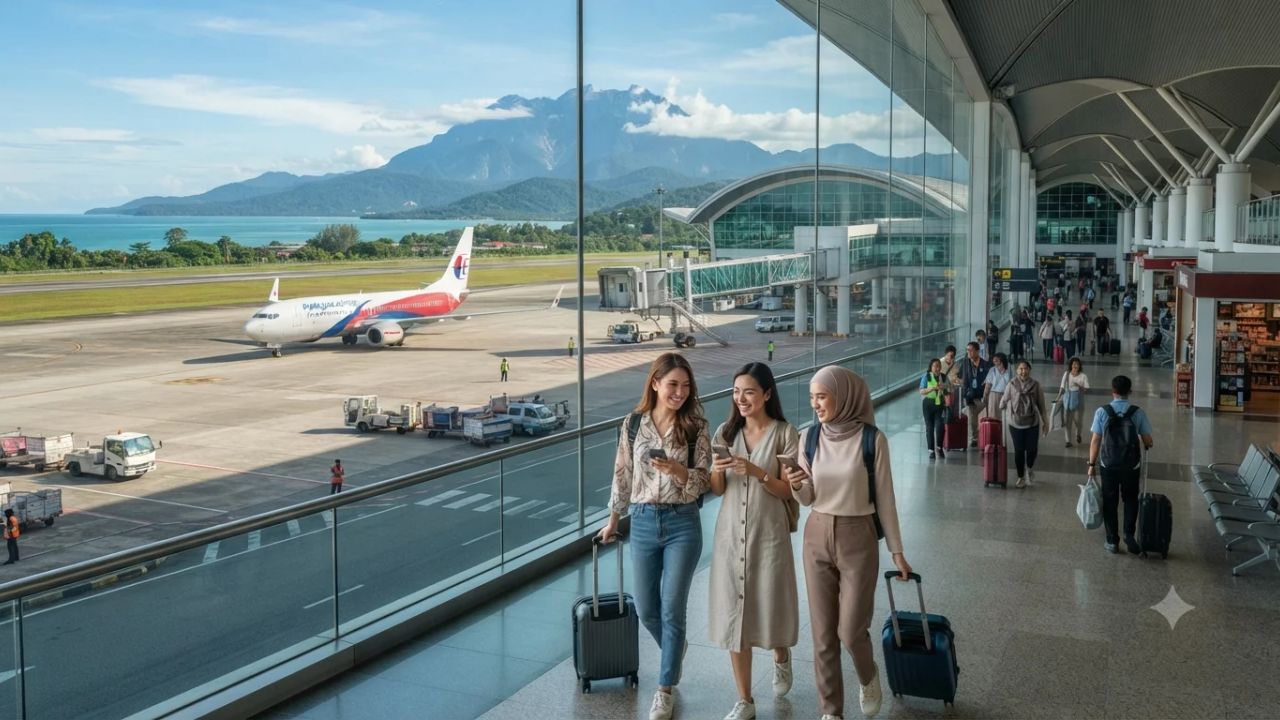
Image generated by AI
An eight-hour emergency runway closure at Kota Kinabalu International Airport (KKIA) on 17 September 2026 disrupted at least 20 commercial flights, exposing the acute single-runway vulnerability of Malaysia’s second-busiest aviation hub just as Sabah’s tourism economy generates RM8.74 billion annually. The shutdown, initiated at 2:45 PM for urgent tarmac rectification work and extended by relentless tropical rainfall until final clearance at 11:30 PM, forced widespread diversions to Labuan and Sandakan while triggering rotational delays across Southeast Asian flight networks.
Single-Runway Chokepoint Economics: Unpacking the September 17 Incident
Unlike Peninsular Malaysia, which benefits from an interconnected web of multi-lane expressways, electrified double-track railways, and secondary commercial airports, the East Malaysian state of Sabah on northern Borneo is an island economy entirely dependent on commercial aviation. Kota Kinabalu International Airport serves as the undisputed transit gateway for the state, processing international holidaymakers, inter-state commerce from Kuala Lumpur, and essential regional flights connecting interior rainforest outposts.
When airfield engineers detected surface defects requiring immediate engineering rectification, Malaysia Airports Holdings Berhad (MAHB) suspended runway movements to conduct safety tests. However, severe monsoonal downpours degraded asphalt adhesion and slowed curing times, extending what was intended to be a brief maintenance window into a protracted disruption lasting nearly nine hours.
Under safety directives enforced by the Civil Aviation Authority of Malaysia (CAAM), air traffic controllers placed arriving commercial airliners into holding patterns before rerouting flights to secondary diversion fields at Labuan Airport (LBU) and Sandakan Airport (SDK). Departing passengers remained stranded inside terminal concourses as airlines scrambled to accommodate displaced airframes and out-of-position flight crews. While operations formally resumed late Thursday night following comprehensive friction and lighting tests, the operational hangover rippled across airline schedules well into the following morning.
Capacity Saturation vs Macroeconomic Surge: The 12-Million Passenger Dilemma
The disruption arrives at a defining moment for Sabah’s aviation infrastructure. Designed with a rated terminal capacity of nine million passengers annually, KKIA already exceeded this threshold prior to the pandemic, handling 9.4 million travelers in 2019. The post-pandemic resurgence has pushed the facility right back toward saturation. In December 2025 alone, the airport processed approximately 802,000 passengers—a month-on-month leap of 23.5 percent—while January 2025 posted a 34.5 percent year-on-year traffic expansion.
This aviation throughput feeds a booming state economy. Data from the Sabah Chief Minister’s Office reveals that Sabah welcomed 3.79 million visitors in 2025, representing a 20.8 percent increase over the prior year and generating RM8.74 billion in gross tourism receipts while supporting roughly 400,000 jobs. Official figures compiled by the Sabah Tourism Board confirm this momentum accelerating into 2026: gross visitor arrivals between January and April reached 1,380,830—up 17.2 percent compared to the same period in 2025.
International arrivals expanded 18.6 percent to 547,354 over the first four months of 2026, driven overwhelmingly by mainland China. Chinese visitor entries surged 49.8 percent to 292,396 travelers, with April alone recording 79,973 arrivals—nearly double the volume of April 2025. Other key source markets posted solid gains, including Europe (32,832 visitors, up 13.5 percent), Australia (7,577 visitors, up 6.7 percent), India (3,802 visitors, up 27.6 percent), and Canada (3,279 visitors, up 26.1 percent).
| Operational & Economic Dimension | Current Baseline / Incident Data | Historical Benchmark | Long-Term Strategic Target |
|---|---|---|---|
| Annual Passenger Capacity | 9.0 million passengers | 9.4 million handled (2019) | 12.0 million capacity (12.4M demand by 2034) |
| Runway Infrastructure | Single active runway (BKI) | 8-hour 45-min closure (17 Sep) | Upgraded tarmac drainage & automated lighting |
| Aircraft Parking Stands | Constrained apron capacity | Diverted 20 flights to LBU / SDK | 7 additional aircraft parking bays planned |
| State Visitor Volume | 3.79 million visitors (2025) | 1,380,830 Jan–Apr 2026 (+17.2%) | Rapidly expanding toward 4.5M+ annual target |
| Tourism Economic Value | RM8.74 billion revenue | RM6.2B inbound / +45.9% domestic (DOSM) | RM500M private hotel pipeline (Hilton Tuaran) |
| Tourism Workforce Share | 387,600 jobs (22.6% state total) | 86.1% in retail, dining & hotels | Core driver of regional employment stability |
According to the Department of Statistics Malaysia (DOSM), tourism directly sustains 22.6 percent of all employment in Sabah, with retail trade, dining, and hotel operations accounting for 86.1 percent of that workforce. Across the entire nation, tourism generated RM323 billion in value added in 2025, accounting for 15.9 percent of national GDP.
Expert Analysis: Rotational Dominoes, Single-Strip Vulnerability, and Itinerary Insulation
From an aviation network planning perspective, Kota Kinabalu illustrates the operational fragility inherent in high-density, single-runway island gateways.
The pricing pressure this creates means low-cost carriers operating out of KKIA—principally AirAsia and Malaysia Airlines—operate ultra-tight aircraft turnarounds of 25 to 35 minutes to keep seat costs low. When an unpredicted runway closure traps aircraft on the ground for eight hours, the direct operational consequence is an immediate collapse of downstream flight rotations. Aircraft scheduled to operate subsequent evening sectors to Sandakan, Tawau, Singapore, or Hong Kong are grounded, stranding crews as flight-duty time limits expire.
For travelers booking this route, the direct consequence is severe vulnerability on tight connecting itineraries. Tourists heading to Sabah frequently book separate tickets: flying an international carrier into Kota Kinabalu before transferring onto regional turboprop flights to dive resorts in Sipadan or wildlife lodges along the Kinabatangan River. When KKIA suspends runway operations, missed regional connections force travelers into costly, non-refundable hotel changes and lost safari bookings.
To insulate Sabah's economic lifeline, the Ministry of Transport is advancing a major master plan to expand KKIA's terminal capacity from 9 million to 12 million passengers annually by 2034, adding seven aircraft parking bays, multi-storey vehicle parking, and digital airfield monitoring systems. However, until physical tarmac upgrades and redundant taxiway capabilities are completed, travelers exploring northern Borneo must build conservative 24-hour buffers in Kota Kinabalu to absorb inevitable tropical weather and single-runway maintenance disruptions.
Key Takeaways
- Runway Reopening Confirmed: Kota Kinabalu International Airport resumed normal flight operations at 11:30 PM on 17 September 2026 following urgent runway repairs.
- Twenty Flights Disrupted: The eight-hour afternoon closure led to cancellations, ground delays, and diversions to Labuan and Sandakan airports.
- High Economic Exposure: Sabah’s tourism industry welcomed 3.79 million visitors in 2025, generating RM8.74 billion and supporting 22.6 percent of state employment.
- Surging Chinese Market: Arrivals from China climbed 49.8 percent to 292,396 visitors between January and April 2026, underlining the state’s reliance on international air links.
- Planned 12-Million Expansion: The Malaysian government is advancing terminal and airfield expansions to boost KKIA capacity to 12 million passengers annually by 2034.
FAQ: Kota Kinabalu Airport Runway Disruption 2026
Why was the runway closed at Kota Kinabalu Airport on 17 September 2026?
The runway was temporarily closed at 2:45 PM for urgent pavement rectification work and safety testing. Heavy, continuous rainfall extended the repair process until final safety clearance was granted at 11:30 PM.
How many flights were affected during the Kota Kinabalu runway shutdown?
At least 20 commercial flights were delayed, cancelled, or diverted, with several inbound aircraft rerouted to secondary airfields in Labuan and Sandakan before operations resumed.
What is the passenger capacity of Kota Kinabalu International Airport?
KKIA currently has a designed capacity of nine million passengers annually, with an approved government expansion underway to expand terminal capacity to 12 million passengers annually to handle projected demand.
What should passengers do if their flight was impacted by the disruption?
Travelers should check real-time flight schedules directly with their operating airline before departing for the airport, confirm onward connecting tickets, and contact regional hotels or tour operators to adjust itineraries.
On an island where the rainforest meets the open sea, an airport runway is far more than concrete and lights—it is the indispensable artery of Sabah’s economic life.
Related Travel Guides
Hundreds of Travelers Impacted as 3,744 Delays Hit Asian Aviation Hubs
Disclaimer
This article is for informational and educational purposes only. It does not constitute legal, financial, or professional advice. While we strive to provide accurate and up-to-date information, travel policies, regulations, and conditions change rapidly. Always verify information with official sources before making travel decisions. Nomad Lawyer makes no representations about the accuracy, reliability, completeness, or suitability of the information provided. Readers should consult qualified professionals for advice specific to their circumstances. The views expressed in this article are those of the author and do not necessarily reflect the views of Nomad Lawyer.
Preeti Gunjan
Contributor & Community Manager
A passionate traveller and community builder. Preeti helps grow the Nomad Lawyer community, fostering engagement and bringing the reader experience to life.
Learn more about our team →