European Flight Security Alerts: Seven Aircraft Undergo Emergency Bomb Inspections Across Spain, Italy, and Poland

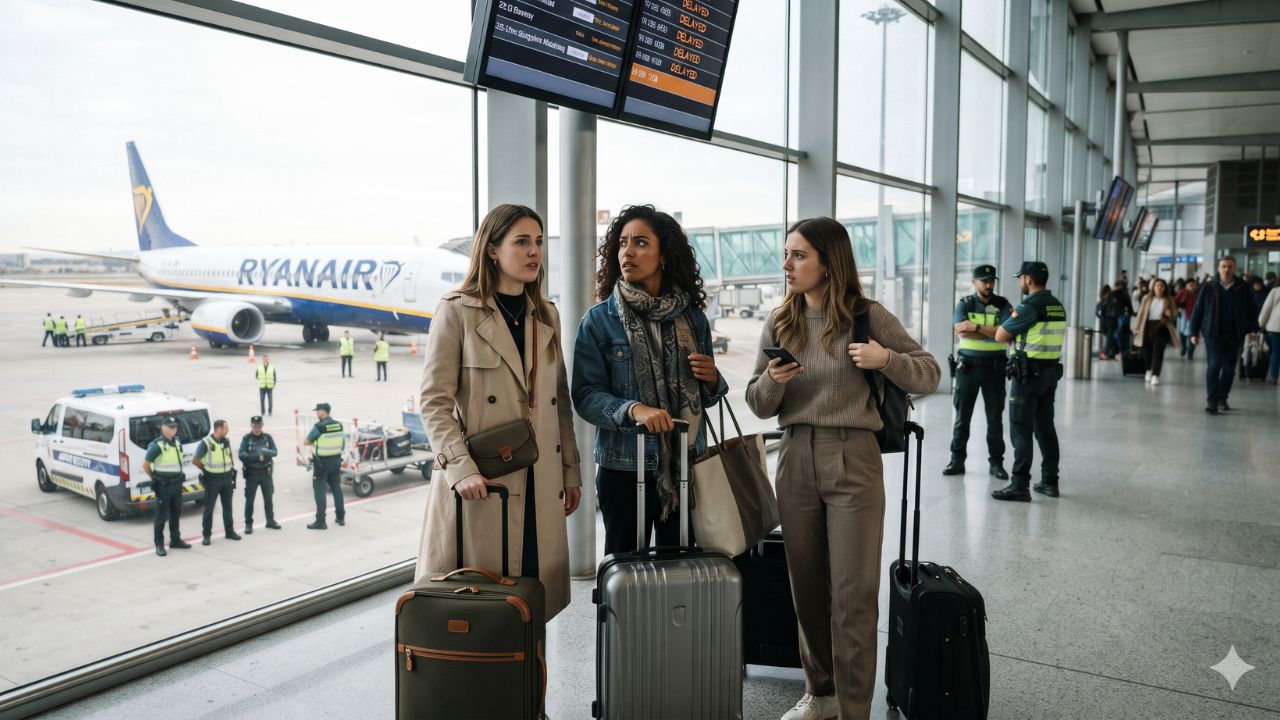
Image generated by AI
When Italian Air Force fighter jets scrambled to intercept a Ryanair Boeing 737 descending from Dublin toward Rome Fiumicino, passengers looked out their cabin windows to see military escorts guiding their commercial airliner to an isolated runway. That dramatic interception on 3 November 2026 formed part of a coordinated cascade of aviation security alerts that triggered emergency inspections across seven commercial passenger flights in Poland, Italy, Bulgaria, and Spain. Mobilizing emergency response units across five European airports, the incidents disrupted operations for Ryanair, LOT Polish Airlines, Scandinavian Airlines (SAS), and Wizz Air, prompting runway shutdowns and anti-sabotage canine sweeps before forensic specialists confirmed that every threat was an unfounded hoax, with zero explosives discovered and zero injuries reported.
Continental Security Scramble: Interconnected Hubs and Emergency Protocols
The multi-nation sequence of 3 November 2026 illustrated how quickly digital threats can reverberate across Europe's shared skyways. While the European Union Aviation Safety Agency maintains rigorous safety oversight across continental airspace, air traffic controllers and national civil protection agencies are legally obligated to treat every unverified security transmission as an active emergency.
The alerts involved four major carriers operating point-to-point European routes connecting the United Kingdom, Ireland, Denmark, and Portugal with southern, central, and eastern Europe. Low-cost giant Ryanair accounted for four of the seven affected flights—representing approximately 57.1 percent of the disrupted services—while LOT Polish Airlines, Scandinavian Airlines, and Wizz Air operated one service each. Across the four services with publicly confirmed occupant counts, at least 663 passengers and crew were directly subjected to emergency evacuation protocols and baggage screenings.
The most acute operational disruption occurred in central Poland. A LOT Polish Airlines Boeing 737 MAX en route from London Heathrow to Warsaw Chopin Airport was diverted north toward Warsaw-Modlin Airport following an emergency alert logged at approximately 9:54 am. The aircraft touched down safely at Modlin at 10:01 am carrying 181 people aboard and roughly 3.7 tonnes of remaining fuel. Airport authorities suspended all flight operations, grounding outbound departures and diverting incoming traffic while bomb disposal squads and canine units inspected the airframe. Modlin's runways remained closed for approximately 109 minutes, resuming initial operations at 11:50 am before authorities formally lifted the emergency alert at 12:21 pm.
| Operating Airline | Flight Route & Sector | Receiving Airport & Country | Occupants Aboard | Security Measures Implemented |
|---|---|---|---|---|
| LOT Polish Airlines | London Heathrow (LHR) to Warsaw | Warsaw-Modlin (WMI), Poland | 181 people | Diverted; 3.7t fuel; airport closed for 109 mins |
| Scandinavian Airlines | Copenhagen (CPH) to Warsaw | Warsaw (WAW/WMI), Poland | Unspecified | Post-landing apron isolation; baggage screening |
| Ryanair | Manchester (MAN) to Murcia (RMU) | Region of Murcia (RMU), Spain | 114 pax, 7 crew | Post-disembarkation inspection; cargo holds cleared |
| Ryanair | Lisbon (LIS) to Rome (FCO) | Rome Fiumicino (FCO), Italy | Unspecified | Runway isolation, passenger screening, hold searches |
| Ryanair | Dublin (DUB) to Rome (FCO) | Rome Fiumicino (FCO), Italy | Unspecified | Italian Air Force fighter escort; remote stand search |
| Wizz Air | Milan Bergamo (BGY) to Sofia (SOF) | Sofia Airport (SOF), Bulgaria | 176 passengers | Anti-sabotage sweeps following email threat alert |
| Ryanair | Dublin (DUB) to Sofia (SOF) | Sofia Airport (SOF), Bulgaria | 185 passengers | Police inspection; combined 361 pax across Sofia flights |
| Wizz Air (2 Nov Incident) | London Luton (LTN) to Sofia (SOF) | Budapest Liszt Ferenc (BUD), Hungary | Unspecified | Diverted to Hungary; full sweep; cleared to Sofia |
The coordinated nature of the alerts extended beyond central Europe. In southeastern Spain, a Ryanair flight from Manchester carrying 114 passengers and seven crew members landed at the Region of Murcia International Airport, where Spanish National Police sealed the aircraft on a remote taxiway for comprehensive inspection after travelers disembarked. In Bulgaria, Sofia Airport received two affected flights carrying a combined 361 passengers from Milan Bergamo and Dublin. Bulgarian security officials confirmed that the alarming messages had arrived via electronic mail.
This wave followed an isolated precursor on 2 November 2026, when a Wizz Air flight from London Luton to Sofia diverted to Budapest Liszt Ferenc International Airport in Hungary under an identical bomb alert. After thorough security screening in Budapest, that aircraft was cleared to resume its flight to Sofia, bringing the two-day total of investigated European services to eight.
What Makes Point-to-Point Low-Cost Aviation Vulnerable to Security Hoaxes
The operational footprint of Europe's low-cost carrier network relies on rapid aircraft turnarounds and tight fleet utilization. Airlines like Ryanair and Wizz Air operate point-to-point networks where a single narrowbody Boeing 737 or Airbus A321 completes between six and eight distinct flight sectors daily, operating on ground turnarounds as brief as 25 minutes.
When a security alert grounds an aircraft for physical inspection—requiring canine searches, cargo de-palletization, passenger interviews, and technical recertification—that airframe is effectively sidelined for four to eight hours. The delay does not remain contained; it cascades through that aircraft's entire remaining daily schedule, impacting passengers at regional airports hundreds of miles away who may have no awareness of an earlier security event in another country.
In addition, secondary regional hubs like Warsaw-Modlin and Murcia Corvera operate with single runways and limited ground handling equipment. Unlike major multi-runway hubs such as London Heathrow or Paris-Charles de Gaulle that can absorb an isolated incident by assigning flights to parallel runways, a security alert that isolates a runway at a secondary airport halts all airfield movements, paralyzing regional transport for hours.
Visitor Insider Tips: Passenger Rights, Secondary Airfields, and High-Speed Rail
When security incidents disrupt European air travel, experienced voyagers understand their legal protections and alternative ground routing strategies.
- Understanding EU261 Rights During Security Alerts: Under European Commission Passenger Rights (Regulation EC 261/2004), suspected bomb threats and state-mandated security diversions are legally classified as "extraordinary circumstances." This means airlines are exempt from paying fixed statutory cash compensation (€250 to €600). However, carriers remain strictly obligated under their "duty of care" to provide free hotel accommodation, ground transfers, and complimentary meals and refreshments during extended delays. Always retain itemized receipts for food, transport, and lodging to submit for reimbursement.
- Navigating Regional Airport Closures: If your flight is diverted to an alternate airport—such as landing at Warsaw-Modlin instead of Warsaw Chopin—do not wait hours for airline-arranged ground shuttles. At Modlin, walk directly to the curbside bus stand to catch the ModlinBus or local Koleje Mazowieckie train connecting to Warszawa Centralna in roughly 45 minutes for under €8.
- Pivoting to High-Speed Rail: If traveling within Italy or Spain when airport security operations trigger ground-stop delays, consider shifting to high-speed rail. In Italy, Trenitalia's Frecciarossa and Italo high-speed trains connect Rome Termini to Milan Central in three hours, unaffected by airport security holds. In Spain, Renfe AVE, Iryo, and Ouigo trains link central Madrid with Valencia and the Mediterranean coast at 300 km/h.
- Airport Screening Composure: If your flight is met by emergency vehicles and police squads on the tarmac, follow crew instructions without panic. Leave all overhead luggage behind during emergency disembarkations, keep your passport and mobile phone in your pocket, and prepare for secondary security interviews and hand-luggage swab screenings.
Cultural and Environmental Context: Regional Tourism Resilience and Cross-Border Policing
The vulnerability of modern European tourism to malicious digital communications spotlighted a critical challenge for international law enforcement. Borderless Schengen travel and affordable regional air routes have transformed once-remote provincial destinations into thriving cultural capitals. Towns across Murcia, southern Poland, and western Bulgaria depend on predictable flight schedules to sustain family-owned guesthouses, historic district walking tours, and seasonal gastronomy.
When malicious actors deploy untraceable hoax emails to trigger military scrambles and airport shutdowns, the immediate victim is public tranquility. However, the coordinated response executed by Polish, Italian, Bulgarian, and Spanish police demonstrates the strength of cross-border intelligence sharing. National security agencies operating under Europol protocols work continuously to trace electronic server footprints and prosecute perpetrators under severe anti-terrorism and aviation endangerment statutes.
Environmental efficiency also suffers when false alarms disrupt air traffic management. Diverting modern airliners like the Boeing 737 MAX, burning fuel in holding stacks, and scrambling supersonic fighter jets generates thousands of gallons of unnecessary fuel consumption. By maintaining robust security validation protocols that quickly separate malicious hoaxes from authentic dangers, European aviation authorities protect passengers while ensuring regional travel remains accessible, dependable, and safe.
FAQ: Navigating European Aviation Security Alerts 2026
Were any explosive devices found on the seven European flights on 3 November 2026?
No. Exhaustive physical inspections by police bomb disposal teams and specialized canine units confirmed that zero explosives were aboard, and every threat was an unfounded hoax.
Are passengers entitled to cash compensation under EU261 for bomb threat delays?
No. Because bomb threats represent external security risks beyond an airline's control, they are categorized as extraordinary circumstances, exempting airlines from cash payouts, though the duty of care for meals and lodging remains mandatory.
Why was the LOT Polish Airlines flight diverted from Warsaw Chopin to Modlin?
Aviation safety protocols require potentially compromised aircraft to land at facilities where they can be isolated on dedicated remote aprons without shutting down primary national international gateways.
Which airlines were involved in the European security alerts?
Ryanair operated four of the seven affected services, while LOT Polish Airlines, Scandinavian Airlines (SAS), and Wizz Air operated one flight each across Poland, Italy, Bulgaria, and Spain.
[As sirens fade across the tarmac and quiet departures resume beneath autumn skies, Europe's unified aviation network proves that traveler safety remains uncompromised.]
Related Travel Guides
Asia Flight Disruptions: Over 2,270 Delays and 280 Cancellations Hit Bangkok, Beijing, and Mumbai
Chiang Mai Airport Flight Disruptions for Yi Peng and Loy Krathong: Complete Traveler Guide 2026
This article is for informational purposes. Flight routes, passenger regulations, visa rules, and transit advisories are subject to change by airlines and aviation authorities. Readers are advised to verify schedules and travel documentation with relevant carriers and border agencies before departure.
Related Stories
Wizz Air Flight Diverts to Budapest After Mid-Air Threat: NATO Gripen Escort and Passenger Guide
KLM Cancels Entire Dubai Winter Season Through March 2027: Schiphol Rebooking and Middle East Travel Guide