Jordan Unveils $15 Billion Investment Powerhouse With Tourism Energy And Transport Projects To Boost Growth

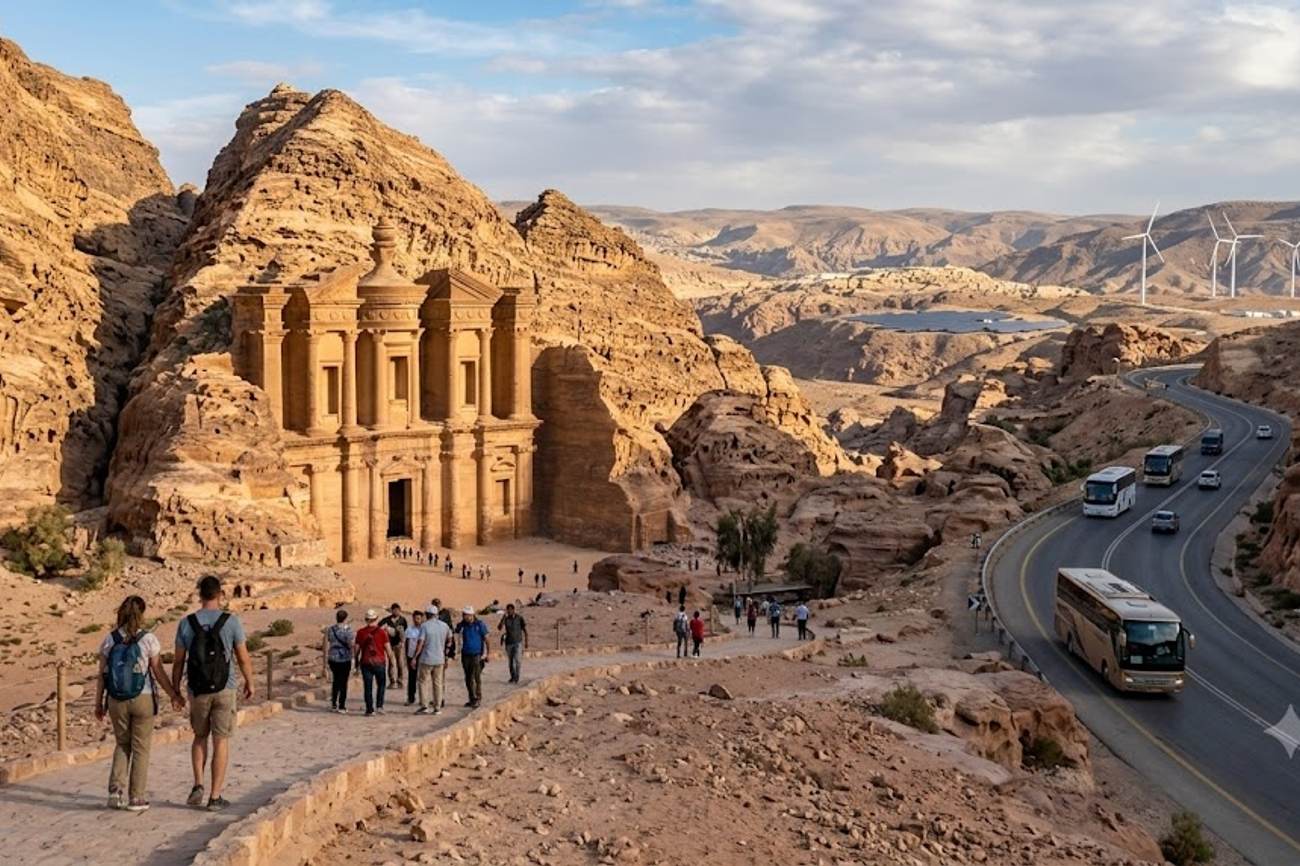
Image generated by AI
Jordan is currently pivoting its entire economic identity toward a $15 billion investment portfolio designed to transform the kingdom from a transit point into a global hub for sustainable energy and high-end tourism. While most visitors associate the country solely with the rose-red facades of Petra, the government is now aggressively courting European capital to build a future defined by green hydrogen, light rail systems, and massive entertainment complexes.
The Shift Toward a Modernized Kingdom
Jordan is no longer content with relying on traditional sightseeing. The launch of a $15 billion investment strategy marks a decisive move to diversify the national economy across 15 different sectors. This isn't just a series of isolated projects; it is a structured attempt to align the country with the Economic Modernisation Vision. By presenting this portfolio at the inaugural Jordanian-European Investment Conference, the kingdom is signaling a shift toward Western partnerships to modernize its infrastructure.
The financial weight of this plan is heavily skewed toward the future of energy. Approximately $7.1 billion is earmarked for the energy and mining sector, focusing on solar power, wind energy, and the burgeoning field of green hydrogen. This transition is paired with a push into mineral resources, specifically targeting basalt, silica sand, and rare earth elements to fuel industrial growth.
Beyond energy, the kingdom is attacking the bottlenecks of regional trade. With $3.56 billion dedicated to transport—specifically national railway development and light rail systems—and another $1.61 billion for logistics, Jordan aims to solidify its role as the primary gateway between regional markets. Key hubs like the Ma’an Dry Port, the Mafraq Development Area, and the Madouna Logistics Centre are central to this plan, alongside the modernization of the Jaber Border Crossing to streamline international trade.
What Makes Jordan Different
Jordan possesses a rare duality: it is a sanctuary of ancient history that is simultaneously attempting to become a laboratory for clean technology. While the world looks to the UNESCO World Heritage site of Petra for insights into the Nabatean civilization, the government is investing $442 million into water sustainability projects to combat one of the most acute water scarcity crises on the planet.
The experiential uniqueness of Jordan lies in this tension between the old and the new. The tourism sector, which is receiving $1.08 billion in targeted investments, is moving beyond the "bucket list" circuit. The development of the Amra Entertainment City and the expansion of the Abdali Conference Centre indicate a shift toward leisure and business tourism (MICE), aiming to attract high-spending corporate travelers and families rather than just backpackers and history buffs.
Even the coastal experience is being reimagined. The Aqaba Youth Camp project is designed to transform the Red Sea coast into a center for recreation and youth-centric tourism, diversifying the appeal of the southern region. This is complemented by a $265 million investment in the circular economy, which includes electric vehicle assembly and clean technology, ensuring that the growth of the tourism industry doesn't come at the cost of the environment.
Visitor Insider Tips
To experience Jordan beyond the brochure, you have to understand the rhythm of the "diwan" (social gathering) and the geography of the desert.
Timing Your Visit Avoid the peak window of March to May if you want to avoid the crowds at Petra. Instead, visit in late October or November. The weather is mild, and the crowds thin out, making it easier to negotiate with local guides and find quiet corners in the city.
The Art of the "Coffee Ritual" In Jordan, coffee is not just a drink; it is a social contract. When offered Arabic coffee (gahwa), always accept the first cup. When you have had enough, gently shake your small cup from side to side to signal you are finished. To simply set it down means the host will keep refilling it.
Navigating the South While the new investments in transport are promising, current travel between Amman and Aqaba is best handled via private hire or the JETT bus service. If you are heading to the Wadi Rum desert, base yourself in a Bedouin camp rather than a hotel to get a true sense of the landscape.
Jordan's new investment powerhouse is expected to significantly boost the country's tourism sector, with a focus on developing sustainable energy and transport projects. The Jordan Tourism Board has outlined plans to enhance the visitor experience, including improvements to passenger logistics at Queen Alia International Airport, which can be found on the official airport website. This will enable more efficient travel for the increasing number of tourists visiting Jordan's historic sites.
Regional Specialties Move beyond the standard hummus. Seek out Mansaf—the national dish of lamb cooked in fermented dried yogurt (jameed)—but do so at a local home or a traditional restaurant in the highlands of Salt or Madaba.
Base Yourself Wisely For those interested in the new business developments, stay in the Abdali district of Amman. It is the "new city" and provides the best access to the emerging conference infrastructure. For cultural immersion, the Rainbow Street area remains the heart of the city's creative energy.
Cultural and Environmental Context
The influx of $15 billion in investment brings a complex set of challenges. Jordan is one of the most water-stressed nations globally, which is why the $442 million allocation for water development is the most critical part of the entire portfolio. Tourism, by nature, consumes vast amounts of water, and the expansion of leisure cities and luxury resorts must be balanced against the needs of local agricultural communities.
There is also a delicate balance between foreign capital and local ownership. The government has explicitly stated that the success of these projects depends on partnerships between European firms and Jordanian businesses. This is intended to prevent "enclave tourism," where profits flow back to overseas investors while locals are left with low-wage service jobs. By focusing on technology transfer and skills development in sectors like electric vehicle assembly and green hydrogen, Jordan is attempting to ensure that the economic benefits trickle down to the local workforce.
Furthermore, the push toward renewable energy is a matter of national security. By reducing reliance on imported energy through $7.1 billion in solar and wind projects, Jordan is attempting to insulate its economy from regional volatility, which in turn creates a more stable environment for long-term cultural preservation.
FAQ: Visiting Jordan 2025
What is the best time to visit? The shoulder seasons of spring (March-May) and autumn (September-November) offer the best weather. For those seeking solitude and cooler temperatures in the desert, winter months are ideal, though you will need heavy clothing for the highlands.
Do I need a visa? Most visitors can obtain a visa on arrival or purchase the "Jordan Pass" before traveling. The Jordan Pass is highly recommended as it waives the visa fee and includes entry to Petra and dozens of other sites.
How do I get there from Amman to the south? The most reliable method is the JETT bus system or a private rental car. While the government is investing $3.56 billion in new rail and light rail infrastructure, these projects are currently in development and not yet available for tourist transit.
Is it safe for solo travelers? Yes, Jordan is generally very safe for solo travelers. Hospitality is a core cultural value. However, it is always advisable to use registered guides in remote areas and stay updated via the official Jordan Tourism Board guidelines.
Jordan is no longer just a museum of the ancient world; it is a blueprint for a sustainable middle-eastern future.
Related Travel Guides
- Porto Tops Europe for Gen Z in 2026 as Edinburgh, Copenhagen and Berlin Surge in Youth Travel Appeal
- Lithuania Is Now on Top of a Private European Sleep Tourism Ranking for More Restful City Breaks
- Florida Aligns With New York And More As US Tourism Faces New Pressure As Canada Moves Closer To Europe
This article is for informational purposes. Flight routes, passenger regulations, visa rules, and transit advisories are subject to change by airlines and aviation authorities. Readers are advised to verify schedules and travel documentation with relevant carriers and border agencies before departure.
Related Stories
Zen Awakening Festival 2026: Florida's Transformational Music, Mindfulness, and Arts Gathering in Fruitland Park
12 Underrated Cities in China That International Travelers Are Starting to Discover