Lithuania Is Now on Top of a Private European Sleep Tourism Ranking for More Restful City Breaks

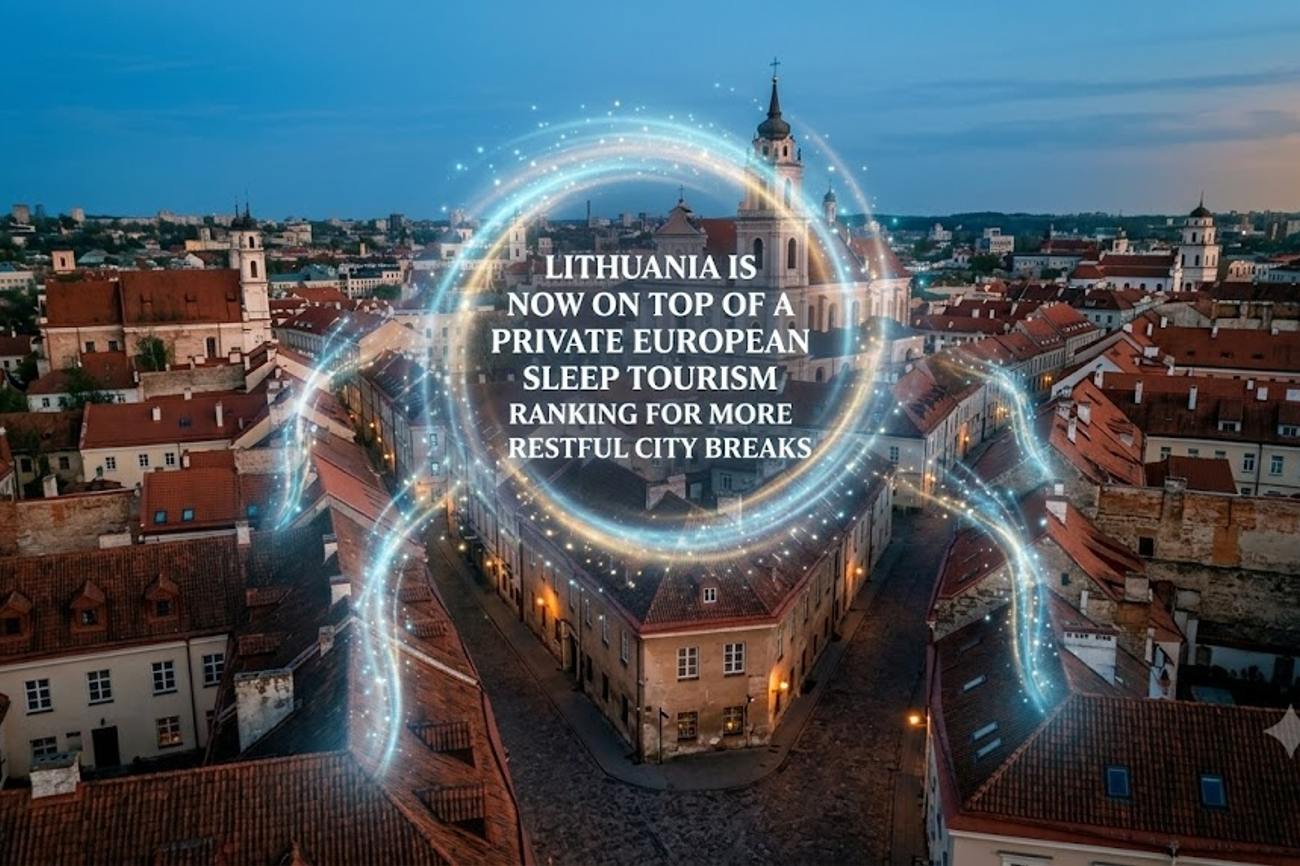
Image generated by AI
An 8.26 out of 10 score for Vilnius, Lithuania, marks the peak of a private study identifying the most restful European destinations. This ranking, republished on 19 September 2026, introduces the concept of "Sleep Tourism" as a strategic pivot away from the traditional, high-intensity sightseeing model. While the study positions Vilnius as the premier choice for recovery-focused travel, followed by Dresden, Poznań, Warsaw, and Riga, it lacks endorsement from any official government body or tourism board. For the sophisticated traveler, this represents a shift in how urban destinations are marketed—moving from "must-see" checklists to environmental wellness indicators.
The Mechanics of the Sleep Tourism Metric
The private research utilized a composite of environmental and lifestyle indicators to determine which cities best facilitate rest. The scoring system weighed air quality, the prevalence of urban greenery, ambient noise levels, artificial light pollution, average temperatures, rainfall patterns, and the density of nightlife. By quantifying these variables, the study attempted to identify cities where the external environment minimizes sleep disruption.
However, a significant discrepancy exists between this private data and official records. While the study credited Vilnius with 56% greenery, official government data confirms a higher figure of 61%. This gap highlights the volatility of private rankings; the lack of standardized boundaries and definitions means these scores should be viewed as directional inspiration rather than scientific proof.
The following table outlines the verified components of the story and their actual impact on the traveler:
| News Component | Verified Finding | Relevance to Traveler |
|---|---|---|
| Commercial Ranking | Vilnius leads with 8.26/10 | Inspirational guide, not a quality standard |
| Environmental Data | 61% of Vilnius is green space | Supports low-intensity, outdoor itineraries |
| Market Demand | 3.1 billion EU accommodation nights (2025) | High capacity for niche wellness products |
| Regulatory Status | No changes to visas or borders | Standard Schengen Area rules apply |
| Economic Impact | No measured effect on revenue/bookings | No evidence of increased spending yet |
Market Dynamics of the European Rest Sector
The emergence of sleep-focused travel occurs against a backdrop of massive accommodation volume. In 2025, the European Union recorded nearly 3.1 billion tourist-accommodation nights. The market remains heavily concentrated, with Spain, Italy, France, and Germany accounting for 61.7% of all stays. Germany alone contributed 442.1 million nights.
Growth patterns in the Eastern European cities mentioned in the ranking show diverging trends. Poland saw a 7.2% increase in accommodation nights, while Lithuania experienced a 24.1% surge in foreign-guest nights during the first quarter of 2026 compared to the same period in 2025. Conversely, Latvia saw a 7.5% decline in the same metric. This volatility suggests that while "wellness" or "rest" trends may be gaining traction, they are not yet the primary driver of international arrivals, which remain subject to broader economic and geopolitical shifts.
For those visiting the ranked cities, the physical infrastructure for rest is evident. In Dresden, the Großer Garten serves as a primary anchor for slow travel, featuring a park railway that covers six kilometres in 30 minutes. In Warsaw, official data indicates that nearly 25% of the city is composed of green assets, including botanical gardens and urban forests. These verified environmental assets provide the foundation for a "slow" itinerary, regardless of whether a private study assigns them a specific sleep score.
Expert Analysis: The Commercialization of Quiet
The rise of "Sleep Tourism" is not a medical breakthrough but a marketing evolution. For travelers booking routes into the Baltics or Central Europe, the direct consequence is a shift in hotel value propositions. We are seeing a transition where "luxury" is no longer defined by gold leaf and concierge services, but by acoustic engineering and circadian lighting.
The pricing pressure this creates means that properties capable of proving their "quietude" can command a premium. When a city like Vilnius is branded as a sleep destination, hotels are incentivized to move beyond generic descriptions and provide technical specifications: decibel ratings for soundproofing, the efficacy of blackout curtains, and room orientation relative to transit hubs.
From a logistical standpoint, the "rest" narrative is a clever hedge against the volatility of peak-season tourism. By promoting "low-intensity sightseeing," destinations can encourage midweek and off-season visits, smoothing out the occupancy curves that typically plague European cities. However, the traveler must remain wary: a city-wide "sleep score" is a macro-metric that fails to account for micro-environments. A hotel located next to a railway line in a "quiet" city will still offer a poor sleep experience. The burden of due diligence remains with the guest to verify the specific property's environmental controls.
Furthermore, the disconnect between the private study's 56% greenery figure and the official 61% figure in Vilnius suggests that these rankings often rely on outdated or third-party data aggregators. Travelers should prioritize official data from the European Travel Commission or national tourism boards over privately produced "lifestyle" lists when planning high-stakes wellness retreats.
Key Takeaways
- Data Discrepancy: Official records show Vilnius is 61% green space, outperforming the 56% figure cited in the private Sleep Tourism Ranking.
- Market Scale: The trend operates within a massive EU market of 3.1 billion accommodation nights, though no direct link between "sleep tourism" and increased revenue has been proven.
- Regional Growth: Lithuania is seeing a significant spike in international interest, with foreign-guest nights rising 24.1% in Q1 2026.
- Verification Needed: Travelers should ignore city-wide scores and instead request specific hotel data on soundproofing, room orientation, and temperature regulation.
- Regulatory Stability: This ranking is a commercial study and has zero impact on visa requirements or border protocols for the Schengen zone.
FAQ: Sleep Tourism Europe 2026
Does the Sleep Tourism Ranking affect my visa requirements for Lithuania or Latvia? No. The ranking is a private commercial study. All entry requirements, passport controls, and visa regulations remain governed by official Schengen Area policies.
Which city is officially the best for a restful break? There is no official government "best" city. While Vilnius scored 8.26/10 in a private study and was the 2025 European Green Capital, these are not official quality guarantees for sleep.
How can I ensure my hotel in these cities is actually quiet? Avoid relying on city rankings. Ask the hotel specifically about the room's orientation (away from main roads), the presence of blackout curtains, and whether the windows are double or triple-glazed for soundproofing.
Is Sleep Tourism a recognized medical travel category? No. In the context of this report, it refers to a travel style focused on relaxation and environmental wellness, not the treatment of clinical sleep disorders.
The pursuit of silence in an urban environment is the new luxury frontier.
Tags: Vilnius 2026, European Sleep Tourism Ranking, Lithuania Tourism, Dresden Wellness, Schengen Travel Trends, Urban Greenery Metrics
Related Travel Guides
- Florida Aligns With New York And More As US Tourism Faces New Pressure As Canada Moves Closer To Europe
- Italy Outpaces Spain, Germany, and Other European Places as New Research Says Positano Beach is the Most Instagrammable Destination
- Croatia Joins Italy And More To Spotlight Dubrovnik Beaches For Diverse Adriatic Travel Experiences
This article is for informational purposes. Flight routes, passenger regulations, visa rules, and transit advisories are subject to change by airlines and aviation authorities. Readers are advised to verify schedules and travel documentation with relevant carriers and border agencies before departure.
Related Stories

Zen Awakening Festival 2026: Florida's Transformational Music, Mindfulness, and Arts Gathering in Fruitland Park