
Japan Along with Thailand and More in Supercharging Asia Domestic Tourism with Record Travel Demand in 2026
Japan Along with Thailand and More in Supercharging Asia Domestic Tourism with Record Travel Demand in 2026

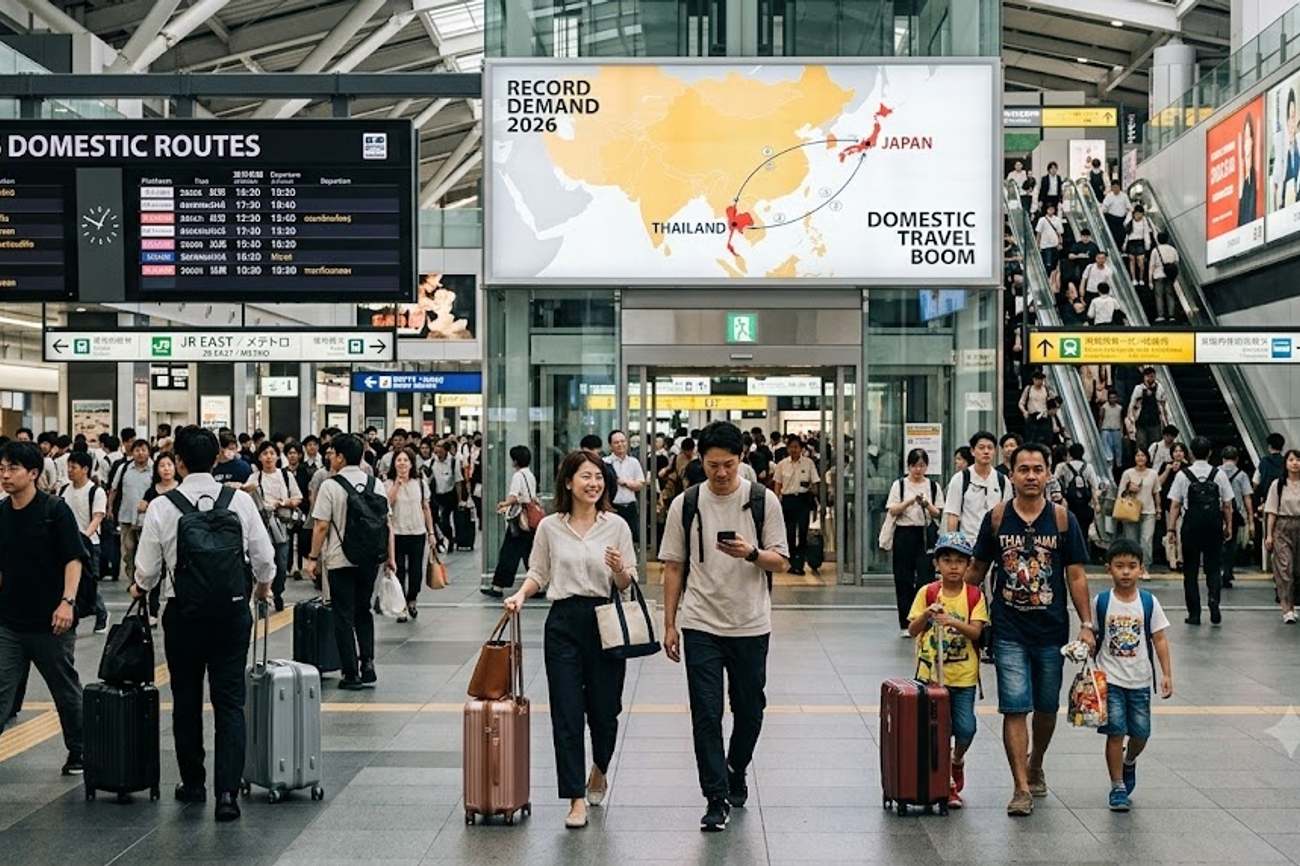
Image generated by AI
[Tokyo, September 2026] — Domestic travel consumption in Japan surged by 11.7% year-on-year during the second quarter of 2026, reaching a total of 7.5 trillion yen. This spike signals a broader structural pivot across Asia, where nations are aggressively subsidizing internal tourism to offset a sluggish recovery in international arrivals.
The shift comes as the Asia-Pacific region struggles to reclaim its pre-pandemic momentum. According to provisional data from the UN Tourism, international arrivals in the region grew by only 3% in the first quarter of 2026 and remain 11% below the 2019 baseline. In response, governments in Japan, Thailand, China, and India are restructuring transport networks and deploying financial incentives to transform domestic travel into the primary driver of economic growth.
Macroeconomic Triggers for Internal Pivoting
The acceleration of domestic tourism is a calculated response to a volatile global financial climate. Rising inflation and currency instability have made outbound international travel prohibitively expensive for many Asian citizens. In Japan, the historical weakness of the yen has specifically pushed residents to reallocate their leisure budgets toward internal destinations. Similarly, Thailand and India are seeing a rise in local travel as global aviation fuel costs and international hotel rates climb.
Governments are not leaving this shift to chance. Strategic policy adjustments include:
- Direct Financial Subsidies: State-funded incentives to lower the cost of local trips.
- Infrastructure Modernization: Expansion of regional transport hubs and high-speed rail.
- Tax Incentives: Specific measures, particularly in Thailand, to encourage citizens to explore domestic provinces.
- Digital Integration: Aggressive adoption of booking platforms and digital tourism certificates.
While inflation has reduced the frequency of travel for some, it has paradoxically increased the average spend per trip. Travelers are now prioritizing "high-quality" local experiences over budget-driven travel, shifting wealth from international hotel chains to small and medium-sized enterprises (SMEs) within provincial economies.
Regional Impact and Market Distribution
The pivot toward domesticity is affecting different markets through varied mechanisms. While Japan focuses on high-spend luxury and culinary tourism, other nations are leveraging alternative accommodations to broaden their reach.
| Market | Primary Driver | Key Strategy | Impact Area |
|---|---|---|---|
| Japan | Culinary & Wellness | High-speed rail & JTA subsidies | Regional Onsens & Gastronomy |
| Thailand | Tax Incentives | Government-backed travel credits | Provincial hospitality sectors |
| India | Cost Mitigation | Transport network restructuring | Short-haul domestic circuits |
| China | Infrastructure | Expansion of regional transport hubs | Tier 2 and Tier 3 cities |
In Japan, the Japan Tourism Agency (JTA) reports that the domestic market is thriving even as the country manages a historic volume of inbound foreign tourists. The synergy between these two markets is creating a "Golden Age" of internal exploration, where local infrastructure is being upgraded to serve both residents and visitors.
What This Means for Travelers
For the average person booking a trip in 2026, the "internal pivot" translates to a fundamental change in how travel is priced and experienced.
1. Higher Quality, Lower Frequency Travelers are moving away from "checklist tourism" toward immersive experiences. This means more spending on regional gastronomy, wellness treatments, and cultural activities, while spending on basic transport and lodging remains relatively flat.
2. Rise of the "Homestay" Economy There is a significant shift toward Airbnbs and local homestays. These alternatives provide a lower-cost entry point for short-term travel and allow citizens to access remote areas that traditional hotels do not serve.
3. Subsidized Exploration Depending on the country, travelers may find "staycation" packages or government-funded travel vouchers that make premium domestic upgrades more affordable than mid-range international flights.
4. Infrastructure Efficiency The focus on domestic networks means that regional connectivity—particularly via rail in Japan—is faster and more reliable, reducing the reliance on expensive short-haul flights.
Japan's Q2 2026 Statistical Breakdown
The financial data from the second quarter of 2026 (April to June) provides a blueprint for how domestic tourism is scaling. Total travel volume reached 150 million individuals, a 3.3% increase. May 2026 was the peak month, seeing a 5.4% surge in volume attributed to the Golden Week holiday period.
Expenditure Analysis:
- Total Consumption: 7.5 trillion yen.
- Overnight Trips: 6 trillion yen (up 13.6%).
- Day Trips: 1.6 trillion yen (up 5.1%).
- Average Spend per Trip: 50,381 yen (up 8.2%).
- Overnight Average: 76,947 yen (up 6.8%).
- Day Trip Average: 21,875 yen.
These figures follow a record-breaking fiscal year 2025, where total domestic expenditure hit 8.4 trillion yen. A critical trend identified by the Jalan Research Center (JRC) in August 2026 is the dominance of "in-destination spending." In FY2025, spending on local activities accounted for 43.8% of all travel costs, totaling 3.7 trillion yen.
Culinary exploration has become the primary motivator for Japanese residents, with 43.7% of travelers citing local food as their main objective, followed closely by traditional hot springs (onsen) and ryokan stays. While Tokyo remains the top destination with 11 million domestic tourists, growth is accelerating in provincial regions.
The Path Toward Sustainable Growth
The current trajectory suggests that domestic tourism is no longer a fallback option during crises but a permanent pillar of Asian economic strategy. By decoupling their tourism revenue from the volatility of international arrivals, these nations are creating a more resilient economic model.
The next phase of this evolution will likely involve deeper integration of "wellness tourism" and "slow travel." As the European Union Aviation Safety Agency (EASA) and other global bodies monitor the environmental impact of aviation, Asian nations are finding that high-speed rail and local circuits offer a more sustainable path to growth.
Investors are now targeting customer segments based on these local trends, focusing on "hyper-local" hospitality and boutique experiences. The transition from mass tourism to targeted, high-value domestic experiences is expected to continue through the end of 2026 and into 2027.
FAQ: Asia Domestic Tourism 2026
Why is domestic travel increasing in Asia despite inflation? Governments are using subsidies and tax incentives to lower costs, while currency weakness (like the yen) makes international travel too expensive. Travelers are choosing fewer, higher-quality local trips over costly foreign vacations.
What are the most popular activities for domestic travelers in Japan? Culinary exploration is the top driver, cited by 43.7% of travelers. Other primary motivations include visiting traditional hot springs (onsen) and staying in traditional ryokans.
How are accommodation trends changing for local travelers? There is a marked shift toward Airbnbs, homestays, and local tourism offers. These provide affordable, alternative methods for short-term travel and help distribute tourism wealth to smaller, provincial communities.
Is international travel in Asia completely dead? No, but it is recovering slowly. International arrivals in the Asia-Pacific region grew by 3% in Q1 2026 but are still 11% below 2019 levels, prompting the shift toward domestic markets.
Asia's tourism engine has shifted gears, trading global reach for local depth.
#JapanTourism2026 #AsiaPacificTravel #JTA #UNTourism #DomesticTourismPivot #TokyoTravel2026
Related Travel Guides
Disclaimer
This article is for informational and educational purposes only. It does not constitute legal, financial, or professional advice. While we strive to provide accurate and up-to-date information, travel policies, regulations, and conditions change rapidly. Always verify information with official sources before making travel decisions. Nomad Lawyer makes no representations about the accuracy, reliability, completeness, or suitability of the information provided. Readers should consult qualified professionals for advice specific to their circumstances. The views expressed in this article are those of the author and do not necessarily reflect the views of Nomad Lawyer.
Naina Thakur
Contributor & Travel Specialist
Travel enthusiast and legal writer covering visa regulations, responsible tourism, and cultural journeys across global destinations.
Learn more about our team →