
Indonesia Ferry Disaster Leaves Six Dead And 129 Missing After Java Sea Capsize
Indonesia Ferry Disaster Leaves Six Dead And 129 Missing After Java Sea Capsize

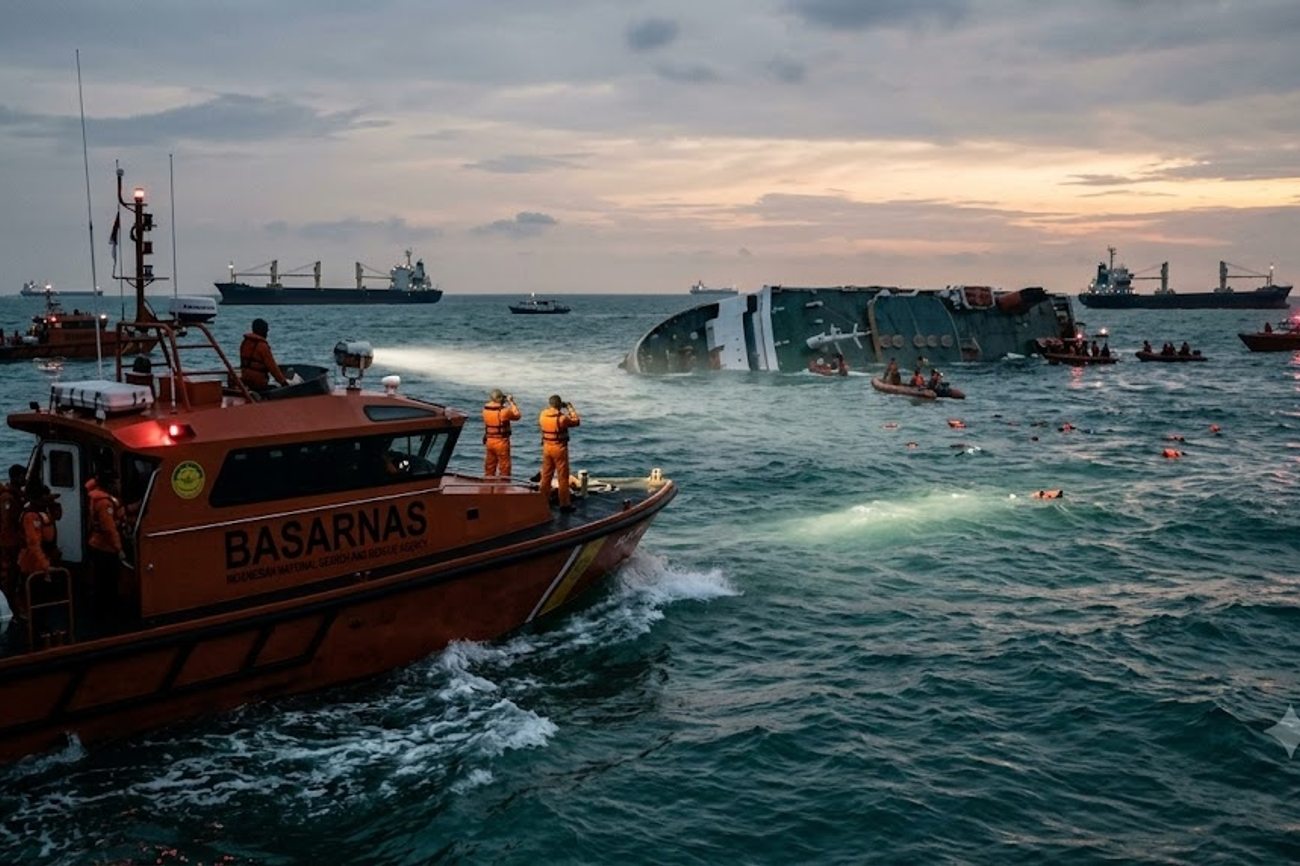
Image generated by AI
Maritime casualty rates in the Indonesian archipelago have historically fluctuated, but the September 13, 2026, disaster involving the Virgo Transport 8 underscores a persistent volatility in inter-island transit safety. With 129 people missing out of 243 aboard—a 53% unaccounted-for rate—this incident highlights a critical gap between vessel capacity and survival outcomes during severe weather events in the Java Sea.
The Java Sea Crisis in Numbers
The capsizing of the Virgo Transport 8 is not merely a localized accident but a data point in the ongoing struggle to secure Indonesia's maritime corridors. The vessel was navigating the route from Surabaya in East Java to Banjarmasin in South Kalimantan when it encountered severe weather. The raw data from the rescue operation reveals a stark disparity between those saved and those lost:
- Total Manifest: 243 passengers and crew.
- Successful Rescues: 108 individuals.
- Confirmed Fatalities: 6 deaths.
- Current Missing Count: 129 people.
- Search Magnitude: 622 personnel deployed across approximately 12 rescue ships.
The operational scale of the response—utilizing over 600 personnel for a single vessel—indicates the high complexity of search-and-rescue (SAR) operations in the Java Sea. According to initial reports from rescue official Edy Prakoso, the vessel suffered a catastrophic list after strong waves struck the starboard side. This sequence of events suggests a failure in stability or a breach of safety margins during adverse weather, though Transport Minister Dudy Purwagandhi has clarified that a formal investigation is still underway to determine the definitive cause.
Comparative Maritime Safety Context
When analyzing this incident against regional benchmarks, the Virgo Transport 8 disaster fits into a broader pattern of "weather-triggered" maritime failures common in Southeast Asia. According to data from the International Maritime Organization (IMO), stability failures in passenger ferries often correlate with overloading or inadequate ballast management during peak seasonal storms.
In the Indonesian context, the reliance on ferry transport is a geographical necessity. However, the ratio of missing persons to rescued persons in this specific event (1.19 missing for every 1 person rescued) is significantly higher than in standardized coastal accidents, suggesting the vessel may have capsized rapidly, leaving little time for the deployment of life-saving apparatus.
The following table compares the Virgo Transport 8 incident against typical maritime operational parameters for the Surabaya-Banjarmasin corridor:
| Metric | Virgo Transport 8 Incident | Standard Corridor Benchmark | Variance/Impact |
|---|---|---|---|
| Passenger Load | 243 | Variable by Vessel Class | High density for mid-sized ferry |
| Survival Rate | 44.4% (Rescued) | >90% (Typical Calm Weather) | Severe drop due to weather/capsizing |
| Missing Rate | 53.1% | <1% | Extreme outlier indicating rapid sink |
| SAR Response | 622 Personnel / 12 Ships | Route-specific standby | Massive mobilization required |
| Primary Trigger | Starboard Wave Impact | Routine Navigation | Catastrophic stability failure |
This data suggests that while the Java Sea is a primary artery for trade and tourism, the safety margins for passenger vessels during the September weather window are precariously thin. For a deeper look at global maritime safety statistics, Statista provides comprehensive data on shipping accidents and their economic impacts.
What This Means for Travelers
For the individual traveler, the Virgo Transport 8 disaster serves as a quantitative warning regarding the risks of inter-island transit during the transition of weather seasons in Indonesia. The fact that 129 people remain missing despite the deployment of 12 ships and 622 personnel proves that once a vessel lists in the open Java Sea, the probability of rescue drops precipitously.
Actionable Booking and Travel Advice:
- Weather-Based Itinerary Flexibility: If you are traveling between East Java and South Kalimantan, build a 48-to-72-hour "buffer window" into your itinerary. Given that weather is the primary trigger for these disasters, avoid tight connections to flights or hotels that charge high cancellation fees.
- Vessel Verification: Before boarding, inquire about the vessel's stability records and the availability of life jackets for 100% of the manifest. The rapid capsizing of the Virgo Transport 8 indicates that "standard" safety measures may be insufficient during starboard-side wave impacts.
- Alternative Routing: For those prioritizing safety over cost, evaluate flight options between Surabaya and Banjarmasin. While more expensive, the risk profile is exponentially lower than maritime transit during the volatile September weather window.
- Real-Time Monitoring: Do not rely solely on the ferry operator's confirmation of sailing. Monitor official notices from the Indonesian Ministry of Transportation and the World Tourism Organization (UNWTO) for regional travel advisories.
Forward Projection: The Future of Indonesian Maritime Transit
Based on the current trajectory of maritime accidents in the region, we can project three primary shifts in the industry over the next 24 months:
First, there will likely be a push for mandatory "Real-Time Stability Monitoring" (RTSM) systems on all passenger ferries operating in the Java Sea. The current inability to prevent a list after a single wave impact suggests that manual stability checks are outdated.
Second, we expect a shift in insurance premiums for maritime operators. As the data from the Virgo Transport 8 incident becomes public, underwriters will likely increase premiums for vessels that do not meet upgraded weather-resistance certifications, potentially leading to higher ticket prices for travelers.
Third, the Indonesian government may accelerate the transition toward larger, more stable Ro-Pax vessels to replace smaller ferries. Data shows that larger hulls generally handle the starboard-side impacts that crippled the Virgo Transport 8 more effectively.
The gap between the 108 rescued and the 129 missing is a haunting metric that will likely drive a regulatory overhaul of how "bad weather" is defined before a ship is cleared to leave port in Surabaya.
FAQ: Java Sea Ferry Safety 2026
Will ferry prices increase due to new safety regulations? Likely yes. If the investigation mandates upgraded stability equipment or larger vessel requirements, operators will pass these capital expenditures onto passengers through higher fare structures.
Is it safe to travel by ferry in Indonesia right now? Maritime transport remains operational, but the risk increases during severe weather. Travelers should avoid sea voyages during storm warnings and prioritize vessels with modern safety certifications.
Which routes are most affected by these weather patterns? The corridor between East Java (Surabaya) and South Kalimantan (Banjarmasin) is particularly exposed to the volatility of the Java Sea during the September window.
How can I check if a ferry is safe before boarding? Check for current safety certifications and ensure the vessel is not visibly overloaded. Always verify that the operator has a clear communication link with the local rescue agency.
The distance between a routine voyage and a maritime disaster is often measured by a single wave and a failure of stability.
#JavaSeaMaritimeSafety #VirgoTransport8 #IndonesianFerryTrends2026 #SurabayaBanjarmasinRoute #MaritimeStabilityData #SouthKalimantanTransit
Related Travel Guides
Disclaimer
This article is for informational and educational purposes only. It does not constitute legal, financial, or professional advice. While we strive to provide accurate and up-to-date information, travel policies, regulations, and conditions change rapidly. Always verify information with official sources before making travel decisions. Nomad Lawyer makes no representations about the accuracy, reliability, completeness, or suitability of the information provided. Readers should consult qualified professionals for advice specific to their circumstances. The views expressed in this article are those of the author and do not necessarily reflect the views of Nomad Lawyer.
Kunal K Choudhary
Co-Founder & Contributor
A passionate traveller and tech enthusiast. Kunal contributes to the vision and growth of Nomad Lawyer, bringing fresh perspectives and driving the community forward.
Learn more about our team →