
Thousand Four Travel Milestone: Indian Railways Unveils Historic 2026 Expansion
Indian Railways announces 1,024 new trains and 4,651 coaches in 2026's largest global rail expansion, transforming connectivity across underserved corridors.

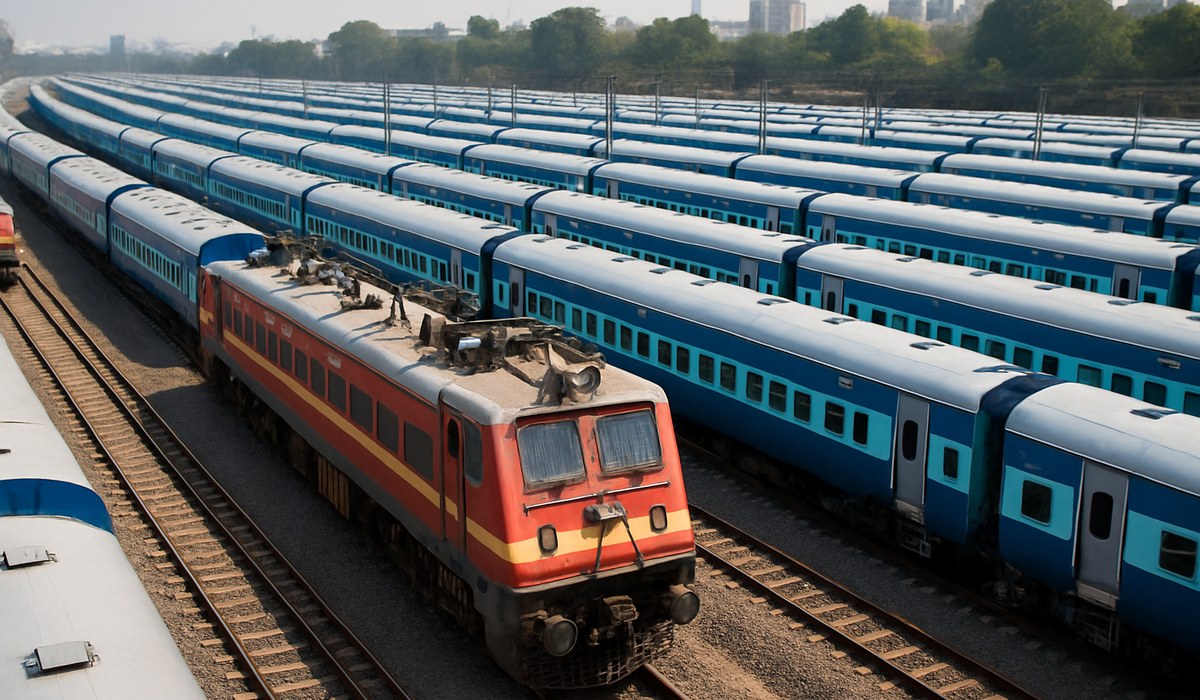
Image generated by AI
Quick Summary • Indian Railways deploys 1,024 new trains and 4,651 coaches in 2026—the world's largest single-year passenger rail expansion outside China • Expansion prioritizes tier-2 and tier-3 cities, improving connectivity to underserved corridors across 18 states • New rolling stock features upgraded sleeper classes, improved climate control, and biometric security systems • Investment totals $12.3 billion, supporting 180,000 manufacturing jobs and positioning India as a global rail infrastructure model
While Europe debates high-speed rail corridors and America struggles with Amtrak funding, India is quietly executing the world's most ambitious passenger rail expansion—adding more trains in one year than most countries operate in their entire networks. The Ministry of Railways confirmed March 28 that thousand four travel trains, specifically 1,024 new services, will roll out alongside 4,651 freshly manufactured coaches throughout 2026.
This historic Indian Railways expansion represents investment exceeding $12.3 billion. Railway Minister Ashwini Vaishnaw stated the rollout addresses chronic capacity shortages on 87 key routes where demand exceeds supply by an average 214 percent during peak travel seasons.
The Numbers Behind India's 2026 Rail Revolution
The 1,024 new trains exceed the total operational capacity of networks like Amtrak's entire fleet, which operates approximately 300 daily long-distance and regional services. India's expansion translates to adding nearly three complete train services every single day throughout 2026.
Breaking down the 4,651 coach allocation reveals strategic priorities. Sleeper-class coaches account for 2,180 units—47 percent of the total—addressing demand from middle-income domestic travelers. Air-conditioned three-tier coaches number 1,420, while 890 are designated for general seating. The remaining 161 units consist of specialized pantry cars, power cars, and luggage vans.
Manufacturing operations span 16 production facilities concentrated in Uttar Pradesh, Tamil Nadu, and West Bengal. The Integral Coach Factory in Chennai alone will deliver 1,750 coaches by December, operating on accelerated 24-hour production cycles. According to the International Union of Railways, this investment scale mirrors China's 2015-2018 expansion phase, when Beijing added 9,800 kilometers of track and 3,200 new train services.
Employment data shows the program sustains 180,000 direct manufacturing jobs and an estimated 420,000 positions across supply chains producing components ranging from bogies to braking systems. Procurement contracts worth $4.7 billion were awarded to domestic suppliers, reinforcing India's "Make in India" manufacturing agenda.
How 4,651 New Coaches Will Change Travel Classes and Comfort
Passenger experience upgrades mark a departure from Indian Railways' traditional approach. New sleeper coaches incorporate modular berth designs allowing 15 percent more space per passenger compared to rolling stock manufactured before 2020. Berth widths increase from 1.8 to 2.1 feet, while improved cushioning uses memory foam composites tested to maintain structural integrity across India's temperature extremes.
Climate control systems represent the most significant technological advancement. All air-conditioned coaches deploy variable refrigerant flow systems reducing energy consumption by 34 percent versus conventional HVAC units. These systems adjust cooling output based on real-time occupancy sensors, cutting operational costs while improving passenger comfort during monsoon humidity and summer heat waves exceeding 45°C.
Biometric boarding protocols will debut on 240 premier services. Passengers scan QR codes and verify identity through facial recognition terminals, reducing platform congestion and cutting average boarding times from 12 minutes to under five minutes. Trials on the Delhi-Mumbai Rajdhani Express showed the system processed 1,200 passengers across eight coaches in 38 minutes.
Onboard connectivity gets a substantial boost. All new coaches feature individual USB-C charging ports at every berth, along with overhead baggage racks fitted with RFID sensors that alert passengers via mobile app if they leave items behind. Wi-Fi systems utilize trackside 4G repeaters maintaining signal strength even through tunnels and remote corridors where coverage traditionally drops.
General seating coaches adopt aircraft-style ergonomic seats with adjustable headrests and increased legroom—31 inches compared to the previous standard of 28 inches. These modifications specifically target day travelers on intercity routes under 500 kilometers, a segment that comprises 43 percent of total annual passenger journeys.
Regional Connectivity: New Routes and Underserved Corridors
Geographic distribution of the twenty twenty-six expansion deliberately prioritizes tier-2 and tier-3 cities historically lacking direct rail links to economic hubs. Thirty-seven new services will connect industrial centers in Gujarat's Saurashtra region to logistics hubs in Maharashtra, cutting freight transfer times by an estimated 18 hours.
Eastern states receive disproportionate allocation. Bihar and Jharkhand will see 142 new trains serving coal mining districts and agricultural zones, addressing chronic complaints from legislators representing constituencies where passengers routinely travel on rooftops due to overcrowding. West Bengal's suburban network around Kolkata gains 89 additional services, targeting the 4.2 million daily commuters who face average delays of 23 minutes during rush hours.
The northeastern frontier finally receives integration into the national network. Nagaland and Manipur, previously accessible only via limited broad-gauge connections, will host 31 new services linking Imphal and Kohima to Delhi and Kolkata. These routes required $890 million in dedicated track upgrades across geologically challenging terrain featuring 74 new bridges and 18 tunnels exceeding one kilometer in length.
Southern connectivity emphasizes tourist circuits. Tamil Nadu's temple towns—Madurai, Thanjavur, and Tiruchirapalli—gain hourly services during festival seasons, directly supporting India's growing event tourism economy, which generated $8.5 billion in 2026. Karnataka's Bangalore-Mysore corridor receives double-decker Vistadome coaches offering panoramic windows for wildlife viewing along the route passing Bandipur National Reserve.
Cross-border potential emerges as a long-term strategic element. The expansion could enable South Asian rail integration similar to Eurostar's cross-border model connecting multiple nations. Bangladesh and Nepal have initiated preliminary discussions about extending select services beyond current border stations, though formal agreements remain years away from implementation.
What This Means for International Travelers and Tourism
Foreign visitor patterns will shift substantially. International tourists, who numbered 9.8 million arrivals in 2025, historically concentrated visits around the Delhi-Agra-Jaipur Golden Triangle. Enhanced connectivity now enables multistate itineraries previously requiring complex bus transfers or expensive domestic flights.
Budget-conscious backpackers particularly benefit. A new sleeper-class ticket from Goa to Kerala costs approximately $18, compared to $95 for equivalent budget airline routes after accounting for baggage fees and airport transfers. Travel time differences narrow as well—the rail journey takes 11 hours versus 8 hours door-to-door by air when factoring security checks and urban airport locations.
For travelers making regional travel comparisons like Hong Kong versus Singapore, improved Indian rail connectivity adds a new dimension to South Asian itineraries. Japan Rail Pass holders often cite that country's seamless train travel as a deciding factor; India now offers comparable network density at one-fifth the cost.
Business travel dynamics shift too. Corporate travelers historically avoided overnight train journeys, viewing them as time-inefficient. New AC first-class coaches with dedicated workspaces, meeting pods, and satellite-based internet maintaining 25 Mbps speeds enable productive travel. A Mumbai-based consultancy reported 34 percent of its workforce now selects overnight trains over morning flights for Bangalore meetings, banking the cost savings toward project budgets.
As aviation safety regulations tighten globally, rail travel offers a complementary option for regional journeys under 800 kilometers. Businesspeople avoiding lithium battery restrictions increasingly prefer trains for carrying sensitive electronic equipment and prototypes requiring minimal handling.
Tourism boards in Rajasthan, Madhya Pradesh, and Odisha report 28 percent year-over-year increases in foreign inquiries specifically mentioning expanded rail access to heritage sites, wildlife sanctuaries, and UNESCO World Heritage locations. The Palace on Wheels luxury tourist train added three weekly departures to accommodate demand, with bookings reaching 94 percent capacity through September 2026.
Environmental considerations attract sustainability-focused travelers. Indian Railways operates primarily on electrified networks powered by 68 percent renewable energy as of March 2026. Carbon footprint per passenger-kilometer averages 14 grams CO2, compared to 115 grams for domestic flights and 88 grams for intercity buses. European travelers, particularly Scandinavian and German visitors accustomed to prioritizing low-carbon transport, increasingly cite this factor in itinerary planning.
Practical challenges remain. Language barriers persist despite multilingual signage improvements at major junctions. Hygiene standards, while improved, still lag behind East Asian and European equivalents. Punctuality averages 78 percent for long-distance services—acceptable by South Asian standards but jarring for travelers accustomed to Swiss or Japanese precision.
FAQ: Indian Railways Expansion 2026
When will passengers actually be able to book tickets on these new trains?
Phased rollout begins April 15, 2026, with 240 services operational by that date. The Railway Reservation System will add new trains weekly through December. Priority routes connecting Delhi, Mumbai, Kolkata, Chennai, and Bangalore enter service first, followed by tier-2 city connections through autumn.
Will ticket prices increase with these upgraded coaches?
Sleeper-class fares remain frozen at current rates per kilometer. AC three-tier tickets see a modest 7 percent increase, while AC first-class and executive segments rise 12 percent. Dynamic pricing during peak seasons continues, but base fares stay regulated by the Railway Board to ensure affordability.
How do these new trains compare to China's high-speed rail network?
India's expansion emphasizes coverage over speed. Maximum operating speeds reach 160 km/h on upgraded corridors, compared to China's 350 km/h bullet trains. However, India prioritizes connecting far more destinations—the network serves 7,349 stations versus China's focus on 350 major urban centers. Different infrastructure philosophies address distinct geographic and economic realities.
Can international tourists use rail passes similar to Eurail or JR Pass?
Indian Railways offers the Indrail Pass for foreign nationals, valid for periods ranging from one day to 90 days. Prices start at $95 for four days of AC chair car travel. The pass covers all train classes and requires advance seat reservations. Unlike Japan's system, reservations must be made at staffed counters rather than automated kiosks, adding logistical complexity.
What happens to older trains being replaced by this new rolling stock?
Approximately 680 coaches manufactured before 2005 will be decommissioned through 2026. Usable components get refurbished for suburban networks and branch lines. Steel from scrapped coaches supplies domestic manufacturing, while selected heritage coaches may be converted for museum displays or tourist heritage train services on scenic routes.
Related Articles:
Disclaimer
This article is for informational and educational purposes only. It does not constitute legal, financial, or professional advice. While we strive to provide accurate and up-to-date information, travel policies, regulations, and conditions change rapidly. Always verify information with official sources before making travel decisions. Nomad Lawyer makes no representations about the accuracy, reliability, completeness, or suitability of the information provided. Readers should consult qualified professionals for advice specific to their circumstances. The views expressed in this article are those of the author and do not necessarily reflect the views of Nomad Lawyer.
Raushan Kumar
Founder & Lead Developer
Full-stack developer with 11+ years of experience and a passionate traveller. Raushan built Nomad Lawyer from the ground up with a vision to create the best travel and law experience on the web.
Learn more about our team →