
Hundreds of Travelers Disrupted Around Asia As 136 Flights were Cancelled and 4,153 Delayed at Tokyo, Ho Chi Minh City and More Airports
Hundreds of Travelers Disrupted Around Asia As 136 Flights were Cancelled and 4,153 Delayed at Tokyo, Ho Chi Minh City and More Airports

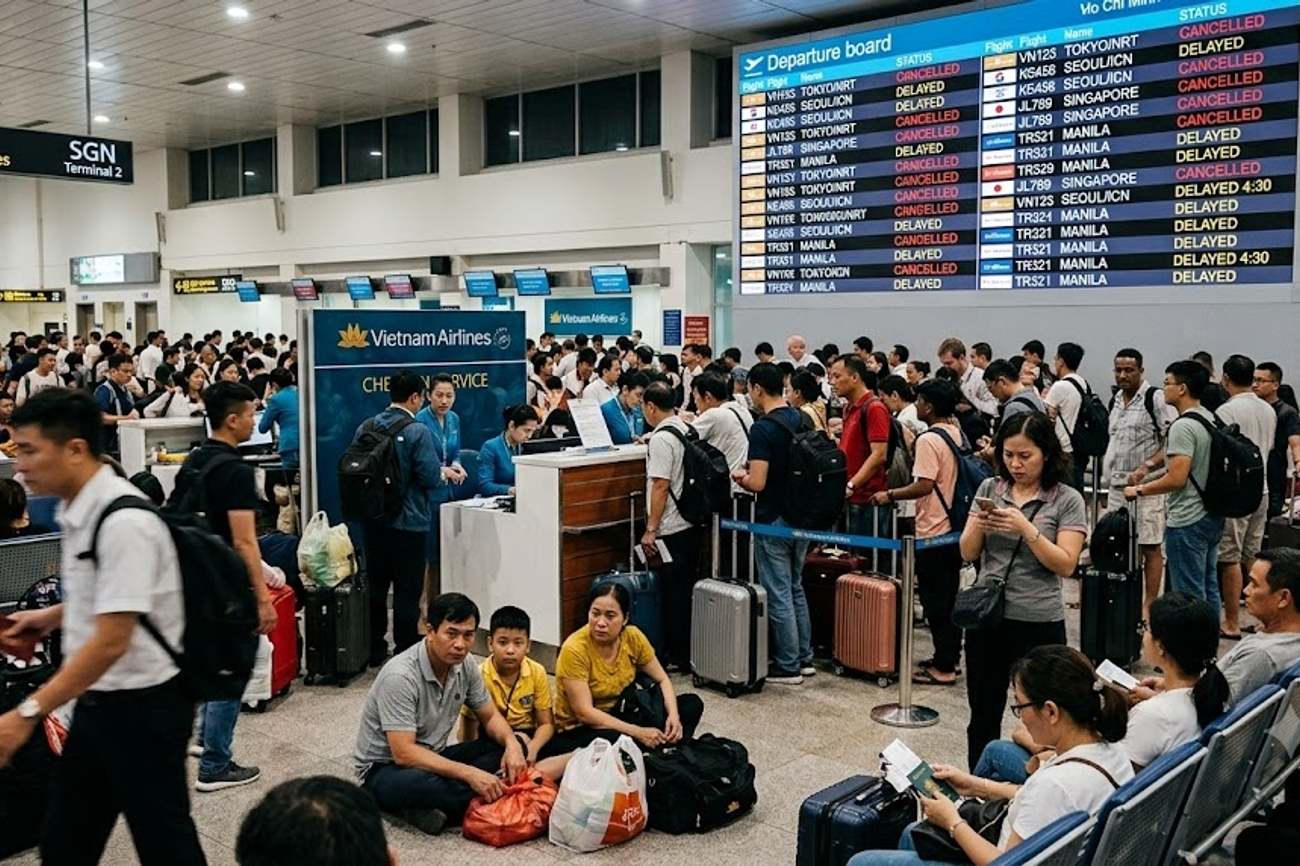
Image generated by AI
title: Asian Aviation Infrastructure Strain: Analysis of the September 2026 Operational Collapse date: 2026-09-15 author: Travel Industry Trend Analyst tags: [Asia-Pacific Aviation 2026, Airport Operational Efficiency, IATA Delay Metrics, India-China Aviation Growth, Saudi Arabia Aviation Disruptions]
While global aviation recovery has stabilized, the regional volatility in Asia has spiked, with 4,153 flights delayed and 136 cancelled across key hubs in a single reporting window. This surge in operational instability represents a critical friction point in the Asia-Pacific corridor, where passenger demand is currently outstripping the physical and digital infrastructure of primary gateways.
The Operational Collapse in Numbers
The scale of the disruption reported on September 14, 2026, reveals a systemic failure across multiple jurisdictions rather than an isolated weather event or technical glitch. The data identifies a clear hierarchy of failure, with India and China acting as the primary epicenters of delay.
Indira Gandhi International Airport in Delhi emerged as the most volatile node in the network, recording 596 delays and 5 cancellations. This concentrated pressure reflects the broader struggle of Indian aviation to scale its ground operations in tandem with fleet expansion. In China, the disruption shifted toward secondary hubs, with Shenzhen Bao’an International Airport recording 406 delays and 1 cancellation, the second-highest delay volume in the region.
The data suggests a correlation between carrier market share and disruption frequency. In India, IndiGo faced 449 delays, which accounted for 22% of its total operations. However, the intensity of the disruption was more pronounced for smaller carriers; SpiceJet reported a staggering 58% delay rate across 37 flights, alongside 7 cancellations. This indicates that while larger carriers have more buffer, smaller operators are operating at a precarious capacity limit.
Comparative Regional Disruption Benchmarks
When analyzing the data across Asia and the Middle East, a distinct pattern emerges: East and South Asia are suffering from "delay-heavy" congestion, while Southeast Asia and the Middle East are experiencing "cancellation-heavy" instability.
In Indonesia, Jakarta Soekarno-Hatta International Airport reported 20 cancellations—the highest single-airport cancellation count in the dataset—despite having fewer delays (193) than Delhi. This suggests that Indonesian operators are more likely to scrap flights entirely when operational pressure peaks, whereas Indian and Chinese hubs attempt to push flights through the system, resulting in massive delay queues.
The Middle East presents a third pattern of instability. King Abdulaziz International Airport in Jeddah reported 10 cancellations and 84 delays, while King Khalid International Airport in Riyadh recorded 9 cancellations and 70 delays. The most striking figure from the Gulf region is Saudia, which recorded 18 cancellations, the highest number of cancelled flights among all listed carriers.
The following table provides a comparative breakdown of the most affected hubs by region to highlight these differing operational pressures:
| Region | Top Affected Airport | Delays | Cancellations | Primary Pressure Type |
|---|---|---|---|---|
| South Asia | Delhi (Indira Gandhi) | 596 | 5 | High-Volume Congestion |
| East Asia | Shenzhen Bao’an | 406 | 1 | Schedule Saturation |
| Southeast Asia | Jakarta (Soekarno-Hatta) | 193 | 20 | Operational Collapse |
| Middle East | Jeddah (King Abdulaziz) | 84 | 10 | Connection Instability |
| East Asia (Hub) | Tokyo Haneda | 210 | 1 | Slot Constraint |
This regional variance is consistent with broader trends tracked by IATA, where emerging markets often struggle with "last-mile" airport infrastructure—such as taxiway capacity and ground handling—even as aircraft procurement increases.
What This Means for Travelers
The data indicates that the "hub-and-spoke" model in Asia is currently operating at a dangerous threshold. For the individual traveler, this means that the probability of a missed connection is no longer a statistical anomaly but a structural risk.
If you are routing through Delhi, Shenzhen, or Jakarta, the current 22% to 58% delay rates among certain carriers suggest that a minimum connection window of 4 hours is now the baseline for safety. Booking tight 90-minute transfers at these hubs is a high-risk strategy.
For those utilizing Southeast Asian carriers, specifically in Indonesia, the high cancellation rate (as seen with Batik Air's 16 cancellations) means that travel insurance with comprehensive "trip interruption" coverage is mandatory. Relying on the airline's internal rebooking process during a systemic collapse—where 20 flights are cancelled at a single airport—often leads to multi-day delays.
Travelers using Gulf carriers for Asia-Europe or Asia-Africa transit should monitor the stability of Saudi hubs. With Saudia recording the highest cancellation volume in the dataset, passengers should prioritize flights through Dubai International (which, despite 167 delays, had only 2 cancellations) if schedule reliability is the primary concern.
Forward Projection: The Infrastructure Gap
The current trajectory suggests that Asia's aviation growth is decoupling from its operational capacity. We are seeing a trend where airlines are adding seats and routes faster than airports can expand their apron and gate capacity. According to data trends often analyzed by OAG, when delay rates exceed 15% across a regional network, it typically signals a need for immediate slot management reform.
The fact that Tokyo Haneda (210 delays) and Incheon (114 delays) are also feeling this pressure—despite having world-class infrastructure—indicates that the problem is not just local, but a network-wide synchronization failure. As aircraft rotation becomes more complex, a delay in Delhi cascades into a delay in Tokyo.
We expect to see a shift toward "de-hubbing" in the next 24 months, where premium travelers increasingly opt for direct point-to-point flights to avoid the volatility of the major Asian gateways. Until airport throughput in India and Indonesia catches up to fleet growth, the "delay-heavy" environment will remain the standard for the region.
FAQ: Asia Aviation Disruptions 2026
Will flight prices increase due to these disruptions? Likely yes. As airlines face higher operational costs from delays and cancellations, and as they potentially reduce frequency to stabilize schedules, the remaining seats will command a premium. Expect higher fares on routes involving Delhi and Jakarta.
Is this a good time to book flights through major Asian hubs? It is acceptable, provided you build in significant buffers. Avoid "tight" connections. If your itinerary allows, prioritize hubs like Dubai over Jeddah or Jakarta for better reliability based on the current cancellation-to-delay ratios.
Which airlines are currently most reliable in the region? Based on the data, carriers with lower delay percentages relative to their volume are safer. While most are struggling, the extreme 58% delay rate of SpiceJet suggests that larger legacy carriers or high-efficiency low-cost carriers are currently more stable.
Are these delays caused by weather or systemic issues? The widespread nature of the disruptions—spanning from Tokyo to Jeddah—points to systemic issues including schedule congestion and aircraft rotation failures rather than localized weather events.
The data is clear: Asia's skies are growing faster than its ground can handle.
Related Travel Guides
- Flights Cancelled Swept America As Boston, Los Angeles, and Other Airports Face 175 Cancellations And 3,979 Delays, Affecting Air Travel
- American, Southwest, and Major Airlines Add Special Flights Exceeding 50,000 Seats as Sports Travel Demand Swells
- UK Airport Disruption: Holafly Expert Shares Essential Advice for Travellers Facing Delays and Cancellations
Disclaimer
This article is for informational and educational purposes only. It does not constitute legal, financial, or professional advice. While we strive to provide accurate and up-to-date information, travel policies, regulations, and conditions change rapidly. Always verify information with official sources before making travel decisions. Nomad Lawyer makes no representations about the accuracy, reliability, completeness, or suitability of the information provided. Readers should consult qualified professionals for advice specific to their circumstances. The views expressed in this article are those of the author and do not necessarily reflect the views of Nomad Lawyer.
Preeti Gunjan
Contributor & Community Manager
A passionate traveller and community builder. Preeti helps grow the Nomad Lawyer community, fostering engagement and bringing the reader experience to life.
Learn more about our team →