
Breaking Airline News: Severe Travel Chaos Paralyzes Hangzhou Xiaoshan Airport as 153 Flight Delays Trigger Massive Operational Meltdown
Breaking airline news: Amidst a terrifying era of massive passenger congestion, Hangzhou Xiaoshan International Airport suffers a catastrophic operational collapse, trapping thousands of travelers in a 158-flight disruption nightmare.

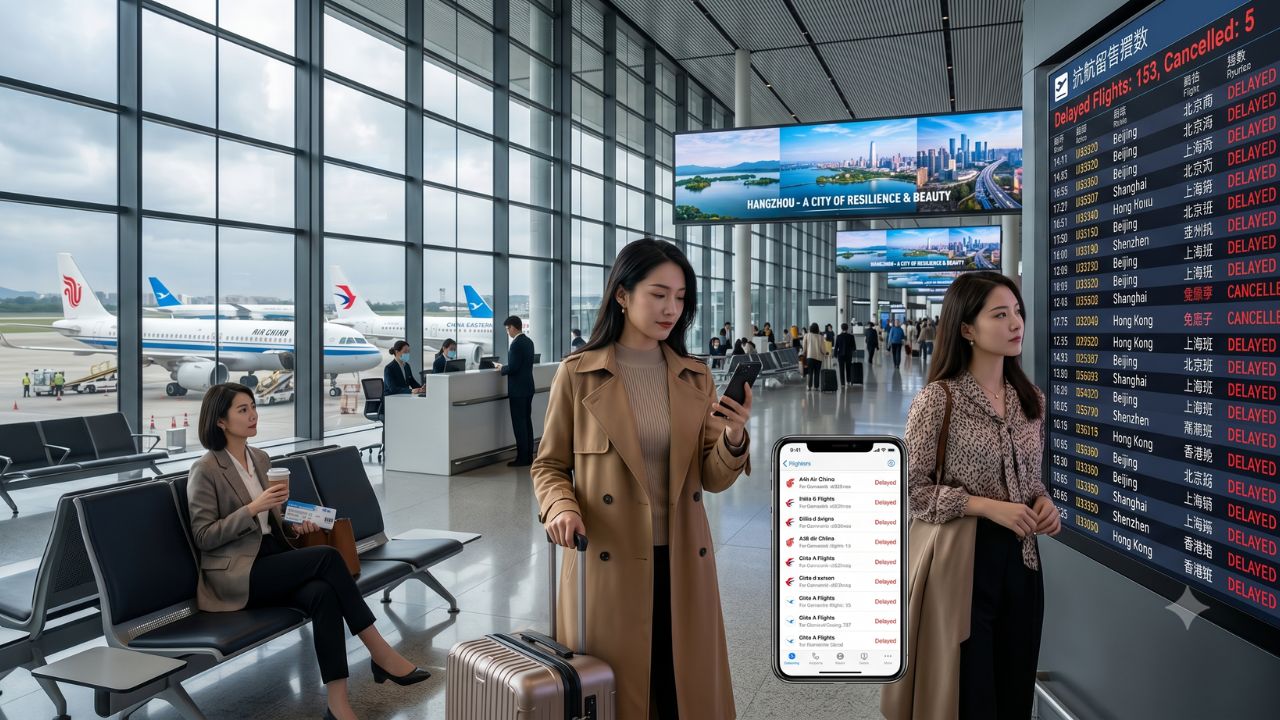
Image representing the intense strategic battle as global aviation authorities desperately attempt to contain severe flight delays and massive travel chaos following a catastrophic terminal gridlock in eastern China.
Breaking Airline News: Severe Travel Chaos Paralyzes Hangzhou Xiaoshan Airport as 153 Flight Delays Trigger Massive Operational Meltdown
As paralyzing airport disruptions, highly constrained operational bandwidth, and severe airspace friction violently sweep through the massive Chinese aviation network, a catastrophic logistical collapse has completely severed eastern China’s primary transit artery. In a devastating blow to regional connectivity and commercial flight schedules, Hangzhou Xiaoshan International Airport suffered a massive operational meltdown today, recording an absolutely staggering 153 delayed flights alongside 5 outright cancellations. While the total number of physical cancellations remained restricted, the sheer, crushing volume of delayed aircraft created an insurmountable operational challenge, violently plunging thousands of desperate domestic and international travelers into an inescapable web of severe travel chaos. As major heavyweights including Air China, China Eastern Airlines, XiamenAir, and China Southern Airlines frantically battle to reposition grounded fleets, the resulting terminal gridlock has severely disrupted the vital Asian tourism corridor.
In a harrowing display of modern aviation fragility, the sheer volume of delayed aircraft currently overwhelming the Hangzhou transit hub brutally exposes the terrifying cascading effects of high-density operational friction. Operating within a highly synchronized, hyper-connected domestic network, even the slightest deviation in arrival and departure scheduling can rapidly devolve into a high-stress, massive emergency scenario. Today’s operational data confirms a terrifying delay-to-cancellation ratio exceeding 30 to 1, indicating that airline dispatchers furiously attempted to preserve their schedules by holding aircraft on the ground rather than explicitly canceling them. However, this desperate strategy actively paralyzed the airport. With ground operations failing to clear the massive backlog of incoming and outgoing flights, furious passengers are left trapped inside overflowing, severely congested terminals, completely without immediate rebooking options as the travel chaos aggressively escalates across interconnected hubs.
Expanded Overview: The Massive Scale of the Contagion
The terrifying crisis currently gripping Hangzhou Xiaoshan International Airport brutally exposes the incredibly fragile nature of the Chinese domestic transit grid. When a strategically vital gateway experiences a severe operational meltdown of this magnitude, the cascading effects on the secondary national grid are absolutely devastating. The grounded and delayed commercial aircraft actively paralyze the entire regional fleet, aggressively strangling both the domestic technology economy and vital eastern tourism sectors. Because major carriers operate incredibly high-frequency routes connecting Hangzhou with Beijing, Shanghai, Guangzhou, Shenzhen, Chengdu, Chongqing, and Kunming, today's localized disruption immediately triggered massive shockwaves, proving that heavily loaded commercial passenger jets are entirely vulnerable to the cascading delays triggered by localized weather constraints and air traffic control (ATC) restrictions.
Section-Wise Breakdown: The Operational Collapse
Air China and the Cancellation Crisis
The massive incident aggressively centered around the sudden logistical failure of China's primary flag carrier. Air China emerged as the absolute most heavily impacted operator regarding terminated services, ruthlessly executing 4 of the airport’s 5 cancelled flights (representing a terrifying 80% of all recorded cancellations today). In a desperate attempt to stabilize the remaining schedule, Air China also held 23 flights in massive delays. This devastating combination of cancellations and extreme delays immediately triggered the highest level of passenger anxiety, physically blocking thousands of travelers from reaching vital domestic connections.
China Eastern and XiamenAir Suffer Severe Friction
The terrifying operational shockwaves violently disrupted all major commercial competitors attempting to navigate the Hangzhou airspace. XiamenAir recorded the sole remaining cancellation while simultaneously suffering a massive 21 delayed flights, demonstrating severe, uncontrollable schedule pressure across its regional network. Meanwhile, China Eastern Airlines matched Air China’s delay volume exactly, logging a staggering 23 delayed flights. However, China Eastern executed a radically different survival strategy, completely avoiding outright cancellations by forcing passengers to endure grueling wait times to maintain the core flight schedule.
Regional Paralysis Decimates Smaller Fleets
While the massive national carriers absorbed the highest total volume of delays, the percentage of disruption absolutely decimated the operational reliability of smaller, regional airlines. Both China United Airlines and Suparna suffered a terrifying 100% delay rate on their scheduled operations. Dalian Airlines and Urumqi Air experienced a catastrophic 50% delay rate, while Hebei Airlines (40%), Lucky Air (33%), Tibet Airlines (33%), and Chengdu Airlines (33%) saw massive portions of their daily schedules completely derailed by the ensuing travel chaos.
Aviation Incident & Operational Disruption Matrix
To fully comprehend the massive logistical and strategic fallout of this Hangzhou Xiaoshan Airport collapse, corporate travel managers and affected commercial passengers must review the exact incident metrics currently paralyzing the Chinese network. The following matrix provides a granular breakdown of the specific, officially verified flight disruption data that triggered this severe travel chaos.
| Airline | Cancelled | Cancelled % | Delayed | Delayed % |
|---|---|---|---|---|
| Air China | 4 | 3% | 23 | 17% |
| XiamenAir | 1 | 0% | 21 | 19% |
| Air Macau | 0 | 0% | 1 | 25% |
| Beijing Capital Airlines | 0 | 0% | 5 | 11% |
| Dalian Airlines | 0 | 0% | 1 | 50% |
| Zhejiang Loong | 0 | 0% | 12 | 12% |
| Shandong Airlines | 0 | 0% | 6 | 20% |
| China Eastern | 0 | 0% | 23 | 22% |
| Hainan Airlines | 0 | 0% | 6 | 13% |
| Spring Airlines | 0 | 0% | 3 | 20% |
| Sichuan Airlines | 0 | 0% | 9 | 28% |
| China Southern Airlines | 0 | 0% | 15 | 13% |
| Shenzhen Airlines | 0 | 0% | 3 | 15% |
| China United Airlines | 0 | 0% | 2 | 100% |
| Urumqi Air | 0 | 0% | 1 | 50% |
| Juneyao Airlines | 0 | 0% | 3 | 25% |
| Tianjin Airlines | 0 | 0% | 3 | 25% |
| Hebei Airlines | 0 | 0% | 4 | 40% |
| China Express Airlines | 0 | 0% | 1 | 25% |
| Lucky Air | 0 | 0% | 2 | 33% |
| Okay Airways | 0 | 0% | 1 | 16% |
| Tibet Airlines | 0 | 0% | 2 | 33% |
| Chengdu Airlines | 0 | 0% | 2 | 33% |
| Suparna | 0 | 0% | 4 | 100% |
Passenger Impact: Surviving the Terminal Nightmare
For the thousands of domestic tourists and corporate commuters physically trapped inside heavily congested commercial terminals due to the sudden operational collapse, the human cost of this emergency is absolutely terrifying. The brutal reality of enduring massive 153-flight delays inflicts intense psychological stress and entirely destroys meticulously planned itineraries. The disruption caused immediate friction, resulting in severely missed domestic connections, abandoned hotel reservations, massive financial losses, and entirely ruined business schedules as furious passengers battled to secure alternative flights out of the locked-down airport.
Survival Guide for Stranded Travelers
Travelers desperately navigating this chaos at Hangzhou Xiaoshan International Airport must immediately execute the following survival protocols:
- Do Not Panic, Deploy Digital Tools: Avoid aggressively swarming the physical airline desks; immediately utilize your airline's official digital app to track rapidly changing gate assignments and secure emergency rebookings.
- Secure Vouchers Immediately: Commercial passengers delayed extensively by the operational lockdown should aggressively demand meal vouchers and potential hotel accommodations from carrier customer service, keeping meticulous records for future travel insurance claims.
- Monitor Connection Cascades: Because 153 flights are operating out of sequence, passengers with onward connections in Beijing or Guangzhou must assume their entire itinerary is compromised and proactively request route alterations before boarding their delayed initial flight.
Industry Analysis: The Fragility of Summer Operations
From a strategic aviation perspective, the travel turmoil currently decimating Hangzhou highlights the terrifying vulnerability of managing highly dense flight schedules during peak operational stress. Industry analysts confirm that adverse summer weather conditions, severe thunderstorms along major domestic flight corridors, and heavily restricted air traffic flow management directly trigger these massive delay events. The massive commercial failure observed today proves that major airline networks remain incredibly vulnerable to localized airspace constraints. To prevent the complete destruction of eastern China’s travel reputation, aviation authorities must aggressively overhaul ground handling and aircraft rotation protocols to rapidly restore efficiency following severe disruption events.
Conclusion: A Strategic Retreat to Ensure Aviation Survival
As the situation across Hangzhou Xiaoshan International Airport remains highly fluid, the sudden collapse of this primary eastern travel hub represents a massive warning to domestic travelers. The staggering 153 delays and concentrated cancellations prove that flight schedules remain terrifyingly fragile under unexpected operational lockdowns. Corporate travel buyers and everyday passengers attempting to navigate this highly unstable era of airport disruptions must maintain extreme flexibility. By acting aggressively to secure robust travel insurance and relentlessly monitoring real-time data, travelers can successfully survive this unprecedented operational meltdown and escape the severe travel chaos currently paralyzing the region.
Key Takeaways
- Massive Airport Paralysis: Hangzhou Xiaoshan International Airport suffered a catastrophic operational meltdown, recording 153 flight delays and 5 cancellations.
- Air China Severely Impacted: The flagship carrier executed 80% of all cancellations (4 flights) while simultaneously logging 23 massive delays.
- Network Giants Suffer Extreme Friction: China Eastern (23 delays), XiamenAir (21 delays), and China Southern (15 delays) were forced to operate under severe, paralyzing schedule constraints.
- Smaller Fleets Decimated: Regional carriers including China United Airlines and Suparna suffered a devastating 100% delay rate on their scheduled operations.
- Traveler Advisory: Passengers trapped in the terminal gridlock must aggressively utilize mobile apps to track rapidly altering gate assignments and immediately secure compensation for extended ground delays.
Related Travel Guides
- How Airline Consolidations Are Sparking Major Travel Chaos Across the Globe
- Navigating Severe Flight Cancellations: A Passenger's Guide to Surviving Airport Disruptions
- The Ultimate Guide to Beating Airport Congestion During the 2026 Summer Surge
Disclaimer: The information presented in this article is based on official operational data from Hangzhou Xiaoshan International Airport available as of June 10, 2026. Flight schedules, airspace regulations, and operational capacities at the airport are highly dynamic and subject to immediate, extreme change due to ongoing weather events and ATC restrictions. Passengers are strongly advised to verify all operational statuses directly with their respective airlines before arriving at the airport.
Kunal K Choudhary
Co-Founder & Contributor
A passionate traveller and tech enthusiast. Kunal contributes to the vision and growth of Nomad Lawyer, bringing fresh perspectives and driving the community forward.
Learn more about our team →