
Air Canada & Azorra Back Airbus A220-500 — A New Era for Narrowbodies
Air Canada and Florida-based leasing company Azorra have publicly backed the Airbus A220-500, a stretched variant of the A220-300 that promises greater seat capacity, stronger operating economics, and a potential shift in Airbus' narrowbody strategy globally.

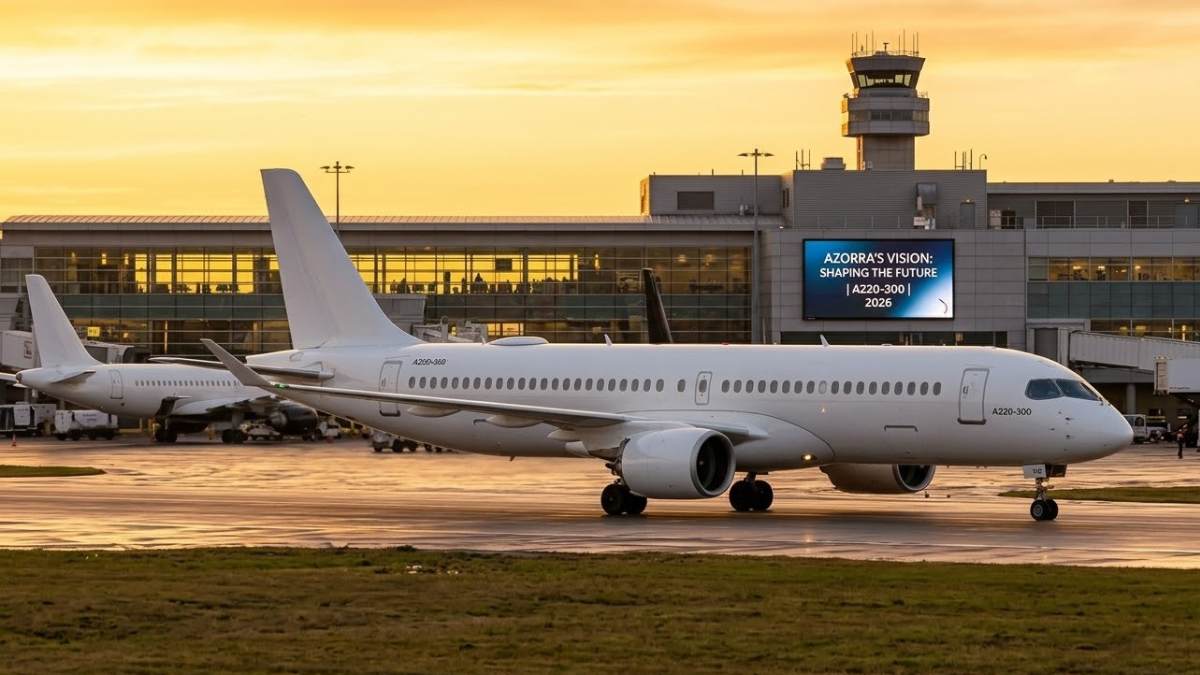
Image generated with AI
Quick Summary
- Air Canada and Azorra — a Florida-based aircraft leasing company — have both publicly backed the Airbus A220-500, a stretched, higher-capacity variant of the popular A220-300
- The A220-500 is designed to bridge the gap between regional jets and larger narrowbodies like the Airbus A320neo and Boeing 737 MAX 8, offering improved economics at medium capacities
- Air Canada currently operates 42 A220 aircraft with 23 more on order, positioning it as a natural launch candidate for the A220-500
- Airbus is still evaluating the timing and specifics of the A220-500 launch, including whether to preserve the A220-300's ~3,400 nautical mile range or accept a reduction in exchange for lower development costs
Industry momentum behind the Airbus A220-500 is accelerating, with Air Canada — one of North America's largest carriers — and Azorra, a prominent Florida-based aircraft lessor, both lending their public support to the stretched narrowbody concept. As Airbus continues to assess whether and when to formally launch the program, backing from operators and lessors of this scale adds significant commercial weight to the aircraft's case — and raises the prospect of a new chapter in the narrowbody market's evolution.
The A220-500 is envisioned as a stretched derivative of the existing A220-300, designed to carry more passengers per trip while preserving the platform's celebrated operating efficiency. For airlines like Air Canada, which flies across one of the world's most geographically demanding domestic networks, the aircraft's combination of increased capacity and cost-per-seat economics presents a compelling proposition.
What Is the Airbus A220-500?
The Airbus A220-500 is a proposed stretched version of the A220-300 — itself already the larger of the two A220 variants currently in service. By extending the fuselage of the A220-300, the A220-500 would offer greater seat capacity than any current A220 model, positioning it directly above the A220-300 in terms of passenger throughput while retaining the aircraft family's core advantage: superior fuel efficiency and lower operating costs relative to competing narrowbodies.
The A220 family — originally developed by Bombardier as the C Series and acquired by Airbus in 2018 — has established itself as a strong performer in the 100–150 seat market segment. The A220-500 would push that ceiling higher, potentially serving routes that currently require an A320neo or Boeing 737 MAX 8 but where lower frequencies or thinner demand make those larger jets economically oversized.
Air Canada: A Proven A220 Operator with Expansion Plans
Air Canada is among the most significant A220 operators in the world. The carrier currently flies 42 A220 aircraft, with a further 23 on order for future delivery. Its operational experience with the A220 platform — across domestic Canadian routes and shorter North American services — has demonstrated the aircraft's versatility across the country's vast and varied route network.
The A220-500's increased seating capacity would directly address Air Canada's need to scale capacity on established A220 routes without stepping up to the significantly larger and costlier A320neo. For a carrier operating in a country the geographic scale of Canada, having a higher-capacity narrowbody with the A220's efficiency profile represents a meaningful operational advantage.
Azorra: The Leasing Sector's Voice for the A220-500
Azorra, the Florida-headquartered aircraft leasing company, has been a consistent and vocal advocate for the A220 family. Azorra President Ron Baur has repeatedly highlighted the aircraft's efficiency credentials and operational advantages — attributes he believes will be amplified in the A220-500 variant.
For leasing companies, the A220-500 offers a particularly attractive proposition: a versatile, efficient narrowbody that serves well for a wide range of airline types and route structures, without the higher acquisition and operating costs associated with larger aircraft. Azorra's endorsement is significant because lessors function as critical market-makers in commercial aviation — their willingness to place orders and take delivery positions directly influences the commercial viability of new aircraft programs.
The Economics: Why Stretching Works
One of the most powerful arguments for the A220-500 is grounded in the economics of aircraft stretching. When an aircraft fuselage is extended to add seat rows, operating costs do not rise proportionally with the increase in capacity. Fixed costs — including crew, maintenance cycles, landing fees, and base fuel burn — are spread across a larger number of revenue-generating seats, producing a lower cost per available seat mile (CASM) than the smaller variant.
This means airlines operating the A220-500 could potentially achieve higher profitability per flight on routes where current A220-300 capacity is insufficient but an A320neo or 737 MAX 8 would be too large or too costly to operate efficiently. The A220-500 would effectively fill that economic sweet spot — delivering narrowbody economics in a size that sits above the A220-300 but below the dominant 150–180 seat narrowbodies.
The Range Dilemma: A Critical Engineering Trade-Off
The A220-500's most debated design variable is range. Stretching an airframe typically reduces range, as the added fuselage weight and passenger load increase fuel consumption without a corresponding increase in fuel tank capacity.
The A220-300 currently delivers a range of approximately 3,400 nautical miles — roughly equivalent to 3,900 statute miles. This range is sufficient for transcontinental services within North America, a critical capability for carriers like Air Canada serving routes between eastern Canadian cities and western destinations such as Vancouver and Calgary.
Airbus faces a choice: engineer a fuel capacity increase to maintain the A220-300's range in the stretched variant — adding cost and complexity — or accept a range reduction and offer a more economically streamlined development path. Ron Baur of Azorra has argued the trade-off is acceptable, on the basis that the capacity and economics gains outweigh the range concession for the majority of routes the aircraft would serve.
The answer may also vary by geography. U.S. carriers prioritizing transcontinental coverage would prefer maximum range retention, while European airlines — operating dense, shorter networks — may have little need for extended range and would accept a reduced-range variant without significant operational impact.
Strategic Implications for Airbus' Narrowbody Portfolio
The A220-500's potential launch carries significant strategic implications for Airbus' broader narrowbody lineup. If the A220-500 absorbs demand from the lower end of the A320neo market — where airlines currently order the A320neo primarily for seat capacity rather than range — Airbus could redirect its A320neo production focus toward the A321neo, which has become the dominant force in modern narrowbody order books globally.
This portfolio shift would allow Airbus to serve the 120–160 seat market efficiently through the A220-500, while using the A321neo — with its extended range and higher capacity — to address the upper end of the narrowbody and lower end of the widebody spectrum. The result would be a more differentiated and efficient Airbus narrowbody family, with less internal competition between closely sized variants.
Key Facts at a Glance
- Air Canada operates 42 A220 aircraft with 23 more on order
- Azorra President Ron Baur has publicly backed the A220-500's economics and operational case
- The A220-300 range is approximately 3,400 nautical miles (~3,900 miles)
- The A220-500 would sit above the A220-300 in capacity, below the A320neo and Boeing 737 MAX 8
- Stretching an aircraft improves cost economics by spreading fixed costs across more seats per flight
- Airbus is still evaluating launch timing, range specifications, and development costs
- The A220 family was originally developed by Bombardier as the C Series, acquired by Airbus in 2018
- Potential portfolio effect: A220-500 could reduce A320neo demand and shift Airbus' focus to the A321neo
What This Means for Travelers
For passengers, the A220-500's potential market entry carries tangible benefits. The A220 cabin is widely regarded as one of the most comfortable narrowbody interiors currently flying, featuring 2-3 seating across (compared to the 3-3 configuration of A320neo and 737 MAX cabins), wider seats, larger windows, and lower cabin altitude for reduced passenger fatigue. A stretched A220-500 would bring these comfort advantages to a larger passenger count per aircraft.
Airlines operating the A220-500 on routes currently served by A320neo or 737 MAX 8 would offer a meaningfully better passenger experience at equivalent or superior operating economics — a combination that could drive adoption across a broad range of carriers, from full-service flag carriers to hybrid and low-cost operators.
Frequently Asked Questions
What is the Airbus A220-500? The Airbus A220-500 is a proposed stretched variant of the current A220-300, designed to carry more passengers per flight while retaining the A220 family's fuel efficiency and low operating cost profile. It would fill the market gap between the A220-300 and larger narrowbodies like the Airbus A320neo and Boeing 737 MAX 8. Airbus has not yet formally launched the program.
Why are Air Canada and Azorra supporting the A220-500? Air Canada already operates 42 A220s and sees the stretched variant as a natural capacity step-up for its domestic and North American network without the cost jump of moving to an A320neo. Azorra, a major aircraft lessor, backs the A220-500 for its superior economics and versatility across a wide range of airline operators and route types — making it an attractive leasing product.
Will the A220-500 have a shorter range than the A220-300? Possibly. Stretching an aircraft typically reduces range as weight increases without a proportional increase in fuel capacity. The A220-300's range is ~3,400 nautical miles. Airbus is evaluating whether to engineer additional fuel capacity to preserve this range or accept a moderate reduction to lower development costs. Both Ron Baur of Azorra and Airbus have acknowledged this trade-off as a central design decision.
How does the A220-500 fit into Airbus' broader strategy? The A220-500 could reduce internal competition between the A220-300 and the lower end of the A320neo market, allowing Airbus to concentrate A320neo production focus on the A321neo — which dominates current narrowbody order books. This would sharpen the differentiation across Airbus' narrowbody family and potentially improve overall delivery economics.
Related Travel Guides
Canada Hit: 92 Cancellations, 752 Delays — Toronto & Montreal Worst Affected
Dulles Airport Hit: Flights to Doha, London, Chicago & Orlando Axed
Massive Flight Chaos at U.S. Airports: Cancellations Hit Hawaii-Bound Travelers Hard
Disclaimer
This article is for informational and educational purposes only. It does not constitute legal, financial, or professional advice. While we strive to provide accurate and up-to-date information, travel policies, regulations, and conditions change rapidly. Always verify information with official sources before making travel decisions. Nomad Lawyer makes no representations about the accuracy, reliability, completeness, or suitability of the information provided. Readers should consult qualified professionals for advice specific to their circumstances. The views expressed in this article are those of the author and do not necessarily reflect the views of Nomad Lawyer.
Raushan Kumar
Founder & Lead Developer
Full-stack developer with 11+ years of experience and a passionate traveller. Raushan built Nomad Lawyer from the ground up with a vision to create the best travel and law experience on the web.
Learn more about our team →