
Aviation Updates: Qantas Trans-Tasman Diversion Exposes Border Bureaucracy Behind Severe Regional Travel Chaos
A routine Qantas diversion from Wellington to Auckland rapidly spiraled into a grueling tarmac delay as rigid New Zealand customs rules stranded passengers mid-journey.

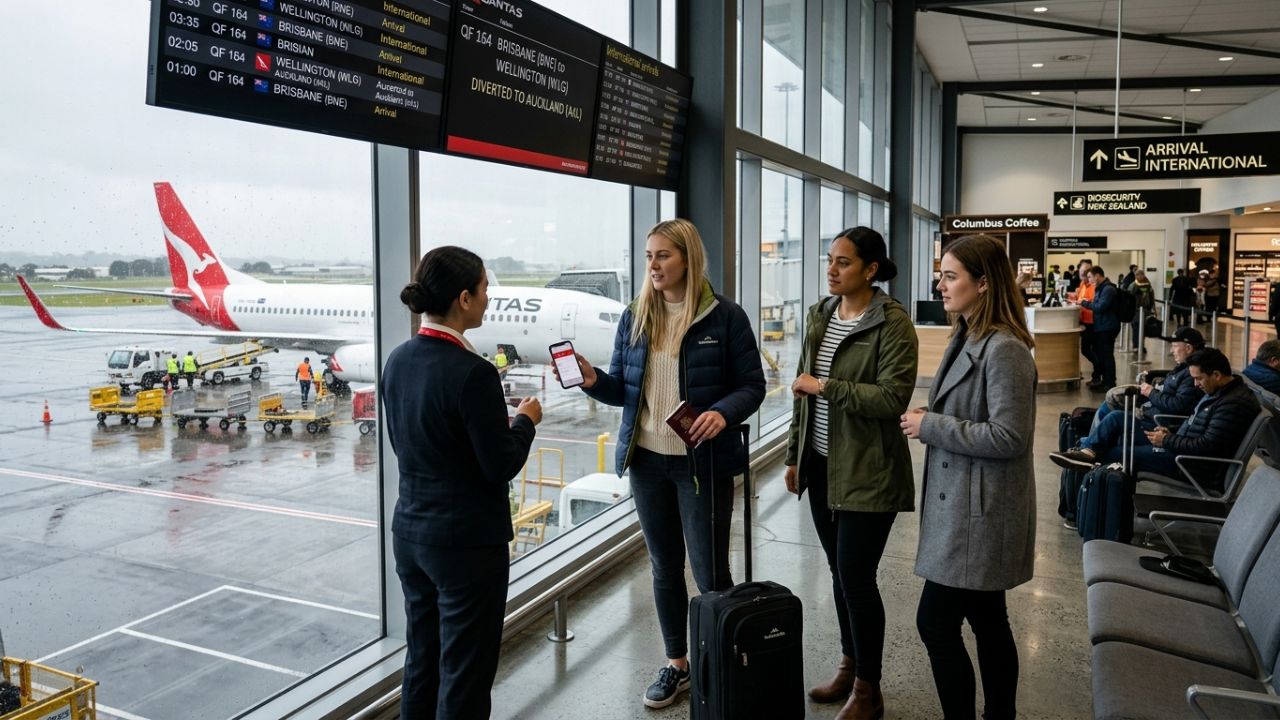
Image generated by AI
Aviation Updates: Qantas Trans-Tasman Diversion Exposes Border Bureaucracy Behind Severe Regional Travel Chaos
As severe weather violently compromises New Zealand’s aviation corridors, a routine Qantas diversion from Wellington to Auckland has aggressively exposed how deeply fragmented customs protocols can instantly weaponize a safety maneuver, trapping passengers in a grueling tarmac delay and triggering massive, localized travel chaos.
Image generated by AI
As urgent airline news platforms and highly critical aviation updates continuously track the escalating operational friction across the South Pacific, a shocking incident has brutally highlighted the hidden vulnerabilities of international air travel. A scheduled Qantas service operating the highly trafficked trans-Tasman route from Brisbane to Wellington was forced into a sudden emergency diversion due to severe low cloud cover. While diverting to Auckland Airport was a standard, flawlessly executed safety protocol, the aftermath was a bureaucratic nightmare. Hundreds of furious passengers, including New Zealand residents desperately trying to return home, were held completely captive onboard the aircraft on the Auckland tarmac for over one hour. This highly frustrating delay was not caused by mechanical failures, but by devastatingly rigid international entry rules. The incident proves that massive airport disruptions and the cascading threat of flight cancellations are no longer just weather-dependent; they are actively fueled by archaic border protocols that guarantee severe travel chaos for disrupted passengers.
Expanded Overview: When Safety Meets Bureaucracy
When analyzing the massive macroeconomic forces governing regional aviation, the absolute lack of agility in international border processing is staggering.
The Australia–New Zealand air corridor is widely considered one of the most efficient, high-frequency international routes on the planet. Passengers implicitly expect a seamless experience. However, when the Qantas flight safely touched down in Auckland to escape the volatile weather in Wellington, the operational reality violently shifted. What should have been a rapid disembarkation turned into a severe operational bottleneck. Because real-time aviation diversions physically clash with static, inflexible regulatory frameworks, the airline and airport authorities were paralyzed. The failure to rapidly process these displaced travelers exposes a massive systemic flaw: aviation resilience is severely crippled if border authorities cannot instantly adapt to emergency diversions.
Section-Wise Breakdown: The Weather-Triggered Collapse
The disruption originated solely as a highly necessary, safety-driven tactical maneuver.
As the Qantas jet began its descent into the notoriously challenging Wellington Airport, the flight crew encountered an aggressive, rapidly developing wall of severe low cloud cover. Because visibility instantaneously dropped well below strict safe operational thresholds, the pilots were legally and aerodynamically forced to abandon the landing approach. Adhering perfectly to aviation safety protocols, the captain aggressively diverted the aircraft to Auckland Airport, which served as the absolute nearest, highly viable international gateway. From a purely aeronautical standpoint, the diversion was a flawless execution of risk management designed to prevent a catastrophic runway incident.
Section-Wise Breakdown: The Customs Bureaucracy Trap
The true travel chaos ignited the exact second the aircraft’s engines spooled down on the Auckland tarmac.
The passengers onboard were officially cleared by the government for legal entry into New Zealand specifically via Wellington—not Auckland. New Zealand Customs protocols are brutally rigid: international passengers are legally mandated to disembark exclusively at their formally declared port of entry unless an incredibly complex, highly coordinated re-clearance is physically arranged on the ground. Consequently, despite the fact that New Zealand citizens had successfully landed inside their own sovereign territory, they were legally barred from leaving the aircraft. This massive regulatory barrier paralyzed ground operations, leaving the flight crew and passengers entirely at the mercy of administrative red tape.
Aviation Details: Trans-Tasman Qantas Diversion Matrix
The exact operational telemetry outlining this highly frustrating regional disruption, detailing the specific route architecture, the tarmac delay, and the regulatory catalyst, has been consolidated into the mandatory matrix below.
Trans-Tasman Qantas Diversion Matrix (2026)
| Operational Metric | Verified Flight Data |
|---|---|
| Airline Operator | Qantas |
| Scheduled Route | Brisbane (Australia) to Wellington (New Zealand) |
| Diversion Hub | Auckland Airport |
| Primary Catalyst | Severe low cloud cover and poor visibility over Wellington |
| Tarmac Delay Duration | Over 1 hour stranded onboard upon landing |
| Regulatory Obstacle | Rigid New Zealand Customs entry port restrictions |
Passenger Impact: Hostages to Administrative Friction
For the furious travelers trapped inside the Qantas cabin, the experience was a grueling lesson in operational communication failures.
Passengers sat in a state of high anxiety for over an hour, receiving deeply confusing and contradictory updates. The emotional fatigue of the turbulent flight was massively compounded when authorities presented two terrifying options: either remain onboard and attempt another highly risky landing in Wellington once the weather cleared, or bizarrely, fly completely back to Brisbane simply because of entry clearance constraints. Ultimately, common sense prevailed and Auckland disembarkation was officially permitted. However, the psychological toll of being held captive on the tarmac, followed by the logistical nightmare of securing rebooked onward travel to Wellington, inflicted massive, entirely avoidable stress on the passengers.
Industry Analysis: The Need for Diversion Agility
Aviation economists explicitly highlight that this specific Qantas diversion serves as a massive wake-up call for global border authorities.
The incident shatters the dangerous misconception that flight diversions are strictly operational issues solved the moment rubber hits the runway. In reality, a diversion airport is not an interchangeable entry point under current international law. As severe weather volatility aggressively increases across the South Pacific due to climate shifts, the frequency of these emergency diversions will inevitably spike. Without the immediate development of temporary clearance mechanisms and highly integrated, real-time border response systems, airlines will constantly face these paralyzing administrative bottlenecks.
Conclusion: Reforming the Diversion Protocol
Ultimately, the Qantas Brisbane-to-Wellington diversion exposes a deeply terrifying gap between modern aviation flexibility and archaic border rigidity. While the flight crew brilliantly executed a safety diversion to protect lives, the subsequent one-hour tarmac delay in Auckland proved that the administrative support systems are fundamentally broken. As trans-Tasman travel continues to experience massive growth, airlines and governments must collaborate aggressively to establish smarter, infinitely more flexible emergency diversion protocols. Until customs and immigration agencies can dynamically process displaced passengers in real-time, international travelers will remain heavily exposed to unpredictable delays that extend far beyond the weather, guaranteeing that severe travel chaos remains a permanent fixture of regional flying.
Key Takeaways
- Weather-Driven Diversion: A Qantas flight scheduled from Brisbane to Wellington was forced to divert to Auckland due to severe low cloud cover and dangerously poor visibility.
- The Tarmac Delay: Upon safely landing in Auckland, passengers were held completely captive onboard the aircraft for over one hour.
- The Regulatory Catalyst: The massive delay was caused by rigid New Zealand Customs protocols, which initially prevented passengers from disembarking because Auckland was not their formally declared port of entry.
- Confusing Ultimatum: Stranded passengers were initially told they might have to wait out the weather for another Wellington landing attempt or be flown all the way back to Brisbane.
- Eventual Resolution: Authorities eventually permitted disembarkation in Auckland, and Qantas actively initiated rebooking arrangements to physically transport the displaced passengers to Wellington.
FAQ: Qantas Brisbane to Wellington Diversion 2026
Why did the Qantas flight divert from Wellington to Auckland? The flight crew encountered an aggressive, rapidly developing system of severe low cloud cover over Wellington. Because visibility dropped below safe operational thresholds, the crew diverted to Auckland to ensure passenger safety.
Why were passengers stuck on the plane for over an hour after landing? Despite landing safely, passengers were trapped by New Zealand Customs protocols. Because they were officially cleared to enter the country via Wellington, authorities legally barred them from disembarking in Auckland until complex re-clearance was arranged.
What options were the displaced passengers given? During the delay, passengers were confused by instructions stating they might have to wait for the Wellington weather to clear or return to Brisbane. Ultimately, disembarkation was allowed, and Qantas rebooked them onto subsequent domestic flights to Wellington.
Related Travel Guides
Etihad Airways Abu Dhabi Dhaka Inaugural Flight Travel Chaos 2026
SkyWest American Airlines SKW6427 Aspen Diversion Travel Chaos 2026
Oceania Regional Flight Disruption Survival Guide 2026
Disclaimer: This article is strictly for informational and geopolitical aviation analysis purposes. The specific flight diversion data, delay timelines (including the one-hour tarmac hold), and regulatory constraints (New Zealand Customs port-of-entry restrictions) are based on operational reports surrounding the Qantas Brisbane-to-Wellington service available at the time of publication. International border processing rules, specific customs re-clearance protocols during weather diversions, and airline rebooking obligations are incredibly rigid, highly dynamic, and subject to immediate enforcement by sovereign national authorities. Passengers must explicitly verify exact immigration requirements, specific airline diversion policies, and real-time flight statuses directly with their operating carrier and relevant border agencies prior to international travel.
Disclaimer
This article is for informational and educational purposes only. It does not constitute legal, financial, or professional advice. While we strive to provide accurate and up-to-date information, travel policies, regulations, and conditions change rapidly. Always verify information with official sources before making travel decisions. Nomad Lawyer makes no representations about the accuracy, reliability, completeness, or suitability of the information provided. Readers should consult qualified professionals for advice specific to their circumstances. The views expressed in this article are those of the author and do not necessarily reflect the views of Nomad Lawyer.
Preeti Gunjan
Contributor & Community Manager
A passionate traveller and community builder. Preeti helps grow the Nomad Lawyer community, fostering engagement and bringing the reader experience to life.
Learn more about our team →