
Golden Eagle Revives Silk Road Luxury Rail Journey
Golden Eagle Revives Silk Road Luxury Rail Journey

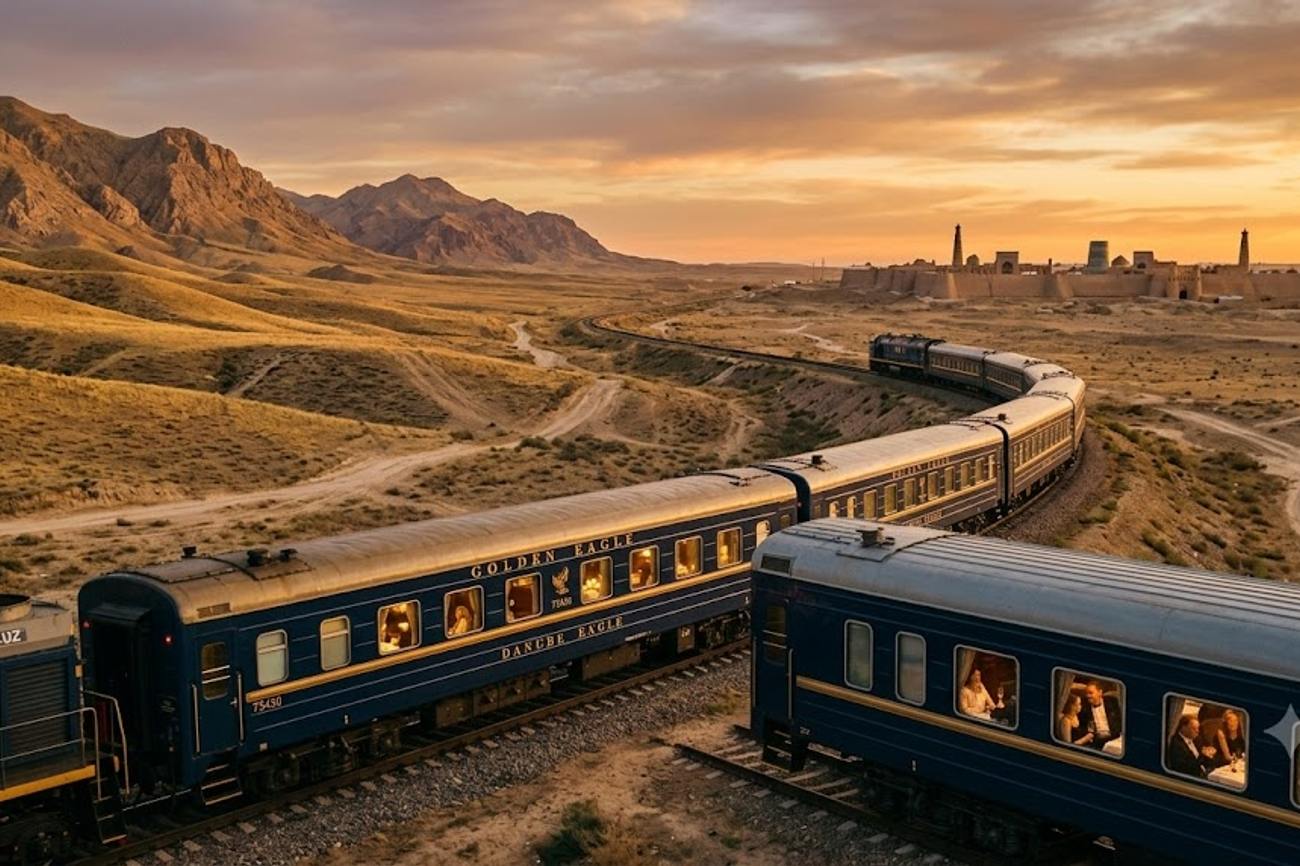
Image generated by AI
22 days of continuous overland transit across six nations marks the return of the most ambitious luxury rail corridor in the modern era. Starting September 21, 2026, Golden Eagle Luxury Trains will execute a massive logistical operation connecting Beijing, China, to Tashkent, Uzbekistan, effectively reviving the ancient Silk Road as a high-end commercial tourism product. This is not a series of connected trips, but a single, sustained expedition designed to replace the fragmented flight-and-hotel model with a mobile five-star infrastructure.
The Logistics of the Great Overland Corridor
The revival of this route is a calculated move to capture the "slow travel" luxury market, where the transit method is the primary product rather than a utility. By utilizing private rail carriages with en-suite cabins, Golden Eagle is solving the primary friction point of Central Asian travel: the disparity in luxury accommodation standards across remote border crossings.
The journey begins in Beijing, leveraging the city's status as a global hub to onboard travelers before they move west. The itinerary is structured to transition passengers from the imperial density of the Forbidden City and the Great Wall into the stark, open geography of the Gobi Desert. This transition is a critical psychological component of the trip, moving the traveler from the hyper-modernity of eastern China into the prehistoric scale of the interior.
As the train crosses into Central Asia, the logistical complexity increases. The route traverses Kazakhstan, Kyrgyzstan, Tajikistan, Turkmenistan, and Uzbekistan. Each border crossing represents a regulatory hurdle that the operator manages on behalf of the passenger, turning what is typically a grueling bureaucratic process for independent travelers into a seamless transition.
Geographic Breakdown and Cultural Anchors
The expedition is designed around specific "anchor" destinations that justify the 22-day duration. The route is not merely a straight line but a curated sequence of environmental shifts.
| Region | Primary Geographic/Cultural Feature | Strategic Role in Itinerary |
|---|---|---|
| Eastern China | Beijing / Imperial Heritage | Onboarding and historical grounding |
| Western China | Gobi Desert | Transition to remote wilderness |
| Kazakhstan | Steppe Landscapes | Introduction to Central Asian trade history |
| Kyrgyzstan | Lake Issyk-Kul | High-altitude alpine contrast |
| Tajikistan | Pamir-adjacent Mountains | Peak geographical drama and isolation |
| Turkmenistan | Desert Archaeological Sites | Deep-dive into ancient Silk Road ruins |
| Uzbekistan | Samarkand, Bukhara, Khiva | Architectural climax and journey terminus |
The inclusion of Lake Issyk-Kul in Kyrgyzstan serves as a vital sensory break from the arid landscapes of the Gobi and Turkmenistan. By integrating UNESCO heritage site tours into the rail schedule, the operator ensures that the journey remains intellectually stimulating, preventing the "transit fatigue" that often plagues long-distance rail travel.
Expert Analysis: The Commercialization of the Silk Road
For the modern traveler, the direct consequence of this route's launch is the "commodification of remoteness." Central Asia has historically been the domain of the rugged adventurer or the diplomatic envoy. By introducing five-star onboard facilities, Golden Eagle is lowering the barrier to entry for high-net-worth individuals who possess the desire for exploration but lack the appetite for logistical hardship.
The Golden Eagle luxury train offers an immersive expedition across Central Asia, blending opulent onboard accommodations with curated excursions to historic landmarks. Travelers can explore the architectural wonders of Uzbekistan and Kazakhstan, often coordinating their arrival through the Official Tourism Organization of Uzbekistan to maximize their cultural experience.
The pricing pressure this creates is significant. By bundling transportation, luxury lodging, and curated heritage access into a single 22-day package, the operator removes the need for passengers to negotiate local transport or vet hotels in regions like Tajikistan or Turkmenistan. This creates a "closed-loop" economy where the traveler is insulated from the local volatility of the region.
From a regulatory perspective, this journey relies on the stability of the International Union of Railways (UIC) standards and the cooperation of six different national rail administrations. The fact that such a route is being marketed for 2026 suggests a high level of diplomatic confidence in the stability of these corridors. For those booking this route, the value proposition is not the destination—Tashkent is merely the finish line—but the ability to witness the gradual shift in human civilization, architecture, and geography in real-time.
Furthermore, this move signals a shift in how Central Asia is positioned globally. By linking Beijing to Tashkent via a luxury rail link, the region is being rebranded from a "post-Soviet frontier" to a "premium heritage corridor." This will likely lead to increased investment in luxury infrastructure at the stop-over points, as local governments seek to capture the spillover spending from these high-spending cohorts.
Key Takeaways
- Fixed Start Date: The expedition officially commences on September 21, 2026, marking a specific window for luxury overland travel.
- Six-Nation Scope: The route provides seamless transit through China, Kazakhstan, Kyrgyzstan, Tajikistan, Turkmenistan, and Uzbekistan.
- Infrastructure Integration: The train serves as a mobile five-star hotel, eliminating the need for repeated hotel check-ins across six different countries.
- Curated Access: The itinerary specifically targets UNESCO heritage sites and archaeological ruins, blending transit with academic exploration.
- Logistical Simplification: The package converts a complex multi-border journey into a single, managed experience ending in Tashkent.
FAQ: Silk Road Luxury Rail 2026
Do I need separate visas for every country on the Beijing to Tashkent route? While the tour operator typically manages the logistical coordination, travelers must still comply with the visa requirements of all six nations. It is recommended to check the official portals of the Ministry of Foreign Affairs of the People's Republic of China and the respective Central Asian embassies.
What is the primary difference between this and a standard train trip? This is a private luxury charter. Unlike public rail, it features en-suite cabins, five-star dining, and a curated itinerary of guided tours. You are paying for the exclusivity, the onboard service, and the managed border crossings.
Is the 22-day duration mandatory? Yes, the itinerary is structured as a single, continuous expedition. Because the train moves as a cohesive unit across the six countries, passengers cannot typically "hop off" and rejoin the train in a different city.
What are the main highlights of the Uzbekistan leg? The journey culminates in Uzbekistan, focusing on the architectural grandeur of Samarkand, Bukhara, and Khiva, before ending in the capital city of Tashkent.
The rail line is no longer just a way to get somewhere; it has become the destination itself.
Tags: Golden Eagle Luxury Trains, Beijing-Tashkent Route, Central Asia Rail 2026, Silk Road Tourism, Uzbekistan Luxury Travel, Gobi Desert Expedition
Related Travel Guides
Disclaimer
This article is for informational and educational purposes only. It does not constitute legal, financial, or professional advice. While we strive to provide accurate and up-to-date information, travel policies, regulations, and conditions change rapidly. Always verify information with official sources before making travel decisions. Nomad Lawyer makes no representations about the accuracy, reliability, completeness, or suitability of the information provided. Readers should consult qualified professionals for advice specific to their circumstances. The views expressed in this article are those of the author and do not necessarily reflect the views of Nomad Lawyer.
Naina Thakur
Contributor & Travel Specialist
Travel enthusiast and legal writer covering visa regulations, responsible tourism, and cultural journeys across global destinations.
Learn more about our team →