Ghana Unveils $1 Billion Tourism Strategy: MICE Infrastructure, Luxury Hotels, and Cultural Heritage Expansion (2027–2030)

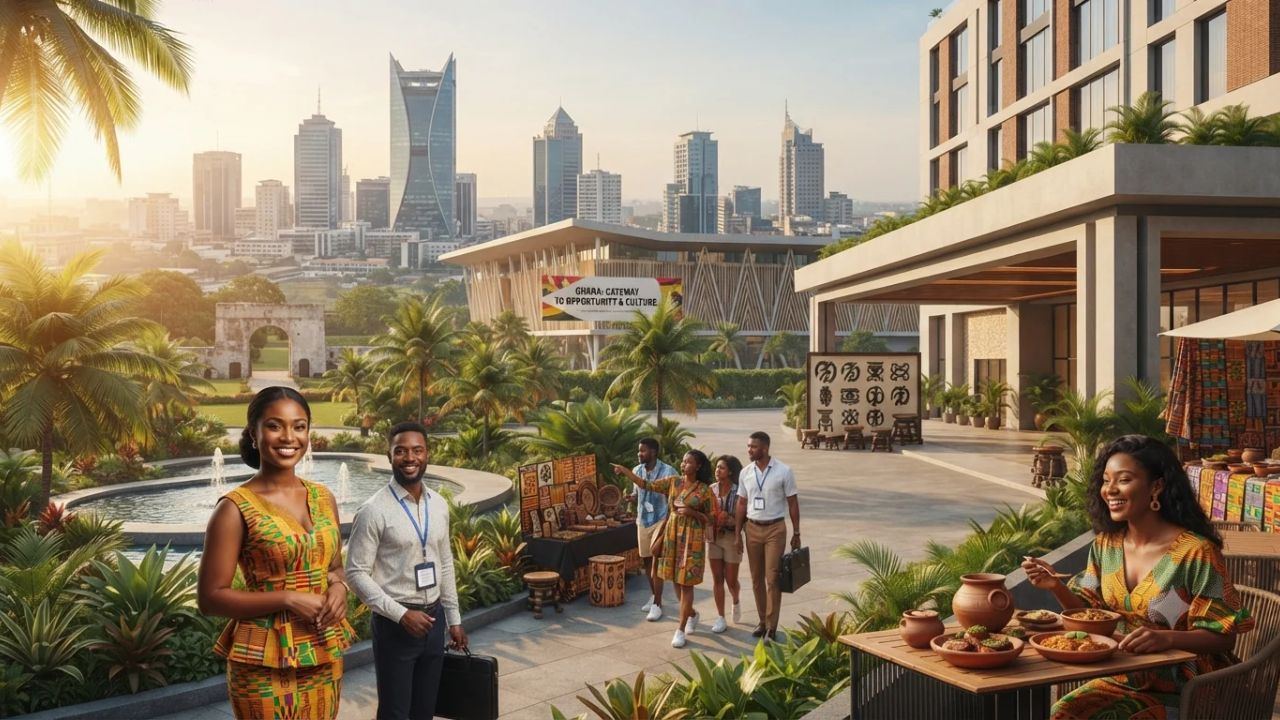
Ghana has unveiled a landmark $1 billion multi-year tourism, culture, and hospitality development strategy under its proposed 2027–2030 New Economy framework, seeking to transform the West African nation into a premier continental hub for international conferences, heritage exploration, and luxury travel. Forming a core pillar of a broader $10 billion national economic transformation initiative, the investment roadmap addresses a pronounced economic paradox revealed in official 2025 performance audits: while international tourist arrivals climbed 1.4% to reach 1,306,962 visitors, total foreign tourism receipts fell approximately 10% from $4.82 billion in 2024 to $4.34 billion in 2025, driven by an 11.3% drop in average visitor expenditure from $3,743 to $3,320. To close this revenue gap, the Ghanaian government is systematically shifting focus from raw arrival numbers toward high-yield visitor segments by constructing a state-of-the-art international convention centre at Accra's La Trade Fair grounds, establishing a dedicated national Convention Bureau, developing five luxury hotels across regional economic corridors, and expanding year-round cultural programming through the Black Star Experience.
The strategic recalibration arrives at an essential moment for West Africa's tourism economy, where corporate meetings, incentives, conferences, and exhibitions (MICE) already account for approximately 31% of all overseas visitor entries. By upgrading Kotoka International Airport (ACC)—which handled 82.6% of all foreign arrivals in 2025—and dispersing upscale hotel infrastructure to Kumasi, the Cape Coast–Elmina coastal belt, the Volta Region, and Northern Ghana, policymakers aim to extend visitor dwell times beyond the capital. Backed by a thriving domestic travel market that recorded over 1.79 million visits to 55 key heritage sites in 2025, Ghana’s ambitious 2027–2030 investment envelope seeks to build an enduring visitor economy that converts cultural heritage into sustainable regional prosperity.
========================================================================================
GHANA TOURISM PERFORMANCE & 2027–2030 INVESTMENT SCORECARD
========================================================================================
Macroeconomic Tourism Indicator  Recorded Metric (2024)   Recorded Metric (2025)   Strategic Variance
----------------------------------------------------------------------------------------
International Tourist Arrivals   1,288,804 Visitors       1,306,962 Visitors       +1.41% Inbound Growth
Total Foreign Tourism Receipts   $4.82 Billion USD        $4.34 Billion USD        -9.96% Revenue Drop
Average Spend Per Visitor        $3,742.98 USD            $3,319.90 USD            -$423.08 (-11.30%)
MICE / Business Travel Share     ~29% of Inbound Volume   31.00% of Total Arrivals Key Economic Driver
Kotoka Airport (ACC) Share       81.8% of Total Entries   82.60% (1.08M Visitors)  Primary Global Gateway
Domestic Tourist Site Visits     1.62 Million Visits      1.79 Million Visits      +10.49% Domestic Growth
Licensed Tourism Enterprises     6,702 Registered Firms   7,109 Registered Firms   +6.07% Business Expansion
Proposed Tourism Investment Pool $1.00 Billion USD       Covering 2027–2030       Part of $10B Initiative
Flagship Infrastructure Target   La Trade Fair Centre     New International Convention Centre & Hotel
Regional Hotel Development Scope 5 New Strategic Hotels   2 Five-Star / 3 Four-StarAcross 5 Provinces
========================================================================================
Source: Ghana Tourism Authority (GTA) Audits & Ministry of Tourism, Arts and Culture, 2026.
========================================================================================
The Expenditure Paradox: Deconstructing the 2024–2025 Receipts Contraction
The catalyst behind Ghana’s $1 billion strategic intervention is the divergence between visitor volume and economic yield observed during the 2024–2025 operating cycles. While tourism authorities celebrated a record milestone of 1,306,962 international arrivals in 2025, macroeconomic earnings told a sobering story of declining monetization.
An analysis of expenditure vectors reveals three distinct structural factors responsible for the 10% contraction in national tourism receipts:
- Shifting Travel Demographics: The initial post-2019 surge in high-spending transatlantic diaspora travelers associated with the "Year of Return" evolved into a higher proportion of short-haul regional travelers originating within the Economic Community of West African States (ECOWAS). While regional African visitors contribute substantial volume, their average trip length and discretionary hotel spending are structurally lower than those of long-haul visitors from North America and Europe.
- Shortened Average Length of Stay: Confronted with global inflationary pressures and elevated international airfares, visiting professionals and holidaymakers compressed their itineraries. A trip that previously spanned 14 to 18 days was frequently condensed into a 7- to 10-day stay, directly reducing nightly lodging receipts, restaurant meals, and domestic excursion spending.
- Accommodation Downgrading and Informal Stays: Due to a historic shortage of mid-scale branded hotel rooms outside Accra, an increasing share of overseas travelers turned to short-term residential rentals, guest houses, and family accommodations. This informal spend bypassed formal taxation channels and corporate hospitality operators, depressing recorded commercial tourism receipts.
By recognizing that volume growth alone cannot sustain economic expansion, Ghana’s Ministry of Tourism, Arts and Culture has reoriented national policy toward high-value visitor attraction. The 2027–2030 framework directly targets the metric that slipped in 2025: lifting average expenditure back above $4,000 per visitor through premium infrastructure.
========================================================================================
GHANA INBOUND EXPENDITURE TREND ANALYSIS (2024 VS 2025)
========================================================================================
Expenditure Category         2024 Recorded Spend  2025 Recorded Spend  Observed Trend
----------------------------------------------------------------------------------------
Lodging & Hotel Services     $1.78 Billion USD    $1.56 Billion USD    -12.36% (Shift to rentals)
Food, Beverage & Dining      $1.11 Billion USD    $1.02 Billion USD    -8.11% (Shorter trip stays)
Domestic Transport & Aviation$0.72 Billion USD    $0.68 Billion USD    -5.56% (Fewer regional hops)
Crafts, Retail & Souvenirs   $0.65 Billion USD    $0.59 Billion USD    -9.23% (Reduced retail spend)
Recreation & Site Admissions $0.56 Billion USD    $0.49 Billion USD    -12.50% (Fewer guided tours)
----------------------------------------------------------------------------------------
Total National Receipts      $4.82 Billion USD    $4.34 Billion USD    -9.96% Overall Contraction
========================================================================================
The MICE Catalyst: Elevating Accra into West Africa’s Conference Capital
International business travelers represent the financial backbone of Ghana’s tourism earnings, accounting for 31% of all foreign arrivals in 2025. Recognizing that conference delegates spend up to three times more per day than standard leisure travelers, the 2027–2030 development strategy places the Meetings, Incentives, Conferences, and Exhibitions (MICE) sector at its epicenter.
========================================================================================
ACCRA MICE INFRASTRUCTURE UPGRADE ROADMAP
========================================================================================
Project Component            Operational Specification & Strategic Objective
----------------------------------------------------------------------------------------
Flagship Convention Centre   Construction of a modern multi-purpose facility at La Trade Fair
Plenary Hall Capacity        Engineered to host major multilateral summits with 5,000+ delegates
Exhibition Space             Flexible modular exhibition halls for global industrial expos
National Convention Bureau   Establishment of a specialized bidding agency to secure global events
Targeted Event Segments      Pan-African corporate summits, energy congresses, fintech expos,
                             medical associations, and diaspora academic conventions
Hospitality Integration      Direct pedestrian connectivity to planned five-star business hotel
Economic Multiplier Target   Generate 4.5x indirect spending across transport, retail, and dining
========================================================================================
The La Trade Fair Convention Complex
The centerpiece of the MICE initiative is the complete redevelopment of the La Trade Fair Centre in Accra. Historically a regional trade exposition ground, the site is being reimagined as an integrated business campus featuring:
- A state-of-the-art plenary auditorium capable of seating thousands of delegates with simultaneous interpretation facilities.
- Expansive column-free exhibition halls suited for heavy industrial, agricultural, and technological displays.
- Integrated culinary and banqueting infrastructure designed to support diplomatic state dinners and international gala events.
The National Convention Bureau
To ensure the new complex does not become an underutilized asset, the government plans to establish a professional National Convention Bureau. Modeled after successful bidding authorities in Rwanda and South Africa, this agency will actively prospect, bid for, and secure recurring annual assemblies from international medical federations, global trade associations, and multilateral institutions.
By capturing regional association congresses that historically bypassed West Africa in favor of Kigali, Nairobi, or Cape Town, Accra aims to secure high-occupancy corporate bookings that insulate local hotels from leisure seasonality.
Regional Dispersion: The Five-Hotel Development Initiative
A primary structural flaw of Ghana’s existing hospitality landscape is extreme geographical concentration: high-end international hotels are almost exclusively clustered within a five-mile radius of Kotoka Airport in Accra. Consequently, international visitors rarely venture into the interior for multi-night stays, limiting the economic benefits of tourism to the Greater Accra metropolitan area.
To resolve this imbalance, the $1 billion investment program outlines the development of five new hotels across strategic regional economic corridors:
========================================================================================
GHANA FIVE-HOTEL REGIONAL DEVELOPMENT BLUEPRINT
========================================================================================
Location Corridor        Planned Category  Core Commercial & Cultural Focus
----------------------------------------------------------------------------------------
Accra Metropolitan       Five-Star Deluxe  International MICE, financial services & diplomacy
Kumasi (Ashanti Region)  Five-Star Deluxe  Ashanti royal heritage, gold trading & corporate MICE
Cape Coast – Elmina Belt Four-Star Premium UNESCO coastal forts, diaspora pilgrimage & education
Volta Region (Ho / Keta) Four-Star Premium Eco-tourism, Lake Volta leisure, hiking & waterfalls
Northern Ghana (Tamale)  Four-Star Premium Savannah wildlife safari, Mole National Park & culture
========================================================================================
1. Accra (Five-Star Deluxe): Urban Business Flagship
Positioned adjacent to the new convention complex, this property will serve multinational executives, diplomatic delegations, and high-net-worth conference attendees, providing premium suites, executive lounges, and high-security accommodations.
2. Kumasi (Five-Star Deluxe): Ashanti Heritage and Commerce
As the historic seat of the Ashanti Kingdom and Ghana’s second-largest commercial city, Kumasi hosts major traditional festivals (such as the Akwasidae) and gold trading enterprises. A five-star property in Kumasi will allow business travelers and cultural tourists to experience the Manhyia Palace Museum and Kejetia Market while enjoying luxury international amenities.
3. Cape Coast–Elmina Corridor (Four-Star Premium): Diaspora Pilgrimage Hub
Despite hosting Ghana’s most famous historical landmarks, the Cape Coast and Elmina coastal strip has long suffered from a shortage of high-standard accommodation, forcing most tourists to visit on exhausting day-trips from Accra. A four-star resort will encourage visitors to stay two or three nights, supporting local restaurants, boat operators, and artisan markets.
4. Volta Region (Four-Star Premium): Adventure and Nature Tourism
Renowned for Mount Afadja (Afadjato), Wli Waterfalls, and the tranquil shores of Lake Volta, the Volta Region offers exceptional eco-tourism potential. The planned four-star eco-lodge will cater to outdoor enthusiasts, hikers, and weekend leisure travelers seeking an escape from urban congestion.
5. Northern Ghana (Four-Star Premium): Wildlife and Cultural Exploration
Serving as the staging gateway to Mole National Park (home to roaming West African elephants) and the ancient Larabanga Mosque, a four-star property in Tamale will unlock savannah safari tourism for international travelers previously deterred by basic lodging options.
The Black Star Experience: Deepening Cultural and Diaspora Tourism
Ghana holds a distinct historical position in the global African consciousness. As the first sub-Saharan African nation to gain independence in 1957 under Osagyefo Dr. Kwame Nkrumah, and as the ancestral departure point for millions of enslaved Africans, the country serves as a spiritual homeland for the global African diaspora.
Building upon the success of the 2019 "Year of Return" and its successor "Beyond the Return", the 2027–2030 strategy formalizes the Black Star Experience as a year-round institutional initiative.
========================================================================================
BLACK STAR EXPERIENCE: STRATEGIC PILLARS & HERITAGE INITIATIVES
========================================================================================
Strategic Pillar             Operational Scope & Heritage Investment
----------------------------------------------------------------------------------------
UNESCO Forts Conservation    Restoration and structural stabilization of Cape Coast Castle,
                             Elmina Castle, and Fort Christiansborg (Osu Castle)
Interpretation & Education   Digital interactive museum exhibits and multi-lingual audio guides
Certified Guide Accreditation Rigorous historical training for professional docents and guides
Creative Arts & Music Hubs   Funding for contemporary visual art galleries, highlife music
                             festivals, fashion showcases, and Pan-African film festivals
Community Equity Programs    Direct revenue-sharing models ensuring communities surrounding
                             historic sites receive funding for schools, water, and healthcare
Year-Round Event Calendar    Spreading major diaspora festivals across all 12 calendar months,
                             mitigating the traditional December "Detty December" peak crunch
========================================================================================
By enhancing visitor interpretation at UNESCO World Heritage sites, travelers receive deeply educational, dignified, and emotionally resonant experiences. At the same time, shifting cultural celebrations from an exclusive December focus to a balanced twelve-month calendar prevents seasonal price gouging and stabilizes hotel occupancies throughout the year.
Aviation Connectivity: Expanding Beyond Kotoka’s Gateway
International air access represents the foundation of Ghana’s tourism ambitions. In 2025, Kotoka International Airport (ACC) welcomed approximately 1.08 million overseas passengers, representing 82.6% of the national total.
While Kotoka operates as an efficient, modern terminal served by premier international carriers—including Delta Air Lines, United Airlines, British Airways, Emirates, Qatar Airways, and Ethiopian Airlines—relying entirely on one international gateway creates operational friction for regional travel.
========================================================================================
GHANA AVIATION & TRANSIT INFRASTRUCTURE METRICS
========================================================================================
Aviation Vector              Current Operational Status           2027–2030 Strategic Objective
----------------------------------------------------------------------------------------
Kotoka International (ACC)   1.08 Million Arrivals (82.6% Share)  Expand capacity to 5M annual passengers
Kumasi Airport (KMS)         Upgraded to International Status     Attract direct regional West African routes
Tamale Airport (TML)         Upgraded to International Status     Serve Northern Ghana & Hajj charter flights
Domestic Air Corridors       Daily flights connecting ACC-KMS-TML Increase frequencies and lower seat fares
Coastal Highway Corridor     Heavily congested 2-lane road        Expand Accra-Cape Coast-Takoradi motorway
Marine Ferry Transit         Limited commercial operations        Develop Lake Volta passenger catamarans
========================================================================================
To support regional hotel investments, the government’s transport roadmap emphasizes two critical priorities:
- Accelerating Domestic and Regional Flight Connectivity: Utilizing newly upgraded international facilities at Kumasi Airport (Nana Agyeman Prempeh I International Airport) and Tamale International Airport to introduce regional flights from Abidjan, Lagos, and Ouagadougou, bypassing Accra entirely for direct access to the interior.
- The Coastal Highway Modernization: Upgrading the heavily traveled highway connecting Accra, Cape Coast, and Takoradi into a modern dual-carriageway expressway, reducing the current five-hour transit time to under two and a half hours.
Domestic Tourism: Building Year-Round Economic Resilience
While international arrivals capture global headlines, Ghana’s domestic tourism sector provided vital economic stability during 2025. Official audits recorded more than 1.79 million visits to 55 registered tourist attractions, demonstrating that Ghanaian citizens, resident expatriates, and local school groups are actively exploring their nation.
Concurrently, the Ghana Tourism Authority reported that licensed tourism enterprises expanded from 6,702 in 2024 to 7,109 in 2025, representing an addition of 407 newly regulated businesses across the food service, tour operating, and accommodation sub-sectors.
========================================================================================
DOMESTIC TOURISM CONTRIBUTION MATRIX (2025 AUDIT)
========================================================================================
Indicator Metric             2024 Recorded Baseline 2025 Recorded Metric Net Annual Change
----------------------------------------------------------------------------------------
Total Site Visits (55 Sites) 1,620,000 Visits       1,790,000 Visits     +170,000 (+10.49%)
Licensed Tourism Enterprises 6,702 Businesses       7,109 Businesses     +407 Firms (+6.07%)
Domestic Hotel Bed-Nights    ~1.45 Million Nights   ~1.68 Million Nights +15.86% Local Occupancy
Primary Domestic Sites       Kakum National Park, Aburi Gardens, Manhyia Palace, Mole Safari
Economic Buffer Role         Maintains baseline cash flow for hotels during off-peak rainy season
========================================================================================
Domestic travelers support eco-tourism lodges, regional craft markets, and roadside culinary operators during the mid-year rainy season (May through August) when international travel slows. Strengthening domestic travel culture ensures that tourism infrastructure remains financially viable year-round rather than depending exclusively on foreign tourist seasons.
Strategic Challenges and Execution Risks
While the $1 billion vision presents a transformative development blueprint, several substantial hurdles must be navigated to translate policy commitments into operating assets:
- Financing Architecture and Debt Realities: The $1 billion figure represents an ambitious policy target rather than dedicated Treasury funds. Given ongoing fiscal consolidation, the majority of this capital must be mobilized through Public-Private Partnerships (PPPs), bilateral development finance institutions, and private equity investments. Securing these commitments requires transparent bidding and reliable regulatory frameworks.
- Construction and Timeline Delivery: Large-scale civic projects across West Africa often encounter land tenure disputes, procurement delays, and supply chain friction. Delivering five regional hotels and a world-class convention centre between 2027 and 2030 will require rigorous project management.
- Fierce Regional MICE Competition: Accra is entering an increasingly crowded African convention market. Kigali, Rwanda, has invested heavily in its convention infrastructure, offering an integrated arena, national carrier connectivity, and visa-free access for all Africans. Ghana must aggressively differentiate its MICE value proposition through cultural authenticity and regional trade linkages.
- Conservation vs Commercialization: Expanding visitor numbers at fragile historic landmarks like Cape Coast Castle and Kakum National Park demands strict conservation standards to prevent physical degradation from heavy footfall.
========================================================================================
PROJECT EXECUTION RISK ASSESSMENT MATRIX
========================================================================================
Risk Category      Severity Impact  Mitigation Strategy Planned
----------------------------------------------------------------------------------------
Capital Financing  High             Mobilize structured private equity and international PPPs
Construction Lag   Medium-High      Select reputable international EPC contractors with track records
MICE Competition   High             Offer combined convention-and-cultural incentive packages
Site Degradation   Medium           Implement strict visitor caps and conservation surcharges
Aviation Pricing   High             Negotiate airline fuel levy reductions with airport operators
========================================================================================
Practical Traveler Guide: Planning a Journey to Ghana
For travelers preparing to experience Ghana during the 2026–2027 transition, understanding seasonal realities, entry requirements, and transit logistics ensures a rewarding itinerary:
========================================================================================
GHANA TRAVEL LOGISTICS & VISITATION ADVISORY
========================================================================================
Travel Parameter             Official Recommendation & Guidance
----------------------------------------------------------------------------------------
Visa Entry Protocols         All international travelers require an entry visa or eVisa issued
                             by Ghanaian diplomatic missions; visa-on-arrival is available for
                             African Union citizens and select pre-approved diaspora delegations.
Mandatory Health Rules       Yellow Fever vaccination certificate is strictly required for entry.
Optimal Weather Windows      Dry Season (November through March) offers warm, sunny days;
                             harmattan trade winds bring hazy skies in December and January.
Major Cultural Festivals     Akwasidae (Kumasi, every 6 weeks); Homowo (Accra, August);
                             Aboakyer (Winneba, May); Chale Wote Street Art Festival (August).
Currency & Transactions      Ghana Cedi (GHS). Credit cards are accepted at major hotels and
                             shopping centers in Accra; mobile money (MoMo) is ubiquitous.
Primary Transport Modes      Domestic flights for long hops (PassionAir, Africa World Airlines);
                             ride-hailing apps (Uber, Bolt) are widely available in Accra & Kumasi.
Safety & Stability           Ghana ranks consistently among Africa’s most peaceful democracies,
                             with low rates of violent crime and a welcoming civic culture.
========================================================================================
Curated 7-Day Heritage and City Itinerary
- Days 1–2: Cosmopolitan Accra: Arrive at Kotoka Airport. Explore the Kwame Nkrumah Memorial Park, Black Star Square, Makola Market, and the contemporary art scene at the Nubuke Foundation. Dine on fresh grilled tilapia and jollof rice along Labadi Beach.
- Days 3–4: Historic Cape Coast & Elmina: Drive west along the coast to Cape Coast. Tour the poignant dungeons of Cape Coast Castle and Elmina Castle with certified local historians. The following morning, experience the canopy walkway suspended 40 meters above the virgin rainforest at Kakum National Park.
- Days 5–6: Royal Kumasi: Journey north into the Ashanti heartland. Visit the Manhyia Palace Museum to understand centuries of Asante royal governance, explore the traditional kente cloth-weaving village of Bonwire, and shop for hand-stamped Adinkra textiles in Ntonso.
- Day 7: Return to Accra: Fly back to Accra from Kumasi Airport for last-minute craft shopping at the Accra Arts Centre before evening departure.
Frequently Asked Questions
What is Ghana’s $1 billion tourism investment plan?
Ghana’s $1 billion tourism initiative is a proposed multi-year development envelope under the government’s 2027–2030 New Economy framework, aimed at expanding convention facilities, constructing five regional hotels, improving heritage sites, and boosting visitor spending.
Why did Ghana’s tourism receipts decline in 2025 despite higher arrivals?
While international arrivals grew by 1.4% to 1.31 million in 2025, tourism receipts dropped approximately 10% from $4.82 billion to $4.34 billion because average visitor spending decreased from $3,743 to $3,320 due to shorter trips, changing traveler demographics, and increased use of informal accommodations.
Where will the new international convention centre be built in Accra?
The government plans to construct the modern international convention centre at the redesigned La Trade Fair Centre grounds in Accra, featuring large-scale plenary halls, exhibition spaces, and an integrated hotel.
How much do business travelers contribute to Ghana’s tourism?
According to the Ghana Tourism Authority, business and conference travelers accounted for approximately 31% of all international arrivals in 2025, representing the country’s highest-spending visitor demographic.
Where are the five proposed luxury hotels located?
The plan outlines five hotels across diverse regions: two five-star properties in Accra and Kumasi, and three four-star properties serving the Cape Coast–Elmina corridor, the Volta Region, and Northern Ghana (Tamale).
What is the "Black Star Experience"?
The Black Star Experience is an institutional cultural and diaspora program designed to provide year-round heritage activities, creative arts festivals, museum improvements, and community-based tourism across Ghana.
Which airport handles the majority of international arrivals in Ghana?
Kotoka International Airport (ACC) in Accra received approximately 1.08 million foreign visitors in 2025, representing 82.6% of the national total.
How did domestic tourism perform in Ghana in 2025?
Domestic tourism performed strongly, recording more than 1.79 million visits to 55 key tourist sites across the country, an increase of more than 10% compared to 2024.
How many licensed tourism businesses operate in Ghana?
The Ghana Tourism Authority reported that licensed tourism enterprises grew from 6,702 in 2024 to 7,109 in 2025, representing an expansion of 407 regulated businesses.
What are the main challenges facing Ghana’s tourism strategy?
Primary challenges include mobilizing private capital through Public-Private Partnerships, completing infrastructure projects on schedule, competing with established African convention hubs like Kigali, and ensuring sustainable conservation of historic heritage sites.
Strategic Outlook: Recalibrating West African Tourism Towards Sustainable Value
Ghana’s 2027–2030 tourism roadmap represents an essential strategic evolution. By confronting the reality that raw arrival numbers do not guarantee economic prosperity, policymakers are demonstrating analytical maturity. Shifting capital and organizational focus toward high-yield corporate conferences, luxury regional lodging, and authentic cultural stewardship creates a direct pathway to reversing the 2025 expenditure contraction.
If executed with commercial discipline and transparent governance, the $1 billion investment program has the potential to transform Ghana from an emerging vacation spot into an enduring powerhouse of African travel. As global travelers increasingly seek meaningful heritage connections and modern business facilities, Ghana stands uniquely poised to turn its rich history and geographic advantages into a sustainable engine of national economic growth.
Related Travel Guides
- Southeastern Unveils Landmark UK Rail Timetable: 130 Extra Weekday Trains, Elizabeth Line Links, and Hastings Express
- Thailand Foreign Tourist Arrivals Dip 4.66% as Winter Tourism Push Targets 31.5 Million Year-End Benchmark
- Hong Kong WinterFest 2026: Central Winter Wonderland, 22-Metre Christmas Tree, and Skyline Light Shows Transform Victoria Harbour
- Panama Luxury Travel Guide: Exclusive Resorts, Historic Casco Antiguo, and Pacific Coastline Sanctuaries
This article is for informational purposes. Flight routes, passenger regulations, visa rules, and transit advisories are subject to change by airlines and aviation authorities. Readers are advised to verify schedules and travel documentation with relevant carriers and border agencies before departure.
Related Stories
Greece Archaeological Site Visitors Surge 12.3% in July 2026 as Museum Attendance Dips
Seed Bank Tourism: How Tasting Rare, Climate-Resilient Crops Is Reshaping Sustainable Agro-Travel