Seed Bank Tourism: How Tasting Rare, Climate-Resilient Crops Is Reshaping Sustainable Agro-Travel

Global agriculture has entered an era of profound environmental stress in late 2026, driven by unprecedented temperature anomalies, protracted droughts, and volatile weather patterns that threaten the genetic foundations of the modern food supply. According to sobering research published by the Food and Agriculture Organization of the United Nations (FAO), primary staple crops—including wheat, coffee, beans, and cassava—could lose up to 50% of their optimal bioclimatic growing land by the year 2100 under current warming projections. In response to this looming crisis, an enlightened travel movement is emerging at the intersection of agroecology, botanical science, and experiential culinary tourism: seed bank tourism. Rather than regarding crop preservation as a detached laboratory exercise, curious travelers, chefs, and conservationists are journeying directly to high-altitude living seed banks, indigenous mountain cooperatives, and Arctic gene sanctuaries to taste, document, and financially support the survival of climate-resilient heirloom varieties.
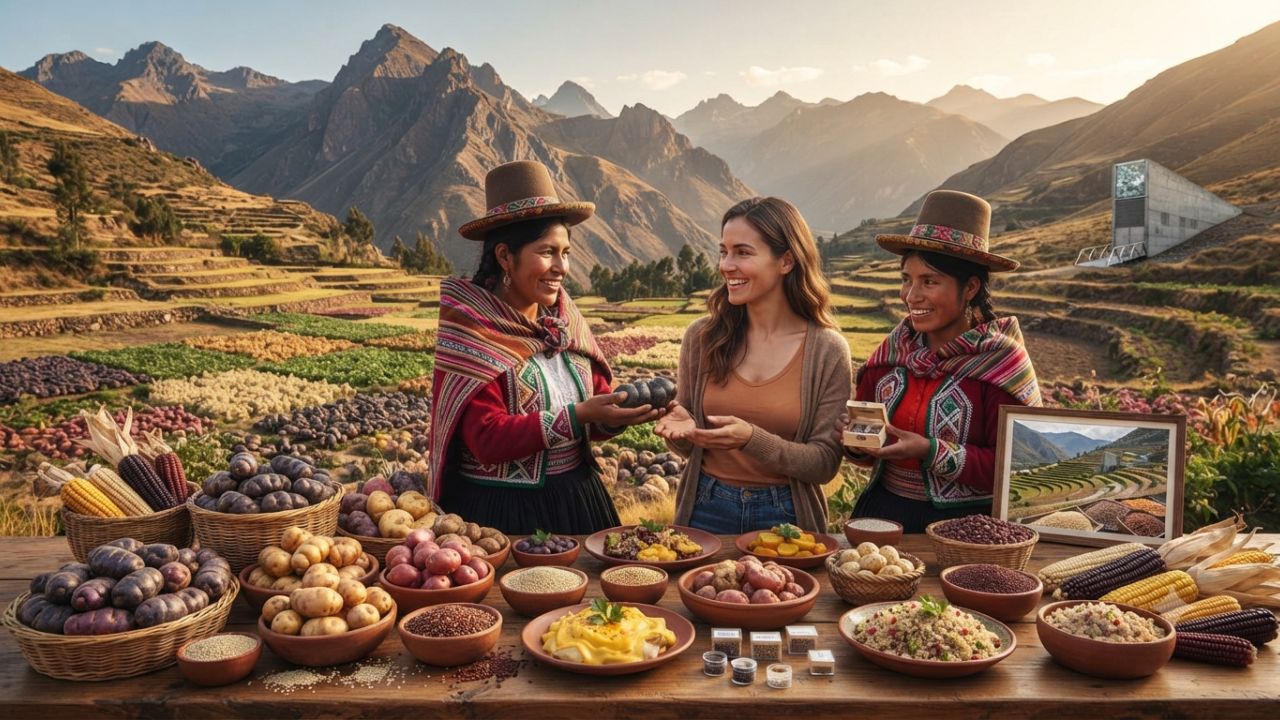
This specialized form of regenerative tourism transcends conventional "farm-to-table" dining by connecting travelers directly with the frontline custodians of agricultural biodiversity. From the high-altitude terraces of Peru's Sacred Valley—where indigenous Quechua communities safeguard more than 1,300 native potato varieties adapted to extreme Andean frosts—to the organic seed sanctuaries of northern India reviving drought-hardy millets and cold-desert orchards in Ladakh, to the Arctic perimeter of Norway’s Svalbard Global Seed Vault, travelers are witnessing how ancestral botanical wisdom holds the key to future food security. By participating in guided field walks, participatory plant-breeding demonstrations, and communal harvest feasts, visitors inject vital capital into remote rural economies, transforming sustainable tourism into a powerful commercial engine that ensures rare, climate-adapted crops thrive in living soils rather than remaining dormant as frozen museum relics.
========================================================================================
GLOBAL SEED BANK TOURISM BENCHMARK MATRIX: THREE PREMIER ARCHETYPES
========================================================================================
Sanctuary Facility       Geographical Location  Altitude & Biome     Primary Conserved Crops Visitor Access & Experience
----------------------------------------------------------------------------------------
Parque de la Papa        Cusco / Sacred Valley, 3,300m to 4,500m     1,300+ Native Andean    Guided agro-ecological treks;
(The Potato Park)        Peru (Andean Mountain) High-Altitude Puna   Potato Landraces & HerbsPapamanka tasting restaurant
Navdanya Biodiversity    Doon Valley,           500m to 3,500m       750+ Indigenous Rice    Residential agroecology courses;
Conservation Farm        Uttarakhand & Ladakh,  Sub-Himalayan Valley & varieties, millets,   seed-saving workshops; heritage
                         India                  Cold-Desert Oasis    apricots, sea buckthorn orchard tours & organic meals
Svalbard Global Seed     Spitsbergen, Svalbard, 130m above sea level 1.4+ Million Global     Exterior architectural tours;
Vault                    Norway                 Arctic Permafrost    Backup Seed Samples     scientific lectures & polar treks
========================================================================================
Sources: Food and Agriculture Organization (FAO), Asociación ANDES Peru, Navdanya Research Foundation, and NordGen.
========================================================================================
The Agronomic Emergency: Monoculture Fragility vs. Agrobiodiversity
To appreciate the rise of seed bank tourism, travelers must understand the precarious biological architecture of the global industrial food system. Over the past century, global agriculture executed an aggressive transition toward high-yielding, uniform crop monocultures. While the mid-twentieth-century Green Revolution successfully prevented widespread famines by multiplying grain production, it introduced severe biological vulnerabilities.
According to FAO genetic resource audits, humanity has lost more than 75% of its plant genetic diversity since 1900. Today, despite the existence of approximately 30,000 edible plant species worldwide, just three crops—wheat, rice, and maize—provide nearly 60% of all calories consumed by the human population.
========================================================================================
GLOBAL CROP GENETIC EROSION PROFILE (FAO & BIODIVERSITY INTERNATIONAL)
========================================================================================
Indicator Metric                     Observed Value       Agronomic Vulnerability & Systemic Risk
----------------------------------------------------------------------------------------
Historic Edible Plant Species Known  ~30,000 Species      Broad evolutionary genetic reservoir
Share of Human Calories from 3 Crops 58.0% of Calories    Extreme dietary reliance on wheat, rice, maize
Crop Genetic Diversity Lost (1900–Now)>75.0% Reduction    Extinction of regional landraces and heritage seeds
Optimal Arable Land Loss (by 2100)   Up to 50.0% Loss     Staple crops (coffee, beans, wheat) facing heat caps
Vulnerability to Pests & Drought     Severe Monoculture   Identical genetic profiles lack evolutionary defenses
The Agrobiodiversity Solution        Heirloom Landraces   Centuries of natural selection for heat and cold tolerance
========================================================================================
The Power of Heirloom Landraces
Commercial hybrid and genetically uniform crops are bred to perform under precise chemical conditions, requiring heavy inputs of synthetic fertilizers, chemical pesticides, and reliable irrigation. When subjected to prolonged heat waves, erratic monsoon cycles, or unseasonable frosts, these uniform monocultures collapse simultaneously across entire regions.
In contrast, landraces—ancestral crop varieties developed through centuries of farmer selection—possess rich genetic variability. Within a single heirloom potato or ancient millet field, individual plants exhibit varying root depths, drought tolerance thresholds, and pest resistances. By conserving these dynamic gene pools in living farm environments, traditional communities maintain the evolutionary defenses necessary to breed the climate-resilient crops of tomorrow. Seed bank tourism bridges the gap between these rural conservation fields and urban consumers, offering city dwellers a direct, sensory understanding of biological survival.
What Is Seed Bank Tourism? Deconstructing the Agro-Ecotourism Model
Seed bank tourism represents an evolution beyond traditional agritourism. While conventional farm visits often limit visitors to passive picking activities or commercial winery tastings, seed bank tourism functions as an immersive synthesis of plant science, cultural anthropology, and gastronomic journalism.
========================================================================================
CONVENTIONAL AGRITOURISM VS. SEED BANK ECO-TOURISM
========================================================================================
Operational Feature      Standard Commercial Agritourism      Seed Bank & Climate-Resilient Tourism
----------------------------------------------------------------------------------------
Primary Focus            Recreational picking; commodity sales In-situ conservation & genetic education
Crop Architecture        Uniform commercial hybrids/orchards  Rare heirloom landraces & wild crop relatives
Visitor Engagement       Passive farm tours and gift shops    Participatory seed cleaning & tasting workshops
Host Relationship        Commercial agribusiness operators    Indigenous seed guardians & botanical researchers
Culinary Format          Standard farm-to-table dining menus  Ancient biodiversity degustations & forgotten grains
Conservation Impact      Incidental local economic spend      Direct funding of living seed banks & legal autonomy
========================================================================================
The Three Pillars of Living Seed Tourism
- In-Situ Biological Exploration: Visitors walk through active experimental fields where hundreds of distinct crop accessions are cultivated side-by-side, learning to identify morphological differences in leaf structure, flower coloration, and root depth that impart resilience.
- Interactive Seed Stewardship: Travelers participate directly in traditional seed-saving methodologies—separating chaff, threshing heritage wheat, selecting optimal seed ears for drying, and documenting regional folk taxonomy.
- Biodiversity Gastronomy: The experience culminates in structured tastings where travelers sample rare crops prepared according to ancestral recipes, discovering complex flavor notes, unusual textures, and high nutrient densities absent from commercial supermarket produce.
Peru’s Parque de la Papa: The Living Andean Tuber Sanctuary
High above the Sacred Valley of the Incas near Pisac in the Cusco region of Peru lies Parque de la Papa (The Potato Park), widely celebrated as the world's premier indigenous-led living agro-biodiversity sanctuary. Spanning an expansive elevation gradient between 3,300 and 4,500 meters above sea level, the park covers more than 9,000 hectares of rugged Andean terrain.
The Potato Park is managed collectively by six indigenous Quechua-speaking communities: Amaru, Chawaytire, Pampallacta, Paru Paru, Cuyo Grande, and Sacaca. Working in partnership with the local non-governmental organization Asociación ANDES and the International Potato Center (CIP), these communities have established a globally recognized model of in-situ biocultural heritage conservation.
========================================================================================
PARQUE DE LA PAPA (THE POTATO PARK) OPERATIONAL PROFILE
========================================================================================
Dimension Parameter      Official Metric / Specification     Significance to Global Agriculture
----------------------------------------------------------------------------------------
Geographical Elevation   3,300m to 4,500m Above Sea Level    Vertical agro-ecological farming zones
Territorial Scope        9,200 Hectares of Collective Land   Protected indigenous biocultural heritage
Native Potato Varieties  Over 1,300 Distinct Landraces       World's largest in-situ living potato collection
Managing Entity          Association of 6 Quechua CommunitiesDirect indigenous governance and profit-sharing
Signature Culinary Venue Papamanka Community Restaurant      Multi-course native tuber tasting menus
Traditional Processing   Chuño & Moraya Freeze-Drying        Ancestral climate preservation techniques
Overtourism Mitigation   Redirects visitors away from Cusco  Distributes tourism spend to high mountain villages
========================================================================================
Sources: Asociación ANDES and The Potato Park Indigenous Community Registry 2026.
========================================================================================
The 1,300-Potato Living Gene Bank
While standard supermarkets rarely stock more than four or five commercial potato varieties (typically Russet, Yukon Gold, or Red Bliss), the soils of Parque de la Papa nurture over 1,300 scientifically documented varieties of native Andean potatoes (Solanum species).
These tubers display an astonishing spectrum of colors, shapes, and biological adaptations:
- Puma Maqui (Puma's Paw): Characterized by deep serrated lobes and high mineral content, adapted to rocky mountain scree.
- Wira Pasña (Fat Maiden): Renowned for its buttery texture, high drought resistance, and deep purple skin.
- Q'eqorani: Packed with intense purple and scarlet flesh containing powerful anthocyanin antioxidants, bred to withstand extreme high-altitude ultraviolet radiation.
The Agro-Ecological Field Experience
Travelers visiting the park embark on guided expeditions led by Quechua agroecology guides (agrónomos comunales). Visitors traverse terraced slopes carved into the mountainsides, observing how varieties are deliberately planted at specific micro-elevations to protect against unpredictable frosts and shifting pest belts caused by global climate change.
Guests are introduced to the ancestral practice of chuño and moraya production—the ancient Andean freeze-drying process where tubers are repeatedly exposed to sub-zero night frosts, trodden by foot to expel moisture, and sun-dried in the arid mountain air, creating preserved potatoes capable of lasting up to a decade without refrigeration.
Dining at Papamanka: A Gastronomic Revelation
The visit concludes at Papamanka, the community-operated restaurant overlooking the glacial peaks of the Sacred Valley. Here, women from the local communities prepare extraordinary tasting degustations:
- Earth-Baked Pachamanca: Native tubers slow-roasted underground over heated volcanic stones, seasoned with aromatic wild mountain herbs such as huacatay (Andean black mint) and muña.
- Chromatic Tuber Terrines: Steamed golden, ruby, and violet potatoes served alongside indigenous sauces crafted from ground tarwi (high-protein Andean lupin beans), toasted pumpkin seeds, and fresh mountain farmer cheeses.
- Ancestral Beverages: Fermented chicha prepared from heritage corn varieties and infusions of wild medicinal alpine botanicals.
By charging admission for guided hikes and hosting culinary degustations, the communities retain 100% of tourism revenues, funding communal health clinics, local bilingual education, and an active community seed repatriation fund that returns lost heritage seeds from international laboratory vaults back into Andean soil.
India’s Living Grain Banks and Himalayan Cold-Desert Sanctuaries
In northern India, seed bank tourism is advancing along two distinct geographic corridors: the subtropical valleys of Uttarakhand and the arid high-altitude cold deserts of Ladakh.
========================================================================================
INDIAN AGROBIODIVERSITY CORRIDORS: UTTARAKHAND VS. LADAKH
========================================================================================
Comparative Parameter   Navdanya Biodiversity Sanctuary     Ladakh High-Altitude Heritage Hub
----------------------------------------------------------------------------------------
Geographical Region      Doon Valley, Uttarakhand (Sub-Himalaya)Leh, Nubra, and Suru Valleys (Trans-Himalaya)
Elevation Range          500m to 700m Above Sea Level        3,000m to 3,800m Above Sea Level
Primary Agricultural FocusIndigenous rice, millets, pulses    Frost-resistant apricots, sea buckthorn, barley
Key Climate Adaptations  Flood tolerance; pest resistance;   Surviving -30°C winter frosts; arid glacial melt
Water Management Model   Organic rain-fed soil moisture captureAncient gravity-fed *kuhl* stone canals
Visitor Experience       Residential agroecology courses;    Heritage village homestays; orchard harvest tours;
                         seed library audits; organic thalis organic dried fruit and sea buckthorn tastings
========================================================================================
Sources: Navdanya Research Foundation for Science, Technology and Ecology & Ladakh Autonomous Hill Development Council.
========================================================================================
1. Navdanya Bija Vidyapeeth (Earth University), Uttarakhand
Founded in 1987 by world-renowned environmentalist and physicist Dr. Vandana Shiva, the Navdanya Biodiversity Conservation Farm (Bija Vidyapeeth) spans 47 organic acres in Uttarakhand's Doon Valley. Navdanya operates as a living university and community gene sanctuary, having trained hundreds of thousands of Indian farmers in organic seed conservation.
For international travelers, Navdanya offers an immersive educational escape:
- The Central Seed Vault: A climate-controlled living library preserving more than 750 indigenous Indian rice varieties, including rare saline-resistant coastal rices (Kagga and Pokkali), flood-tolerant deepwater varieties, and aromatic mountain basmati strains that require zero chemical pesticides.
- The Millet Revival Movement: Travelers explore demonstration plots of ancient, climate-resilient grains that require negligible water: Mandua (Finger Millet / Ragi), Jhangora (Barnyard Millet), and Kodo Millet. Visitors participate in traditional stone-grinding demonstrations, learning how these forgotten superfoods provide essential micronutrients while flourishing in drought-stricken soils.
- The Farm-Fresh Himalayan Thali: Guests reside in simple guest quarters and dine communally in the farm pavilion. Meals feature freshly harvested multi-grain flatbreads, spiced heirloom lentils (dal), freshly plucked seasonal greens, and farm-pressed organic mustard oils, providing travelers with a clean, nourishing gastronomic education.
2. Ladakh: Cold-Desert Orchards and Ancient Kuhl Irrigation
Further north in the Trans-Himalayan high-altitude desert of Ladakh, seed bank tourism takes the form of heritage orchard conservation. Operating in elevations exceeding 3,200 meters, Ladakhi farmers cultivate cold-hardy crops in an environment that receives less than 100 millimeters of annual precipitation and experiences winter temperatures dropping to -30°C (-22°F).
Travelers journeying along the Indus and Nubra river valleys engage directly with living fruit gene banks:
- Raktsey Karpo Apricots: A unique indigenous Ladakhi apricot variety renowned for its snow-white sweet kernel and high sugar concentration. Unlike commercial imported fruit, Raktsey Karpo trees have adapted over centuries to withstand extreme frost cycles.
- Sea Buckthorn (Tsermang): Wild thorny berry bushes native to Himalayan riverbeds, packed with extraordinary concentrations of Vitamin C and Omega-7 fatty acids. Agro-tourism cooperatives invite travelers to participate in late-summer harvests, sampling freshly pressed wild sea buckthorn juices, jams, and medicinal teas.
- Ancient Kuhl Water Engineering: Guided village walks through settlements like Alchi and Nimoo demonstrate how mountain communities divert seasonal glacial meltwater through intricate networks of stone-lined channels (kuhls), sustaining high-altitude barley fields through cooperative community water governance.
Norway: Svalbard Global Seed Vault and Polar Scientific Expeditions
At the northernmost edge of human habitability lies the ultimate safeguard of terrestrial plant life: The Svalbard Global Seed Vault. Located on the remote Norwegian Arctic island of Spitsbergen, just 1,300 kilometers from the North Pole, the vault functions as the world's ultimate backup depository for agricultural diversity.
Operated under a tripartite partnership between the Norwegian Ministry of Agriculture and Food, the Global Crop Diversity Trust (Crop Trust), and the Nordic Genetic Resource Center (NordGen), Svalbard holds duplicates of seed accessions stored in national gene banks across the globe.
========================================================================================
SVALBARD GLOBAL SEED VAULT: ARCTIC SAFEGUARD METRICS
========================================================================================
Operational Dimension    Technical Specification & Polar Reality
----------------------------------------------------------------------------------------
Geographical Latitude    78° 14′ North (Spitsbergen, Svalbard Archipelago, Norway)
Facility Engineering     Carved 120 meters inside Platåberget sandstone mountain; 130m above sea level
Storage Environment      Constant -18°C (-0.4°F) maintained by permafrost and mechanical backup chillers
Current Seed Holdings    Over 1.4 Million distinct crop variety samples from 100+ national gene banks
Internal Visitor Policy  Strictly closed to all public access to preserve sub-zero atmospheric stability
External Visitor ProtocolGuided educational expeditions to the mountain portal and entrance pavilion
Artistic Installation    "Perpetual Repercussion" by Dyveke Sanne (illuminated fiber-optic light sculpture)
Tourism Philosophy       Low-impact, scientific, and educational Arctic exploration; zero mass cruising
========================================================================================
Sources: Nordic Genetic Resource Center (NordGen) and Norwegian Ministry of Agriculture and Food.
========================================================================================
Why the Vault Remains Sealed to the Public
A fundamental rule of Svalbard tourism is that no tourists, journalists, or politicians are permitted inside the underground storage vaults.
The reasoning is purely physical:
- Preserving Sub-Zero Atmospheric Integrity: The three cavernous vault rooms are held at a constant -18°C (-0.4°F). Introducing human body heat, moisture, and ambient outside air into the vault would create temperature fluctuations and frost buildup, threatening the physiological viability of seed samples dried to 5% internal moisture.
- Global Biosecurity Protocols: Seeds stored in Svalbard are held under a "black box" arrangement; only the depositing nation or institution retains the legal right to retrieve or unseal their containers.
The Educational Expedition Experience
Despite the interior closure, thousands of conscientious travelers journey to Longyearbyen each year to participate in authorized Arctic educational expeditions to the vault’s perimeter:
- The Iconic Mountain Portal: Perched on the slope of Platåberget overlooking the icy waters of the Adventfjorden, the vault's concrete entrance stands as an architectural monument to human foresight. Embedded in the roof and facade is the permanent light artwork "Perpetual Repercussion" by Norwegian artist Dyveke Sanne, utilizing stainless steel mirrors, dichroic glass prisms, and fiber optics to reflect Arctic twilight in an ethereal green and turquoise luminescence.
- Expert Polar Storytelling: Licensed Arctic guides—often certified glaciologists and environmental historians—conduct in-depth lectures on the history of global crop conservation, explaining how during the Syrian Civil War, the International Center for Agricultural Research in the Dry Areas (ICARDA) successfully retrieved backup seeds from Svalbard to re-establish their breeding programs in Lebanon and Morocco.
- Polar Wildlife and Climate Context: Seed vault excursions are integrated into broader low-impact polar wildlife expeditions, combining visits to the portal with guided dog-sledding, reindeer tracking, and climate monitoring across retreating Arctic glaciers.
Tasting Climate Resilience: The Gastronomic Architecture of Heirloom Crops
The true commercial catalyst behind seed bank tourism is culinary. Affluent global travelers no longer prioritize generic, standardized fine-dining; they seek unrepeatable flavors that convey a profound sense of place (terroir).
By sampling climate-resilient crops at their biological source, travelers discover that traits evolved for environmental survival often produce superior culinary characteristics.
========================================================================================
GASTRONOMIC PROFILE OF CLIMATE-RESILIENT HEIRLOOM CROPS
========================================================================================
Crop Variety             Native Ecosystem / Origin  Adaptation Trait     Culinary Flavor & Texture
----------------------------------------------------------------------------------------
Mandua (Finger Millet)   Sub-Himalayan Terraces     Drought & Heat       Earthy, nutty, dense texture;
                         (India)                    Resistance           ideal for rich, gluten-free breads
Chuño (Freeze-Dried Pota)High Andean Plateaus       Sub-Zero Night Frost Concentrated umami, velvety bite,
                         (Peru)                     Cycles               exceptional soup-thickening power
Raktsey Karpo Apricot    Trans-Himalayan Desert     Extreme Aridity &    High natural brix sweetness; edible
                         (Ladakh)                   Winter Cold          white kernel resembling almond
Tarwi (Andean Lupin)     Sacred Valley              Poor High-Altitude   Buttery, protein-rich legume paste;
                         (Peru)                     Mountain Soils       natural nutty emulsifier in sauces
Sea Buckthorn Berry      Glacial Riverbeds          Saline Soils & Cold  Vibrant citrus acidity, passion-fruit
                         (Ladakh)                   Winds                undertones, rich silky oil texture
Black Emmer Wheat        Highland Valleys           Fungal Disease &     Robust nutty profile, high chew,
                         (Global Alpine)            Low Nutrient Soils   complex caramelized crust formation
========================================================================================
           THE HEIRLOOM FLAVOR & NUTRITION ADVANTAGE
           =========================================

     [ Stress-Adapted Plant Evolution ]
     *Produces protective secondary metabolites*
                    |
     +--------------+--------------+
     |                             |
     v                             v
[ High Antioxidant Density ]   [ Complex Flavor Profiles ]
(Anthocyanins & Polyphenols)   (Nutty, Umami, Floral Notes)
The Biochemical Flavor Advantage
Why do ancient, stressed crops taste better? When plants are cultivated in harsh alpine soils without chemical fertilizers, they must produce their own chemical defenses to survive insect predation, solar radiation, and moisture stress.
These defense mechanisms take the form of secondary metabolites—including polyphenols, flavonoids, and anthocyanins:
- Nutrient Density: These compounds provide intense pigmentation (such as the deep purple and blue hues of native Andean potatoes) and deliver potent antioxidant, anti-inflammatory health benefits.
- Depth of Flavor: Secondary metabolites generate the subtle astringency, nutty depth, and complex lingering finishes that Michelin-starred chefs prize. Renowned culinary figures—such as Chef Virgilio Martínez of Lima’s world-renowned restaurant Central—collaborate directly with Parque de la Papa communities, incorporating native high-altitude tubers and alpine botanicals into internationally celebrated degustation menus.
Community Economics: Funding Land Stewardship and Halting Rural Depopulation
Beyond ecological and culinary education, seed bank tourism serves a vital socio-economic function: preserving the human culture of farming.
Throughout mountain regions worldwide, small-scale farming faces extinction as young generations abandon family plots to migrate to urban centers in search of wage labor. When mountain agriculture collapses, centuries of unwritten botanical wisdom and living crop landraces are permanently lost.
========================================================================================
ECONOMIC VALUE CAPTURE: SEED BANK TOURISM VS. MASS TOURISM
========================================================================================
Economic Vector          Mass Sightseeing Tourism             Community Seed Bank Tourism
----------------------------------------------------------------------------------------
Destination Leakage      70% to 85% of revenue leaves country 90%+ retained directly in mountain villages
Beneficiary Landscape    International cruise lines, hotel chainsIndigenous families, women's cooperatives
Primary Economic Driver  Volume ticket sales and bus tours    Educational workshops, lodging, & dinners
Youth Employment         Low-wage urban migration jobs        Certified agro-guiding & culinary enterprise
Land Sovereignty Impact  Urban gentrification and land sales  Legal recognition of indigenous biocultural zones
Conservation Funding     Dependent on sporadic state budgets  Self-funded via direct ecotourism receipts
========================================================================================
Preserving Biocultural Heritage Under International Law
Seed bank tourism operationalizes the ethical principles established under international environmental treaties:
- The Nagoya Protocol: Mandates the fair and equitable sharing of benefits arising from the utilization of genetic resources, ensuring that indigenous communities are compensated when their ancestral seeds are used in commercial plant breeding.
- The International Treaty on Plant Genetic Resources for Food and Agriculture (ITPGRFA): Formally recognizes "Farmers’ Rights"—the right of traditional farmers to save, use, exchange, and sell farm-saved seed, and to participate in national decision-making regarding genetic resource management.
When travelers pay for a guided tour through Parque de la Papa or enroll in an agroecology residency at Navdanya, their payments bypass multinational tour brokers. The capital flows directly into community bank accounts managed by village assemblies, funding seed bank refrigeration infrastructure, terraced irrigation repair, and youth scholarships that empower young Quechua and Ladakhi citizens to view agroecology as a prestigious, economically viable career.
Traveler's Guide: Planning an Ethical Seed Sanctuary Journey
For travelers wishing to participate in seed bank tourism responsibly, careful planning is essential to ensure interactions remain culturally respectful and ecologically non-intrusive.
========================================================================================
PRACTICAL ETHICAL TRAVEL CHECKLIST FOR SEED SANCTUARY EXPEDITIONS
========================================================================================
Planning Dimension       Practical Guidance & Ethical Protocols
----------------------------------------------------------------------------------------
Optimal Travel Seasons   Peru: May to September (Dry harvest & freeze-drying window)
                         India (Uttarakhand): October to March (Comfortable valley season)
                         India (Ladakh): July to September (Apricot & sea buckthorn harvest)
                         Norway (Svalbard): February to May (Arctic light & winter expeditions)
Booking Methodologies    Book directly with registered community associations (e.g. ANDES Peru,
                         Navdanya Bija Vidyapeeth, or authorized Svalbard polar operators)
Seed Transport Laws      STRICT WARNING: Never collect, transport, or export living seeds, tubers,
                         or biological material without official government phytosanitary permits
Altitude Acclimatization Mountain sanctuaries operate at extreme altitudes (3,300m to 4,500m);
                         spend at least 48 to 72 hours resting in Cusco or Leh before trekking
Cultural Etiquette       Always request permission before photographing indigenous farmers, sacred
                         seed rituals, or communal storage areas; purchase dried goods directly
========================================================================================
The Strict Biosecurity Warning
A critical ethical mandate for all seed bank travelers: never remove biological plant material across international borders.
Transporting seeds, tubers, or plant cuttings without official phytosanitary inspection certificates and export permits violates international biosecurity laws and threatens destination agriculture with invasive fungal pathogens and bacterial blights. The goal of seed bank tourism is to support crops in their native environments (in situ), not to illegally smuggle germplasm home.
Frequently Asked Questions
What is seed bank tourism?
Seed bank tourism is an educational, sustainable travel niche where visitors tour living gene banks, experimental farms, and indigenous crop reserves to learn about agricultural biodiversity, participate in seed conservation, and taste climate-resilient heritage crops.
Why is crop biodiversity critical for future food security?
Over 75% of plant genetic diversity has been lost since 1900. Genetically uniform commercial monocultures are vulnerable to sudden droughts, pests, and heat waves. Heirloom varieties and landraces retain natural evolutionary adaptations essential for breeding climate-resilient crops.
Where is Parque de la Papa located and what does it protect?
Parque de la Papa (The Potato Park) is located above the Sacred Valley near Cusco, Peru, at elevations over 3,300 meters. Managed by six indigenous Quechua communities, it protects over 1,300 native Andean potato varieties.
Can tourists go inside the Svalbard Global Seed Vault?
No. The interior of the Svalbard Global Seed Vault is strictly closed to the general public to maintain the constant -18°C temperature and atmospheric stability required to preserve duplicate seed samples. However, authorized guided Arctic educational tours operate to the vault’s exterior portal.
What is Navdanya Biodiversity Farm in India?
Navdanya is an organic conservation sanctuary and learning center in Uttarakhand's Doon Valley founded by Dr. Vandana Shiva. It preserves over 750 indigenous rice varieties, drought-resistant millets, and pulses while providing residential agroecology courses.
How do cold-climate crops survive in Ladakh?
Ladakhi farmers cultivate ancestral cold-adapted crops—such as Raktsey Karpo apricots, barley, and sea buckthorn—sustained through severe winter frosts (-30°C) and arid conditions using traditional gravity-fed glacial meltwater stone canals (kuhls).
What is chuño and how is it made?
Chuño is a freeze-dried potato produced in the high Andes through an ancestral technique: exposing native tubers to freezing night air, trampling them to expel moisture, and drying them under intense mountain sun. Chuño can be stored for up to a decade.
What are the health and flavor benefits of heirloom crops?
Heirloom crops grown in harsh climates produce secondary metabolites (such as anthocyanins and polyphenols) for self-defense, resulting in higher antioxidant densities, richer mineral content, and complex, distinct culinary flavor profiles.
How does visiting seed sanctuaries help local mountain communities?
Seed bank tourism provides direct financial revenue to indigenous seed keepers and rural farming cooperatives, funding communal health, infrastructure, and legal autonomy while curbing economic distress migration to crowded cities.
Can travelers collect and bring seeds home from these sanctuaries?
No. Collecting and transporting seeds or tubers across international borders without official government phytosanitary permits is strictly illegal under international biosecurity laws designed to prevent the spread of devastating agricultural diseases.
Strategic Outlook: The Convergence of Food Security and Regenerative Tourism
The rise of seed bank tourism reflects a fundamental realignment in how society values the living natural world. In an era marked by climate disruption and ecological fragility, the traditional tourist mindset of passive consumption is giving way to active participation in global survival.
When a traveler treks across the high slopes of the Peruvian Andes to taste an ancient violet potato, participates in a millet harvest in the foothills of the Himalayas, or gazes upon the glowing portal of the Svalbard Global Seed Vault under the Arctic aurora, they are engaging with the living history of human civilization. These journeys prove that the preservation of biological diversity is not merely a scientific imperative, but an intensely cultural and gastronomic triumph.
By investing vacation dollars directly into living seed sanctuaries, global travelers help guarantee that ancient ancestral wisdom remains economically viable. In doing so, they ensure that the rare, drought-tolerant, and frost-hardy crops that sustained our ancestors will remain alive in our soils, on our plates, and across our agricultural horizons for centuries to come.
Related Travel Guides
- Chronobiology Travel: How Light-Spectrum Itineraries and Circadian Science Beat 8-Hour Jet Lag
- Ocean Coral Riviera Cancun Reopens in Puerto Morelos Following Comprehensive Multi-Million Dollar Luxury Transformation
- China’s US$280 Billion Luxury Travel Surge Challenges US Global Dominance as Wealthy Tourists Look East
- Europe and Saudi Arabia Reveal Two Competing Models for the Future of Sustainable Tourism
This article is for informational purposes. Flight routes, passenger regulations, visa rules, and transit advisories are subject to change by airlines and aviation authorities. Readers are advised to verify schedules and travel documentation with relevant carriers and border agencies before departure.
Related Stories
Greece Archaeological Site Visitors Surge 12.3% in July 2026 as Museum Attendance Dips
Europe and Saudi Arabia Reveal Two Competing Models for the Future of Sustainable Tourism