
Germany Launches Formal Safety Probe Into Vietnam Airlines Boeing 787-9 Tailstrike at Munich Airport
German aviation authorities have initiated a formal investigation after a Vietnam Airlines Boeing 787-9 suffered a suspected tailstrike and emergency landing at Munich Airport, resulting in significant landing gear damage.

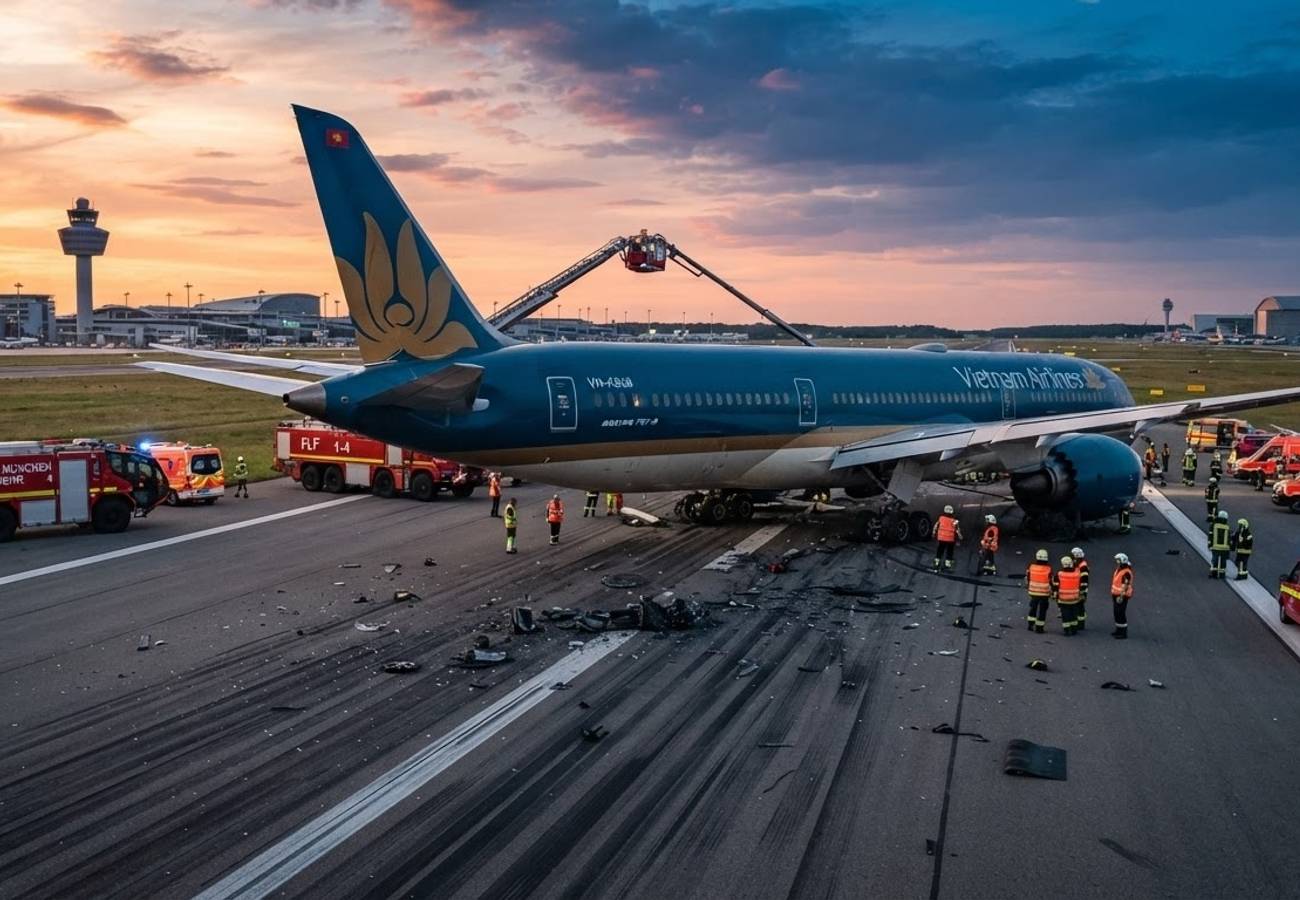
Image generated by AI
A suspected tailstrike during takeoff has forced a Vietnam Airlines Boeing 787-9 to make an emergency return to Munich Airport, triggering a formal safety investigation by German authorities.
The incident, which resulted in the destruction of several main-gear tyres and temporary disruption at one of Europe's busiest hubs, has drawn international attention to the operational handling of widebody aircraft during long-haul departures.
Emergency Return and Landing Sequence at Munich
The event unfolded at Munich Airport when a Vietnam Airlines Boeing 787-9, operating a long-haul service, began its takeoff roll on the northern runway. Flight tracking data and eyewitness video indicate the aircraft utilized nearly the entire length of the runway before lifting off. During this rotation phase, the aircraft appeared to suffer a tailstrike—an occurrence where the lower fuselage makes contact with the runway surface.
Following the departure, the flight crew aborted the climb and entered a racetrack holding pattern over Munich. This maneuver allowed the crew to assess structural integrity and perform a standard fuel dump to reduce the aircraft's weight for a safe emergency landing.
Upon returning to the northern runway, the aircraft touched down under the supervision of pre-positioned emergency services. Post-landing images revealed severe damage to the main landing gear, with shredded rubber and scorched tyre fragments scattered across the runway. Passengers disembarked via mobile stairs and buses; no serious injuries were reported.
Federal Bureau of Aircraft Accident Investigation Takes Lead
The Federal Bureau of Aircraft Accident Investigation (BFU) in Germany has officially opened a safety probe into the incident. Under international aviation protocols, Germany leads the inquiry as the state of occurrence.
The investigation is a collaborative effort involving several key stakeholders:
- Vietnam: Represented by the state of the operator and its civil aviation authority.
- United States: Represented by the state of manufacture (Boeing).
- Engine Manufacturers: Participating in the technical analysis of propulsion performance.
The BFU is currently analyzing flight data recorders (black boxes), cockpit voice recordings, and maintenance logs. The primary objective is to determine the exact sequence of events that led to the tailstrike and the subsequent heavy damage to the tyres during the landing roll.
Technical Focus: Takeoff Performance and Gear Stress
Investigators are scrutinizing the takeoff phase, specifically why the aircraft required almost the full length of Munich's 4,000-meter runway. While heavy long-haul jets often require significant runway distance, the combination of a long roll and a suspected tailstrike suggests potential issues with takeoff configuration or calculation.
Key areas of the technical probe include:
- Weight and Balance: Verification of whether takeoff performance calculations were accurate based on the aircraft's actual load.
- Rotation Technique: Analysis of the pilot's rotation speed and angle.
- System Response: Examination of the anti-skid and braking systems during the emergency landing.
The extreme damage to the main-gear tyres is also a point of interest. Specialists suggest that a combination of high landing weight and intense braking intervention can cause tyre disintegration, even if the landing is otherwise controlled.
Operational Impact on Munich Hub
The incident caused significant friction at Munich Airport during the peak summer travel window. Both runways were temporarily closed to allow emergency vehicles to secure the site and to ensure the runway was clear of debris.
The disruption forced the rerouting and delay of numerous arrivals and departures. Vietnam Airlines and its partner carriers were tasked with the immediate logistical challenge of rebooking passengers whose long-haul journeys were interrupted.
Safety Implications for the Boeing 787-9 Fleet
Tailstrikes are a recognized risk for long-bodied aircraft like the Boeing 787-9. Factors such as mis-set thrust or improper rotation can lead to fuselage contact. While often resulting in limited damage, these events are treated as serious incidents due to the potential for compromising the aircraft's structural skin.
This investigation may result in broader safety recommendations for all Boeing 787-9 operators, potentially leading to:
- Revised takeoff performance calculation protocols.
- Enhanced simulator training specifically for tailstrike prevention and recovery.
- Updated crew guidance for managing suspected structural damage immediately after takeoff.
While Vietnam Airlines generally maintains a strong safety record for its modern fleet, this incident places a temporary spotlight on the carrier's operational oversight and training standards for its Asia-Europe corridors.
The aviation industry now awaits the BFU's initial factual summary to determine if this was a result of human error, technical failure, or a combination of environmental factors.
Related Travel Guides
Disclaimer
This article is for informational and educational purposes only. It does not constitute legal, financial, or professional advice. While we strive to provide accurate and up-to-date information, travel policies, regulations, and conditions change rapidly. Always verify information with official sources before making travel decisions. Nomad Lawyer makes no representations about the accuracy, reliability, completeness, or suitability of the information provided. Readers should consult qualified professionals for advice specific to their circumstances. The views expressed in this article are those of the author and do not necessarily reflect the views of Nomad Lawyer.
Raushan Kumar
Founder & Lead Developer
Full-stack developer with 11+ years of experience and a passionate traveller. Raushan built Nomad Lawyer from the ground up with a vision to create the best travel and law experience on the web.
Learn more about our team →