
Europe Flight Chaos 2026: Mount Etna Eruption Triggers 2,204 Delays and 229 Cancellations
Volcanic ash from Mount Etna and systemic hub congestion caused 2,204 delays and 229 cancellations across Europe, severely impacting Barcelona and Catania airports.

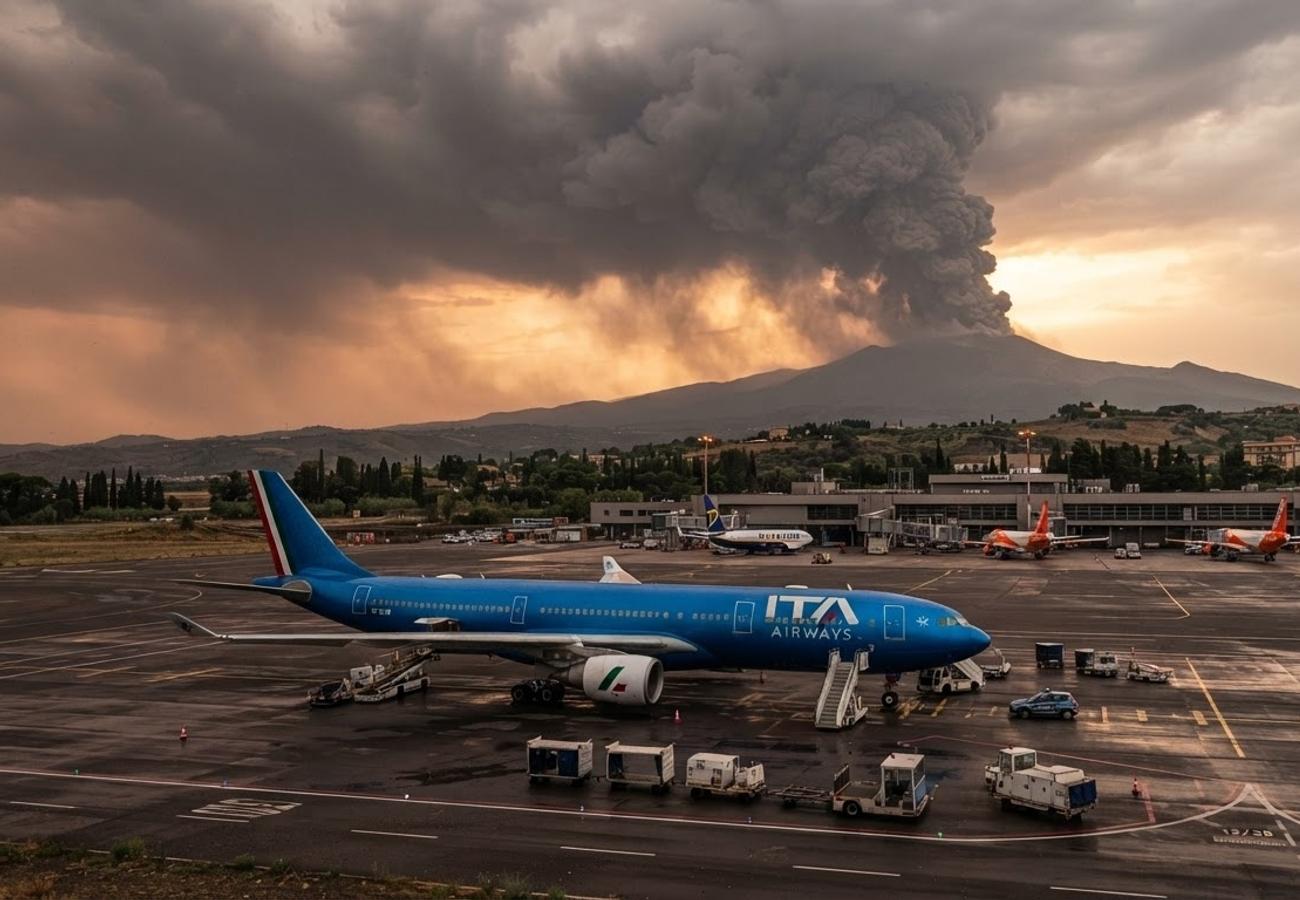
Image generated by AI
Widespread aviation turmoil gripped Europe on August 12, 2026, as a combination of volcanic activity in Sicily and systemic hub congestion resulted in 2,204 delays and 229 flight cancellations. The disruption spanned eight countries, including Italy, Spain, the UK, France, and the Netherlands, leaving thousands of passengers stranded.
The current crisis is characterized by a sharp divide between localized natural disasters and broader operational failures. While a volcanic eruption in eastern Sicily created a concentrated zone of cancellations, major hubs like Barcelona and Amsterdam are struggling with massive delay backlogs that suggest deeper systemic pressure across the European airspace.
Mount Etna Eruption Paralyzes Catania Operations
The most severe operational collapse is centered at Catania-Fontanarossa Airport. Volcanic ash from the ongoing eruption of Mount Etna has forced a drastic reduction in flight capacity, leading to 98 cancellations and 23 delays in a single day. To put this in perspective, Catania alone accounted for approximately 43% of all flight cancellations recorded across 14 of Europe's major airports.
Italian volcanic monitoring authorities have maintained the highest aviation alert level. The presence of volcanic ash is a critical safety hazard; these microscopic glass particles can melt inside jet engines, causing total power loss. Consequently, aviation officials have implemented strict airspace restrictions, transforming Catania into a cancellation hotspot.
The fallout at Catania has hit low-cost carriers the hardest. Ryanair reported 37 cancellations at the airport, followed by easyJet with 20 and Wizz Air Malta with 16. Other airlines caught in the volcanic disruption include Delta Air Lines, Lufthansa, Iberia, Finnair, and Air Baltic.
Major European Hubs Face Massive Delay Backlogs
While Sicily deals with a natural disaster, other European capitals are battling staggering delay figures. Barcelona has emerged as the epicenter of timing failures, recording the highest delay total in Europe with 282 separate incidents, alongside 18 cancellations.
The disruption is not limited to Spain. Major aviation centers including London, Amsterdam, Rome, Milan, Geneva, Athens, Paris, Madrid, and Venice are all reporting significant operational friction. In many of these cities, the trend is weighted toward delays rather than outright cancellations, suggesting that while planes are eventually taking off, the network is operating far beyond its current efficiency threshold.
Breakdown of Airport Disruptions
The following data highlights the specific impact on key European gateways:
| Airport | Cancellations | Delays | Primary Affected Carrier |
|---|---|---|---|
| Catania | 98 | 23 | Ryanair |
| Barcelona | 18 | 282 | Vueling |
| Rome Fiumicino | 9 | 219 | ITA Airways |
| Madrid-Barajas | 6 | 210 | Iberia |
| Amsterdam Schiphol | 22 | 185 | KLM |
| Paris Orly | 10 | 139 | Transavia France |
Airline Operational Pressure Analysis
The operational burden is not distributed evenly across the industry. Some carriers are facing systemic failures across multiple countries, while others are suffering due to their reliance on specific hubs.
easyJet currently holds the highest overall delay count with 220 incidents. The carrier's struggles are geographically diverse, with delays reported in Geneva, Venice, Rome, Athens, Malta, Paris Orly, Gatwick, Milan Malpensa, Barcelona, Amsterdam, and Catania. This suggests a network-wide struggle rather than a localized issue.
Ryanair has faced the highest volume of total cancellations at 51. A significant portion of these occurred in Catania, but the airline also recorded delays in Madrid, Athens, Malta, and Milan.
Vueling is heavily impacted by the situation in Spain, with 154 total delays. An overwhelming 118 of these occurred at Barcelona, though the airline also reported friction at Gatwick and Malpensa.
British Airways is seeing a concentrated failure at its primary hub, with 103 of its 108 total delays occurring at London Heathrow. Similarly, KLM's disruption is centered in Amsterdam, where 84 of its 91 delays and 19 of its 22 cancellations took place.
Why This Matters: The Impact on Modern Travelers
For the passenger, this data reveals a critical vulnerability in the "hub-and-spoke" aviation model. When a primary hub like Barcelona or Amsterdam experiences a surge in delays, it creates a domino effect. A flight delayed by three hours in Amsterdam doesn't just affect the passengers on that plane; it affects the subsequent three flights that aircraft was scheduled to fly that day.
From a legal and logistical standpoint, the distinction between a "volcanic cancellation" and an "operational delay" is vital. Cancellations caused by Mount Etna are typically classified as "extraordinary circumstances," which may limit an airline's liability for cash compensation under European passenger rights regulations (such as EU261). However, the massive delays in London, Madrid, and Paris—where no specific weather or strike event was cited—may open the door for passenger claims if the delays are deemed within the airline's control.
Travelers should be aware that aircraft rotations are currently unstable. Even if a flight is listed as "on time," the aircraft may be arriving from a disrupted hub, meaning status can change in minutes.
Passengers are strongly advised to monitor flight tracking apps in real-time and maintain flexible itineraries while volcanic activity persists in Sicily.
Related Travel Guides
Disclaimer
This article is for informational and educational purposes only. It does not constitute legal, financial, or professional advice. While we strive to provide accurate and up-to-date information, travel policies, regulations, and conditions change rapidly. Always verify information with official sources before making travel decisions. Nomad Lawyer makes no representations about the accuracy, reliability, completeness, or suitability of the information provided. Readers should consult qualified professionals for advice specific to their circumstances. The views expressed in this article are those of the author and do not necessarily reflect the views of Nomad Lawyer.
Raushan Kumar
Founder & Lead Developer
Full-stack developer with 11+ years of experience and a passionate traveller. Raushan built Nomad Lawyer from the ground up with a vision to create the best travel and law experience on the web.
Learn more about our team →