
The Digital Schengen Border: An Insider Guide to Europe's Biometric Entry/Exit System for American Travelers
The European Union's Entry/Exit System (EES) permanently replaces passport stamping with biometric facial and fingerprint registration across 29 Schengen countries.

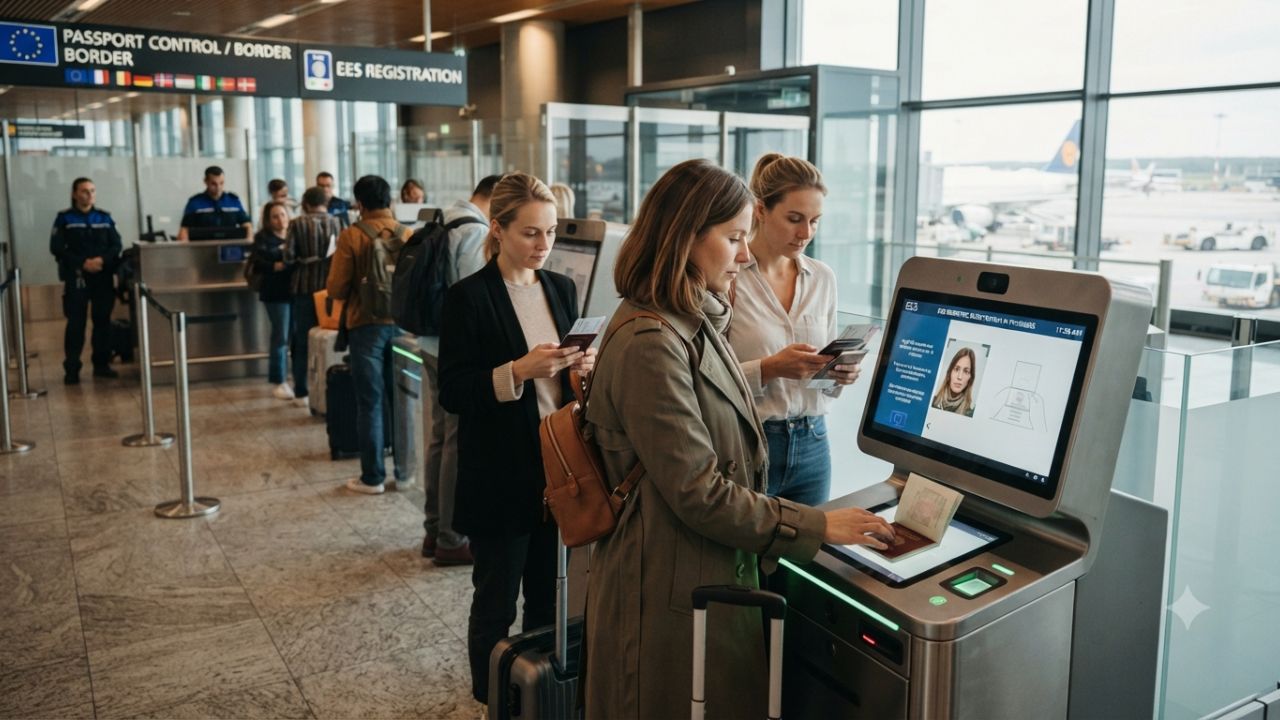
While American travelers have collected souvenir ink stamps across European borders for over four decades, the European Union's Entry/Exit System (EES) permanently retired manual passport stamping on April 10, 2026, establishing a universal biometric digital perimeter across twenty-nine Schengen nations. Following a phased implementation that commenced on October 12, 2025, non-EU short-stay visitors—including vacationers from the United States, Canada, and the United Kingdom—now undergo facial image capture and four-fingerprint digital scanning at external air, sea, and land border checkpoints.
Although the European Commission confirms that first-time biometric enrollment averages just over one minute per traveler under optimal conditions, high-volume arrival banks at major European gateways have created significant immigration queues. Reports from primary transatlantic entry points—including Madrid-Barajas (MAD), Lisbon Humberto Delgado (LIS), Brussels Airport (BRU), Paris Charles de Gaulle (CDG), Frankfurt (FRA), and London St Pancras Eurostar terminals—highlight the necessity for travelers to rethink layover buffers and internal Schengen transit strategies.
EES Biometric Border Matrix & Airport Processing Analysis
| Gateway Hub / Border Point | Primary Infrastructure | First-Time Processing Pressure | Recommended Transit Strategy |
|---|---|---|---|
| Madrid-Barajas (MAD) | Biometric self-service kiosks & national police booths | Heavy queues during morning Latin American/US arrival banks | Allow at least 2.5 hours for domestic or intra-Schengen connections |
| Lisbon Humberto Delgado (LIS) | Automated e-gates and manual biometric desks | Capacity constraints during simultaneous widebody arrivals | Build a 3-hour buffer when connecting to Madeira, Azores, or Europe |
| Brussels Airport (BRU) | Expanding automated biometric e-gate lanes | Intermittent kiosk calibration delays during peak morning hours | Complete kiosk pre-registration promptly before reaching passport desks |
| Paris Charles de Gaulle (CDG) | Automated PARAFE biometric gates and police counters | High volume across Terminals 2E and 2F transfer corridors | Avoid tight 60-minute connections; utilize airport airside shuttles |
| Frankfurt Airport (FRA) | Integrated self-service biometric capture terminals | High efficiency with localized surges during bank deplaning | Verify gate locations across Concourses B and Z ahead of time |
| London St Pancras (Eurostar) | Juxtaposed French border biometric lanes | Peak weekend morning bottlenecks before rail boarding | Arrive at the international rail terminal a full 90–120 minutes early |
Decoding the Mechanics: How EES and ETIAS Interact
Understanding European border modernization requires distinguishing between the two separate digital systems governing short stays up to 90 days within any 180-day rolling window:
1. The Entry/Exit System (EES) — At the Physical Border
The EES operates directly at the physical point of entry into the 29 participating European nations. Upon arrival, the digital system records four biometric data components:
- Travel Document Authentication: Scanning of cryptographic passport chips.
- Facial Biometrics: High-resolution facial image capture matching passport records.
- Fingerprint Collection: Digital scanning of four right-hand fingerprints.
- Time & Location Logging: Exact alphanumeric timestamps of entry and exit, automatically calculating authorized remaining days and detecting overstays without requiring ink stamps.
Once an initial biometric profile is created in the central database, subsequent border crossings during the three-year validity period require only quick facial verification at automated e-gates rather than full re-registration.
2. ETIAS — Pre-Travel Digital Authorization
Scheduled for official launch in the final quarter of 2026 across 30 European countries, the European Travel Information and Authorisation System (ETIAS) is an online pre-screening requirement. Similar to the United States ESTA system, travelers will complete an electronic application before departure, which commercial airlines will verify prior to boarding. ETIAS provides permission to travel, whereas EES executes physical immigration processing upon arrival.
Navigating European Entry Points: An Insider Guide
The implementation of biometric gates has altered how experienced travelers route transatlantic journeys:
- The First-Port Principle: If flying from New York to Florence with a connection in Madrid, you must clear complete EES biometric immigration at Madrid-Barajas before boarding your domestic flight to Italy. Plan your transatlantic ticket with a minimum connection window of two-and-a-half hours.
- Secondary Gateway Strategy: To bypass major capital hub bottlenecks, consider routing through secondary international entry points like Zurich (ZRH), Munich (MUC), or Vienna (VIE), where airport terminal layouts and kiosk-to-passenger ratios frequently facilitate faster biometric processing.
- Eurostar Rail Juxtaposed Controls: Because French border officials conduct EES checks in the United Kingdom prior to boarding trains at London St Pancras, lines form before the security hall. Give yourself a two-hour buffer before departure.
- Physical Passport Maintenance: Ensure your physical passport book remains undamaged with a functioning RFID chip. Keep the booklet easily accessible, as border guards still inspect physical travel documents alongside digital biometric scans.
Visitor Insider Tips for Trouble-Free Schengen Transit
Adapting to Europe's new digital border protocols requires practical preparation:
- Rolling 90/180-Day Compliance: With manual stamping eliminated, border guards no longer estimate dates by thumbing through physical pages. The EES central computer calculates exact hours spent inside the Schengen Area. Use the official EU Schengen Calculator before booking multi-country European itineraries to prevent inadvertent overstay penalties.
- Biometric Kiosk Preparation: When approaching automated self-service kiosks at Brussels or Madrid, remove eyeglasses, hats, and facial coverings before stepping in front of the lens. Place your four fingers flat on the glass scanner without pressing excessively hard.
- Boarding Pass Synchronization: Keep digital and printed copies of return flight confirmations, hotel lodging vouchers, and comprehensive travel insurance easily accessible on your phone, as border officers may request proof of onward transit during manual interviews.
- Terminal Transfer Rail Hacks: If transferring between Terminals 2E and 2F at Paris CDG, follow the yellow "Correspondances" overhead signage and use the automated LISA shuttle train rather than exiting through landside customs.
- Family Travel Logistics: Children under twelve years of age are exempt from fingerprint scanning under EES regulations, but must have their facial image captured alongside a parent or legal guardian at staffed family immigration lanes.
Cultural and Environmental Context
The transition to biometric border processing marks the largest structural evolution of the Schengen Agreement since its founding in 1985 in the quiet Luxembourg village of Schengen. By consolidating immigration checks into an interoperable digital cloud, the European Union aims to safeguard open internal borders across 29 nations while enhancing security against transnational crime and identity fraud.
Simultaneously, the digital transition yields significant environmental efficiencies. Replacing millions of paper landing cards and physical stamps with automated biometric kiosks reduces administrative waste and streamlines passenger throughput. Furthermore, automated e-gates allow historic international airports to absorb expanding international visitor numbers without constructing resource-intensive concrete terminal additions, preserving sensitive coastal and rural landscapes surrounding Europe’s primary aviation hubs.
FAQ: European Biometric Border Processing (EES) in 2026
Do American citizens need a visa to enter Europe under EES?
No. EES is not a visa; it is a digital border-registration system. American tourists continue to enjoy visa-free entry for tourism and business stays up to 90 days within any 180-day period.
Will I still receive a physical stamp in my passport?
No. The EES permanently replaces physical ink passport stamps with electronic records capturing exact entry and exit dates, times, and border locations.
How long does the initial biometric registration take?
The initial registration—capturing facial imagery and fingerprints—averages between one and two minutes per person, though terminal queues can increase wait times during peak arrival banks.
What happens if I have an onward connection in Europe?
You must complete EES biometric registration at your first port of entry into the Schengen Area before transferring to your connecting flight, making a layover of 2.5 to 3 hours highly recommended.
As digital gates replace old ink stamps across the continent, Europe remains as timeless and welcoming as ever—inviting travelers to step smoothly from modern terminals into centuries of living heritage.
Related Travel Guides
Disclaimer
This article is for informational and educational purposes only. It does not constitute legal, financial, or professional advice. While we strive to provide accurate and up-to-date information, travel policies, regulations, and conditions change rapidly. Always verify information with official sources before making travel decisions. Nomad Lawyer makes no representations about the accuracy, reliability, completeness, or suitability of the information provided. Readers should consult qualified professionals for advice specific to their circumstances. The views expressed in this article are those of the author and do not necessarily reflect the views of Nomad Lawyer.
Kunal K Choudhary
Co-Founder & Contributor
A passionate traveller and tech enthusiast. Kunal contributes to the vision and growth of Nomad Lawyer, bringing fresh perspectives and driving the community forward.
Learn more about our team →