
Downtown Seattle Tourism Surges with 3.7 Million July Visitors as FIFA World Cup Boosts Washington Economy
Downtown Seattle welcomed over 3.7 million domestic visitors in July 2026, driven by FIFA World Cup matches and record light rail ridership, signaling a full recovery beyond pre-pandemic levels.

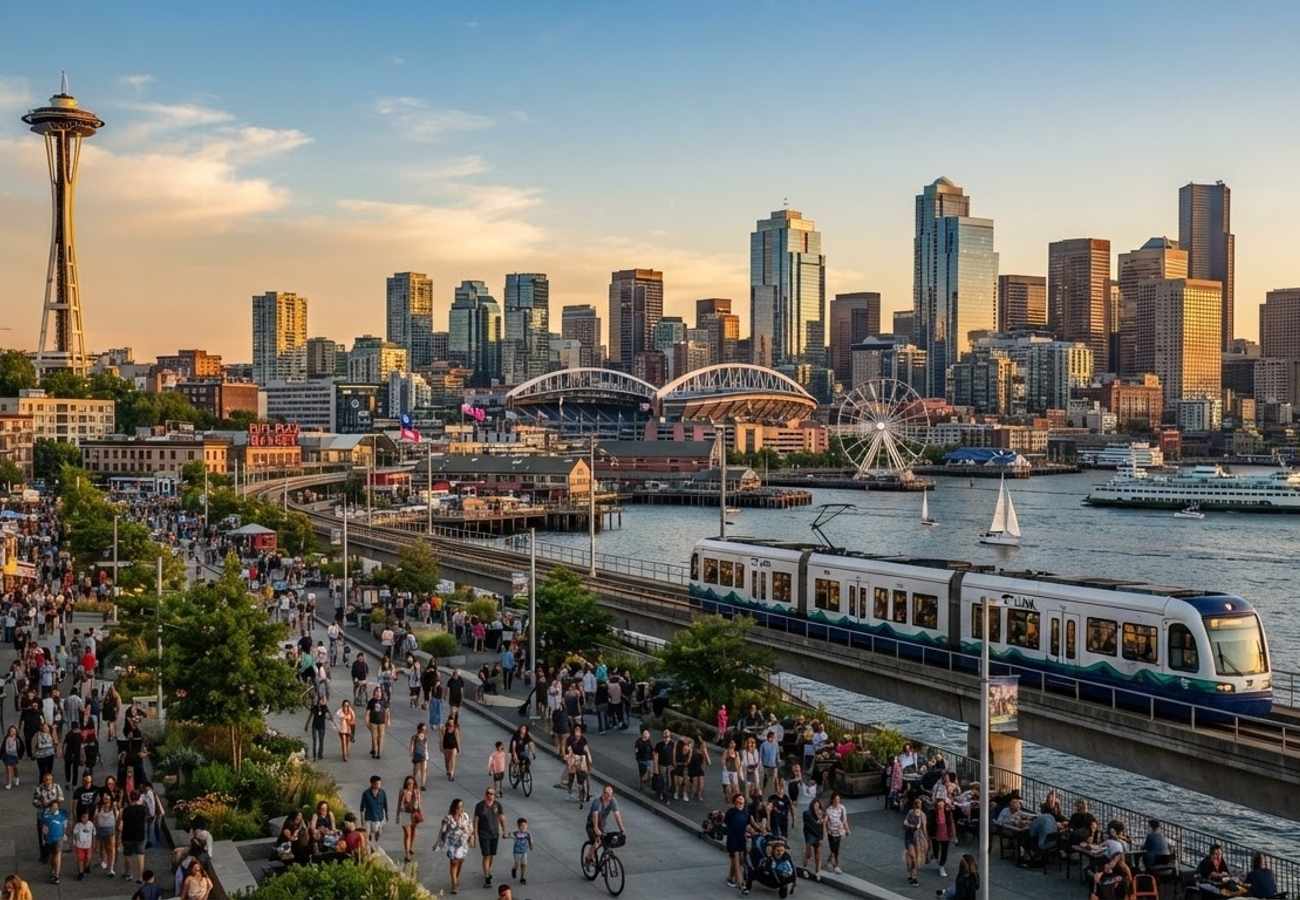
Image generated by AI
Downtown Seattle recorded over 3.7 million domestic visitors in July 2026, marking a significant surge driven by global sporting events and revitalized urban infrastructure.
The latest data from the Downtown Seattle Association confirms that domestic visitor volume in July was 5 percentage points higher than July 2025 and 12% above July 2019 levels. This growth indicates that the city center has not only recovered from pandemic-era disruptions but has expanded its draw for leisure and event-based travel.
The surge is largely attributed to a convergence of three factors: the hosting of six FIFA World Cup matches at Lumen Field, a record-breaking period for the Seattle waterfront, and an unprecedented spike in public transit utilization.
The World Cup Effect and Urban Mobility
The FIFA World Cup served as a primary catalyst for footfall. Across the six match days hosted in Seattle, more than 3 million downtown visitors were measured. This concentrated burst of activity tested and validated the city's operational capacity for high-density global events.
This influx extended directly into the city's transit network. Sound Transit reported 743,041 Link light rail Sunday boardings during July, averaging approximately 123,000 boardings every Sunday. This represents the highest Sunday ridership for a single month in the history of Sound Transit, signaling a shift toward using light rail for leisure and events rather than just traditional commuting.
Waterfront and Local Engagement
Beyond international sporting events, the revitalized waterfront is becoming a primary anchor for both tourists and residents. July saw 351,284 visits from individuals living within 10 miles of downtown—surpassing the previous record of August 2019 by approximately 25,000 visits.
Washington State Visitor Economy Comparison
While Seattle dominates in total volume, the broader Washington state landscape shows a diverse distribution of tourism value. 2025 data highlights a distinction between mass visitation and high-value overnight stays.
- Seattle & King County: Welcomed 39.7 million visitors in 2025, generating $8.8 billion in spending and supporting 68,623 jobs.
- Bellevue: Focused on a higher-concentration overnight model, recording 2.2 million overnight visitors with a total economic impact between $2.03 billion and $2.3 billion.
- Regional Hubs: Spokane, Tacoma, Everett, Bellingham, Vancouver, Yakima, and Olympia continue to serve as critical nodes, though their data is typically aggregated into regional datasets.
2025 Washington Tourism Performance Metrics
| City/Area | 2025 Visitors | Key Tourism Data |
|---|---|---|
| Seattle & King County | 39.7 million | $8.8B spending; 68,623 jobs; $840M taxes |
| Bellevue | 2.2 million (overnight) | $760M overnight spending; $2.03B–$2.3B total impact |
| Spokane | Regional Data | Included in Eastern regional 2025 report |
| Tacoma | Regional Data | Included in Metro Puget Sound reporting |
| Everett | Regional Data | Included in Metro Puget Sound reporting |
| Bellingham | Regional Data | Included in Metro Puget Sound reporting |
Why This Matters: Industry Analysis
From a logistical and urban planning perspective, Seattle's July performance proves that "event-led recovery" is a viable strategy for major US city centers. The real impact here isn't just the raw visitor count, but the shift in how people move through the city.
Our analysis of the ridership data indicates that the Link light rail has successfully transitioned from a commuter tool to a tourism asset. When 123,000 people use the rail on a Sunday, it reduces the reliance on ride-sharing and parking infrastructure, which is the primary bottleneck for urban growth.
Furthermore, the disparity between Seattle's 39.7 million visitors and Bellevue's 2.2 million overnight guests illustrates two different business models: Seattle operates as a high-volume transit and attraction hub, while Bellevue functions as a high-yield corporate and luxury leisure destination. For developers and hospitality investors, this means the strategy for "growth" in Seattle is based on pedestrian flow and volume, whereas in Bellevue, it is based on increasing the average daily rate (ADR) and length of stay.
Forward Outlook
The critical challenge for Seattle is maintaining this momentum once the "World Cup halo" fades. The city is now pivoting toward "permanent activation"—converting the operational strategies used during the tournament into year-round pedestrian experiences.
Industry trends suggest that the focus will shift toward the "10-mile radius" demographic. By breaking the record for local visits to the waterfront, Seattle has found a way to hedge against fluctuations in international travel by fostering a robust "staycation" economy. Expect further investments in public squares and pedestrian-friendly zones to sustain these numbers into 2027.
Seattle has moved beyond recovery; it is now redefining the urban tourism blueprint for the Pacific Northwest.
Related Travel Guides
Disclaimer
This article is for informational and educational purposes only. It does not constitute legal, financial, or professional advice. While we strive to provide accurate and up-to-date information, travel policies, regulations, and conditions change rapidly. Always verify information with official sources before making travel decisions. Nomad Lawyer makes no representations about the accuracy, reliability, completeness, or suitability of the information provided. Readers should consult qualified professionals for advice specific to their circumstances. The views expressed in this article are those of the author and do not necessarily reflect the views of Nomad Lawyer.
Preeti Gunjan
Contributor & Community Manager
A passionate traveller and community builder. Preeti helps grow the Nomad Lawyer community, fostering engagement and bringing the reader experience to life.
Learn more about our team →