
Delhi Weather Crisis: Heavy Monsoon Rain Delays Over 400 Flights at IGI Airport
Torrential downpours across Delhi-NCR trigger widespread flight delays affecting over 400 services at IGI Airport and divert planes to regional hubs.

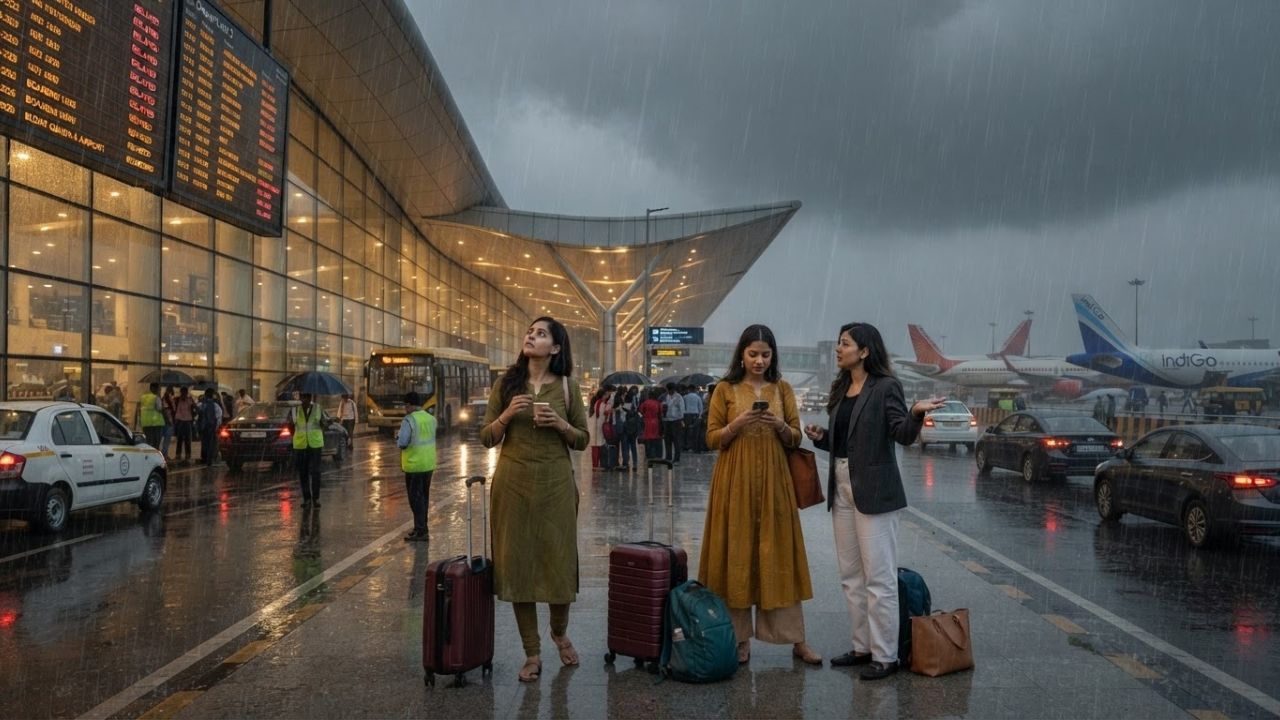
Image generated by AI
Intense monsoon downpours across the Delhi National Capital Region have delayed more than 400 flights at Indira Gandhi International Airport and diverted arriving aircraft to Jaipur, Lucknow, Ahmedabad, and Chandigarh as waterlogged arterial roads snarl airport access.
NEW DELHI — Unprecedented monsoon cloudbursts battered the Delhi National Capital Region (NCR), creating cascading operational disruptions across Indira Gandhi International Airport (IGIA) and submerging critical highway corridors connecting the capital to its primary aviation hub. A relentless weather system on Friday caused localized water accumulation across the airfield perimeter, prompting air traffic control to place dozens of incoming flights into holding patterns before rerouting them to regional diversion fields.
Although airport operator Delhi International Airport Limited (DIAL) confirmed that aerodrome runways and passenger terminals remained operational on Saturday morning, airlines across domestic and international networks issued widespread travel advisories. More than 400 flights suffered delays as ramp handling teams halted baggage loading during severe lightning alerts, producing ripple-effect delays across India's domestic airspace.
The Local Trend Revealed: Monsoon Storms and Multi-Hub Flight Rerouting
The severe weather system swept across Delhi-NCR following warnings from the India Meteorological Department (IMD) for heavy rainfall, thunderstorms, lightning strikes, and high-velocity wind gusts. When extreme squalls reduce runway visual range and trigger wind shear alerts, safety regulations established by the Directorate General of Civil Aviation (DGCA) require air traffic controllers to increase separation between arriving aircraft or suspend approaches.
Unable to land during peak downpours, multiple domestic and international airliners were diverted to alternative airports across western and northern India:
- Jaipur International Airport (JAI): Accommodated short-haul domestic flights unable to penetrate Delhi’s thunderstorm ceiling.
- Lucknow Chaudhary Charan Singh International Airport (LKO): Handled eastern and central regional diversions.
- Sardar Vallabhbhai Patel International Airport (AMD) in Ahmedabad: Received heavy-gauge domestic and long-haul arrivals.
- Shaheed Bhagat Singh International Airport (IXC) in Chandigarh: Served as the northern diversion point for transiting domestic services.
Even after downpours subside, flight operations do not instantly normalize. When more than 400 aircraft are displaced or delayed, airline crew duty-time limitations (FDTL) are exceeded, requiring carriers to reposition reserve pilots and cabin attendants. Consequently, secondary delays and flight turnarounds continue rippling through airline schedules for up to 24 to 36 hours.
Summary of Weather Impact Across Delhi-NCR Aviation Infrastructure
| Disruption Metric | Scope / Detail Recorded | Key Affected Facilities | Operational Status & Action |
|---|---|---|---|
| Delayed Flights | Exceeding 400 flights across domestic & international sectors | Terminal 1, Terminal 2, and Terminal 3 | Rolling schedule adjustments; passengers held in gate lounges |
| Flight Diversions | Multiple scheduled arrivals redirected mid-flight | Diverted to Jaipur, Lucknow, Ahmedabad, and Chandigarh | Aircraft refueled and held pending clear arrival corridors into Delhi |
| Airfield Conditions | Intense precipitation, lightning alerts, and water accumulation | Runways 28/10, 29L/11R, 29R/11L, and taxiway networks | Operational with safety spacing; ground ramp holds during active lightning |
| Arterial Highway Access | Severe waterlogging, traffic gridlock, and slowed vehicle movement | Mahipalpur bypass, NH-48 (Delhi-Gurgaon Expressway), Aerocity underpass | Motorists face 60–90 minute delays; traffic police issuing route diversions |
Cultural & Environmental Value: Ecological Water Management and Urban Transit
The recurring monsoon weather events at Indira Gandhi International Airport highlight the ecological dynamics of Delhi’s geography, where low-lying Yamuna floodplains and rapid urban expansion challenge drainage capacities. In response, airport operator DIAL has constructed expansive rainwater harvesting systems and subterranean retention reservoirs spanning the 5,000-acre aerodrome. These eco-hydrological installations capture millions of liters of seasonal runoff, preventing waterlogging on active runways while recharging the groundwater aquifers of the southern Ridge.
For travelers, navigating Delhi during monsoon season also offers an authentic encounter with North Indian hospitality and urban resilience. Rather than battling congested roadways, environmentally conscious travelers are shifting en masse to the Delhi Metro Airport Express Line. Powered partly by solar energy, the high-speed rail corridor eliminates vehicular emissions while ensuring punctual, flood-proof transit to Terminal 3.
Local Visitor Insider Tips: Navigating Delhi Airport During Severe Weather
Travelers navigating Indira Gandhi International Airport during severe monsoon conditions should adopt these practical strategies to minimize delays:
- Bypass Road Bottlenecks via Airport Express Metro: Heavy rains regularly swamp key road junctions, particularly around the Mahipalpur flyover and NH-48. Avoid road taxis during storm warnings. Instead, board the Delhi Metro Airport Express Line (Orange Line) from New Delhi Railway Station or Shivaji Stadium. The air-conditioned train reaches Terminal 3 in just 19 minutes, completely bypassing flooded roads.
- Terminal Navigation & Transfers: Terminal 3 accommodates international departures and full-service domestic flights (such as Air India and Vistara), while Terminals 1 and 2 handle domestic low-cost carriers (including IndiGo, SpiceJet, and Akasa Air). If transferring between T3 and T1 during rain, use the dedicated electric shuttle bus service or pre-book through the airport helpdesk rather than hailing outside street cabs.
- Fast-Track Security with DigiYatra: Monsoon weather invariably produces dense passenger queues inside terminal check-in halls. Register on the government-backed DigiYatra facial recognition app before reaching the departure gates to utilize dedicated, frictionless biometric lanes that bypass conventional boarding-pass verification queues.
- Monsoon Comfort Dining: If your departure is delayed by tarmac holds, seek out authentic regional comfort food inside the terminal concourses. Savor a cup of spiced kadak masala chai paired with crisp vegetable pakoras or samosas at Chaayos or Haldiram's in T3, or enjoy traditional North Indian chole bhature at Dilli Streat.
- Live Flight Monitoring Protocols: Do not rely on printed itinerary times or third-party booking sites during stormy periods. Keep airline smartphone apps open with push notifications enabled. Airlines recommend arriving at least 3.5 hours prior to domestic flights and 4 hours prior to international departures whenever the weather department issues thunderstorm alerts.
Tourism Outlook: Strengthening Climate Resilience Across India's Aviation Hub
The recurring disruptions at Delhi’s premier airport underscore the broader national drive toward infrastructure climate resilience. As passenger volumes across India surpass pre-pandemic records, major hubs are investing heavily in automated runway drainage pumps, Category III-B instrument landing systems capable of handling severe visibility drops, and expanded terminal gate lounges.
While monsoon showers present temporary inconveniences, traveler awareness and modern transit choices—such as high-speed metro links and digital flight monitoring—ensure that passengers can navigate weather-related delays safely. By coordinating multi-modal transit networks and modernizing airfield water management, Delhi continues to reinforce its role as South Asia’s foremost aviation crossroads.
Related Travel Guides
Disclaimer
This article is for informational and educational purposes only. It does not constitute legal, financial, or professional advice. While we strive to provide accurate and up-to-date information, travel policies, regulations, and conditions change rapidly. Always verify information with official sources before making travel decisions. Nomad Lawyer makes no representations about the accuracy, reliability, completeness, or suitability of the information provided. Readers should consult qualified professionals for advice specific to their circumstances. The views expressed in this article are those of the author and do not necessarily reflect the views of Nomad Lawyer.
Raushan Kumar
Founder & Lead Developer
Full-stack developer with 11+ years of experience and a passionate traveller. Raushan built Nomad Lawyer from the ground up with a vision to create the best travel and law experience on the web.
Learn more about our team →