
Asia Flight Alert: 2,967 Delays and 358 Cancellations Snarl Major Aviation Hubs
Aviation networks across Asia experience 2,967 delays and 358 cancellations, severely impacting operations in Delhi, Jakarta, Kuala Lumpur, and Shanghai.

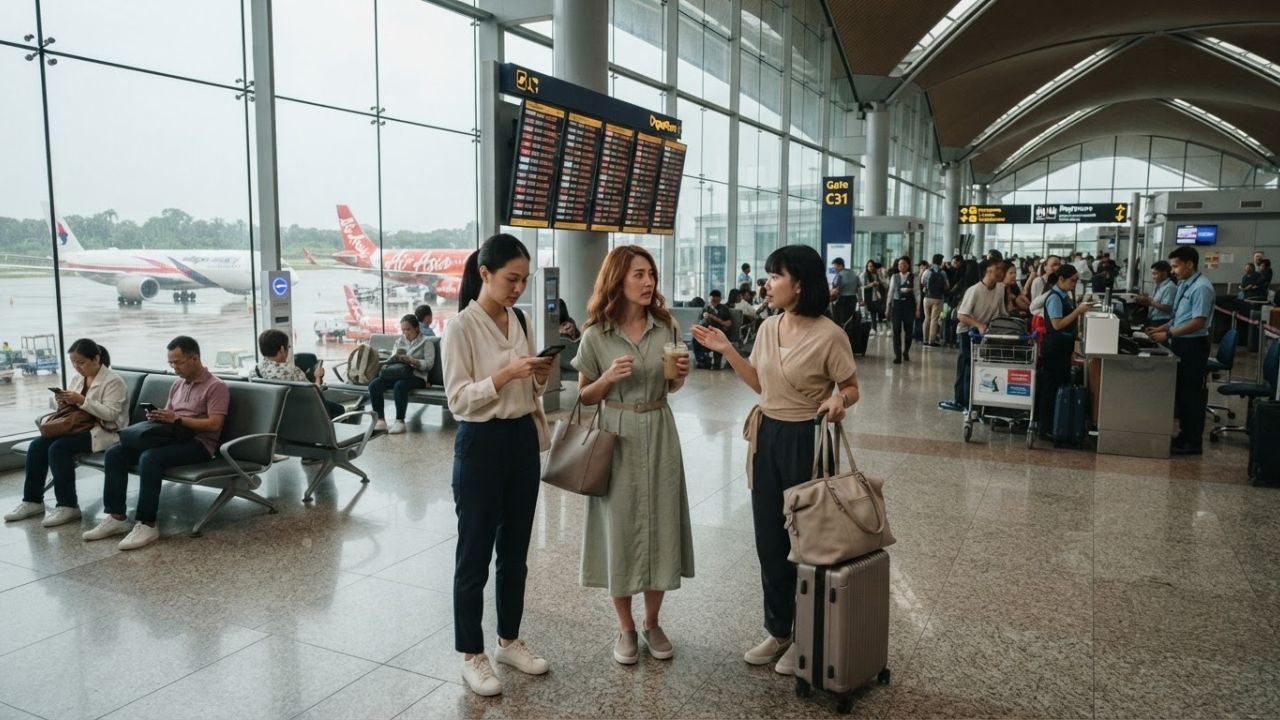
Image generated by AI
Widespread aviation gridlock swept major Asian transit corridors with 2,967 flight delays and 358 cancellations reported, creating acute passenger backlogs across Delhi, Jakarta, Kuala Lumpur, and Shanghai.
SINGAPORE — Commercial aviation networks across Asia experienced compounding operational distress on September 5 and 6, 2026, as interconnected regional flight schedules suffered 2,967 delays and 358 cancellations spanning more than 50 airports. Real-time flight-tracking records logged on September 5 at 3:28 PM ET (September 6, 3:29 AM Singapore Time / GMT+8) revealed that severe bottlenecks impacted major international connection crossroads across India, Indonesia, China, Malaysia, Singapore, and the Philippines.
The disruption wave was anchored by heavy terminal backlogs in South Asia and Southeast Asia. Delhi's Indira Gandhi International Airport logged the region's single highest delay tally with 361 delayed flights, while Jakarta’s Soekarno-Hatta International Airport recorded the highest volume of grounded departures with 50 outright cancellations. As airlines absorbed late-arriving aircraft, crew duty-hour timeouts, and severe slot restrictions, passengers faced multi-hour terminal queues and missed onward long-haul connections.
The Local Trend Revealed: Regional Epicenters of Asian Air Disruption
The scale of schedule deterioration extended across both primary intercontinental hubs and high-frequency domestic trunk routes, placing immense strain on major passenger terminals:
Primary Airport Friction Points
- Delhi Indira Gandhi International (DEL): Recorded 361 flight delays alongside 6 cancellations, marking the most severe aggregate delay count across all surveyed Asian hubs.
- Jakarta Soekarno-Hatta International (CGK): Suffered the highest cancellation total in the region with 50 cancellations and 224 delays, posting a 4% origin cancellation rate and a 3% destination cancellation rate.
- Kuala Lumpur International (KUL): Recorded 223 delays and 4 cancellations, creating acute transfer friction between low-cost and legacy terminals.
- Shanghai Aviation Hub (PVG & SHA): Shanghai’s dual-airport system was hit hard, with Shanghai Pudong International (PVG) reporting 198 delays and 23 cancellations (1% cancellation rate), while downtown Shanghai Hongqiao International (SHA) logged 101 delays and 22 cancellations (3% origin cancellation rate).
- Singapore Changi (SIN): Maintained low cancellation figures (8 cancellations) but registered 126 delayed flights, impacting intercontinental connections to Europe and Australia.
- Manila Ninoy Aquino International (MNL): Logged 94 delays and 5 cancellations.
- Hong Kong International (HKG): Recorded 91 delays and 4 cancellations.
Comprehensive Airport Cancellation Rates Across Asia
The following verified flight-tracking records outline origin and destination cancellation percentages across key Asian facilities:
| Airport | Origin Cancellation % | Destination Cancellation % |
|---|---|---|
| Jakarta-Soekarno-Hatta Int’l (CGK) | 4% | 3% |
| Shanghai Hongqiao Int’l (SHA) | 3% | 1% |
| Shanghai Pudong Int’l (PVG) | 1% | 1% |
| Chengdu Tianfu Int’l (TFU) | 1% | 1% |
| Beijing Capital Int’l (PEK) | 0% | 1% |
| Beijing Daxing Int’l (PKX) | 1% | 1% |
| Guangzhou Baiyun Int’l (CAN) | 0% | 0% |
| Xi’an Xianyang Int’l (XIY) | 0% | 0% |
| Shenzhen Bao’an Int’l (SZX) | 0% | 0% |
| Chengdu Shuangliu Int’l (CTU) | 1% | 1% |
| Wuhan Tianhe (WUH) | 1% | 0% |
| Jieyang Chaoshan Int’l (SWA) | 3% | 4% |
| Wuxi (WUX) | 3% | 1% |
| Kunming Changshui Int’l (KMG) | 0% | 0% |
| Manila Int’l (MNL) | 0% | 0% |
| Sultan Hasanuddin Int’l (UPG) | 1% | 2% |
| Juanda Int’l (SUB) | 1% | 1% |
| Osaka Int’l (Itami) (ITM) | 1% | 2% |
| Huizhou Pingtan Airport (HUZ) | 8% | 7% |
| Tianjin Binhai Int’l (TSN) | 1% | 0% |
| Xiamen Gaoqi Int’l (XMN) | 0% | 0% |
| Chongqing Jiangbei Int’l (CKG) | 0% | 0% |
| Ningbo Lishe Int’l (NGB) | 1% | 1% |
| Fuzhou Changle Int’l (FOC) | 1% | 1% |
| Haikou Meilan Int’l (HAK) | 0% | 1% |
| Kuala Namu International (KNO) | 2% | 4% |
| Nanjing Lukou Int’l (NKG) | 0% | 0% |
| Sanya Phoenix Int’l (SYX) | 0% | — |
| Quanzhou Jinjiang (JJN) | 2% | 2% |
| Yangon Int’l (RGN) | 4% | — |
| Yulin (UYN) | 3% | — |
| Leh Kushok Bakula Rimpochee (IXL) | 13% | — |
| Mianyang Nanjiao (MIG) | 4% | — |
| Beihai (BHY) | 6% | 7% |
| Dongsheng (DSN) | 4% | — |
| Yichang (YIH) | 3% | — |
| Xilinhot (XIL) | 6% | 6% |
| Indira Gandhi Int’l (DEL) | — | 0% |
| Hong Kong Int’l (HKG) | — | 0% |
| Fukuoka (FUK) | — | 0% |
| Hang Nadim (BTH) | — | 3% |
| Dehong Mangshi Airport (LUM) | — | 3% |
| Kazan (KZN) | — | 5% |
| Nantong (NTG) | — | 3% |
| Radin Inten II (Branti) (TKG) | — | 10% |
| Luzhou (LZO) | — | 5% |
| Guillermo Leon Valencia (PPN) | — | 22% |
| Mandalay Int’l (MDL) | — | 25% |
| Kalaymyo (KMV) | — | 66% |
| Kuala Lumpur Int’l (KUL) | 0% | 0% |
| Singapore Changi (SIN) | 0% | 0% |
Airline Performance Breakdown: Full-Service and Low-Cost Carriers Impacted
Disruption figures revealed that airline reliability varied considerably across carriers and sub-regions:
Major Chinese Carriers
China Eastern bore the heaviest cancellation burden across Asia, logging 51 grounded flights alongside 225 delays:
| Airline | Cancellations | Cancellation Rate | Delays | Delay Rate |
|---|---|---|---|---|
| China Eastern | 51 | 1% | 225 | 8% |
| Air China | 24 | 1% | 100 | 4% |
| Tianjin Airlines | 16 | 3% | 29 | 7% |
| Hainan Airlines | 11 | 1% | 44 | 5% |
| Shanghai Airlines | 10 | 2% | 51 | 14% |
| Shenzhen Airlines | 9 | 1% | 65 | 7% |
| China Express Airlines | 4 | 0% | 72 | 14% |
| Spring Airlines | 3 | 0% | 81 | 13% |
| China Southern Airlines | 2 | 0% | 100 | 3% |
| XiamenAir | 2 | 0% | 91 | 12% |
| Sichuan Airlines | 1 | 0% | 80 | 9% |
Southeast Asian and Indian Carriers
In India, market leader IndiGo recorded 305 delays (15% delay rate) and 2 cancellations (0%), while Air India registered 152 delays (21% delay rate) and 1 cancellation (0%). SpiceJet recorded 33 delays (37% delay rate) and 7 cancellations (8% cancellation rate).
In Indonesia and across Southeast Asia, disruptions heavily impacted domestic carriers:
| Airline | Cancellations | Cancellation Rate | Delays | Delay Rate |
|---|---|---|---|---|
| Batik Air | 15 | 4% | 80 | 23% |
| Citilink | 13 | 4% | 35 | 11% |
| Pelita Air Service | 7 | 11% | 12 | 19% |
| Malindo Air | 2 | 1% | 45 | 26% |
| Indonesia AirAsia | 2 | 2% | 7 | 7% |
| Garuda Indonesia | 1 | 0% | 42 | 17% |
Other prominent regional carriers faced notable schedule friction: AirAsia recorded 93 delays (19%) and 2 cancellations; Japan Airlines logged 86 delays (10%); Singapore Airlines recorded 33 delays (8%) and 4 cancellations; Scoot logged 23 delays (11%) and 4 cancellations; and Philippine Airlines recorded 11 delays (11%) and 5 cancellations (5%).
Cultural & Environmental Value: High-Density Air Corridors and High-Speed Rail Alternatives
The recurring gridlock observed across East Asian and Southeast Asian air corridors demonstrates the physical saturation of regional airspace. Air routes between Shanghai, Beijing, Guangzhou, and Hong Kong rank among the world's most heavily traveled commercial skies. When military airspace restrictions or convective weather systems arise, air traffic flow management programs create immediate airborne holding patterns, forcing twin-engine jetliners to consume excess fuel in holding stacks.
In mainland China, this aviation vulnerability has accelerated consumer adoption of the national high-speed rail (HSR) network. Modern Fuxing bullet trains operating at 350 km/h connect Shanghai Hongqiao to Beijing South in just four hours and eighteen minutes. For travelers navigating routes between Shanghai, Hangzhou, Nanjing, and Wuhan, opting for electric high-speed rail completely sidesteps tarmac delays while eliminating nearly 80% of personal travel carbon emissions compared to regional air travel.
Local Visitor Insider Tips: Terminal Transits, Layover Comfort, and Regional Flavors
For international passengers stranded during layovers or facing multi-hour departure holds at Asia’s major hubs, specialized terminal knowledge provides immense relief:
- Navigating Inter-Terminal Transfers at KLIA (Kuala Lumpur): Note that Kuala Lumpur International Airport operates two physically separate terminal complexes: KLIA Terminal 1 (mainline and legacy carriers like Malaysia Airlines) and KLIA Terminal 2 (low-cost carriers like AirAsia). They are separated by several kilometers. Do not rely on walking; board the KLIA Transit train connecting the two terminals in three minutes for RM 2.50 ($0.55 USD).
- Maximizing Singapore Changi Amenities: If delayed at Changi (SIN), avoid crowded gate areas. Explore free airside amenities, including the rooftop Sunflower Garden in Terminal 2, the 24-hour free movie theaters in Terminals 2 and 3, or pass through immigration to visit the Jewel Changi complex to view the world's tallest indoor waterfall (HSBC Rain Vortex).
- Jakarta (CGK) Terminal Transit: At Soekarno-Hatta, international flights operate out of the expansive Terminal 3, while domestic low-cost flights frequently use Terminals 1 and 2. Use the automated, free Skytrain (Kalayang) to transfer between terminals.
- Regional Comfort Dining During Delays:
- Kuala Lumpur (KUL): Order authentic Malaysian nasi lemak featuring fragrant coconut rice, crispy anchovies, boiled egg, spicy sambal, and chicken rendang, washed down with iced teh tarik (pulled milk tea).
- Singapore (SIN): Visit the Singapore Food Street in Terminal 3 for authentic Hainanese chicken rice or rich coconut-curry laksa.
- Jakarta (CGK): Sample traditional Soto Betawi—aromatic beef soup prepared in a rich spiced coconut milk broth served with steamed jasmine rice and bitter emping crackers.
- Delhi (DEL): Enjoy steaming cups of ginger-cardamom chai accompanied by vegetable samosas at airside cafes.
Tourism Outlook: Cross-Border Consumer Rights and Digital Rebooking Protocols
The simultaneous disruption of 2,967 flights across Asian hubs highlights the urgent necessity for standardized, cross-border passenger rights frameworks across the ASEAN and SAARC blocs. While European travelers enjoy automated statutory compensation under EU261, consumer rights across Asia remain highly fragmented:
- In Malaysia: The Malaysian Aviation Commission (MAVCOM) Malaysian Aviation Consumer Protection Code mandates that carriers provide complimentary meals, phone calls, and internet access for delays exceeding two hours, and hotel accommodations for delays of five hours or more.
- In India: Directorate General of Civil Aviation (DGCA) passenger charters require airlines to provide free refreshments for delays over two hours, and full cash refunds or alternative routing if delays exceed statutory thresholds.
- In China: Civil Aviation Administration of China (CAAC) guidelines require airlines to cover food and lodging expenses only when delays originate from carrier-attributable causes (such as maintenance or crew scheduling), while weather-related delays obligate carriers only to assist in arranging services at the passenger’s expense.
As regional travel volumes continue to expand across Asia, passengers are strongly advised to secure international comprehensive travel insurance that includes dedicated flight delay and missed connection riders. Maintaining real-time airline mobile application notifications and verifying multi-city itineraries before leaving for airport terminals remain the most reliable defenses against widespread regional airspace congestion.
Related Travel Guides
Disclaimer
This article is for informational and educational purposes only. It does not constitute legal, financial, or professional advice. While we strive to provide accurate and up-to-date information, travel policies, regulations, and conditions change rapidly. Always verify information with official sources before making travel decisions. Nomad Lawyer makes no representations about the accuracy, reliability, completeness, or suitability of the information provided. Readers should consult qualified professionals for advice specific to their circumstances. The views expressed in this article are those of the author and do not necessarily reflect the views of Nomad Lawyer.
Raushan Kumar
Founder & Lead Developer
Full-stack developer with 11+ years of experience and a passionate traveller. Raushan built Nomad Lawyer from the ground up with a vision to create the best travel and law experience on the web.
Learn more about our team →