
Delhi IGI Airport Weather Alert: Heavy Rain Delays Over 400 Flights and Floods Access Routes
Intense monsoon downpours in Delhi-NCR delay over 400 flights at IGI Airport, triggering air diversions to Jaipur, Lucknow, and regional hubs.

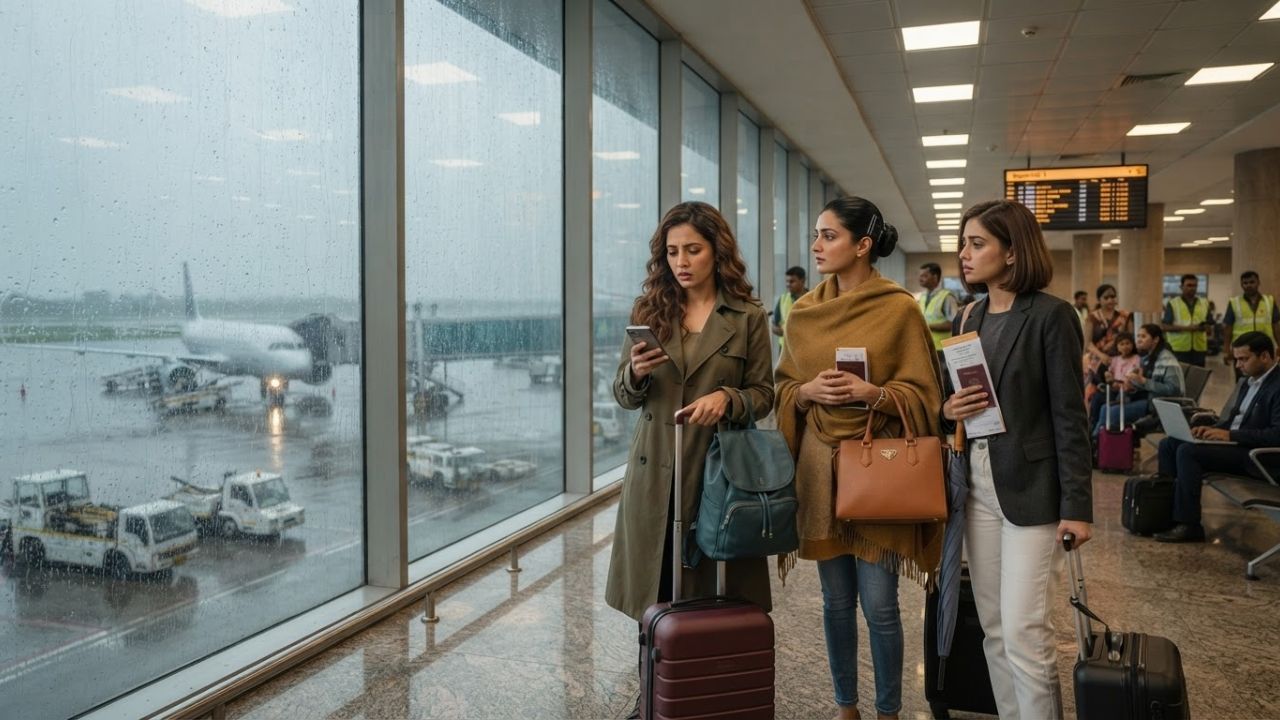
Image generated by AI
Monsoon downpours across Delhi-NCR triggered widespread flight delays affecting over 400 services and diverted incoming aircraft to Jaipur, Lucknow, Ahmedabad, and Chandigarh as waterlogged highways snarled transit to Indira Gandhi International Airport.
NEW DELHI, India — A prolonged spell of torrential monsoon precipitation across the National Capital Region (NCR) has caused substantial flight disruptions, aircraft diversions, and severe roadway congestion around Indira Gandhi International Airport (IGIA). Beginning with intense cloudburst conditions on Friday, the weather system overwhelmed municipal drainage networks, producing heavy standing water along arterial access corridors while lightning and wind gusts compromised air traffic control arrival spacing.
Although airport operator Delhi International Airport Limited (DIAL) confirmed that runway and terminal operations remained active heading into Saturday morning, airlines operating domestic and international departures issued urgent travel advisories. More than 400 flights suffered delays as turnaround times stretched and air traffic controllers held incoming airliners in holding patterns before executing diversions to regional diversion fields.
The Local Trend Revealed: Regional Diversions and Compounding Network Delays
Operating as India’s primary international gateway and domestic aviation crossroad, Delhi Airport manages more than 1,400 daily aircraft movements across its four runways and three passenger terminals (T1, T2, and T3). When extreme weather restricts approach paths, the operational reverberations rapidly ripple across the nation's entire air transit system.
During the height of Friday's storm, reduced cloud ceilings and intense squalls made landing procedures difficult. Multiple arriving commercial flights were ordered into airborne holding patterns until fuel reserves mandated diversion. Flights were rerouted to alternate airports across northern and western India, including Jaipur International Airport (JAI), Chaudhary Charan Singh International Airport in Lucknow (LKO), Sardar Vallabhbhai Patel International Airport in Ahmedabad (AMD), and Shaheed Bhagat Singh International Airport in Chandigarh (IXC).
The resulting cascade affected more than 400 flights. In commercial aviation, delays do not dissipate immediately when skies clear. Aircraft diverted to peripheral stations must refuel, await fresh air traffic control departure slots, and return to Delhi. Simultaneously, flight crews frequently exceed statutory flight duty time limitations (FDTL) set by the Directorate General of Civil Aviation (DGCA), requiring carriers to mobilize reserve flight attendants and pilots, compounding schedule delays well into subsequent operating banks.
Cultural & Environmental Value: Urban Runoff Challenges and Sustainable Airport Infrastructure
The recurring vulnerability of Delhi’s airport perimeter during intense monsoon rainfall highlights broader environmental and civil engineering challenges facing the capital. Rapid urbanization across Gurugram, Mahipalpur, and the Najafgarh drain basin has paved over natural catchment areas, forcing millions of liters of storm runoff directly toward highway underpasses and lower elevation access arteries serving the airport.
In response, DIAL and municipal authorities have accelerated investments in sustainable airport water management. The IGIA facility operates extensive rainwater harvesting structures and underground retention reservoirs designed to capture runoff from the sprawling 5,100-acre airfield. These systems prevent interior runway flooding and recharge regional groundwater tables. However, exterior civic roadways outside airport property—particularly surrounding the Mahipalpur flyover and portions of National Highway 48 (NH-48)—remain susceptible to rapid inundation when municipal drainage channels reach full capacity.
Local Visitor Insider Tips: Metro Transit Routing, Terminal Navigation, and Passenger Rights
For passengers flying out of or connecting through Delhi during active monsoon warnings, strategic logistical choices can prevent missed departures and reduce airport stress:
- Bypass Roadway Waterlogging via Airport Express Metro: Never rely on app-based taxis or private cars along NH-48 during heavy downpours, as waterlogged underpasses between Dhaula Kuan and Aerocity frequently cause multi-hour traffic standstills. Instead, board the Delhi Metro Airport Express Line (Orange Line). Trains depart every 8–10 minutes from New Delhi Railway Station, Shivaji Stadium, and Dhaula Kuan, delivering passengers directly underneath Terminal 3 (T3) in under 20 minutes for just ₹50–₹60 INR ($0.70 USD), completely immune to street-level flooding.
- Terminal-Specific Logistics & Shuttles: Confirm your departure terminal carefully before arriving:
- Terminal 3 (T3): Serves all international departures as well as full-service domestic operations (Air India, Vistara).
- Terminal 2 (T2) & Terminal 1 (T1): Serve domestic low-cost carriers (IndiGo, SpiceJet, Akasa Air). Note that the newly expanded T1 is located on a separate perimeter road; transfer between T3/T2 and T1 requires taking an inter-terminal shuttle bus. During heavy rain, allow at least 45 minutes for inter-terminal transfers.
- Airport Amenities for Delayed Passengers: If experiencing multi-hour flight delays, IGIA features 24-hour pay-per-use lounges (Encalm Lounges located airside in T3, T2, and T1) offering hot buffet dining, Wi-Fi, and shower facilities. In T3 International, travelers can book compact sleeping pods by the hour (Snooze at My Space) to rest comfortably away from crowded gate areas.
- Regional Dining Delights While Delayed: Transform an extended gate delay into a culinary experience. Sample hot regional comfort foods at terminal food courts, such as authentic Old Delhi-style samosas served with tangy tamarind chutney, steaming chole bhature, butter chicken paired with freshly baked naan, or hot clay cups of cardamom-infused masala chai from Chaayos or Chai Point.
- Know Your DGCA Passenger Charter Rights: Under DGCA regulations, if a flight is delayed by more than two hours beyond its scheduled departure, airlines must provide complimentary meals and light refreshments. For delays exceeding 24 hours, or when a flight is cancelled, passengers are entitled to a full alternative flight arrangement or a complete ticket refund without cancellation penalty fees.
Tourism Outlook: Strengthening Climate Resilience at India’s Premier Hub
The heavy downpours impacting Delhi underline how climate variability and intense precipitation events require continuous adaptation across South Asia's transportation hubs. With India projecting domestic passenger journeys to cross 300 million annually over the coming decade, operational resilience during weather anomalies is a paramount economic priority.
Coordinated data sharing between the India Meteorological Department (IMD), air traffic management teams, and city drainage agencies is becoming central to preemptive scheduling. By encouraging arriving passengers to adopt mass transit rail connections and improving rapid-drainage pump stations along perimeter roads, Delhi is actively fortifying its status as a reliable international crossroad capable of weathering extreme seasonal monsoons.
Related Travel Guides
Disclaimer
This article is for informational and educational purposes only. It does not constitute legal, financial, or professional advice. While we strive to provide accurate and up-to-date information, travel policies, regulations, and conditions change rapidly. Always verify information with official sources before making travel decisions. Nomad Lawyer makes no representations about the accuracy, reliability, completeness, or suitability of the information provided. Readers should consult qualified professionals for advice specific to their circumstances. The views expressed in this article are those of the author and do not necessarily reflect the views of Nomad Lawyer.
Raushan Kumar
Founder & Lead Developer
Full-stack developer with 11+ years of experience and a passionate traveller. Raushan built Nomad Lawyer from the ground up with a vision to create the best travel and law experience on the web.
Learn more about our team →