
Direct to the Cultural Gulf: How the Return of Chandigarh–Sharjah Flights Connects Modernist India With Historic Arabia
From October 26, 2026, Air India Express revives direct four-weekly flights between Chandigarh's Shaheed Bhagat Singh International Airport and Sharjah, linking Punjab’s agrarian heartland directly to the UAE’s cultural capital.

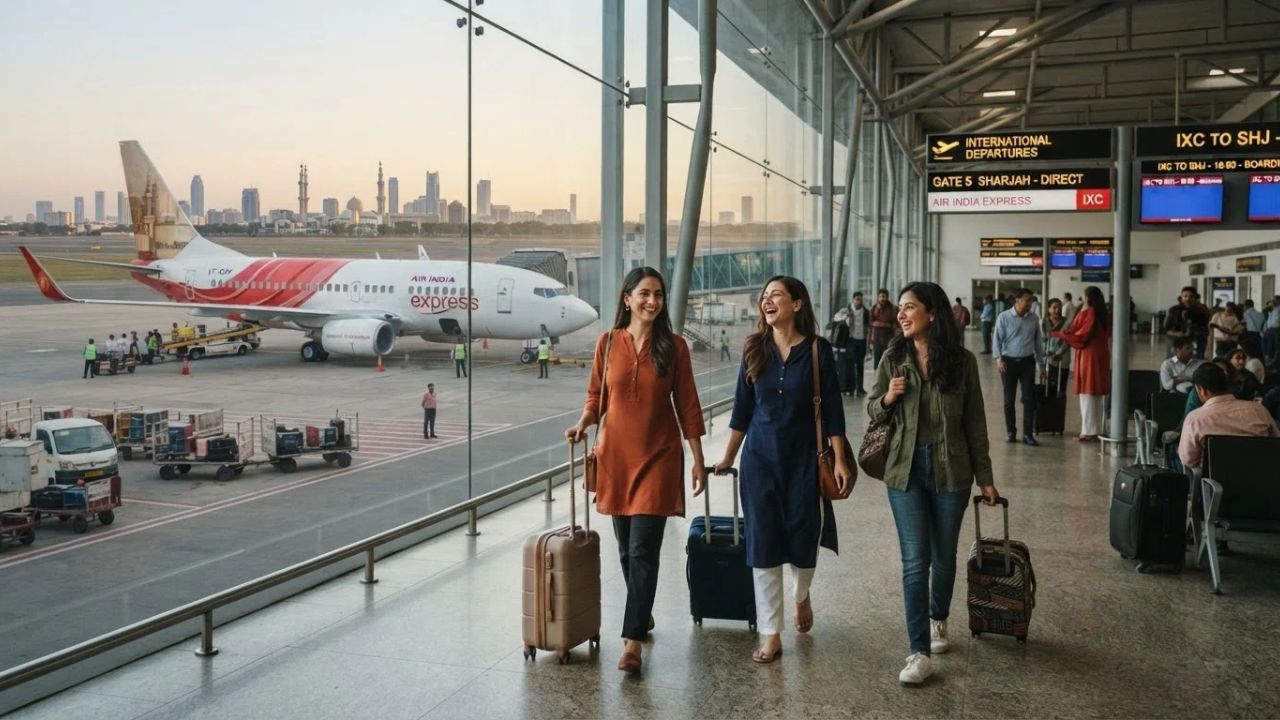
Direct air links between Chandigarh and Sharjah eliminate multi-hour road commutes to Delhi, opening seamless winter journeys across northern India and the Gulf
For nearly two years, travelers departing the agricultural plains of Punjab and Haryana had to endure a grueling 250-kilometer, five-hour highway crawl along National Highway 44 just to reach Delhi’s congested departure gates before flying to the Arabian Gulf. Beginning October 26, 2026, that grueling transit bottleneck finally ends as Air India Express officially restores its direct non-stop air service connecting Chandigarh with Sharjah. Operating four weekly flights from Shaheed Bhagat Singh International Airport, also known as Mohali Airport, under the airline's winter flight schedule, the route becomes only the third international service operating from the northern hub, cutting door-to-door journey times in half for thousands of passengers across northern India.
This reinstated aviation corridor represents far more than an operational timetable adjustment. For decades, northern Indian international travel has remained heavily centralized around Delhi’s Indira Gandhi International Airport, forcing families, elderly retirees, and diaspora workers into exhausting pre-flight road journeys through dense winter fog and expressway gridlock. By restoring a direct international runway link, this revival decentralizes Indian aviation while establishing a direct cultural bridge between two of the most intriguing, deliberately designed urban experiments in Asia: Le Corbusier’s modernist City Beautiful in Punjab and the UAE’s recognized capital of Arab heritage and fine arts.
Beyond the Delhi Transit Trap: The Strategic Revival of Route IXC–SHJ
The suspension of direct flights between Chandigarh and Sharjah nearly two years ago left a conspicuous void across northern India's air travel network. Shaheed Bhagat Singh International Airport serves as the natural aviation focal point not merely for Chandigarh itself, but for an extensive hinterland spanning Punjab, Haryana, Himachal Pradesh, and western Uttar Pradesh. Without direct flights, passengers had no choice but to book multi-segment domestic connections with prolonged layovers or embark on overnight highway taxi rides to Delhi.
The return of Air India Express on October 26, 2026, with four weekly non-stop flights provides an immediate logistical solution. Sharjah International Airport has long functioned as a remarkably user-friendly entry point into the United Arab Emirates. Unlike the immense terminal concourses of Dubai International, where taxi times can stretch past twenty minutes and terminal walks can span kilometers, Sharjah’s single-terminal layout enables arriving flyers to clear immigration, collect luggage, and reach highway exits in a fraction of the time.
For regional business travelers, independent voyagers, and the substantial Punjabi expatriate community working across the northern emirates, the non-stop link restores vital flexibility. Travelers can board an evening flight in Mohali and arrive in Sharjah ready to access meetings in Ajman, downtown Dubai, or Sharjah's industrial and creative districts via the Sheikh Mohammed Bin Zayed Road corridor, bypassing the chronic bottleneck of transiting secondary domestic airports.
What Makes Chandigarh and Sharjah Complementary Cultural Capitals
While standard commercial brochures treat this route purely as a diaspora transit channel, experienced cultural travelers recognize it as an extraordinary shortcut between two architectural masterworks that approached urban planning from opposite philosophical poles.
In northern India, Chandigarh stands as the twentieth century’s boldest modernist urban experiment. Commissioned after the 1947 Partition by Prime Minister Jawaharlal Nehru to symbolize a forward-looking, unburdened India, the city was planned by Swiss-French architectural visionary Le Corbusier. Divided into a precise geometric grid of self-contained sectors, the city deliberately excluded high-rise commercial clutter. The Capitol Complex, recognized by the UNESCO World Heritage Centre, displays Le Corbusier’s raw concrete monuments: the Secretariat, the Legislative Assembly, the High Court, and the iconic Open Hand Monument set against the distant blue backdrop of the Shivalik Hills. Down the road, Nek Chand’s Rock Garden showcases an astounding labyrinth of courtyards, waterfalls, and folk sculptures built entirely from industrial waste, broken ceramic chinaware, and discarded electrical fittings.
Across the Arabian Sea, Sharjah presents an equally profound commitment to cultural preservation. While neighboring Gulf cities pursued glass-and-steel skyscrapers, Sharjah focused on historical memory, earning recognition from UNESCO as the Cultural Capital of the Arab World. Under initiatives promoted by the Sharjah Commerce and Tourism Development Authority, the emirate meticulously restored the Heart of Sharjah, a heritage district built from coral stone and teakwood featuring wind towers known as barjeel that cooled courtyard homes centuries before modern air conditioning. Travelers can browse the fragrant frankincense stalls of Souq Al Arsah, inspect Islamic scientific manuscripts at the Sharjah Museum of Islamic Civilization along Khalid Lagoon, or experience contemporary indoor rain installations at the Al Murabba-based Rain Room managed by the Sharjah Art Foundation.
Connecting these two cities creates a compelling itinerary that bridges Le Corbusier’s cast-concrete modernist geometry with classical coral-stone Islamic architecture, united by warm local hospitality and rich culinary heritage.
Visitor Insider Tips
Navigating both ends of this route with ease requires localized practical knowledge:
- Timing the Mohali Departure: Shaheed Bhagat Singh International Airport is compact and well-organized compared to major metropolitan gateways. Arriving two hours before departure is generally sufficient for international check-in. If traveling between December and January, check daily flight trackers early in the morning, as seasonal northern Indian agricultural mist can occasionally delay operations until midday warmth clears the tarmac.
- Inter-Emirate Highway Strategy: When landing at Sharjah with plans to stay in Dubai, avoid taking taxis across the border between 7:30 AM and 9:30 AM on weekdays, when commuter traffic along the Al Ittihad Road corridor slows to a standstill. Instead, request routes utilizing Emirates Road or bypass traffic by taking a short taxi ride to the Stadium or Al Nahda stations of the Dubai Metro.
- Tasting Chandigarh's Authentic Food Trails: Avoid tourist-heavy dining centers and head directly to legacy establishments in Sector 28 and Sector 35. Sample slow-simmered dal makhani, charred tandoori chicken, and crisp Amritsari kulchas slathered with freshly churned white butter. In the evening, take a quiet walk along the pedestrian promenade of Sector 17 Plaza, where generations of locals gather for hot roasted corn and masala chai.
- Navigating the Heart of Sharjah: Schedule your exploration of Sharjah’s heritage quarter after 4:30 PM, when temperatures cool and the coral-stone lanes come alive with local families. Stop at traditional cafes along the waterfront to sip cardamom-scented gahwa accompanied by date syrup and fresh luqaimat dumplings.
- Low-Cost Airline Luggage Rules: Air India Express enforces strict baggage limits on value fares. Pre-book your checked allowance online at least twenty-four hours before flight time to avoid steep excess charges at the airport, especially if transporting Punjabi brassware, woolen textiles, or Gulf dates and perfumes.
Cultural and Environmental Context
The re-establishment of direct regional aviation routes carries significant environmental and social benefits. Routing northern Indian passengers directly out of Chandigarh removes thousands of private cars, diesel taxis, and intercity buses from the crowded National Highway 44 corridor each month. Bypassing Delhi's highway approaches directly reduces carbon emissions and relieves severe vehicular congestion, providing a tangible benefit during winter months when northern India experiences heightened atmospheric inversion.
Socially, the direct flight preserves community dignity and family cohesion. The vast diaspora of workers and families from rural Punjab and Haryana who maintain the infrastructure and services of the Gulf often travel with young children or elderly parents. Sparing these travelers the physical exhaustion of changing terminals at chaotic mega-hubs transforms an arduous journey into an accessible, dignified family transit.
Furthermore, both Chandigarh and Sharjah share a commitment to controlled, human-scale urbanism. Chandigarh’s extensive tree-lined sector system incorporates protected green belts and community parks that buffer residents from urban heat. In Sharjah, strict zoning laws protect historic coastal neighborhoods from commercial demolition, demonstrating how modern Arab communities can honor their maritime history while participating in the global cultural exchange.
FAQ: Visiting Chandigarh and Sharjah 2026
When do direct Air India Express flights between Chandigarh and Sharjah resume? Direct non-stop flights will officially resume on October 26, 2026, operating four times per week as part of Air India Express's winter schedule.
How far is Sharjah International Airport from central Dubai? Sharjah Airport is located approximately 15 kilometers northeast of Sharjah city center and roughly 30 kilometers from Downtown Dubai, reachable in thirty to forty-five minutes outside peak traffic hours.
What architectural landmarks should I visit during a stay in Chandigarh? Prioritize Le Corbusier's Capitol Complex in Sector 1, the Open Hand Monument, the Government Museum and Art Gallery in Sector 10, and Nek Chand's Rock Garden.
Do Indian passport holders need a visa to visit Sharjah? Yes. Indian citizens traveling to Sharjah require a valid UAE tourist visa obtained online prior to departure, or an eligible US, UK, or EU visa/residence permit to qualify for a visa-on-arrival at immigration.
When regional runways open direct paths across continents, travel sheds its transit fatigue and returns to what it was always meant to be: a seamless encounter between distinct human cultures.
Related Travel Guides
- Echoes of Runway 13: How Kai Tak’s Rebirth and Cathay’s 80-Year Milestone Reveal Hong Kong’s Living Neighborhood Soul
- Wings Over Continents: How Emirates’ Eleven ATM 2026 Partnerships Are Reshaping Global Cultural Corridors
- From Savoy Arcades to Sunlit Turia: How Wizz Air’s New Turin Base Unlocks Valencia and Beyond
Disclaimer
This article is for informational and educational purposes only. It does not constitute legal, financial, or professional advice. While we strive to provide accurate and up-to-date information, travel policies, regulations, and conditions change rapidly. Always verify information with official sources before making travel decisions. Nomad Lawyer makes no representations about the accuracy, reliability, completeness, or suitability of the information provided. Readers should consult qualified professionals for advice specific to their circumstances. The views expressed in this article are those of the author and do not necessarily reflect the views of Nomad Lawyer.
Raushan Kumar
Founder & Lead Developer
Full-stack developer with 11+ years of experience and a passionate traveller. Raushan built Nomad Lawyer from the ground up with a vision to create the best travel and law experience on the web.
Learn more about our team →