
Boston Logan Airport (BOS) Departures Guide 2026: Terminals, Security Timing, and Lounge Access
Boston Logan International Airport (BOS) operates four passenger terminals — A, B, C, and E, with Terminal D non-existent — where Terminals A, B, and C handle domestic and Canadian routes and Terminal E serves all international departures, with minimum recommended arrival times of two hours for domestic and three hours for international flights during the 5:30 a.m. to 8:00 a.m. peak.

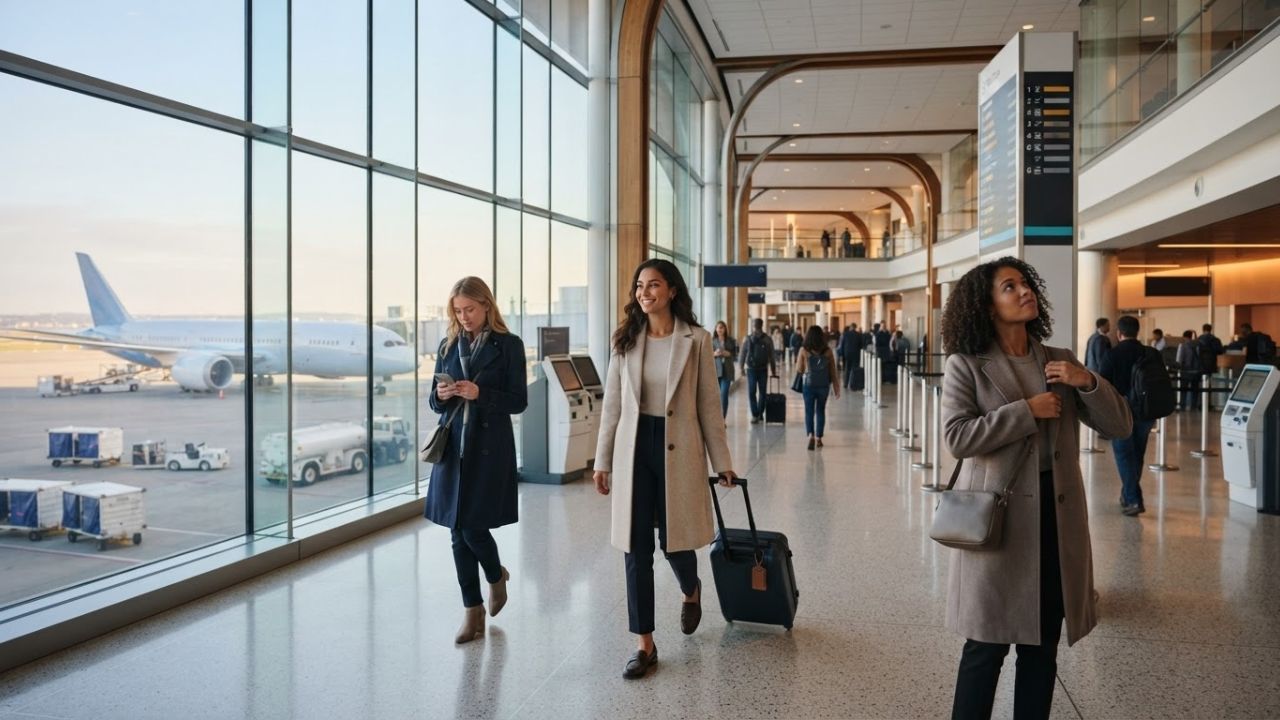
Image generated by AI
Boston Logan International Airport (BOS) runs four active passenger terminals — A, B, C, and E — and the absence of a Terminal D is not a typo: it simply does not exist, a fact that catches first-time travellers off guard when scanning departure boards. Arrive during the early morning peak between 5:30 a.m. and 8:00 a.m. without understanding how Logan's terminal structure, security checkpoint options, and lounge access work, and the stress of New England's busiest air hub arrives before your flight does.
Boston Logan's Four Terminals: Which One Handles Your Route
The starting point for any Logan departure is terminal identification, because the airport's four buildings are not interchangeable. Terminals A, B, and C collectively handle domestic flights and routes to Canada. Terminal E is dedicated to international departures — every flight leaving Logan for a destination outside the United States and Canada departs from this terminal.
There is no Terminal D at Boston Logan. The lettering jumps directly from C to E, and no physical building or signage for a Terminal D exists anywhere in the airport. Travellers who see references to all five letters in general airport guides elsewhere are reading outdated or incorrect information.
Digital signage at the airport's vehicle drop-off and pedestrian entry points directs passengers to the correct terminal based on their airline and destination. Before arriving at Logan — particularly during busy periods — confirming your terminal assignment through your airline's app or booking confirmation avoids the most common navigational mistake at BOS.
Getting Between Terminals: Airside Links, Walkways, and the Massport Shuttle
Moving between terminals at Logan is not as straightforward as some passengers assume. Enclosed walkways connect certain areas, and an airside link exists between Terminal B and Terminal C — meaning passengers on connecting itineraries between airlines operating from those two buildings can sometimes move directly without exiting security. However, this connection is not universal across all concourse sections.
Any transfer requiring a move between terminals that are not connected airside — including any journey involving Terminal E — requires leaving the secure side of the airport, relocating to the destination terminal via the Massport shuttle bus (which operates landside, outside security), and undergoing a fresh security screening at the new terminal's checkpoint.
Travellers on connecting itineraries at Logan who need to change terminals should factor this re-screening time into their connection window. A 45-minute connection that looks adequate on paper can become extremely tight if it involves exiting security, riding the Massport shuttle, and clearing a busy checkpoint at the receiving terminal.
When to Arrive: The 5:30 a.m. to 8:00 a.m. Peak and What It Means for Your Timing
Logan's security checkpoints face their most intense demand during the early morning peak from 5:30 a.m. to 8:00 a.m., when business travellers and leisure passengers converge across Terminals A, B, and C simultaneously. During this window, security throughput can degrade significantly even with expedited screening programmes in operation.
Standard guidance for Boston Logan recommends:
- Domestic flights: arrive a minimum of two hours before departure
- International flights: arrive a minimum of three hours before departure
These are floor figures, not comfortable targets. During the morning peak, on peak-demand travel days such as Sunday evenings or the days surrounding major holidays, or during winter weather events — when ground delays, de-icing operations, and staffing challenges compound one another — these minimum buffers should be extended.
Midday and late-evening departures typically move at a noticeably more manageable pace. If schedule flexibility exists, booking flights that depart outside the morning peak reduces the probability of security-driven stress without requiring earlier wake times.
TSA PreCheck and CLEAR at BOS: Real-Time Wait Data Helps Choose Checkpoints
Boston Logan has TSA PreCheck and CLEAR lanes available across its terminal security infrastructure. TSA PreCheck streamlines the screening process for enrolled travellers — shoes stay on, laptops stay in bags, liquids stay packed — while CLEAR replaces document checking with biometric identity verification, allowing enrolled passengers to move directly to the screening equipment queue.
Both programmes are available at Logan, but their practical benefit depends on real-time checkpoint conditions. Wait times across Logan's checkpoints fluctuate based on staffing levels and incoming passenger volume, and the fastest checkpoint at 6:30 a.m. may not be the fastest checkpoint at 7:15 a.m.
Checking live wait time estimates through Logan's in-terminal information screens or through airline and airport apps before committing to a specific checkpoint within your terminal gives a data-driven basis for choosing the fastest available lane. This is a practical step that many experienced Logan travellers use systematically during the morning peak.
Logan's Lounge Network: Terminal A, B, C, and E Access Options in 2026
Boston Logan's lounge infrastructure is distributed across terminals, with each building offering different access options depending on airline status, credit card eligibility, and cabin class.
Terminal A hosts the Delta Sky Club, accessible to Delta SkyMiles Medallion members, Delta first class passengers on eligible fares, and holders of certain Delta co-branded credit cards.
Terminal B carries the heaviest lounge concentration at Logan. It houses the American Airlines Admirals Club, the United Club, and the Chase Sapphire Lounge by The Club — the last of which extends access to a broader traveller base through Chase Sapphire Reserve card membership rather than restricting entry to a single airline's elite tiers.
Terminals C and E each host airline-specific lounges serving premium-cabin and eligible elite-status passengers on the carriers operating those terminals. The specific lounges vary by airline, and prospective visitors should verify current access policies directly with the relevant carrier or lounge operator before departure, as terms and operating hours change periodically.
Digital Check-In and the Shift Away from Physical Counters at BOS
Online check-in at Boston Logan opens 24 hours before departure across all major carriers operating at BOS, and using it has become the most effective single action for reducing time spent at the airport before departure.
Passengers who check in online and are travelling with carry-on bags only can proceed directly to security after arriving at the terminal, bypassing check-in counter queues entirely. For those travelling with checked luggage, many airlines now offer dedicated bag-drop lanes for pre-checked passengers that move significantly faster than full-service check-in queues.
The broader shift at Logan in 2026 is toward mobile-first airport operations. Boarding passes via phone or watch, real-time gate notifications, and delay alerts through airline apps have reduced reliance on physical check-in infrastructure at all four terminals. International departures from Terminal E retain document verification requirements — passport checks, destination entry requirement confirmation — that cannot be bypassed digitally, but even these processes have been streamlined compared to earlier years through pre-screening document upload systems on certain routes.
Why This Guide Matters for Travellers Departing BOS in 2026
For the traveller departing Logan — whether on a Boston–New York shuttle or a Terminal E flight to London or Lisbon — the operational details above translate into specific choices that determine whether the airport experience is controlled or chaotic.
Knowing that Terminal D does not exist eliminates one category of confusion. Knowing that the morning peak at BOS runs from 5:30 a.m. to 8:00 a.m. converts "arrive early" from vague advice into an actionable threshold. Knowing that Terminal B carries three distinct lounges — including one accessible via credit card — means business and frequent travellers can plan pre-flight comfort without defaulting to their primary airline's programme.
Logan serves the entire New England region, and its terminal infrastructure reflects decades of expansion layered over an original design that was not conceived for modern passenger volumes. Understanding the layout, the timing pressures, and the tools available at BOS turns the airport from an obstacle into a manageable transit point.
FAQ: Boston Logan Airport BOS Departures 2026
How many terminals does Boston Logan Airport have? Boston Logan International Airport (BOS) has four active passenger terminals: A, B, C, and E. Terminal D does not exist. Terminals A, B, and C handle domestic and Canadian routes; Terminal E handles all international departures.
How early should I arrive at Boston Logan for a domestic flight? The minimum recommended arrival time for domestic flights at Boston Logan is two hours before departure. During the early morning peak from 5:30 a.m. to 8:00 a.m., earlier arrival is strongly advisable to account for security congestion.
Which terminal handles international flights at Boston Logan? Terminal E at Boston Logan International Airport is dedicated to international departures. All flights leaving BOS for destinations outside the United States and Canada depart from Terminal E.
What lounges are available in Terminal B at Boston Logan? Terminal B at Boston Logan hosts three lounges: the American Airlines Admirals Club, the United Club, and the Chase Sapphire Lounge by The Club, the last of which offers access to Chase Sapphire Reserve cardholders beyond a single airline's elite programme.
Related Travel Guides
Disclaimer
This article is for informational and educational purposes only. It does not constitute legal, financial, or professional advice. While we strive to provide accurate and up-to-date information, travel policies, regulations, and conditions change rapidly. Always verify information with official sources before making travel decisions. Nomad Lawyer makes no representations about the accuracy, reliability, completeness, or suitability of the information provided. Readers should consult qualified professionals for advice specific to their circumstances. The views expressed in this article are those of the author and do not necessarily reflect the views of Nomad Lawyer.
Raushan Kumar
Founder & Lead Developer
Full-stack developer with 11+ years of experience and a passionate traveller. Raushan built Nomad Lawyer from the ground up with a vision to create the best travel and law experience on the web.
Learn more about our team →