
India Duty-Free Allowance 2026: Customs Rules, Limits, and Airport Clearance Guide
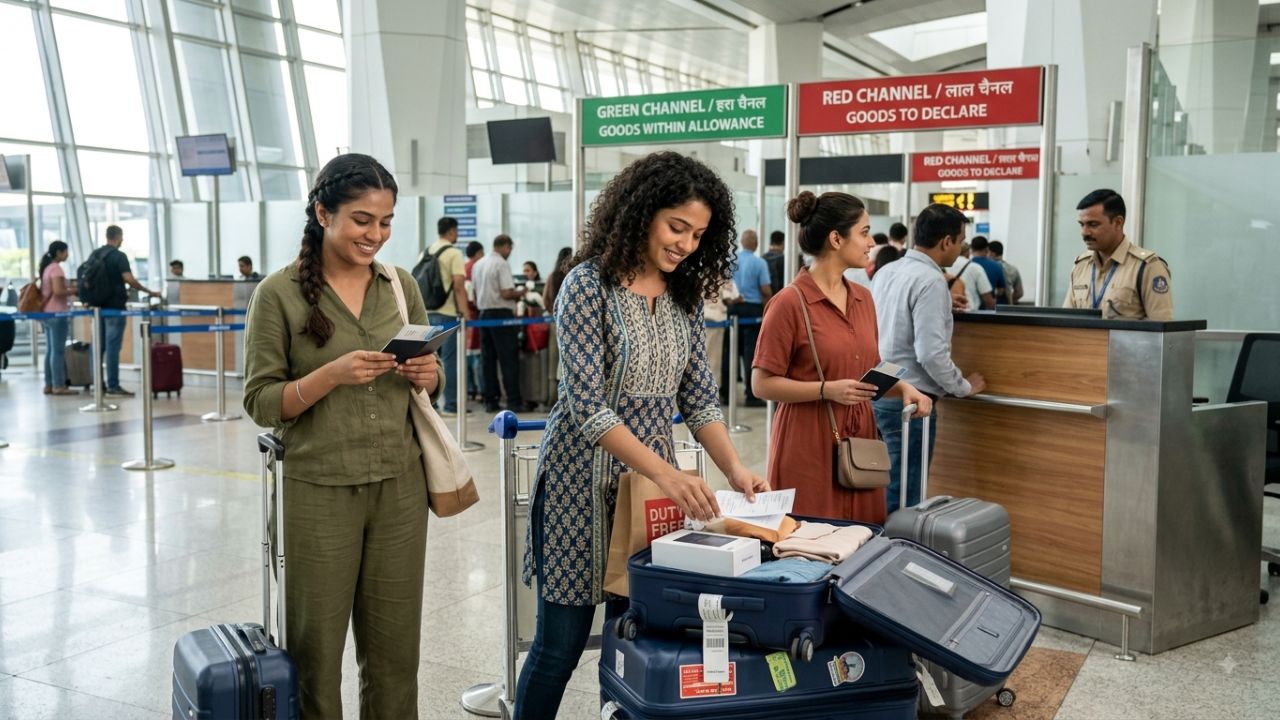
Image generated by AI
India's duty-free allowance increased from Rs 50,000 to Rs 75,000 under the Customs Baggage Rules 2026 — a change that directly reduces clearance friction for the majority of returning residents, NRIs, and OCI cardholders arriving at Indian international airports.
What the Customs Baggage Rules 2026 Actually Set as Your Limit
The governing framework for everything you carry into India is the Customs Baggage Rules 2026. These rules regulate which goods cross the border freely, which require declaration, and which are prohibited outright. Understanding exactly where your items sit in that hierarchy is the difference between walking out of arrivals in minutes and spending an hour at a duty counter.
Under the current 2026 regulations, the general duty-free allowance is set at:
- Rs 75,000 — for Indian residents, Non-Resident Indians (NRIs), Overseas Citizen of India (OCI) cardholders, and foreigners on non-tourist visas
- Rs 25,000 — for foreign tourists
The increase from the previous Rs 50,000 threshold to Rs 75,000 reflects rising global purchasing power and the higher cost of common consumer goods. It also materially reduces the number of passengers who previously fell into a grey zone on legitimate personal purchases.
Three rules about these limits that travellers routinely get wrong:
- The allowance applies to new items — gifts, electronics, clothing purchased abroad. Used personal effects (clothes you are wearing, a laptop you have been using for work) are typically exempt and do not count toward the value ceiling.
- Allowances are strictly individual. You cannot pool your Rs 75,000 with a travelling companion's Rs 75,000 to bring in a single high-value item jointly.
- Combining allowances to justify one expensive purchase is prohibited under the rules, regardless of the number of people travelling together.
The Green Channel and the Red Channel — Choosing Correctly
Every international arrival terminal in India operates a dual-channel clearance system. The channel you walk through is a formal customs declaration.
The Green Channel is for passengers whose total dutiable goods fall within the applicable duty-free limit and who are carrying no restricted or prohibited items. Note: even passengers using the Green Channel must deposit the customs portion of their disembarkation card with officials before leaving the terminal. Not doing so is a procedural violation regardless of what you are carrying.
The Red Channel is mandatory if you are carrying goods that exceed your duty-free allowance, restricted items, or anything that falls into a commercial category. Using the Red Channel is not a problem — it is the correct and lawful process for declaring goods and paying applicable duties. Customs officers will assess and process your items.
The critical point: walking through the Green Channel while carrying undeclared dutiable or restricted goods is a formal offence under Indian law. The consequences include heavy financial penalties, potential prosecution, and complete confiscation of the undeclared items. If you are uncertain, use the Red Channel.
Specific Category Limits Within the Allowance
Several categories have their own precise limits that operate independently of — or within — the general duty-free threshold:
Alcohol
You may bring up to 2 litres of liquor or wine duty-free. This limit is fixed regardless of your general allowance value.
Tobacco
The limit is 100 cigarettes, or 25 cigars, or 125 grams of tobacco — one of these options, not combinations.
Gold Jewellery
This is the category that catches the most returning travellers off guard.
- Women who have been residing abroad for over one year may bring 40 grams of gold jewellery duty-free
- Men who have been residing abroad for over one year may bring 20 grams of gold jewellery duty-free
- The one-year abroad residency period is a qualifying condition, not an assumption — you need to have genuinely been away for that duration
- Gold bars — regardless of weight, quantity, or the traveller's residency status — are always subject to import duty. There is no duty-free allowance for gold in bar form
Prohibited Items
The following are banned entirely and enforced without exception at Indian airport security:
- Narcotics and illegal drugs
- Firearms, weapons, and ammunition
- Commercial quantities of goods (items that suggest resale rather than personal use)
- Currency imports beyond the prescribed limits — Indian Rupee import has specific caps that should be verified against the latest Reserve Bank of India guidelines before travel
What the General Rs 75,000 Allowance Covers — and What It Does Not
The Rs 75,000 figure covers new goods purchased abroad for personal use: electronics, clothing, gifts, cosmetics, and similar consumer items that you are bringing in for yourself or as genuine personal gifts. It does not cover:
- Items intended for commercial resale or distribution
- Goods in quantities that suggest trade rather than personal use
- Categories with their own specific limits (gold, alcohol, tobacco), which are governed by their individual rules regardless of the general allowance
If you carry a new laptop, a camera, a watch, and several items of clothing, the combined new-purchase value of all of them together is what counts against the Rs 75,000 threshold — not each item individually. Used personal items that you have travelled with and are bringing back remain outside this calculation.
Visitor Insider Tips: Clearing Indian Customs Without Trouble
Keep new item receipts separate and accessible: Indian customs officers may ask for proof of purchase value on electronics, jewellery, or high-value goods. Store receipts in a folder or your phone's photo library, organised by item, before you fly — not buried in a bag or checked luggage.
Declare gold jewellery if you are over the limit: The gold jewellery rules are enforced. If you are wearing gold jewellery that exceeds the applicable weight threshold (40g for women, 20g for men after a year abroad), declare it. The penalty for non-declaration at the Red Channel is disproportionately higher than the duty itself.
Disembarkation card — do not skip the customs section: Many passengers complete the immigration portion of the disembarkation card and assume they are done. The customs declaration section must be completed and surrendered before you exit, even if you are using the Green Channel.
Major airports with dedicated customs lanes for NRIs: Chennai, Mumbai (CSIA), Delhi (IGI), and Bengaluru (KIA) all have specific customs assistance desks during peak international arrival windows. If you are arriving during a high-volume period (overnight flights from the Gulf, early morning arrivals from Europe), asking at the customs desk rather than guessing your channel avoids preventable delays.
Currency declaration above USD 5,000: If you are carrying foreign currency or a combination of foreign and Indian currency equivalent to or exceeding USD 5,000 in cash (or USD 10,000 in total monetary instruments), you are required to declare it on the currency declaration form at the Red Channel. This threshold is separate from the duty-free goods allowance.
Check CBIC before you fly: The Central Board of Indirect Taxes and Customs (CBIC) at cbic.gov.in publishes the current baggage rules in English. For any item category you are uncertain about, it is the authoritative source — more reliable than third-party summaries that may reflect older rule sets.
Tourism Outlook: Why the Rs 75,000 Threshold Matters for Inbound Travel
The increase from Rs 50,000 to Rs 75,000 is not simply an administrative adjustment. It reflects a deliberate policy signal: India is aligning its customs framework with the economic reality of modern international travel, where the cost of common consumer goods — electronics, quality clothing, personal care products — has risen significantly since the previous limit was set.
For the Indian diaspora and frequent international visitors, a higher duty-free threshold reduces the friction of bringing gifts, personal items, and modest consumer purchases without triggering formal duties. It also reduces the administrative burden at customs counters and shortens clearance times at major international gateways.
For inbound foreign tourists — whose Rs 25,000 limit is considerably lower — the rules remain restrictive on new goods. Most genuine tourists carrying personal travel items rather than shopping consignments will not approach that figure, but it is worth being aware of if you plan significant retail purchases during your India visit and are considering bringing items home rather than shipping them.
The Central Board of Indirect Taxes and Customs (CBIC), which administers these regulations, continues to update the Customs Baggage Rules as trade patterns and consumer pricing evolve. Checking the current published rules before departure — particularly for gold, electronic equipment, and currency — is the single most effective preparation any international traveller can make before landing in India.
FAQ: India Customs and Duty-Free Allowance 2026
What is the duty-free allowance for Indians returning from abroad in 2026? Under the Customs Baggage Rules 2026, Indian residents, NRIs, and OCI cardholders may bring goods worth up to Rs 75,000 duty-free. Foreign tourists have a lower limit of Rs 25,000. Used personal effects are generally exempt from this value calculation.
How much gold jewellery can I bring into India duty-free? Residents who have been living abroad for over one year may bring 40 grams (women) or 20 grams (men) of gold jewellery duty-free. Gold bars are always subject to import duty with no exemption, regardless of weight or residency duration.
What happens if I use the Green Channel with undeclared goods? Using the Green Channel while carrying undeclared dutiable or restricted goods is a formal legal offence. Penalties include heavy financial fines, potential prosecution, and complete confiscation of the undeclared items. When in doubt, always use the Red Channel.
Related Travel Guides
India Airline Baggage Rules 2026: How to Avoid Heavy Fees and Fly Smarter
TSA-Approved Airport Security Packing Hacks 2026
India Customs Gold Import Rules and NRI Allowances Explained 2026
Disclaimer
This article is for informational and educational purposes only. It does not constitute legal, financial, or professional advice. While we strive to provide accurate and up-to-date information, travel policies, regulations, and conditions change rapidly. Always verify information with official sources before making travel decisions. Nomad Lawyer makes no representations about the accuracy, reliability, completeness, or suitability of the information provided. Readers should consult qualified professionals for advice specific to their circumstances. The views expressed in this article are those of the author and do not necessarily reflect the views of Nomad Lawyer.