
Asia Aviation Disruption: 5,081 Delays, 277 Cancellations Across Shanghai, Dubai, and Hanoi
A cascading aviation disruption hits Asia with 5,081 delays and 277 cancellations as weather, Bangkok flood recovery, and Middle East route adjustments strain major hubs.

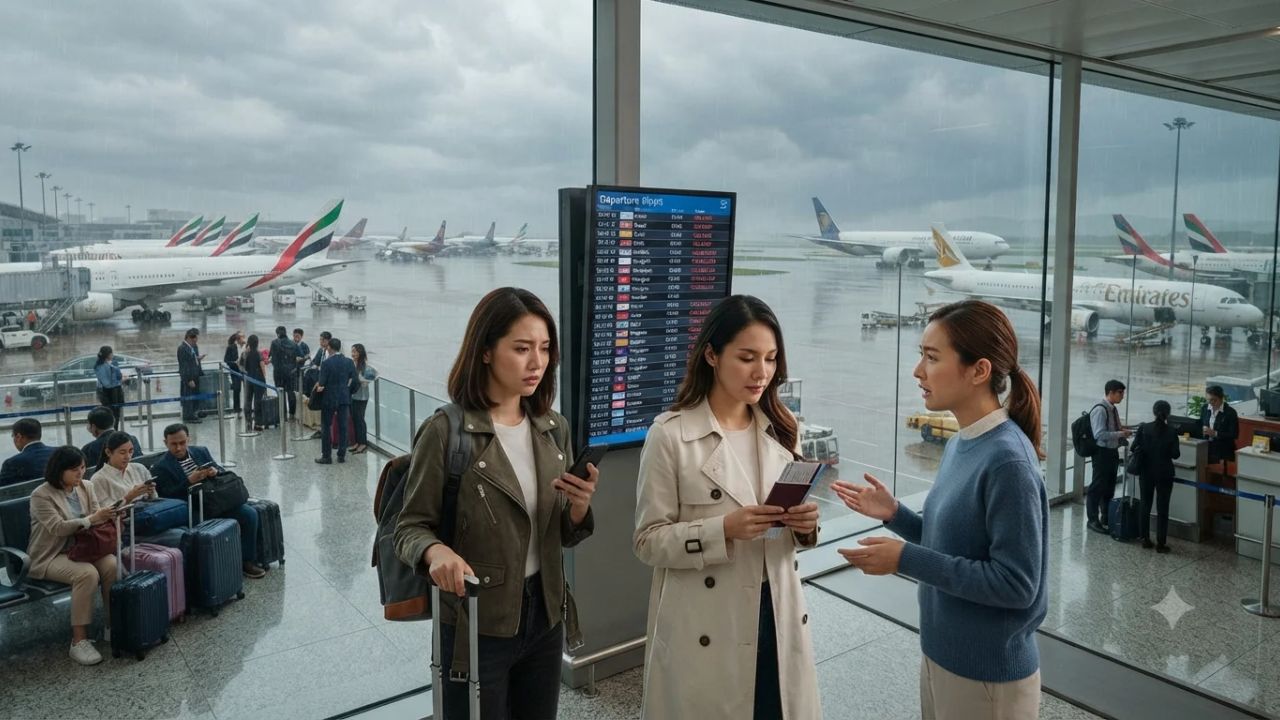
Shanghai Pudong International Airport recorded 333 flight delays in a single operational window while Dubai International logged 24 cancellations—the highest single-airport cancellation total across the continent—as a wave of 5,081 delays and 277 cancellations swept across Asian aviation hubs. According to live tracking logs compiled across regional airspace, intense convective monsoon weather in Southeast Asia, localized road flooding recovery around Bangkok Suvarnabhumi, and Middle Eastern airspace reroutings triggered widespread network bottlenecks.
From East Asia’s dense domestic corridors to the transcontinental connecting megahubs of the Arabian Gulf, airlines including China Southern (410 delays), China Eastern (394 delays), IndiGo (353 delays), and Air China (33 cancellations) faced severe crew scheduling timeouts and rotational delays that cascaded across multiple connecting sectors.
Hub-by-Hub Disruption Analysis: East Asia, Southeast Asia, India, and the Gulf
The operational strain was heavily distributed across primary passenger transit gateways. In mainland China, Shanghai’s dual hubs absorbed 463 combined delays (333 at Pudong and 130 at Hongqiao), while Beijing Capital logged 108 delays and 17 cancellations alongside Beijing Daxing's 124 delays and nine cancellations. Granular data recorded by FlightAware revealed acute regional disruptions at Kunming Changshui (128 delays), Chengdu Tianfu (112 delays), Changsha Huanghua (105 delays), Xi’an Xianyang (97 delays), and Zunyi, where 31% of origin departures were cancelled.
In Southeast Asia, Tan Son Nhat in Ho Chi Minh City led regional disruption with 269 delays and 10 cancellations, followed by Jakarta Soekarno-Hatta (238 delays, 14 cancellations) and Hanoi Noi Bai (176 delays, 6 cancellations). In Thailand, Suvarnabhumi Airport recorded 208 delays and seven cancellations as authorities managed regional ground transport access following intense monsoon rains, prompting Thai Airways to cancel select flights between October 1 and 3.
| Airport Hub & Country | IATA Code | Delays Recorded | Cancellations Recorded | Cancellation Percentage Rate | Primary Operational Factor |
|---|---|---|---|---|---|
| Shanghai Pudong (China) | PVG | 333 Delays | 8 Cancellations | 0% Orig / 0% Dest | Peak traffic density & convective weather |
| Tan Son Nhat Ho Chi Minh (Vietnam) | SGN | 269 Delays | 10 Cancellations | 0% Orig / 1% Dest | Heavy seasonal rainfall & terminal flow |
| King Khalid Riyadh (Saudi Arabia) | RUH | 250 Delays | 5 Cancellations | 0% Dest Cnl | Regional corridor schedule re-alignment |
| Jakarta Soekarno-Hatta (Indonesia) | CGK | 238 Delays | 14 Cancellations | 1% Orig Cnl | Tropical thunderstorms & slot holds |
| Indira Gandhi Delhi (India) | DEL | 233 Delays | 19 Cancellations | 1% Orig / 1% Dest | Air traffic density & rotational turn delays |
| Ben Gurion Tel Aviv (Israel) | TLV | 208 Delays | 17 Cancellations | 2% Orig / 2% Dest | Airspace corridors & security routing |
| Suvarnabhumi Bangkok (Thailand) | BKK | 208 Delays | 7 Cancellations | 0% Orig / 0% Dest | Monsoon flood recovery & surface access |
| Istanbul Airport (Türkiye) | IST | 190 Delays | 4 Cancellations | 0% Dest Cnl | Cross-continental connecting rotations |
| Dubai International (UAE) | DXB | 184 Delays | 24 Cancellations | 2% Orig / 2% Dest | Highest cancellation volume in dataset |
| Noi Bai Hanoi (Vietnam) | HAN | 176 Delays | 6 Cancellations | 0% Orig / 0% Dest | Convective weather in northern Gulf of Tonkin |
| King Abdulaziz Jeddah (Saudi Arabia) | JED | 171 Delays | 2 Cancellations | Minor impact | Regional transit adjustments |
| Singapore Changi (Singapore) | SIN | 168 Delays | 1 Cancellation | Minor impact | Inbound rotational arrival delays |
| Hong Kong International (Hong Kong) | HKG | 145 Delays | 1 Cancellation | Minor impact | Regional feeder schedule adjustments |
| Incheon International (South Korea) | ICN | 142 Delays | 2 Cancellations | Minor impact | Transpacific and East Asian turns |
| Beijing Daxing (China) | PKX | 124 Delays | 9 Cancellations | 0% Orig / 0% Dest | Domestic airway flow management |
| Hamad International Doha (Qatar) | DOH | 116 Delays | 1 Cancellation | Minor impact | Gulf transit bank schedule holds |
| Kempegowda Bengaluru (India) | BLR | 114 Delays | 5 Cancellations | 0% Orig / 0% Dest | South Indian regional weather & slots |
| Manila Ninoy Aquino (Philippines) | MNL | 111 Delays | 7 Cancellations | 1% Orig Cnl | Tropical rain bands & runway flow |
| Chhatrapati Shivaji Mumbai (India) | BOM | 107 Delays | 10 Cancellations | 1% Orig / 1% Dest | Coastal convective activity |
| Beijing Capital (China) | PEK | 108 Delays | 17 Cancellations | 1% Orig / 1% Dest | High-density airway slot control |
Across India, Delhi’s Indira Gandhi International recorded 233 delays and 19 cancellations, while Mumbai’s Chhatrapati Shivaji absorbed 107 delays and 10 cancellations, complemented by 23 delays and 11 cancellations (7% cancellation rate) at the new Navi Mumbai facility. In the Gulf, Dubai International recorded 184 delays and 24 cancellations, alongside Riyadh’s 250 delays and Jeddah’s 171 delays, reflecting ongoing flight path realignments across Middle Eastern airspace.
Airline Fleet Performance: Delays and Fleet Rotation Impacts
Carrier-level statistics highlight how operational friction at mega-terminals disrupts interconnected aircraft rotations. China Southern Airlines absorbed the highest delay volume with 410 delayed flights (15% of tracked operations), followed closely by China Eastern Airlines with 394 delays (14%) and 22 cancellations.
In South Asia, IndiGo logged 353 delayed flights (16% of operations), while Air China posted the highest cancellation volume among all Asian carriers with 33 cancelled flights (7% delay rate). Vietnam Airlines experienced substantial operational drag, logging 123 delays (28% of operations) and 10 cancellations.
| Airline Carrier | Country Base | Delays Recorded | Delay Share (%) | Cancellations Recorded | Cancellation Share (%) |
|---|---|---|---|---|---|
| China Southern Airlines | China | 410 Delays | 15% | 2 Cancellations | 0% (Rounded) |
| China Eastern Airlines | China | 394 Delays | 14% | 22 Cancellations | 0% (Rounded) |
| IndiGo | India | 353 Delays | 16% | 1 Cancellation | 0% (Rounded) |
| Saudia | Saudi Arabia | 151 Delays | 27% | 6 Cancellations | 1% |
| Air China | China | 145 Delays | 7% | 33 Cancellations | 1% (Highest Airline Total) |
| Vietnam Airlines | Vietnam | 123 Delays | 28% | 10 Cancellations | 2% |
| Shenzhen Airlines | China | 104 Delays | 12% | 3 Cancellations | 0% (Rounded) |
| Qatar Airways | Qatar | 99 Delays | 16% | 1 Cancellation | 0% (Rounded) |
| Spring Airlines | China | 95 Delays | 14% | 2 Cancellations | 0% (Rounded) |
| Air India | India | 82 Delays | 13% | 7 Cancellations | 1% |
| Hainan Airlines | China | 80 Delays | 9% | 3 Cancellations | 0% (Rounded) |
| Shanghai Airlines | China | 77 Delays | 21% | 4 Cancellations | 1% |
| Cathay Pacific | Hong Kong | 71 Delays | 16% | 1 Cancellation | 0% (Rounded) |
Passenger Strategies for Cross-Border Asian Transit
- Check Inbound Aircraft Tail Numbers via Flight Tracking Apps: Because aircraft fly multiple consecutive sectors per day, use digital flight trackers to monitor where your incoming plane is arriving from. An on-time departure from Hanoi or Bangkok often depends on whether the aircraft landed on schedule from its previous sector in Shanghai or Singapore.
- Allow Extra Ground Transfer Time in Bangkok: While Suvarnabhumi Airport remains fully operational, recent monsoon flooding has created intermittent surface road congestion on highway corridors leading into the terminal. The Tourism Authority of Thailand advises passengers to allow at least 3.5 hours for airport transit and check-in.
- Review Connection Windows on Separate Tickets: Travelers holding self-transfers or itineraries on separate tickets through hubs like Singapore Changi, Dubai, or Hong Kong risk losing non-refundable onward segments if their initial flight is delayed. Always maintain at least a three-hour transit buffer on unconnected tickets.
- Utilize Dedicated Airline Digital Rebooking Channels: When long-haul cancellations occur at high-density hubs like Dubai (DXB) or Shanghai (PVG), physical customer service desks develop lengthy queues. Access airline mobile apps or verified instant messaging channels (such as WhatsApp support for Gulf carriers or WeChat for Chinese airlines) for faster flight reassignments.
- Retain Receipts for Accommodation and Ground Transfers: Under international air transport guidelines established by Airports Council International Asia-Pacific, passengers experiencing overnight transit cancellations due to non-weather operational adjustments are entitled to airline-provided hotel vouchers and meal allowances.
Cultural and Environmental Context
The scale of flight delays across Asia illustrates the complex environmental pressures facing tropical and subtropical aviation infrastructure. During the autumn monsoon transition, localized tropical depressions generate high-altitude convective squall lines that force air traffic controllers to implement severe airway spacing restrictions.
To mitigate carbon intensity associated with prolonged airborne holding patterns, regional aviation authorities are deploying Collaborative Decision Making (A-CDM) systems. By coordinating real-time ground pushback times with en-route airspace slots across China, Southeast Asia, and India, airports reduce unnecessary taxiway engine idle times, conserving thousands of metric tons of jet fuel during regional disruption events.
FAQ: Asian Flight Disruptions October 2026
What caused the widespread flight disruptions across Asia today?
A combination of severe monsoon thunderstorms across Southeast and South Asia, localized ground flood recovery around Bangkok, and Middle Eastern airspace reroutings resulted in 5,081 delays and 277 cancellations.
Which Asian airport recorded the highest number of cancellations?
Dubai International Airport (DXB) recorded the highest cancellation count in the dataset with 24 cancellations, alongside 184 delays.
Is Bangkok Suvarnabhumi Airport operational following regional flooding?
Yes. Suvarnabhumi Airport is fully open and operating, though travelers should budget extra surface transit time to reach the airport due to localized road conditions.
What should passengers do if their flight is cancelled in Asia?
Check your airline's mobile app immediately for automated rebooking options before waiting in terminal queues, and confirm whether connecting flights on onward legs remain confirmed.
Across the interconnected flight corridors of Asia, real-time tracking, proactive rebooking, and travel flexibility remain essential when navigating dynamic seasonal weather.
Related Travel Guides
Disclaimer
This article is for informational and educational purposes only. It does not constitute legal, financial, or professional advice. While we strive to provide accurate and up-to-date information, travel policies, regulations, and conditions change rapidly. Always verify information with official sources before making travel decisions. Nomad Lawyer makes no representations about the accuracy, reliability, completeness, or suitability of the information provided. Readers should consult qualified professionals for advice specific to their circumstances. The views expressed in this article are those of the author and do not necessarily reflect the views of Nomad Lawyer.
Kunal K Choudhary
Co-Founder & Contributor
A passionate traveller and tech enthusiast. Kunal contributes to the vision and growth of Nomad Lawyer, bringing fresh perspectives and driving the community forward.
Learn more about our team →