
Asian Aviation Gridlock: Over 3,300 Flight Delays Strike Tokyo, Mumbai, and Bangkok Gateways

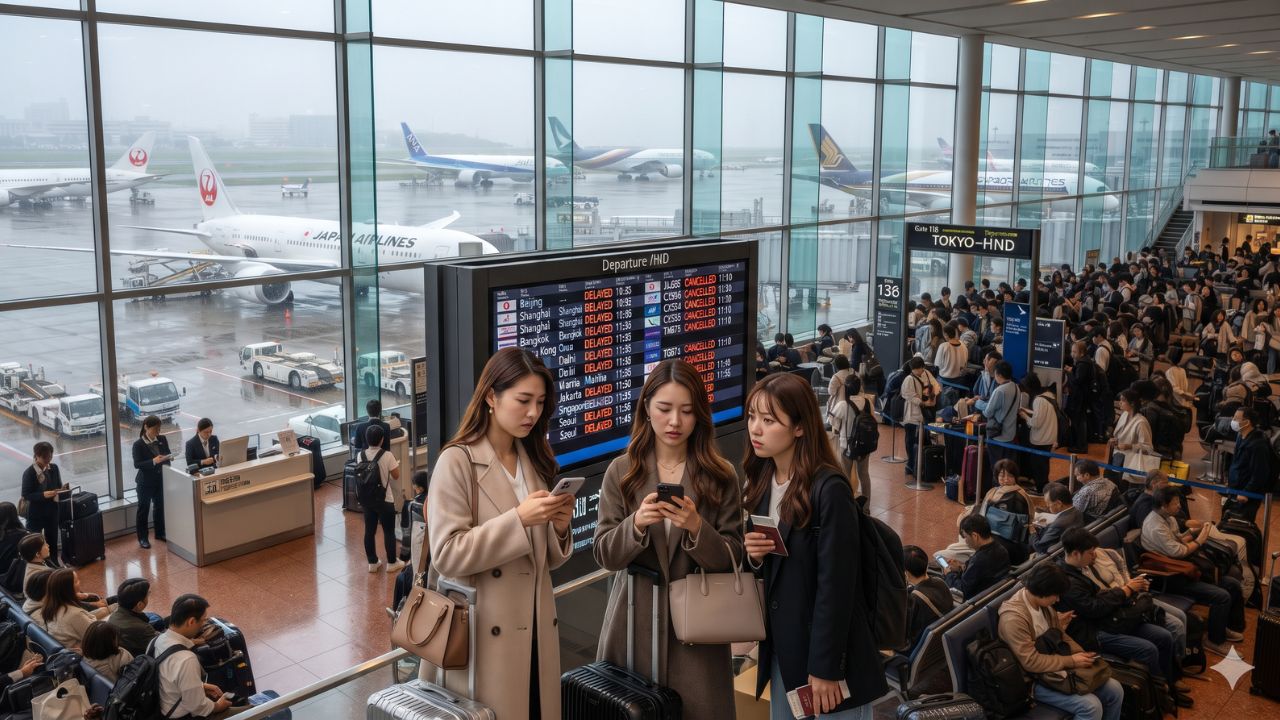
While India’s budget carrier SpiceJet grounded an astounding 40 percent of its tracked departures in a single day, market giant IndiGo absorbed 540 flight delays across domestic corridors, anchoring a massive continental slowdown that snarled travel for tens of thousands of passengers.
On 22 and 23 November 2026, aviation networks across Asia, the Middle East, and connecting Eurasian gateways experienced severe schedule deterioration. Real-time aviation tracking records compiled on 22 November at 1:39 PM Eastern Time (corresponding to 23 November at 12:09 AM Indian Standard Time) registered 3,345 delayed flights alongside 264 outright cancellations. From seasonal radiation fog across the Indo-Gangetic Plain to convective tropical thunderstorms over the Gulf of Thailand and air traffic slot metering across Japan and China, passengers navigating major transfer hubs faced multi-hour tarmac holds and missed international connections.
Regional Cascades Across South Asia, East Asia, and the Gulf
The operational strain fractured along clear geographic corridors. South Asia emerged as one of the most volatile operating environments, centered around India's primary metropolitan hubs. Chhatrapati Shivaji Maharaj International Airport in Mumbai led the subcontinent with 260 delays and 21 cancellations, while Indira Gandhi International Airport in Delhi logged 230 delays and 24 cancellations.
However, schedule erosion spread far beyond the primary metros: Bengaluru recorded 112 delays and 12 cancellations, Kolkata tallied 76 delays and 5 cancellations, while secondary and regional hubs including Navi Mumbai (38 delays, 6 cancellations), Jaipur (38 delays, 6 cancellations), Pune (36 delays, 10 cancellations), Kochi (32 delays, 4 cancellations), Calicut (8 delays, 7 cancellations), and Bagdogra (8 delays, 4 cancellations) suffered severe knock-on holds.
East Asia recorded the highest overall volume of airport delays, tallying 1,315 delayed flights and 99 cancellations across 21 monitored airfields. In Japan, Tokyo Haneda Airport recorded 233 delays and eight cancellations, while Narita registered 101 delays and five cancellations, with peripheral airports like Fukuoka (55 delays, 5 cancellations) and Kagoshima (27 delays, 5 cancellations) absorbing severe rotational delays. In mainland China and Hong Kong, Hong Kong International logged 139 delays and three cancellations, Guangzhou Baiyun recorded 117 delays and 10 cancellations, and Xi'an Xianyang logged 108 delays and five cancellations.
In Southeast Asia, 976 delays and 43 cancellations spread across eight airports. Bangkok’s Suvarnabhumi International Airport proved to be the region’s primary bottleneck, logging 256 delayed flights against four cancellations. Manila’s Ninoy Aquino International Airport followed with 186 delays and 17 cancellations, while Jakarta’s Soekarno-Hatta International Airport recorded 183 delays and six cancellations.
Comprehensive Matrix of Disrupted Hubs and Carrier Reliability
The following data matrix synthesizes flight tracking records captured across surveyed regional gateways.
| Aviation Gateway Hub | Geographic Region | Tracked Flight Delays | Tracked Flight Cancellations | Primary Operational Stress Factor |
|---|---|---|---|---|
| Mumbai (BOM) | South Asia (India) | 260 | 21 | Airspace congestion & rotational holds |
| Bangkok Suvarnabhumi (BKK) | Southeast Asia (Thailand) | 256 | 4 | Convective thunderstorms & gate spacing |
| Tokyo Haneda (HND) | East Asia (Japan) | 233 | 8 | Flow control & regional slot limits |
| Delhi (DEL) | South Asia (India) | 230 | 24 | Morning fog & visibility throttling |
| Manila Ninoy Aquino (MNL) | Southeast Asia (Philippines) | 186 | 17 | Severe weather diversions & equipment |
| Jakarta Soekarno-Hatta (CGK) | Southeast Asia (Indonesia) | 183 | 6 | Tropical squall lines & arrival holds |
| Hong Kong International (HKG) | East Asia (Hong Kong SAR) | 139 | 3 | Regional flow management delays |
| Hanoi Noi Bai (HAN) | Southeast Asia (Vietnam) | 136 | 3 | Terminal airspace traffic metering |
| Guangzhou Baiyun (CAN) | East Asia (China) | 117 | 10 | Air traffic routing restrictions |
| Bengaluru (BLR) | South Asia (India) | 112 | 12 | Downstream rotation delays from BOM/DEL |
| Jeddah King Abdulaziz (JED) | West Asia (Saudi Arabia) | 107 | 11 | International pilgrim charter banks |
| Tokyo Narita (NRT) | East Asia (Japan) | 101 | 5 | Crosswind runways & international banks |
| Kolkata (CCU) | South Asia (India) | 76 | 5 | Regional feeder aircraft delays |
| Riyadh King Khalid (RUH) | West Asia (Saudi Arabia) | 51 | 4 | Regional security & slot constraints |
| Moscow Vnukovo (VKO) | Eurasia (Russia) | 51 | 3 | De-icing procedures & winter holding |
Airline performance highlighted stark differences in operational resilience. In India, Akasa Air suffered 40 cancellations (16 percent of operations) and 42 delays (16 percent), while SpiceJet saw 29 cancellations (40 percent of its tracked schedule) and 15 delays (20 percent). By contrast, market leader IndiGo kept cancellations to seven (0 percent) but absorbed 540 delays, affecting 24 percent of its entire network.
In Southeast Asia, Thai Vietjet Air posted a 47 percent delay rate (76 flights delayed), while Malaysia Airlines experienced delays on 33 percent of operations (103 flights). In East Asia, China Eastern recorded 322 delays (13 percent) and 20 cancellations, while All Nippon Airways logged 108 delays (19 percent) and Japan Airlines posted 104 delays (13 percent).
In West Asia, Saudi Arabia recorded 165 delays and 20 cancellations across Jeddah, Riyadh, and Prince Naif Bin Abdulaziz Airport (7 delays, 5 cancellations). National carrier Saudia posted 58 delays and five cancellations, while Gulf carriers Emirates (75 delays), Qatar Airways (97 delays), flydubai (66 delays), and Turkish Airlines (198 delays) absorbed heavy schedule pushes.
Tactical Guidance for Transit Passengers Across Asian Hubs
Navigating complex flight schedules across these affected hubs demands strategic oversight:
- Protect Transfer Windows at Suvarnabhumi and Haneda: With Bangkok Suvarnabhumi recording 256 delays and Tokyo Haneda registering 233, connection buffers under two hours are perilous. If self-transferring between separate airline tickets or international-to-domestic terminals, allocate at least three and a half hours to account for immigration queues and baggage transfers.
- Track Inbound Aircraft Tail Numbers in India: If departing Mumbai, Delhi, or Bengaluru, do not rely on terminal departure screens, which often push departure times back incrementally in 20-minute increments. Instead, use live tracking tools to locate the physical inbound aircraft assigned to your flight number. If that airframe is stuck on a taxiway in Pune or Jaipur, you have immediate notice to explore alternative departures.
- Verify Overnight Vouchers and Rebooking Protocols: If an airline cancellation strands you overseas, approach the airline service desk before exiting customs to secure an official written cancellation certificate. Passengers traveling on international full-service carriers like Thai Airways, JAL, or Singapore Airlines are generally accommodated on subsequent partner flights, whereas budget operators often default to ticket refunds rather than overnight hotel vouchers.
- Carry Essential Medication in Cabin Baggage: With regional hubs recording elevated cancellation counts, checked baggage often remains locked in transit holding areas when flights are scrubbed. Always carry three days of personal prescription medicine, mobile chargers, and basic toiletries in your personal carry-on pack.
Meteorological Realities and Regional Airspace Friction
The simultaneous degradation of flight operations across five geographic zones illustrates the compounding nature of modern international aviation. Late November marks the onset of winter inversion fog across northern India and eastern China, where industrial particulate matter combines with cooling nocturnal air to slash runway visibility below standard instrument landing minimums.
Concurrently, intertropical convergence squalls across Southeast Asia force air traffic controllers to implement severe route deviations around Manila and the Java Sea, lengthening flight times and consuming aircraft fuel reserves. When high-density hub airports operate at 95 percent runway capacity, a 30-minute weather hold in Bangkok or Mumbai cascades downstream, creating missed crew rotations and grounding regional feeder services thousands of kilometers away.
Frequently Asked Questions
Which Asian airport recorded the highest number of flight delays?
Mumbai’s Chhatrapati Shivaji Maharaj International Airport (BOM) led the region with 260 delays, followed closely by Bangkok’s Suvarnabhumi Airport (BKK) with 256 delays and Tokyo Haneda (HND) with 233 delays.
Why did SpiceJet experience such a high cancellation rate?
SpiceJet suffered 29 flight cancellations, representing 40 percent of its tracked daily schedule, driven by aircraft rotation bottlenecks and operational constraints across regional Indian airports.
Are airlines required to provide hotel rooms for delayed flights in Asia?
Compensation depends on the operating carrier, ticket class, and local civil aviation regulations. Full-service airlines generally provide meal vouchers and hotel accommodations for prolonged overnight delays caused by operational issues, whereas low-cost carriers frequently restrict assistance to ticket rebooking or refunds.
Monitoring upstream aircraft movements and building generous layover buffers ensures that seasonal weather holds across Asian hubs do not unravel your international travel plans.
Related Travel Guides
This article is for informational purposes. Flight routes, passenger regulations, visa rules, and transit advisories are subject to change by airlines and aviation authorities. Readers are advised to verify schedules and travel documentation with relevant carriers and border agencies before departure.
Related Stories
Asian Aviation Gridlock: Over 7,400 Flight Delays Strike Tokyo, Delhi, and Regional Hubs

San Francisco SFO Weather Delays: 40 MPH Winds Trigger FAA Ground Stop and 658-Minute Holds
