
Argentina Aligns With Chile And More As Solar Train Transforms Sustainable Travel In The Andes
Argentina Aligns With Chile And More As Solar Train Transforms Sustainable Travel In The Andes

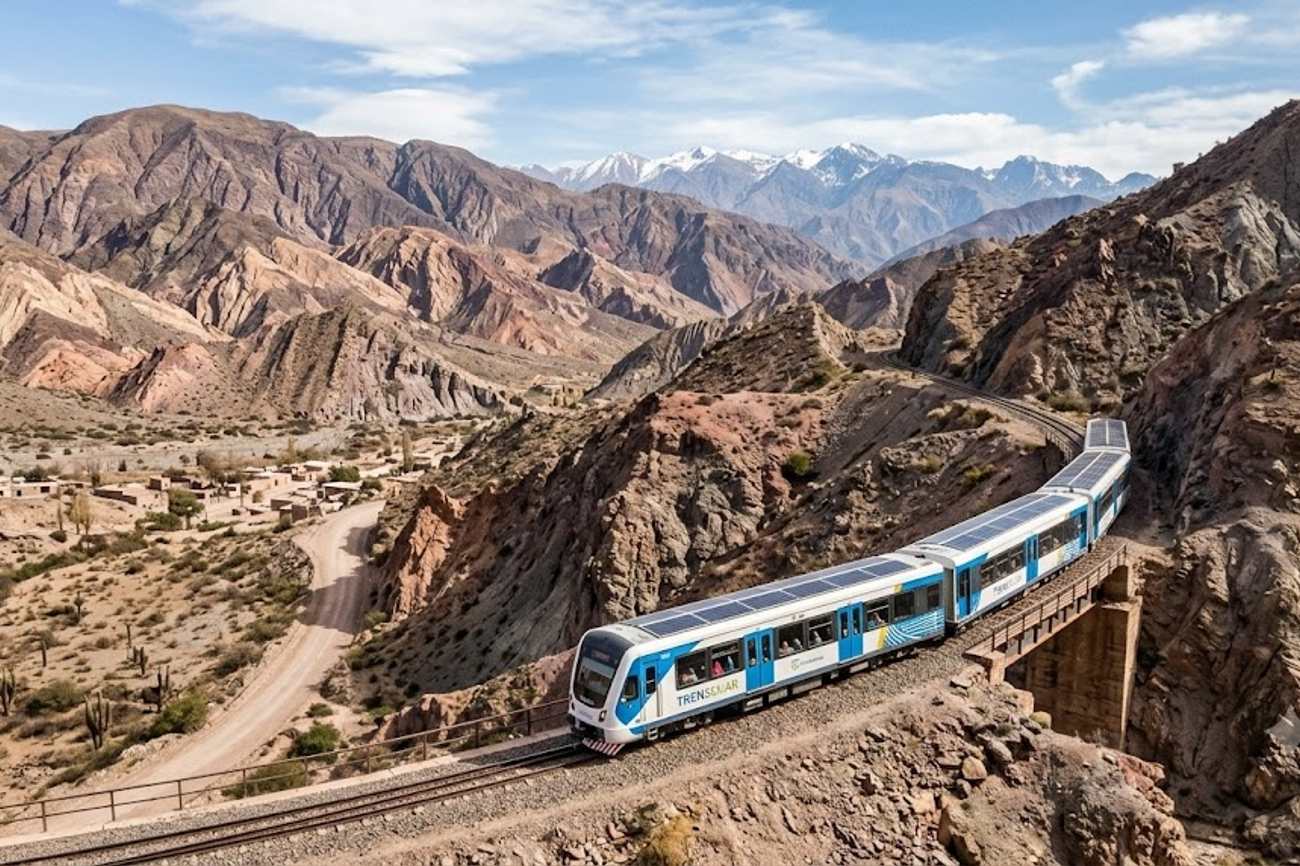
Image generated by AI
90,000 passengers have traversed the Quebrada de Humahuaca since June 2024, marking the return of passenger rail to this UNESCO World Heritage site after a 30-year hiatus. This resurgence is not merely a nostalgic restoration but a strategic pivot toward renewable infrastructure via the Tren Solar de la Quebrada, a battery-electric system powered by the high-altitude solar yields of Argentina's Jujuy province.
The Geopolitics of Andean Connectivity
The Quebrada de Humahuaca is more than a scenic corridor; it is a historical artery of the Andes that has facilitated trade and migration for millennia. By reintroduced rail service to this valley, the Jujuy government is attempting to decouple regional tourism growth from carbon-heavy diesel dependence. The project functions as a pilot for "off-grid" electrification, proving that remote, mountainous regions can maintain high-volume tourism without the prohibitive cost and environmental scarring associated with installing thousands of kilometers of overhead catenary wires.
This initiative aligns with broader goals promoted by UNESCO, which emphasizes the preservation of cultural landscapes. By replacing combustion engines with a silent, emission-free alternative, the province reduces the acoustic and chemical pollution that often threatens the integrity of World Heritage sites. The strategic integration of the railway into the local economy suggests a move toward "slow travel," where the transit method itself becomes a primary attraction, encouraging visitors to spend more time in the six connected towns rather than rushing through the valley in rental cars.
Technical Specifications and Operational Data
The Tren Solar de la Quebrada operates on a specific technical loop that prioritizes energy recovery and local sourcing. While branded as a "solar train," it is technically a Battery Electric Multiple Unit (BEMU). The energy is not harvested in real-time via roof panels but is drawn from the regional solar grid into a high-capacity storage system.
The following data outlines the operational parameters of the service:
| Specification | Detail |
|---|---|
| Route Total Distance | 42 kilometres |
| Power Source | Local Jujuy solar electricity |
| Energy Storage | 6 Lithium batteries |
| Operational Range | 100–120 kilometres |
| Active Charging Hubs | Volcán and Purmamarca |
| Pending Infrastructure | Tilcara charging station |
| Service Commencement | June 2024 |
| Passenger Volume | 90,000+ (since launch) |
| Rolling Stock | Two-carriage configuration |
A critical component of this system is the implementation of regenerative braking. As the train descends the steep Andean gradients, the kinetic energy is captured and fed back into the six lithium batteries. This creates a closed-loop efficiency that extends the battery life and reduces the frequency of required external charges.
Expert Analysis: The BEMU Model and Tourism Economics
For the modern traveler and the aviation-linked tourism industry, the Tren Solar de la Quebrada represents a shift toward "modular electrification." The most striking data point is the battery range: at 100 to 120 kilometres, the train possesses nearly three times the energy required to complete its 42-kilometre circuit. This creates a significant operational buffer, ensuring that service reliability remains high even during periods of lower solar yield or unexpected delays.
The direct consequence for travelers booking trips to Northern Argentina is a reduction in "last-mile" friction. Historically, reaching the six towns of the Quebrada required fragmented private transport or diesel buses. The railway streamlines this into a single, sustainable experience. However, the pricing pressure created by this infrastructure is worth noting. High-tech lithium systems and dedicated charging stations in Volcán and Purmamarca require significant capital expenditure. To recoup these costs, the province may shift toward a premium tourism model, where the "green" nature of the transport justifies higher ticket prices.
From a regulatory standpoint, this project serves as a blueprint for other regions under the guidance of the International Union of Railways (UIC). By avoiding overhead lines, Argentina has bypassed the most expensive part of rail electrification. For other Andean nations or remote territories, the "Charge-and-Run" model—utilizing fast-charging hubs at strategic intervals—is far more scalable than traditional electrification. The planned expansion into Tilcara indicates that the province is testing the limits of this hub-and-spoke charging network, potentially paving the way for longer routes that could connect further into the interior of Jujuy.
Key Takeaways
- Infrastructure Leap: The service ends a 30-year gap in passenger rail, utilizing a BEMU system that avoids the need for expensive overhead electrical lines.
- Energy Efficiency: The train uses six lithium batteries charged by local solar power, supplemented by regenerative braking to recover energy during descents.
- Operational Buffer: With a maximum range of 120 kilometres on a 42-kilometre route, the system is engineered for high reliability and potential future expansion.
- Strategic Hubs: Current charging is centralized in Volcán and Purmamarca, with a third critical node planned for Tilcara to optimize route efficiency.
- Rapid Adoption: The volume of 90,000 passengers in a few months suggests a high market demand for sustainable transit in heritage-rich zones.
FAQ: Tren Solar de la Quebrada 2024
Does the train have solar panels on its roof? No. The train is powered by six lithium batteries that are charged at designated stations using electricity generated by solar plants located within the Jujuy province.
Which towns does the solar train connect? The railway operates a 42-kilometre route linking six different towns across the Quebrada de Humahuaca valley in Northern Argentina.
How far can the train travel on a single charge? The batteries provide an operational range between 100 and 120 kilometres, which is significantly longer than the current 42-kilometre route.
Is the train more environmentally friendly than diesel? Yes, it eliminates direct fossil fuel emissions during transit and utilizes regenerative braking to maximize energy efficiency, though total sustainability depends on the battery lifecycle.
A silent glide through the Andes is no longer a luxury, but a blueprint for the future of heritage transit.
#TrenSolarQuebrada #JujuyTourism #AndeanRail2024 #SustainableArgentina #BEMUTechnology #QuebradaDeHumahuaca
Related Travel Guides
- Italy Train Travel Warning For Tourists As Unvalidated Paper Tickets Risk Costly Fines
- Uzbekistan Expands High Speed Rail Network to Nukus by March 2027 Slashing Travel Time to Seven Hours Across Karakalpakstan
- Northern Railway Launches Festival Special Trains to Ease Dussehra, Diwali and Chhath Puja Travel Rush
Disclaimer
This article is for informational and educational purposes only. It does not constitute legal, financial, or professional advice. While we strive to provide accurate and up-to-date information, travel policies, regulations, and conditions change rapidly. Always verify information with official sources before making travel decisions. Nomad Lawyer makes no representations about the accuracy, reliability, completeness, or suitability of the information provided. Readers should consult qualified professionals for advice specific to their circumstances. The views expressed in this article are those of the author and do not necessarily reflect the views of Nomad Lawyer.
Raushan Kumar
Founder & Lead Developer
Full-stack developer with 11+ years of experience and a passionate traveller. Raushan built Nomad Lawyer from the ground up with a vision to create the best travel and law experience on the web.
Learn more about our team →