
American Airlines Jet Suffers Multiple Main-Gear Tire Blowouts During Landing at Chicago O’Hare 2026
An American Airlines flight arriving at Chicago O’Hare International Airport experienced multiple main landing gear tire failures upon touchdown, triggering an emergency response and temporary runway closure.

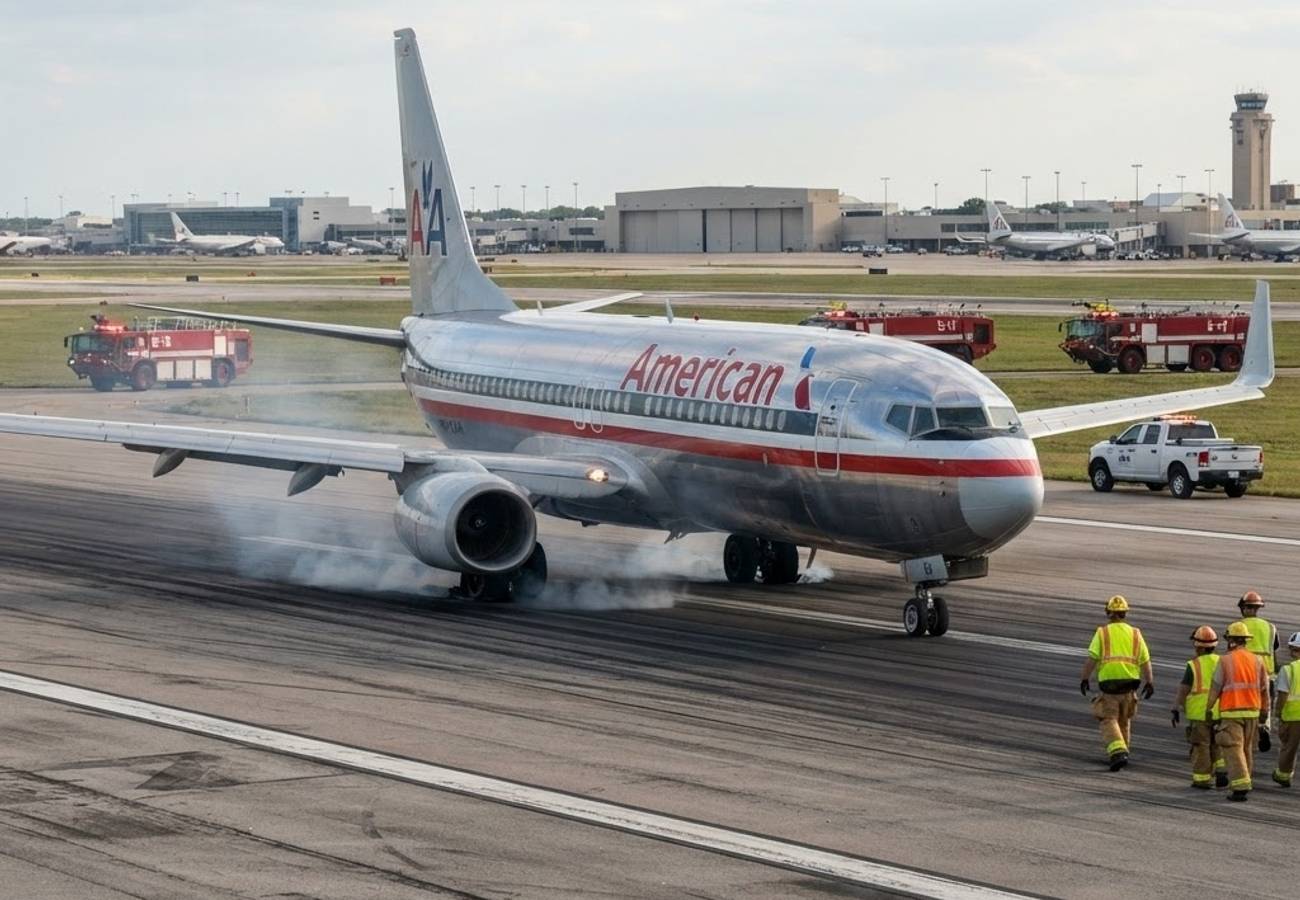
Image generated by AI
An American Airlines flight arriving at Chicago O’Hare International Airport experienced a critical landing failure when several main landing gear tires blew out upon touchdown. The incident triggered an immediate emergency response and forced a temporary closure of the affected runway, though no serious injuries were reported among passengers or crew.
The aircraft was on final approach when the tires failed during the touchdown and deceleration phase. Standard emergency protocols were initiated, with foam trucks and airport rescue vehicles surrounding the jet as it came to a complete stop on the runway.
Operational Breakdown of the Incident
Reports from the scene indicate a "firm" landing followed by aggressive braking. Passengers inside the cabin reported a strong smell of hot rubber, a typical indicator that tires and brakes have reached their maximum operational thermal limits. Despite the tire failures, the flight crew maintained the aircraft's alignment with the runway centerline, preventing a veer-off and avoiding structural damage to the airframe.
The runway remained out of service until ground crews completed two primary tasks:
- Towing the disabled aircraft from the active runway.
- Clearing the pavement of rubber fragments and metal debris to prevent Foreign Object Debris (FOD) damage to subsequent arrivals.
Passenger Experience and Evacuation
Travelers described a tense environment characterized by heavy shaking and noise during the rollout. Cabin crew maintained order, directing passengers to remain seated while the flight deck provided updates that the aircraft was under control and the emergency response was precautionary.
Depending on the aircraft's final position, passengers were evacuated using one of two methods:
- Deplaning via mobile stairs onto shuttle buses.
- Towing the aircraft to a designated terminal gate.
Impact on O’Hare Hub Operations
The closure of a single runway at one of the world's busiest aviation hubs created an immediate ripple effect across Midwest air traffic. Because O'Hare operates on a high-frequency sequence, the disruption led to:
- Arriving flights being placed into holding patterns.
- Departure delays for multiple carriers.
- Diversions of some flights to nearby alternate airports.
- Shifted gate assignments and taxiway congestion.
Technical Analysis of Landing Gear Failure
Commercial aircraft tires are engineered to support the full weight of the aircraft at high speeds while enduring extreme friction. However, several variables can lead to the type of failure seen in this American Airlines incident:
- Thermal Stress: Excessive heat buildup during rapid deceleration.
- Surface Contaminants: Sharp debris on the runway causing punctures.
- Material Fatigue: Structural flaws or wear exceeding safety margins.
Modern landing gear assemblies utilize redundancy. The failure of a few tires on a main gear typically does not result in a loss of control, as the remaining wheels and the anti-skid braking systems allow the crew to maintain directional stability via the rudder and nosewheel steering.
Investigation and Next Steps
A standard post-incident analysis is underway. Investigators will analyze the following data points to determine the root cause:
- Flight Data Recorder (FDR) and Cockpit Voice Recorder (CVR): To evaluate the approach and landing sequence.
- Maintenance Logs: To check the age and inspection history of the tires.
- Onboard Telemetry: To review pressure and temperature readings during the rollout.
- Runway Friction Data: To assess if recent maintenance or surface conditions contributed to the blowout.
The incident highlights the critical role of redundancy in aviation design, ensuring that a mechanical failure does not escalate into a catastrophic event.
Related Travel Guides
Disclaimer
This article is for informational and educational purposes only. It does not constitute legal, financial, or professional advice. While we strive to provide accurate and up-to-date information, travel policies, regulations, and conditions change rapidly. Always verify information with official sources before making travel decisions. Nomad Lawyer makes no representations about the accuracy, reliability, completeness, or suitability of the information provided. Readers should consult qualified professionals for advice specific to their circumstances. The views expressed in this article are those of the author and do not necessarily reflect the views of Nomad Lawyer.
Preeti Gunjan
Contributor & Community Manager
A passionate traveller and community builder. Preeti helps grow the Nomad Lawyer community, fostering engagement and bringing the reader experience to life.
Learn more about our team →