
American Airlines Jet Suffers Multiple Tire Blowouts During Landing at Chicago O'Hare in 2026
An American Airlines arrival at Chicago O'Hare triggered an emergency response after multiple main-gear tires failed on touchdown, causing temporary runway closures.

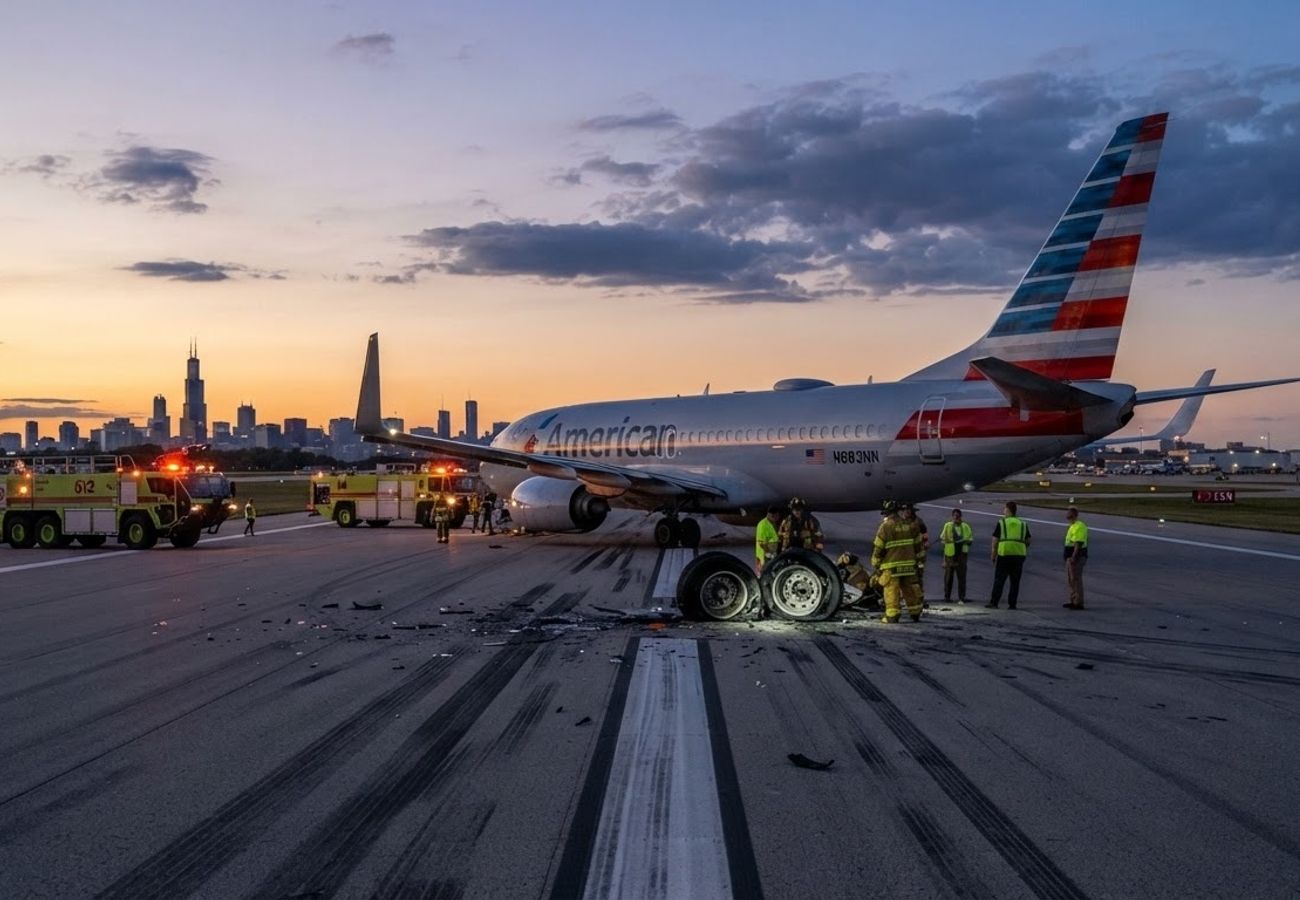
Image generated by AI
An American Airlines arrival at Chicago O’Hare International Airport triggered a full-scale emergency response on August 18, 2026, after multiple main-gear tires failed upon touchdown. Despite the jarring deceleration and runway closures, no injuries were reported among passengers or crew.
The incident occurred during an evening arrival at one of the United States' most congested aviation hubs. While the approach was routine, the landing ended abruptly when tires on the main landing gear ruptured, leaving the aircraft stationary on the runway. Visual evidence from the scene confirmed that at least two main-gear tires were completely deflated or destroyed, leaving debris scattered across the tarmac.
Flight crews successfully maintained the aircraft's position on the runway centerline, a critical maneuver that prevented a runway excursion—where a plane veers off the paved surface into the grass or safety areas. Following an inspection by airport fire and rescue teams to rule out fuel leaks or active fires, passengers were deplaned via mobile stairs or shuttled to the terminal.
The Operational Ripple Effect at O'Hare
The failure of the landing gear necessitated the immediate closure of the affected runway. At a hub as complex as O'Hare, such an event creates a cascading effect on air traffic. While the airport utilizes a sophisticated network of parallel runways to maintain flow, the closure forced controllers to reroute arrivals and departures, leading to holding patterns and rolling delays for connecting travelers.
For the passenger, the experience was marked by a sudden jolt and the distinct smell of burnt rubber—a common result of high-speed tire failure. While some travelers reported minor discomfort due to the abrupt stop, medical evaluations conducted on the ramp were precautionary.
Analyzing Tire Failure in Modern Aviation
Commercial aircraft tires are engineered to withstand immense pressure and extreme thermal stress. However, safety specialists note that several variables can lead to a rupture:
- Foreign Object Debris (FOD): Small pieces of metal or stone on the runway can puncture a tire casing.
- Preexisting Wear: Undetected structural weaknesses in the rubber.
- Touchdown Force: An exceptionally firm landing that exceeds the load limits of the gear assembly.
Following this event, investigators will review maintenance logs and tire service records. Airport operators are also expected to increase runway sweeps to ensure no debris remains that could threaten other aircraft.
Regional Impact and Safety Resilience
This incident occurs against a backdrop of significant economic activity for the carrier; a recent Texas Christian University study estimates that American Airlines contributes up to $71 billion annually to the North Texas economy. While mechanical failures are unsettling, aviation analysts suggest that the successful containment of this incident highlights the resilience of modern emergency protocols.
The coordination between the flight crew, who kept the jet on course, and the O'Hare ground teams demonstrates the efficacy of established safety redundancies. The aircraft was eventually towed from the runway, allowing maintenance teams to assess surface scarring and friction levels before the strip returned to full service.
Visitor Insider Tips: Navigating O'Hare During Disruptions
For the frequent flyer or nomad lawyer transiting through Chicago, operational hiccups are a reality of hub travel. To mitigate the impact of runway closures or mechanical delays:
- The "Parallel" Advantage: If you see your flight is circling or delayed, check the airport map. O'Hare's parallel runway system often means only one "strip" is closed; stay updated via the FlyChicago app for real-time gate changes.
- Connection Buffers: During peak evening windows, aim for a minimum of 2 hours for domestic connections. If a "ground stop" or runway closure is announced, immediately head to your airline's customer service kiosk rather than waiting at the gate.
- Hidden Transit: If you are stranded during a delay, the airport's ATS (Airport Transit System) is the fastest way to move between terminals, but the walkways near Terminal 3 often provide quieter spots for remote work.
Tourism and Aviation Outlook
The long-term impact of such incidents is typically minimal, provided that the subsequent federal aviation reviews lead to tightened maintenance schedules. For the destination of Chicago, the ability of O'Hare to absorb these shocks without total system failure is key to maintaining its status as a global transit leader. As aviation continues to evolve toward more sustainable and resilient infrastructure, the focus remains on reducing FOD and enhancing real-time runway monitoring.
A testament to modern safety: a dramatic failure resolved without a single injury.
Related Travel Guides
Disclaimer
This article is for informational and educational purposes only. It does not constitute legal, financial, or professional advice. While we strive to provide accurate and up-to-date information, travel policies, regulations, and conditions change rapidly. Always verify information with official sources before making travel decisions. Nomad Lawyer makes no representations about the accuracy, reliability, completeness, or suitability of the information provided. Readers should consult qualified professionals for advice specific to their circumstances. The views expressed in this article are those of the author and do not necessarily reflect the views of Nomad Lawyer.
Kunal K Choudhary
Co-Founder & Contributor
A passionate traveller and tech enthusiast. Kunal contributes to the vision and growth of Nomad Lawyer, bringing fresh perspectives and driving the community forward.
Learn more about our team →