
Alaska Airlines Flight ASA556 Boeing 737-990ER Diverts from Seattle to Omaha Route to Denver International Airport on July 30 2026
Alaska Airlines Flight ASA556, a Boeing 737-990(ER) operating the nonstop Seattle to Omaha route, diverted to Denver International Airport on July 30, 2026, disrupting the only direct connection between the two cities.

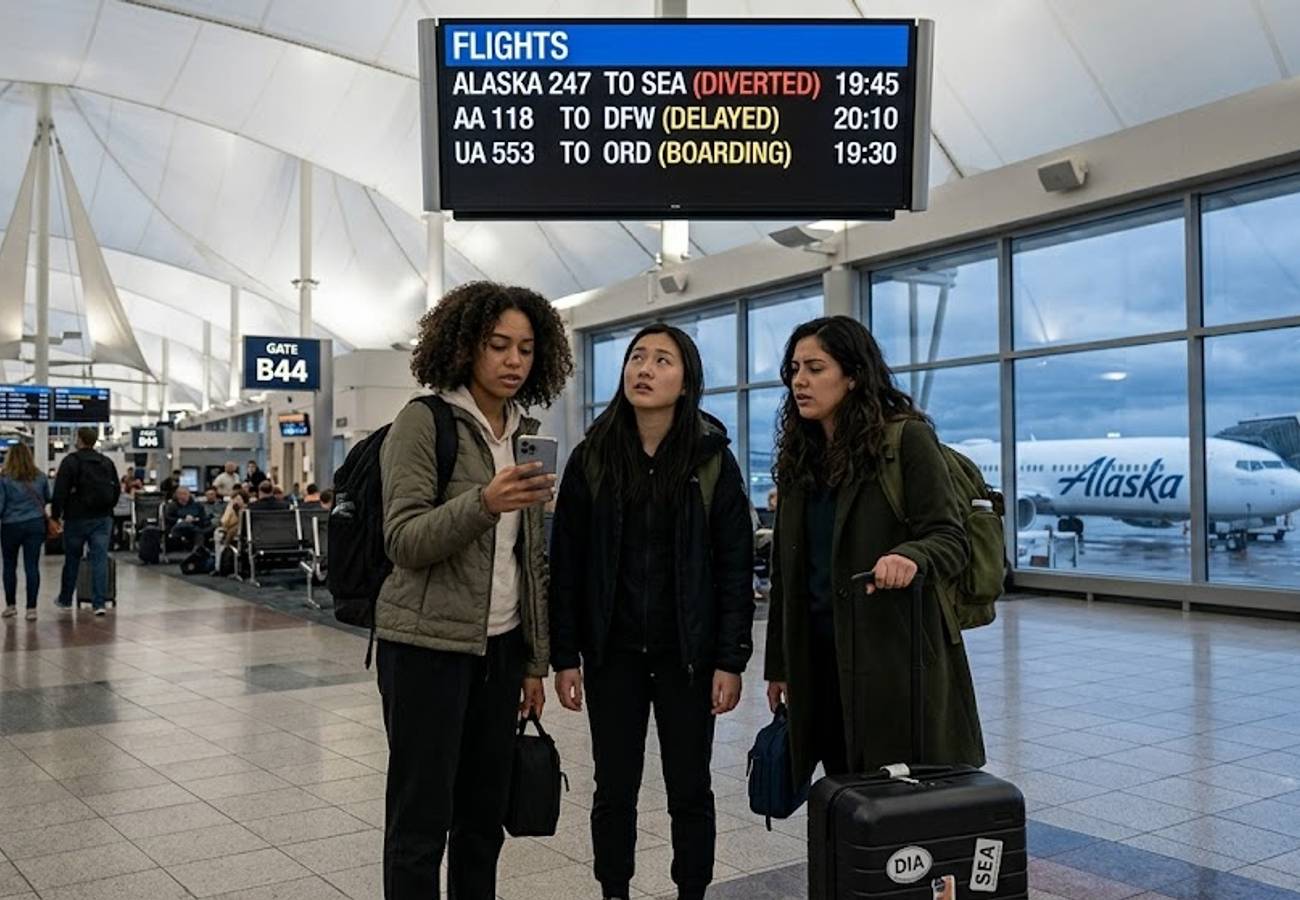
Image generated by AI
Alaska Airlines Flight ASA556, operating the sole nonstop Seattle-to-Omaha service on July 30, 2026, diverted to Denver International Airport instead of completing its scheduled arrival at Eppley Airfield, leaving passengers on the only direct link between the Pacific Northwest and Nebraska rerouted to Colorado.
Confirmed Diversion Details for Alaska Airlines Flight ASA556
Alaska Airlines Flight ASA556 was operating its regularly scheduled nonstop service from Seattle-Tacoma International Airport (SEA) to Omaha Eppley Airfield (OMA) on July 30, 2026. The aircraft, a Boeing 737-990(ER) registered as N407AS, departed Seattle at approximately 18:47 local time with an expected arrival in Omaha at 23:59 local time. The route normally takes roughly three hours and fifteen minutes.
Instead of landing in Omaha, the aircraft diverted to Denver International Airport (DEN) in Colorado. The diversion has been confirmed through published schedule data and flight tracking information. However, no verified explanation has been issued by Alaska Airlines or any aviation authority establishing the specific cause of the diversion.
Alaska Airlines is the only carrier listed in referenced schedule data as providing a nonstop Seattle-Omaha connection. This makes the July 30 diversion particularly impactful for passengers who rely on this route, as no alternative direct service exists between the two cities from another carrier.
Flight Schedule and Route Specifications
| Parameter | Details |
|---|---|
| Flight Number | ASA556 (AS556) |
| Aircraft Type | Boeing 737-990(ER) |
| Registration | N407AS |
| Origin | Seattle-Tacoma International Airport (SEA) |
| Planned Destination | Omaha Eppley Airfield (OMA) |
| Diversion Airport | Denver International Airport (DEN) |
| Scheduled Departure | 18:47 local time (Seattle) |
| Scheduled Arrival | 23:59 local time (Omaha) |
| Normal Flight Duration | ~3 hours 15 minutes |
| Date of Diversion | July 30, 2026 |
| Route Type | Nonstop (Alaska Airlines exclusive) |
Historical flight records confirm that AS556 is a recurring Seattle-Omaha service rather than an unusual or one-off operation. Previous July services have been recorded on the same city pair, establishing that the July 30 flight was operating on an established route before the diversion to Denver disrupted its normal pattern.
What Remains Unresolved About the Diversion
No reliable public source has confirmed the specific cause of the July 30 diversion. It would be misleading to attribute the event to any particular factor—mechanical problem, medical emergency, severe weather, passenger incident, or air traffic restriction—unless Alaska Airlines or an official aviation authority subsequently confirms it.
Denver International Airport serves as a major US aviation hub and functions as a practical alternate destination when an aircraft cannot safely or operationally continue to its planned airport. The selection of Denver as the alternate does not itself identify the reason for the diversion, and the choice should not be automatically interpreted as evidence of an emergency.
Weather remains one possible operational consideration, particularly during summer operations across the central United States where thunderstorms can affect destination airports. However, insufficient evidence exists to establish that weather caused ASA556 to divert on July 30. The same caution applies to mechanical or medical explanations—a diversion by itself does not demonstrate that an aircraft experienced a technical failure or that a passenger required urgent medical attention.
Passenger Impact and Operational Considerations
For passengers, a diversion from Omaha to Denver creates a considerably different arrival scenario. Denver and Omaha are in different states and are not neighbouring airports serving the same metropolitan area. The distance between Denver International Airport and Omaha Eppley Airfield is approximately 470 miles by air, meaning passengers faced significant onward travel arrangements.
Travellers may have encountered additional waiting time, possible rebooking onto connecting flights, baggage-handling complications, and changes to ground transportation plans depending on what Alaska Airlines arranged after the aircraft reached Denver. From a ground-level perspective, the best way to navigate this type of disruption is to immediately check the Alaska Airlines mobile app or website for rebooking options, as the airline typically prioritises passengers on diverted flights for next-available connections. Passengers should also retain all receipts for meals or ground transportation incurred during the delay, as Alaska Airlines may provide compensation or reimbursement under its customer service commitments.
A diversion should not automatically be viewed as evidence that passengers were placed in danger. Airlines and flight crews use alternate airports precisely because they provide a controlled option when continuing to the original destination is not operationally appropriate, with the priority remaining the safe operation of the aircraft and everyone onboard.
Traveler Logistics Guide: Navigating Flight Diversions
From a ground-level perspective, the best way to navigate an unexpected diversion like the ASA556 event is to act quickly and methodically:
Rebooking and Connections: If your flight diverts to a hub airport like Denver, immediately check the airline's app for rebooking options. Denver International Airport serves as a major hub for multiple carriers, which can work in your favour if Alaska Airlines arranges onward connections. However, since Alaska Airlines operates the only nonstop Seattle-Omaha service, passengers diverted to Denver may need to wait for the same aircraft to continue or be rebooked on connecting flights through other hubs.
Layover Planning: When booking future travel on routes served by a single carrier, consider building buffer time into your itinerary. The SEA-OMA route's approximately three-hour-and-fifteen-minute duration leaves limited margin for diversions. For critical connections in Omaha, allow at least two hours of buffer beyond the scheduled 23:59 arrival, particularly during summer months when central US thunderstorms can disrupt operations.
Digital Transit Policies: Ensure your Alaska Airlines mobile app is updated with real-time push notifications enabled. For US domestic diversions, no digital entry permits like ETIAS or Digi Yatra apply, but having your boarding pass stored digitally and your reservation accessible offline can save critical time during rebooking at an unexpected airport.
Baggage Considerations: When a flight diverts, checked baggage typically remains with the aircraft. Passengers should confirm baggage transfer arrangements with Alaska Airlines ground staff at the diversion airport before leaving the terminal, as baggage may continue to the original destination on a later flight or require separate claim at the diversion point.
Infrastructure Impact Assessment
The diversion of ASA556 highlights the operational vulnerability of routes served exclusively by a single carrier. Alaska Airlines maintains the only nonstop link between Seattle-Tacoma International Airport and Omaha Eppley Airfield, meaning any disruption to this service leaves passengers without a direct alternative. When the aircraft diverted to Denver on July 30, passengers lost their only direct option between the Pacific Northwest and Nebraska for that operating cycle.
Denver International Airport's role as a diversion airport underscores its strategic value in the US aviation network. Its central location, extensive runway infrastructure, and status as a major hub make it a practical alternate for flights operating across the western and central United States. The airport's capacity to absorb diverted traffic from routes like SEA-OMA demonstrates why it functions as a critical node in the national aviation system.
For regional connectivity, the incident illustrates the importance of maintaining robust alternate planning on thin routes. Omaha Eppley Airfield, while serving a metropolitan area of nearly one million people, relies on a limited set of nonstop long-haul options. The loss of the sole Seattle connection—even temporarily—can affect business travellers, connecting passengers, and those with time-sensitive plans in Nebraska's largest city.
Alaska Airlines Flight ASA556 diverted safely to Denver International Airport on July 30, 2026, but the reason behind the route change from Seattle to Omaha remains officially unconfirmed.
Related Travel Guides
Disclaimer
This article is for informational and educational purposes only. It does not constitute legal, financial, or professional advice. While we strive to provide accurate and up-to-date information, travel policies, regulations, and conditions change rapidly. Always verify information with official sources before making travel decisions. Nomad Lawyer makes no representations about the accuracy, reliability, completeness, or suitability of the information provided. Readers should consult qualified professionals for advice specific to their circumstances. The views expressed in this article are those of the author and do not necessarily reflect the views of Nomad Lawyer.
Raushan Kumar
Founder & Lead Developer
Full-stack developer with 11+ years of experience and a passionate traveller. Raushan built Nomad Lawyer from the ground up with a vision to create the best travel and law experience on the web.
Learn more about our team →